
Innovation: A durable and differentiated investment theme
June 2026, Equity
- Key Insights
-
- We see innovation as a measurable and durable source of competitive advantage that may create economic value overlooked by traditional accounting and style frameworks.
- Our analysis suggests innovation has historically been associated with stronger returns, while extending across value and growth stocks, sectors, and market cap segments.
- Portfolio construction is critical. In innovation investing, risk awareness is not a defensive add‑on; it is part of the alpha process.
Innovation is, in our view, a repeatable source of competitive advantage, a measurable corporate behavior, and a persistent driver of excess return. According to our research, companies that invest effectively in innovation have often generated economic value that is not reflected in traditional accounting methods or style boxes. This difference may lead to a lasting investment advantage.
In our view, innovation should not be framed as a narrow thematic sleeve proxied by large‑cap growth. Innovation is broader and more durable. It spans sectors, styles, and market cap segments. Additionally, portfolio construction decisions matter materially for outcomes.
Innovation is broader and more durable. It spans sectors, styles, and market cap segments.
Innovation has historically been rewarded
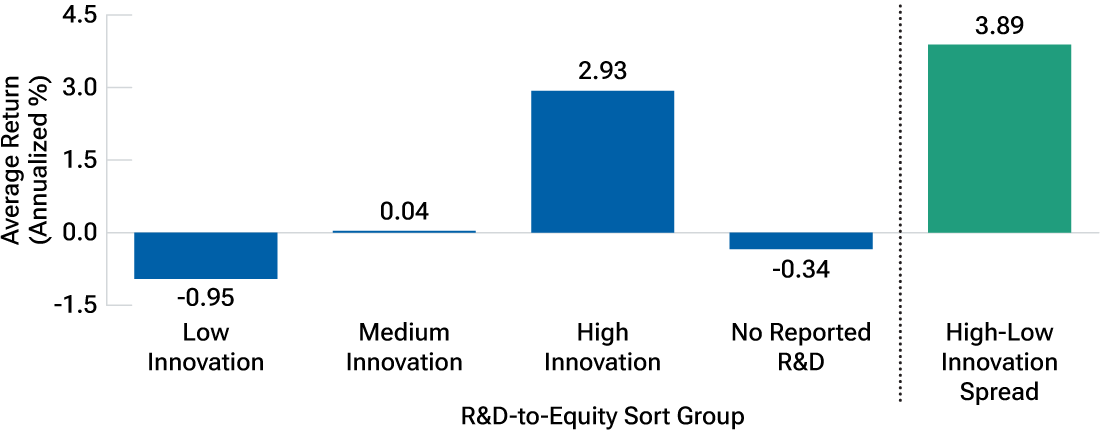
Based on our analysis, innovation has historically been associated with higher returns. Figure 1 shows Russell 3000 stocks sorted by research and development (R&D)‑to‑equity into three groups, with a 4.8% annualized excess return spread between the high‑innovation and low‑innovation buckets from 1999 to 2025. When innovation is measured directly, increased innovation has been associated with better subsequent returns.
Academic papers find multiple possible explanations for an innovation premium. One explanation has been termed “creative destruction,” where economic growth is driven not by preserving existing business models, but by replacing them.1 New technologies, products, and ways of organizing production displace older, less efficient incumbents. This allows innovators to capture excess profits. In practice, innovation creates value not only by adding something new, but by rendering prior solutions obsolete. This shifts market share, pricing power, and profit pools toward firms that adapt fastest.
…innovation is a cross‑style characteristic that can appear in businesses classified as value as well as growth.
Another model suggests that the uncertainty around the future profitability of an R&D investment may result in discounted stock prices.2 R&D is expensive and takes time to realize results. For investors, R&D can be rather opaque, especially when intellectual property is involved and research is secretive in nature. Since investors cannot properly assess the probability of payoff, they adjust their discount factor to reflect the increased uncertainty of the outcome. This high discount can materialize as a premium for those investors willing to invest in the company.
(Fig. 1) Higher innovation stocks have historically delivered higher returns
Past performance is not a guarantee or a reliable indicator of future results.
Notes: All bucketing in this document is based on R&D to equity ratio. Returns are always the immediate month after rebalancing based on the ratio. Some companies do not report R&D expense, often due to sector convention. We bucket companies with income statement values but no R&D listed into a separate group.
At the end of each month, stocks that report R&D are sorted into three equal‑sized groups, with a fourth bucket for stocks not reporting R&D. High innovation is defined as companies that have the highest R&D‑to‑Equity ratio, and low innovation are companies that have the lowest R&D‑to‑Equity ratio. Bucket returns are calculated on an equal‑weighted basis. Accounting data are lagged 6 months to be consistent with literature. Compustat data are used for quarterly R&D values. Integrated Equity data are used for market cap.
Sources: T. Rowe Price analysis based on Russell 3000 data from 1999 to 2025. See Additional Disclosures.
close
Innovation extends beyond growth
Innovation is frequently mislabeled as “just growth.” In our analysis, the high‑innovation bucket is almost evenly split between value and growth names: 51.37% value and 48.63% growth (see Figure 2). This supports our view that innovation is a cross‑style characteristic that can appear in businesses classified as value as well as growth, and shows that innovation‑oriented exposure can differ meaningfully from having exposure to a large‑cap growth index.
Value matters too for innovation
(Fig. 2) High‑innovation stocks are nearly evenly split between growth and value
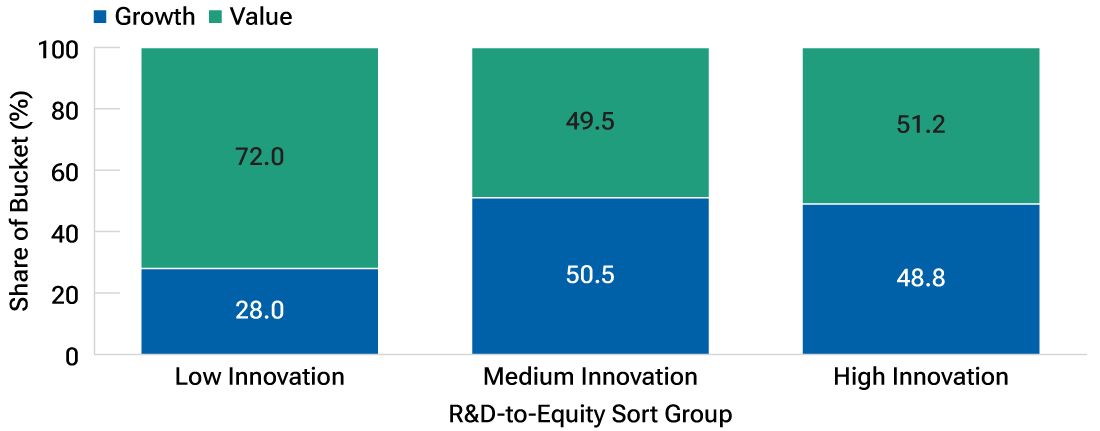
Note: We use the Russell 3000 Growth and Value indexes to sort stocks into Growth and Value. For stocks that are in both indexes, we sort them into the style where more shares are held. Percentages are calculated on a market‑weighted basis. See Fig. 1 disclosure for additional methodology on the buckets.
Sources: T. Rowe Price analysis based on Russell 3000 data as of April 24, 2026.
close
Innovation shifts across sectors over time
Nor is innovation confined to one sector or fixed in place. In Figure 3, the sector mix of the highest‑innovation bucket has changed materially over time. Innovation is better understood as a dynamic market structure than as a static sector label. Therefore, a flexible approach is key—one that is unconstrained by any single theme or sector and supported by active management, allowing investors to adapt as new technologies emerge and industries evolve. This results in differentiated sources of return that complement core equity holdings and offer the potential to improve long‑term returns.
(Fig. 3) Innovation is more than a sector
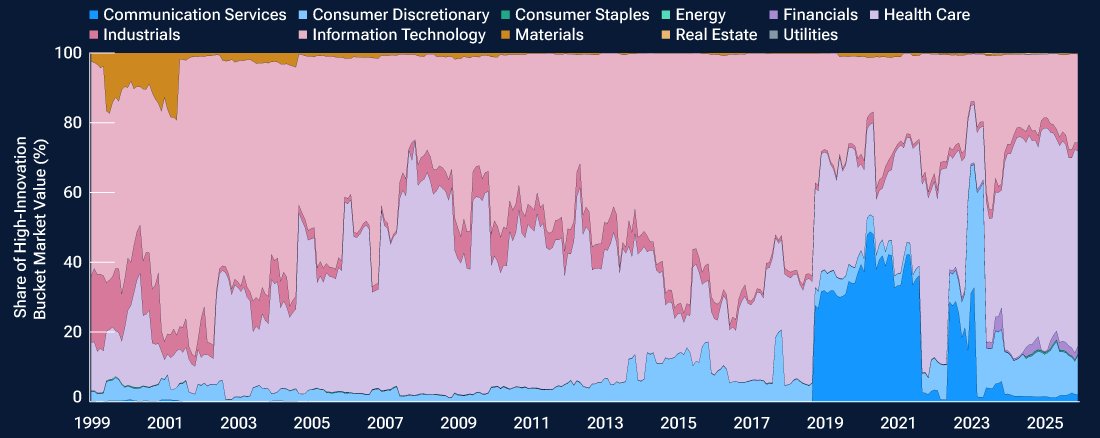
Note: Sectors are defined by Global Industry Classification Standard. High‑innovation bucket refers to the highest R&D‑to‑equity group among Russell 3000 stocks, formed monthly. Sector weights are calculated on a market‑weighted basis. See Fig. 1 for additional methodology on the buckets.
Sources: T. Rowe Price analysis based on Russell 3000 data and Global Industry Classification Standard from 1999 to 2025 (see sources for Fig. 1).
close
Risk‑aware portfolio construction matters
Naïve portfolio construction can expose investors to unintended risk. Our analysis shows that within the highest‑innovation bucket, market cap weighting improved hypothetical long‑run outcomes versus equal weighting (see Figure 4). Portfolio design determines how much of the potential premium investors keep. In innovation, risk awareness is not a defensive add‑on; it is part of the alpha process.
Market weights can improve risk levels
(Fig. 4) Hypothetical growth of 100
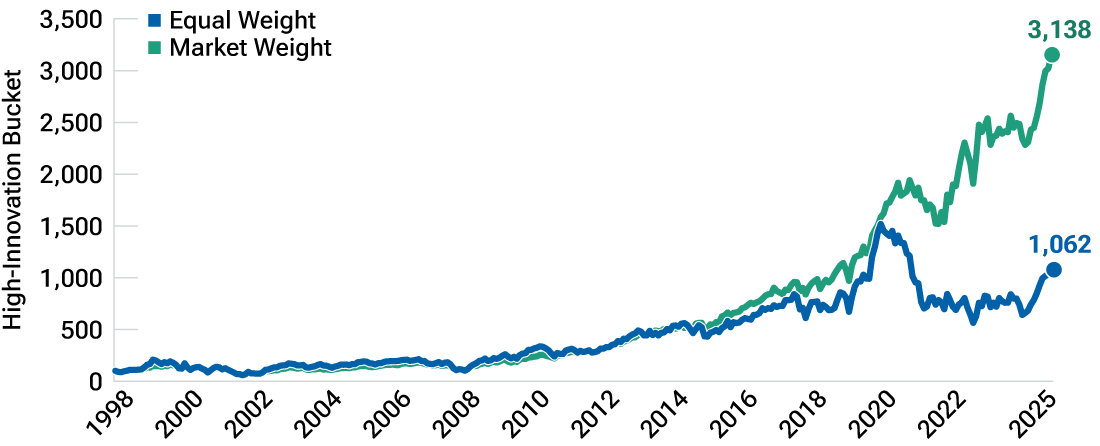
Past performance is not a guarantee or a reliable indicator of future performance. The results shown do not reflect actual results achieved and are for illustrative purposes only. The high‑innovation bucket is not an actual investment or portfolio nor does it reflect fees or costs which, if deducted, would reduce results shown. The bucket cannot be invested into. Actual investment results associated with the innovation theme might differ, perhaps significantly.
We establish buckets using the methodology provided in Fig. 1. Using the High Innovation bucket, we evaluate two different weighting mechanisms, where weights are set at month end to either be equal or market weight.
Sources: T. Rowe Price analysis based on Russell 3000 data from 1999 to 2025 (see sources for Fig. 1).
close
Innovation as an enduring allocation
Innovation is durable because it is rooted in how firms create future value. In our view, it works because successful innovators build intangible assets, widen competitive moats, and create earnings power that conventional accounting often understates. It is not just a style or sector, and portfolio construction plays a vital role for delivering the potential premium to investors.
Our work suggests that innovation can be measured, diversified, and differentiated. That supports the case for an innovation allocation that is enduring rather than fad‑driven, cross‑sector rather than theme‑concentrated, and distinct from large‑cap growth rather than redundant with it.
Our work suggests that innovation can be measured, diversified, and differentiated.
 Som Priestley, CFA
Head, Global Investment Solutions
Som Priestley, CFA
Head, Global Investment Solutions
 Sean P. McWilliams
Head, Systematic Investing, Multi-Asset
Sean P. McWilliams
Head, Systematic Investing, Multi-Asset
 Gio Steckel, CFA, CAIA®
Quantitative Investment Analyst
Gio Steckel, CFA, CAIA®
Quantitative Investment Analyst
 Gerard Brunick, Ph.D., CFA
Associate Director, Research
Gerard Brunick, Ph.D., CFA
Associate Director, Research
Experience you can act on.
See how our approach to planning and investing can help guide your progress toward achieving your financial goals.
1 Aghion, Philippe, and Peter Howitt. 1992. “A Model of Growth Through Creative Destruction.” Econometrica 60, no. 2: 323‑351.
2 Louis K. C. Chan, et al. “The Stock Market Valuation of Research and Development Expenditures.” The Journal of Finance, vol. 56, no. 6, 2001, pp. 2431–56. JSTOR, http://www.jstor.org/stable/2697829. Accessed 14 May 2026.
Risks: All investments are subject to market risk, including the possible loss of principal. Large‑ and mid‑cap stocks: Securities issued by large‑ and mid‑cap companies tend to be less volatile than securities issued by small‑cap companies. However, large‑cap companies may not be able to attain the high growth rates of successful small‑cap companies, especially during strong economic periods, and may be unable to respond as quickly to competitive challenges. Growth stocks are subject to the volatility inherent in common stock investing, and their share price may fluctuate more than that of a income‑oriented stocks. The value approach to investing carries the risk that the market will not recognize a security’s intrinsic value for a long time or that a stock judged to be undervalued may actually be appropriately priced. Investing in technology stocks entails specific risks, including the potential for wide variations in performance and usually wide price swings, up and down. Technology companies can be affected by, among other things, intense competition, government regulation, earnings disappointments, dependency on patent protection and rapid obsolescence of products and services due to technological innovations or changing consumer preferences. Health sciences firms are often dependent on government funding and regulation and are vulnerable to product liability lawsuits and competition from low‑cost generic product. Diversification cannot assure a profit or protect against loss in a declining market.
Additional Disclosures
For U.S. investors, visit troweprice.com/glossary for definitions of financial terms.
Please see vendor indices for more information, including definitions and source data: troweprice.com/marketdata.
London Stock Exchange Group plc and its group undertakings (collectively, the “LSE Group”). © LSE Group 2026. All rights in the FTSE Russell indexes or data vest in the relevant LSE Group company which owns the index or the data. Neither LSE Group nor its licensors accept any liability for any errors or omissions in the indexes or data and no party may rely on any indexes or data contained in this communication. No further distribution of data from the LSE Group is permitted without the relevant LSE Group company’s express written consent. The LSE Group does not promote, sponsor or endorse the content of this communication.
Important Information
This material is provided for informational purposes only and is not intended to be investment advice or a recommendation to take any particular investment action.
The views contained herein are those of the authors as of May 2026 and are subject to change without notice; these views may differ from those of other T. Rowe Price associates.
This information is not intended to reflect a current or past recommendation concerning investments, investment strategies, or account types, advice of any kind, or a solicitation of an offer to buy or sell any securities or investment services. The opinions and commentary provided do not take into account the investment objectives or financial situation of any particular investor or class of investor. Please consider your own circumstances before making an investment decision.
Information contained herein is based upon sources we consider to be reliable; we do not, however, guarantee its accuracy.
Past performance is not a guarantee or a reliable indicator of future results. All investments are subject to market risk, including the possible loss of principal. All charts and tables are shown for illustrative purposes only.
T. Rowe Price Investment Services, Inc., distributor. T. Rowe Price Associates, Inc., investment adviser. T. Rowe Price Investment Services, Inc., and T. Rowe Price Associates, Inc., are affiliated companies.
© 2026 T. Rowe Price. All Rights Reserved. T. ROWE PRICE, INVEST WITH CONFIDENCE, the Bighorn Sheep design, and related indicators (see troweprice.com/ip) are trademarks of T. Rowe Price Group, Inc. All other trademarks are the property of their respective owners. Use does not imply endorsement, sponsorship, or affiliation of T. Rowe Price with any of the trademark owners.
- 202605‑5520621