
As China’s disinflation fades, inflation risks may rise globally
April 2026, Markets and Economy
- Key Insights
-
- China’s anti‑involution drive, which aims to curb loss-making in certain sectors, is a little‑discussed inflation factor that may have global implications.
- To monitor the anti‑involution policy’s effectiveness, we track baskets of Asian stocks that are most exposed as well as the prices of key commodities.
- The year‑over‑year change in China’s PPI will likely remain positive through 2026, removing a disinflationary force that has helped central bankers control inflation.
Even prior to the conflict in Iran and the heightened global inflation focus, the inflation factor few were talking about—but one that could have profound global implications—was China’s “anti‑involution” drive. Announced in July 2025, the policy aims to curb destructive domestic competition in a variety of industries by driving capacity consolidation. If successful, it would curb price wars, encourage consolidation in some sectors, and boost profit margins, creating upward pressure on prices.
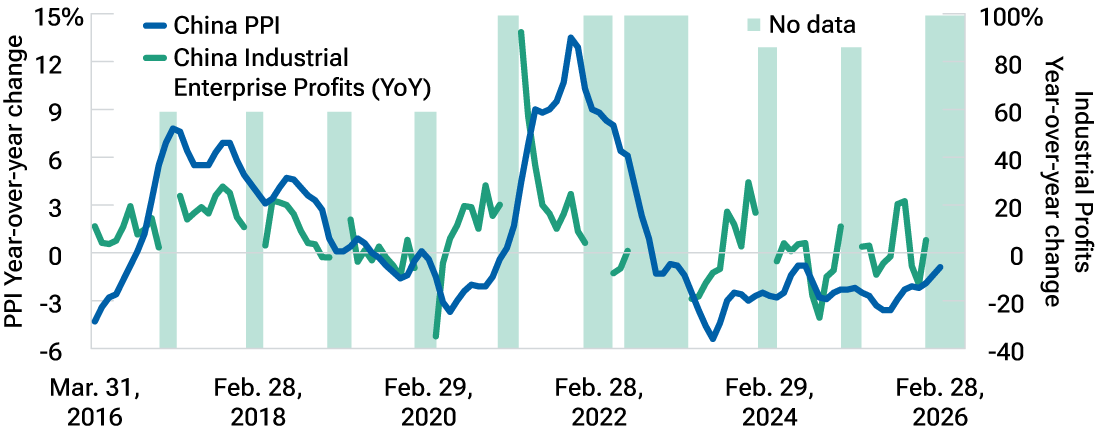
Over time, the result could be that the year‑over‑year change in China’s producer price index (PPI) will remain positive through 2026 after running in negative territory from late 2022 into early 2026. The oil price jump resulting from the Middle East conflict helped flip the change in PPI into positive territory in March 2026 given the close correlation of Chinese PPI and oil prices.
On a global level, such a shift matters because it would remove a disinflationary tailwind that has helped central bankers control inflation in recent years. Against this backdrop, it is critical to monitor the anti‑involution policy’s effectiveness. To do so, we track the performance of baskets, or custom indexes, of Asian stocks that are most exposed to the effectiveness of anti‑involution policies as well as the prices of key commodities in China.
Successful capacity consolidation effort in 2015–2016
China carried out a similar capacity consolidation push in 2015–2016 after more than three years of negative monthly PPI readings. This effort was very successful in raising commodity prices in targeted areas such as steel and coal. The key difference between now and 10 years ago is the Chinese government at that point was also stimulating demand, which appears unlikely today. Also, the capacity cuts in 2015 were much more blunt than today’s actions, which are more controlled.
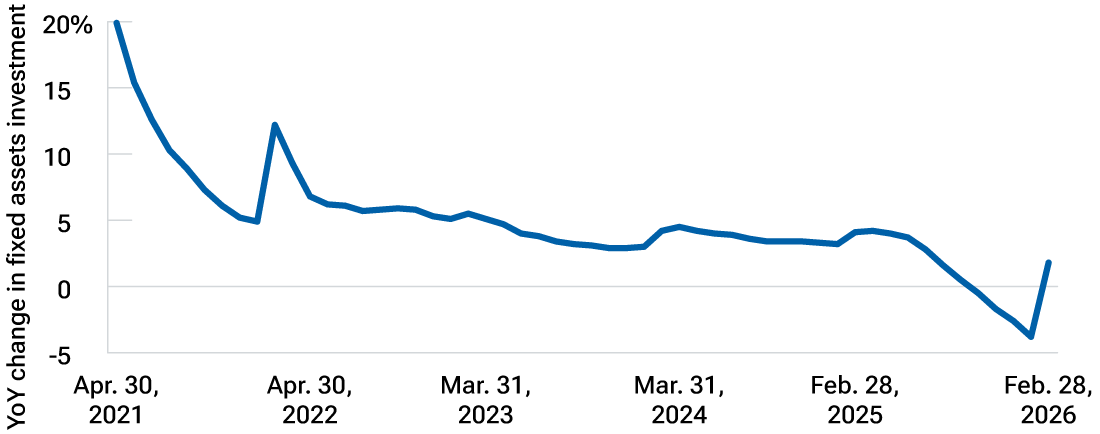
The effects of the latest anti‑involution campaign are evident in the country’s fixed assets investment, which declined in the second half of last year before rebounding at the beginning of 2026.
Recent upturn in fixed assets investment
(Fig. 1) After falling in late 2025, FAI rose in early 2026
As of February 28, 2026.
Source: Bloomberg Finance L.P.
close
Tight link between industrial profits and PPI
We believe rising prices of this basket of Asian stocks will be the first signal of sustained higher profits and commodity prices stemming from the anti‑involution campaign. Chinese industrial profits and PPI have been highly correlated. We think that the equity prices are signaling higher profits, leading an upward turn in the underlying commodity prices and, finally, Chinese PPI soon after.
Industrial profits could signal PPI rise
(Fig. 2) Profits in industry and PPI have been correlated
As of March 31, 2026.
Source: Bloomberg Finance L.P. Shaded areas indicate time periods for which National Bureau of Statistics of China did not provide data.
close
Affected equity prices have turned upward
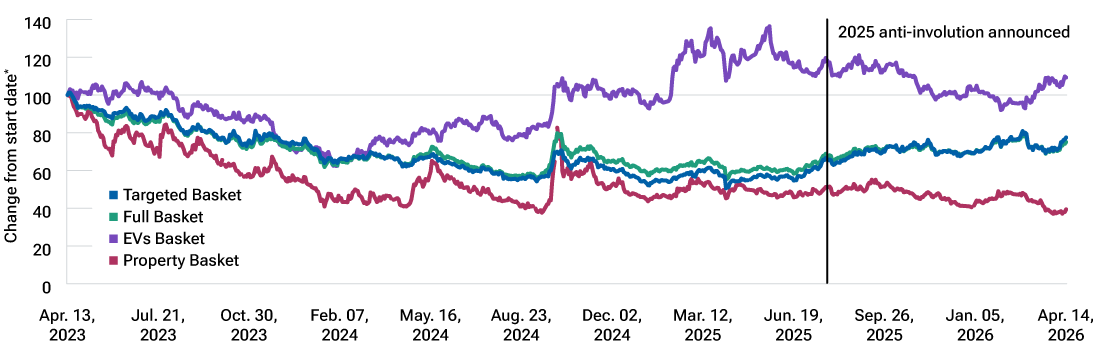
(Fig. 3) But Asian EV and property sectors have lagged
As of April 14, 2026
Source: Bloomberg Finance L.P.
* Vertical axis scale represents change from 100 on the start date. For example, 120 is a 20% increase, and 80 is a 20% decrease.
close
Tracking custom indexes of most‑affected Asian stocks
With the help of T. Rowe Price’s global equity analysts, we created baskets of Asian stocks to track the specific sectors directly targeted by anti‑involution as well as related industries likely to feel knock‑on effects.
The targeted industries basket made a strong move upward following the mid‑2025 anti‑involution announcement from the Chinese government before plateauing in the last quarter of the year. It resumed its gains in January and February 2026. The EV‑related equities, however, have been slow to respond because of their longer production cycles and significant export exposure. Also, capacity consolidation within EV supply chains and industries such as steel has been less advanced.
We believe the positive impulse for equities in the targeted industries will continue as, more importantly, the disinflationary force from China fades over the course of 2026.
The Chinese property industry remains weak and is the sector most likely to experience a delayed response to anti‑involution. However, any consolidation among the major players in China’s real estate market could stabilize residential prices as well as equities in the sector.
Factors coalescing to push inflation higher
You could say that President Xi Jinping has been the best Federal Reserve governor in recent years because of the disinflationary impulse that China has exported since 2022 and only be partially joking. However, we think that this disinflationary force is winding down. Even outside of China’s anti‑involution, other factors are coalescing to move inflation higher.
We’ve already been seeing more inflation in 2026 across many factors—with the major exception of housing—and the fading disinflationary impulse from the anti‑involution campaign in China will add to the upward momentum. We believe a prolonged conflict in the Middle East would undoubtedly sustain higher energy prices and exacerbate the global inflation situation, making a central banker’s job even more difficult. This could translate into fewer rate cuts or into hikes from central banks in energy importing areas like Europe.
 Adam Marden
Portfolio Manager
Adam Marden
Portfolio Manager
 Christopher J. Kushlis, CFA
Asia Sovereign Analyst
Christopher J. Kushlis, CFA
Asia Sovereign Analyst
 Ivan Morozov, CFA
Associate Portfolio Manager
Ivan Morozov, CFA
Associate Portfolio Manager
What's ahead?
Gain valuable perspective on the markets and what’s ahead.
Additional Disclosure
For U.S. investors, visit troweprice.com/glossary for definitions of financial terms.
T. Rowe Price cautions that economic estimates and forward-looking statements are subject to numerous assumptions, risks, and uncertainties, which change over time. Actual outcomes could differ materially from those anticipated in estimates and forward‑looking statements, and future results could differ materially from historical performance. The information presented herein is shown for illustrative, informational purposes only. Any historical data used as a basis for analysis are based on information gathered by T. Rowe Price and from third-party sources and have not been verified. Forecasts are based on subjective estimates about market environments that may never occur. Any forward-looking statements speak only as of the date they are made. T. Rowe Price assumes no duty to, and does not undertake to, update forward-looking statements.
Important Information
Outside of the United States, this is intended for investment professional use only. Not for further distribution.
This material is being furnished for informational and/or marketing purposes only and does not constitute an offer, recommendation, advice, or solicitation to sell or buy any security.
Prospective investors should seek independent legal, financial and tax advice before making any investment decision. T. Rowe Price group of companies including T. Rowe Price Associates, Inc. and/or its affiliates receive revenue from T. Rowe Price investment products and services.
Past performance is not a guarantee or a reliable indicator of future results. All investments involve risk, including possible loss of principal.
Information presented has been obtained from sources believed to be reliable, however, we cannot guarantee the accuracy or completeness. The views contained herein are those of the author(s), are as of April 2026, are subject to change, and may differ from the views of other T. Rowe Price Group companies and/or associates. Under no circumstances should the material, in whole or in part, be copied or redistributed without consent from T. Rowe Price.
All charts and tables are shown for illustrative purposes only. Actual future outcomes may differ materially from any estimates or forward‑looking statements provided.
The material is not intended for use by persons in jurisdictions which prohibit or restrict the distribution of the material and in certain countries the material is provided upon specific request.
USA—Issued in the USA by T. Rowe Price Investment Services, Inc., distributor and T. Rowe Price Associates, Inc., investment adviser, 1307 Point Street, Baltimore, MD 21231, which are regulated by the Financial Industry Regulatory Authority and the U.S. Securities and Exchange Commission, respectively.
© 2026 T. Rowe Price. All Rights Reserved. T. Rowe Price, INVEST WITH CONFIDENCE, the Bighorn Sheep design, and related indicators (see troweprice.com/ip) are trademarks of T. Rowe Price Group, Inc. All other trademarks are the property of their respective owners. Use does not imply endorsement, sponsorship, or affiliation of T. Rowe Price with any of the trademark owners.
202604‑5380585