
Is AI infrastructure spending sustainable?
May 2026, Equity
- Key Insights
-
- The impact of artificial intelligence (AI) spending on earnings has been dramatic, with earnings growth expectations reflecting the huge demand for infrastructure required to support AI.
- Relatively contained valuations suggest investors recognize current earnings strength but remain uncertain about how long the current strong fundamentals can persist.
- Rising capital expenditure (capex) and input costs are increasingly testing hyperscalers’ ability to sustain aggressive spending as free cash flow comes under pressure.
Artificial intelligence infrastructure spending remains one of the most debated topics in equity markets today.
On one hand, companies exposed to this massive wave of capital expenditure have been delivering exceptional earnings growth. On the other hand, investors continue to question whether this level of spending is sustainable—and whether it will ultimately translate into durable returns.
A surge in earnings growth
The impact of AI spending on earnings has been dramatic.
If we look at a basket of U.S. companies that are significant beneficiaries of AI infrastructure investment, the shift in earnings expectations is striking. For much of the past decade, forward earnings growth for this group moved between 5% and 20%—a healthy but relatively stable range.
That changed sharply over the past three years, after the public release of ChatGPT and the acceleration in AI adoption. Earnings growth expectations climbed rapidly and stood at more than 50% as of late April.
This reflects enormous demand for the infrastructure needed to support AI—everything from semiconductors and memory to data center equipment and networking capacity.
Valuations reflect ongoing skepticism
Despite this surge in earnings, valuations have not followed the same trajectory.
The price-to-earnings multiple for this group has remained relatively contained, fluctuating between roughly 21 and 36 times earnings as investor sentiment has shifted. As of late April, the multiple stood near 27 times—only modestly higher than the broader S&P 500.
That divergence highlights a key tension in the market. Investors clearly recognize the strength of current fundamentals, but they remain uncertain about how long those fundamentals can persist.
Why the Skepticism?
Importantly, this skepticism is not driven by concerns about the hyperscalers’ willingness to invest.
Management teams at the largest technology companies have been very clear: they are more concerned about falling behind in the AI race than they are about overspending. In other words, the incentive is to invest aggressively—even at the risk of near-term financial pressure.
The challenge is that the scale of spending required to compete in AI is rising rapidly.
Demand for computing power continues to grow at an extraordinary pace. Both model training and real-time inference require increasingly large amounts of processing capacity. The emergence of more advanced agentic AI systems has further increased workloads, while also accelerating adoption across a broader set of industries.
At the same time, supply constraints have begun to emerge.
The rapid increase in demand for data center infrastructure has led to shortages in key components. Prices for some inputs have surged—highlighting the strain on global supply chains. For example, as of April 28th, prices for DRAM chips have increased by more than 1,700% since the start of 2025.1 While this is a somewhat extreme example, it reflects a broader pattern across many critical inputs required to support AI expansion.
The pressure on free cash flow
As a result, hyperscaler capex budgets have risen sharply.
In the early stages of the AI buildout, investors were largely unconcerned. These companies generated ample free cash flow and were well positioned to fund aggressive investment. In fact, markets initially rewarded them for leaning into what appeared to be a transformative opportunity.
But that dynamic is beginning to shift.
As capex continues to grow, it is placing increasing pressure on free cash flow. Based on current analyst estimates, rolling 12-month free cash flow for the hyperscalers could approach zero by early 2027. If spending continues to exceed expectations, free cash flow could even turn negative.
That said, the outcome remains highly uncertain. If these companies are able to monetize their AI investments more quickly and more effectively than expected, free cash flow could remain strong enough to support elevated spending levels.
Conclusion
The bottom line is that AI infrastructure spending represents both a powerful opportunity and a growing source of uncertainty.
Earnings growth among AI beneficiaries has been exceptional, reflecting the scale and speed of this investment cycle. But the sustainability of that cycle remains an open question—particularly as capital intensity rises and free cash flow comes under pressure.
For now, markets appear to be balancing these competing forces: strong near-term fundamentals alongside longer-term uncertainty.
As a result, we continue to monitor the evolution of AI spending closely, with a particular focus on whether earnings growth can justify the scale of capital being deployed.
Outside of the United States, this is intended for investment professionals only. Not for further distribution.
Artificial intelligence infrastructure spending remains one of the most debated topics in equity markets today. On one hand, companies exposed to this massive wave of capex have been delivering exceptional earnings growth. On the other hand, investors continue to question whether this level of spending is sustainable—and whether it will ultimately translate into durable returns.
A surge in earnings growth
The impact of AI spending on earnings has been dramatic. Looking at a basket of U.S. companies that are significant beneficiaries of AI infrastructure investment, the shift in earnings expectations is striking. For much of the past decade, forward earnings growth for this group moved between 5% and 20%—a healthy but relatively stable range.
That changed sharply over the past three years, after the public release of ChatGPT and the acceleration in AI adoption. Earnings growth expectations climbed rapidly and stood at more than 50% as of late April (see Fig. 1). This reflects the enormous demand for the infrastructure needed to support AI—everything from semiconductors and memory to data center equipment and networking capacity.
Exceptional earnings growth for AI infrastructure companies
(Fig. 1) AI infrastructure basket:1 Projected next 12 months earnings per share (EPS) growth
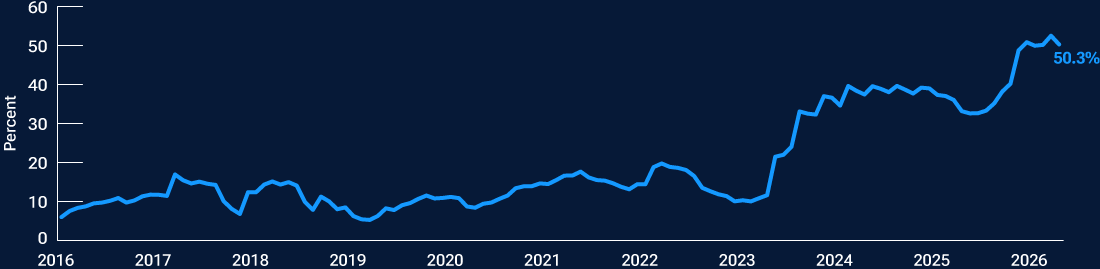
10 Years ending April 28, 2026.
Past performance is not a guarantee or a reliable indicator of future results.
1 Market‑cap weighted index of Arista Networks, Astera Labs, Dell Technologies, Advanced Micro Devices, Marvell Technology, NVIDIA, Oracle, Super Micro Computer, Broadcom, and Everpure.
The specific securities identified and described are for informational purposes only and do not represent recommendations. Estimated EPS growth reflects consensus analyst estimates for earnings over the next 12 months. The AI basket was created by identifying representative stocks with clear exposure to infrastructure. Identification was based on K‑means clustering methodology and ChatGPT verification of theme commonality.
Source: T. Rowe Price analysis using data from FactSet Research Systems Inc. All rights reserved. See Additional Disclosures.
close
Valuations reflect ongoing skepticism
Despite this surge in earnings, valuations have not followed the same trajectory. The price to earnings multiple for this group has remained relatively contained, fluctuating between roughly 21 and 36 times earnings as investor sentiment has shifted. As of late April, the multiple stood near 27 times—only modestly higher than the broader S&P 500.
That divergence highlights a key tension in the market. Investors clearly recognize the strength of current fundamentals, but they remain uncertain about how long those fundamentals can persist.
Valuations reflect skeptical views of capex sustainability
(Fig. 2) AI infrastructure basket:1 Forward price‑to‑earnings ratio
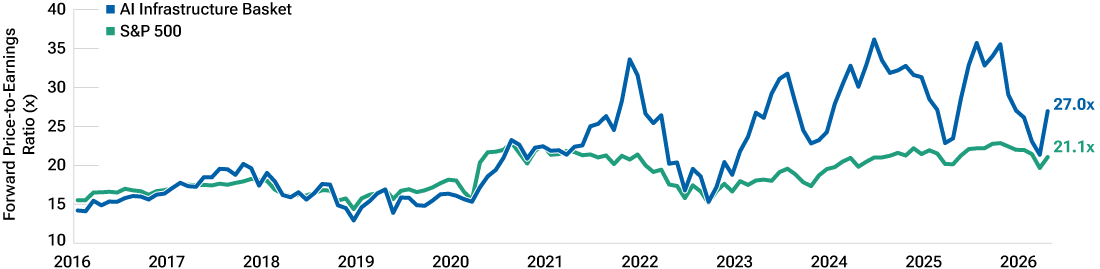
10 Years Ending April 2026.
Past performance is not a guarantee or a reliable indicator of future results.
1 Market‑cap weighted index of Arista Networks, Astera Labs, Dell Technologies, Advanced Micro Devices, Marvell Technology, NVIDIA, Oracle, Super Micro Computer, Broadcom, and Everpure.
The specific securities identified and described are for informational purposes only and do not represent recommendations.
The AI basket was created by identifying representative stocks with clear exposure to infrastructure. Identification was based on K‑means clustering methodology and ChatGPT verification of theme commonality.
Source: T. Rowe Price analysis using data from FactSet Research Systems Inc. All rights reserved. See Additional Disclosures.
close
Input costs have risen sharply
(Fig. 3) Memory chip prices
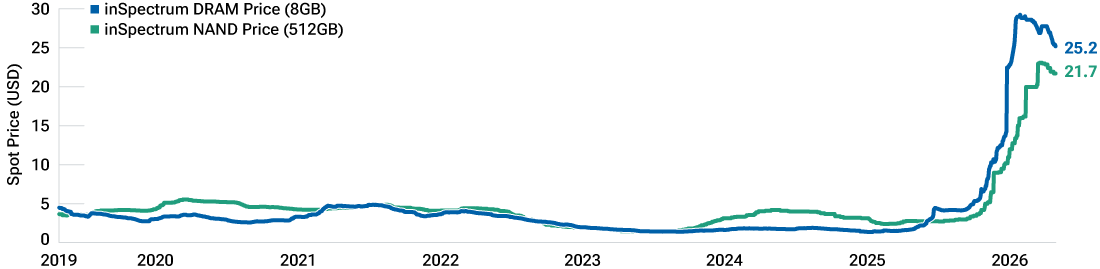
March 31, 2019 to April 28, 2026.
DRAM is a type of volatile memory used for fast, temporary data storage while a device is operating, and it commonly serves as main system memory in PCs, servers, laptops, smartphones, tablets, and graphics cards. NAND is a non volatile flash memory used for long term data storage, and it is found in solid state drives (SSDs), USB flash drives, memory cards, smartphones, tablets, cameras, and many embedded and automotive systems.
Source: Bloomberg Finance L.P.
close
Why the skepticism?
Importantly, this skepticism is not driven by concerns about the hyperscalers’ willingness to invest. Management teams at the largest technology companies have been very clear: They are more concerned about falling behind in the AI race than they are about overspending. In other words, the incentive is to invest aggressively—even at the risk of near‑term financial pressure.
The challenge is that the scale of spending required to compete in AI is rising rapidly. Demand for computing power continues to grow at an extraordinary pace. Both model training and real‑time inference require increasingly large amounts of processing capacity. The emergence of more advanced agentic AI systems has further increased workloads, while also accelerating adoption across a broader set of industries.
At the same time, supply constraints have begun to emerge. The rapid increase in demand for data center infrastructure has led to shortages in key components. Prices for some inputs have surged—highlighting the strain on global supply chains. For example, as of April 28, prices for dynamic random‑access memory (DRAM) chips have increased by more than 1,700% since the start of 2025. While this is a somewhat extreme example, it reflects a broader pattern across many critical inputs required to support AI expansion.
The challenge is that the scale of spending required to compete in AI is rising rapidly.
The pressure on free cash flow
As a result, hyperscaler capex budgets have risen sharply. In the early stages of the AI build‑out, investors were largely unconcerned. These companies generated ample free cash flow and were well positioned to fund aggressive investment. In fact, markets initially rewarded them for leaning into what appeared to be a transformative opportunity.
However, that dynamic is beginning to shift. As capex continues to grow, it is placing increasing pressure on free cash flow. Based on current analyst estimates, rolling 12‑month free cash flow for the hyperscalers could approach zero by early 2027 (see Fig. 4). If spending continues to exceed expectations, free cash flow could even turn negative.
That said, the outcome remains highly uncertain. If these companies are able to monetize their AI investments more quickly and more effectively than expected, free cash flow could remain strong enough to support elevated spending levels.
Hyperscalers’ capacity for capex spending is being tested
(Fig. 4) Hyperscaler1 capex and free cash flow, rolling 4‑quarter total
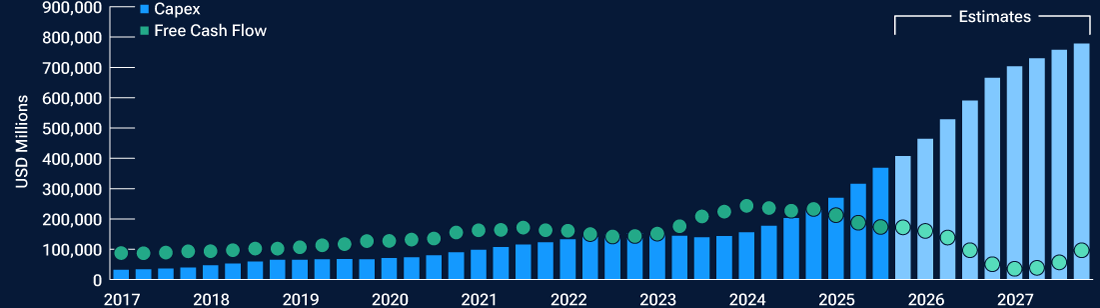
Q1 2017 to Q4 2026 (Q4 2025 to Q4 2027 are estimates).
Past performance is not a guarantee or a reliable indicator of future results.
The specific securities identified and described are for informational purposes only and do not represent recommendations. For illustrative purposes only.
There can be no assurance that the estimates will be achieved or sustained. Actual results may vary.
1 Microsoft, Alphabet, Amazon, Meta, and Oracle.
Source: T. Rowe Price analysis using data from FactSet Research Systems Inc. All rights reserved. See Additional Disclosures.
close
Conclusion
The bottom line is that AI infrastructure spending represents both a powerful opportunity and a growing source of uncertainty. Earnings growth among AI beneficiaries has been exceptional, reflecting the scale and speed of this investment cycle. But the sustainability of that cycle remains an open question—particularly as capital intensity rises and free cash flow comes under pressure.
For now, markets appear to be balancing these competing forces: Strong near‑term fundamentals alongside longer‑term uncertainty. As a result, we continue to monitor the evolution of AI spending closely, with a particular focus on whether earnings growth can justify the scale of capital being deployed.
The bottom line is that AI infrastructure spending represents both a powerful opportunity and a growing source of uncertainty.
 Timothy C. Murray, CFA
Capital Markets Strategist
Timothy C. Murray, CFA
Capital Markets Strategist
What's ahead?
Gain valuable perspective on the markets and what’s ahead.
Risks: Investing in technology stocks entails specific risks, including the potential for wide variations in performance and usually wide price swings, up and down. Technology companies can be affected by, among other things, intense competition, government regulation, earnings disappointments, dependency on patent protection and rapid obsolescence of products and services due to technological innovations or changing consumer preferences.
Additional Disclosures
For U.S. investors, visit troweprice.com/glossary for definitions of financial terms.
Please see vendor indices for more information, including definitions and source data: troweprice.com/marketdata.
Important Information
Outside of the United States, this is intended for investment professional use only. Not for further distribution.
This material is being furnished for informational and/or marketing purposes only and does not constitute an offer, recommendation, advice, or solicitation to sell or buy any security.
Prospective investors should seek independent legal, financial and tax advice before making any investment decision. T. Rowe Price group of companies including T. Rowe Price Associates, Inc. and/or its affiliates receive revenue from T. Rowe Price investment products and services.
Past performance is not a guarantee or a reliable indicator of future results. All investments involve risk, including possible loss of principal.
Information presented has been obtained from sources believed to be reliable, however, we cannot guarantee the accuracy or completeness. The views contained herein are those of the author(s), are as of May 2026, are subject to change, and may differ from the views of other T. Rowe Price Group companies and/or associates. Under no circumstances should the material, in whole or in part, be copied or redistributed without consent from T. Rowe Price.
All charts and tables are shown for illustrative purposes only. Actual future outcomes may differ materially from any estimates or forward‑looking statements provided.
The material is not intended for use by persons in jurisdictions which prohibit or restrict the distribution of the material and in certain countries the material is provided upon specific request.
USA—Issued in the USA by T. Rowe Price Investment Services, Inc., distributor and T. Rowe Price Associates, Inc., investment adviser, 1307 Point Street, Baltimore, MD 21231, which are regulated by the Financial Industry Regulatory Authority and the U.S. Securities and Exchange Commission, respectively.
© 2026 T. Rowe Price. All Rights Reserved. T. Rowe Price, INVEST WITH CONFIDENCE, the Bighorn Sheep design, and related indicators (see troweprice.com/ip) are trademarks of T. Rowe Price Group, Inc. All other trademarks are the property of their respective owners. Use does not imply endorsement, sponsorship, or affiliation of T. Rowe Price with any of the trademark owners.
202605‑5415085