

Global Fixed Income: With Volatility to Remain Elevated, Selectivity is Key
Executive Summary
Elevated volatility in bond and currency markets is likely to persist, necessitating careful security selection but also creating opportunities.
- Higher volatility arising from regional growth uncertainties and divergent global central bank policies is likely to persist, producing fixed income investment opportunities.
- Investors can benefit from taking advantage of the global opportunity set and diversifying their bond exposures into countries where interest rates could decline.
- Valuations for emerging markets currencies are compelling, but caution is warranted.
- Careful security selection is needed in credit markets, as the broad, momentum-driven gains of recent years have faded, while issuer-specific risks have risen.
Volatility erupted across financial markets in 2015, throttling returns for most fixed income asset classes. Risk premiums rose on the back of global growth concerns—centred on China—and the prospect of defaults by overleveraged commodity producers with oil prices mired at uneconomic levels. Global rates traversed varied paths amid divergent monetary policy stances in both advanced and developing economies. Market turbulence is unlikely to relent in 2016, necessitating prudent country, sector, and currency positioning—but also creating opportunities.
MARKETS OVERLY FOCUSED ON THE FED
Throughout 2015, investors parsed statements from Federal Reserve policymakers, seeking insight into when they might deem the US economy sturdy enough to edge away from their zero interest policy. Although low inflation reduced the urgency to begin renormalising policy, the Fed’s decision in December to finally raise rates is justified by signs of wage pressures as the economy nears full employment. And taking the first step earlier will help the Fed maintain the slow pace of tightening it has been communicating.
While tighter financial conditions will raise funding costs for some countries and fuel volatility, concerns that marginally higher US rates will destabilise the global economy and tip it back into recession appear unfounded. The Fed intends to proceed quite gradually, and interest rate cycles around the world do not move in lock step. Many central banks have capacity to hold rates steady, if not lower them. And high current yields in countries that have already started tightening can help cushion the impact of rising rates.
EXPLOITING A DIVERSE INTEREST RATE ENVIRONMENT
The global fixed income opportunity set enables investors to pick and choose among markets, extending duration in countries where rates are high and expected to fall, while reducing duration where rates appear unjustifiably low.
Although valuable for their liquidity, most developed sovereign markets are unattractively valued. US Treasuries provide scant coupon income to offset potential price declines as the Fed raises rates. Government bond yields in Europe and Japan offer even less protection as their central banks maintain large-scale asset purchase programs. Eventually, stronger growth and inflation should take hold, driving bond yields up and prices down.
Investors can increase the potential for income and price appreciation by diversifying their bond exposures into markets where central banks may have scope to loosen monetary conditions. For example:
- In India, sovereign yields exceed 7% across the yield curve1. As an energy importer, India has benefited from lower-priced oil, which has reduced inflationary pressures and provided its Reserve Bank with some capacity for further rate cuts.
- Serbia has significantly reduced its current account deficit and possesses substantial currency reserves. This, combined with low inflation, permits a supportive monetary policy stance. Liquidity is thin in this small, immature market, but relatively high yields help to compensate for the risks.
- For those with high risk tolerance, Brazil offers intriguing long-term return potential. The country’s economic crisis may worsen enough to oblige the government to enact badly needed fiscal reforms. This would allow the central bank to eventually reduce rates from growth-stifling levels, providing a tailwind for its high-yielding government bonds.
TREADING CAREFULLY IN CURRENCY MARKETS
Elevated exchange rate volatility heightens risks for global investors. The euro and yen have stabilised recently versus the US dollar following sharp declines driven by widening yield differentials. Emerging markets currencies, such as the Brazilian real and Russian ruble, endured more severe devaluations amid deteriorating terms of trade and dollar strength (Figure 1). Valuations for many currencies are their cheapest in decades, but some may need to adjust further to restore competitiveness. We therefore employ hedges in a number of countries whose interest rates are attractive but currencies appear vulnerable.
Figure 1: Some Currencies Have Weathered US Dollar Strength Better Than Others
As of 31 Oct 2015
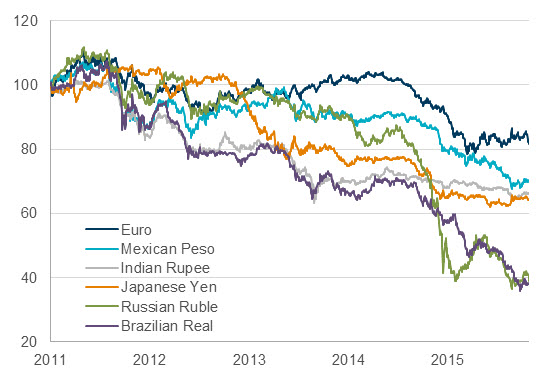
Performance of various currencies versus the US dollar; 31 Dec 2010 = 100.
Sources: Thomson Reuters and T. Rowe Price.
A few fundamentally sound currencies suffered collateral damage as investors sold emerging markets assets en masse. Today we see compelling long-term appreciation potential in select markets where growth prospects are high and governments are implementing reforms that should attract capital flows, including:
- Indian Rupee: India’s economic growth, expected to register about
8% next year, is relatively robust in a sluggish global environment. Policymakers are working to make India more business-friendly and have lifted some barriers to foreign direct investment, which is supportive of the currency.
- Mexican Peso: The highly liquid peso, which often serves as a proxy for hedging risk exposures, was a victim in 2015 as traders struggled to exit positions in distressed markets such as Brazil. Valuations are quite attractive, and we expect the government’s reform efforts—which include opening Mexico’s inefficient oil industry to private investment—to ultimately bear fruit.
EASY GAINS IN CREDIT MARKETS HAVE ENDED
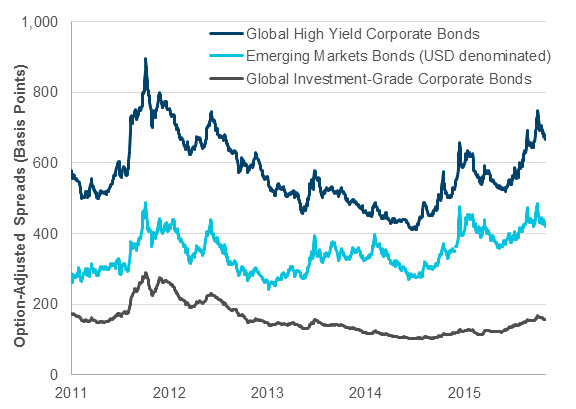
Similar to rates and currency markets, security selection is increasingly vital within the world’s credit markets. Investors enjoyed widespread gains for nearly six years following the global financial crisis as credit spreads followed generally downward trajectories. But risk premiums have risen since mid-2014, and performance has become more nuanced within sectors.
As a result, valuations for most sectors are near their most attractive since the eurozone debt crisis temporarily rattled nerves in 2011 (Figure 2). Yet investors are ill-advised to rush in to buy beaten-down bonds. In some cases, bonds have deservedly cheapened. With idiosyncratic risks rising, investors need to be highly discriminating in what they own:
- Investment Grade: Heavy new issuance and ratings downgrades have pressured corporate spreads to more enticing levels. Although rising leverage is a concern for US corporate issuers, they generally offer better relative value than their European peers. We remain wary of commodity producers and instead favour cyclicals—such as automakers and airlines—that should benefit from low oil prices and stronger consumer spending. We also like US and European banks that have been raising capital and deleveraging. In securitised markets, we view asset-backed and commercial mortgage-backed securities as rather stable ways to attain extra yield versus government bonds.
- High Yield: Our analysts anticipate an increase in defaults in the coming months, though largely confined to the energy and mining sectors, which constitute an outsized share of the US market. We have become more bearish on overall returns but do not foresee a broad-based market meltdown. We prefer defensive segments, such as broadcasters and media, over commodity-related names. Bank loans hold appeal for their lower commodity exposure and somewhat higher-quality profile. European high yield is also attractive; Europe has a smaller energy sector than the US and should benefit from a healing domestic economy and a highly supportive European Central Bank.
- Emerging Markets: Sovereign and corporate credit spreads are at multiyear wides, as a bevy of macro and internal factors soured sentiment toward developing markets. Fundamentals have weakened—mainly for countries whose budgets relied on high commodity prices—but remain solid overall. Encouragingly, several countries are making difficult adjustments and implementing economic reforms; market pressures will force others to follow suit. We remain cautiously positioned given potential for further near-term weakness in these liquidity-challenged markets as Fed rate hikes approach. But dislocations should present long-term buying opportunities.
BE PREPARED FOR VOLATILITY
Liquidity risks in fixed income markets have garnered much attention. With stricter regulations pushing investment banks to commit less capital to bond trading, it has become harder to sell when demand wanes and to buy when demand is high. In a volatile environment, we believe it is prudent to maintain some liquidity in portfolios to take advantage of dislocations. Fundamental credit analysis is also more imperative to avoid being a forced seller due to unexpected downgrades or credit events.
The reintroduction of volatility in global fixed income markets following an extended absence is disconcerting, but investors should embrace the exciting opportunities it creates. Valuations have become more attractive as markets have repriced risks. Yet we believe investors should be selective, lengthen their investment horizons, and take full advantage of the wider global opportunity set.
1 Source: Thomson Reuters. As of 30 Oct 2015.
2015-GL-2923
重要情報
当資料は、ティー・ロウ・プライス・アソシエイツ・インクおよびその関係会社が情報提供等の目的で作成したものを、ティー・ロウ・プライス・ジャパン株式会社が翻訳したものであり、特定の運用商品を勧誘するものではありません。また、金融商品取引法に基づく開示書類ではありません。当資料における見解等は資料作成時点のものであり、将来事前の連絡なしに変更されることがあります。当資料はティー・ロウ・プライスの書面による同意のない限り他に転載することはできません。
資料内に記載されている個別銘柄につき、売買を推奨するものでも、将来の価格の上昇または下落を示唆するものでもありません。また、当社ファンド等における保有・非保有および将来の組入れまたは売却を示唆・保証するものでもありません。投資一任契約は、値動きのある有価証券等(外貨建て資産には為替変動リスクもあります)を投資対象としているため、お客様の資産が当初の投資元本を割り込み損失が生じることがあります。
当社の運用戦略では時価資産残高に対し、一定の金額までを区切りとして最高1.265%(消費税10%込み)の逓減的報酬料率を適用いたします。また、運用報酬の他に、組入有価証券の売買委託手数料等の費用も発生しますが、運用内容等によって変動しますので、事前に上限額または合計額を表示できません。詳しくは契約締結前交付書面をご覧ください。
「T. ROWE PRICE, INVEST WITH CONFIDENCE」および大角羊のデザインは、ティー・ロウ・プライス・グループ、インクの商標または登録商標です。
ティー・ロウ・プライス・ジャパン株式会社
金融商品取引業者関東財務局長(金商)第3043号
加入協会:一般社団法人日本投資顧問業協会/一般社団法人投資信託協会


