

Emerging Markets Debt: Short-Term Risks, Longer-Term Opportunities
Executive Summary
Downside risks could be catalysts for needed reforms in key emerging markets.
- We see the most significant downside risks for emerging markets bonds in 2016 as a poorly managed growth slowdown in China, a continuing inability on the part of Brazil’s politicians to implement needed fiscal reforms, and a further decrease in commodity prices.
- On the positive side, these risk factors could act as catalysts for reforms that would position some emerging markets for healthy growth over the longer term.
- We currently see the best risk- and liquidity-adjusted emerging markets opportunities in dollar-denominated sovereign debt, followed by corporate bonds and locally denominated sovereigns, respectively.
- T. Rowe Price applies three levels of liquidity risk management in its portfolios of emerging markets debt, which is one of the least liquid segments of the fixed income universe.
Heightened concerns about China’s ability to manage its economic slowdown, combined with plunging oil prices, triggered a sell-off in emerging markets bonds and currencies in the late summer and early fall of 2015. At the end of September, credit spreads on emerging markets corporate bonds and sovereign debt, denominated in both local currencies and the US dollar, all reached their widest levels since the global financial crisis. structural and economic reforms in many developing countries will generate compelling investment opportunities in emerging market debt.
LOW CONTAGION RISK
However, fundamental changes in emerging markets, including floating exchange rates, independent central banks, and lower levels of dollar-denominated debt, have helped minimise the risk of financial contagion along the lines of the Asian currency crisis of the late 1990s.
In fact, over the medium to longer term, we are confident that structural and economic reforms in many developing countries will generate compelling investment opportunities in emerging market debt.
We currently see the most significant downside risks for emerging markets bonds in 2016 as a poorly managed or deeper than anticipated growth downturn in China, an inability on the part of Brazil’s politicians to implement badly needed fiscal reforms, and a further decrease in commodity prices. The positive side of these risk factors is that they could act as catalysts for reforms that would position some emerging markets for healthy growth over the longer term.
RISKS COULD BE CATALYSTS FOR STRUCTURAL REFORMS
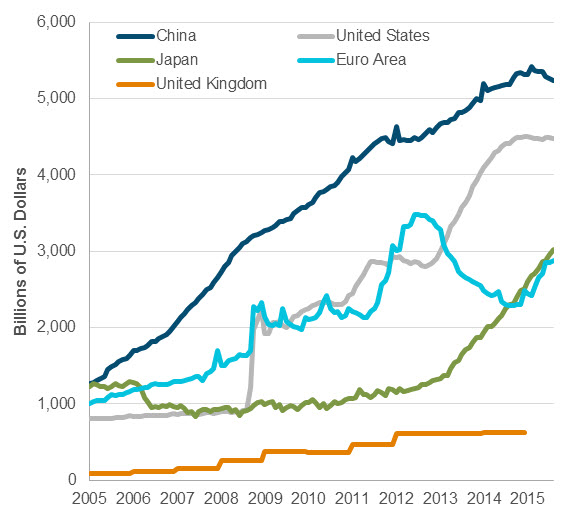
We anticipate that Chinese policymakers will essentially be able to do whatever it takes—such as cutting interest rates further and using China’s ample foreign exchange reserves to manage renminbi volatility—to prevent an abrupt slowdown in the economy’s growth (Figure 1). China’s political structure makes its government officials focus intently on maintaining full employment. Looking ahead over the medium term, we think that annual growth in the Chinese economy can decelerate to 5.5%–6.0% and still support full employment. The reforms that the government will need to implement to maintain this pace—focusing on increasing consumption and reforms in social services—should position Chinese debt as an attractive longer-term investment.
Figure 1: Central Bank Assets*
January 2005 to August 2015
Sources: Haver Analytics and FactSet.
*Based on the following exchange rates: 0.00835 USD per JPY, 1.123 USD per euro, 0.15698 USD per yuan/renminbi, 1.52 USD per British pound
Similarly, Brazil’s struggles to emerge from recession could develop into a catalyst for meaningful fiscal reforms that we believe would benefit bonds over a longer time horizon. Brazil’s government made the error of counting on higher oil prices to sustain its fiscal policies and is now finding it difficult to cut its elevated levels of social spending. However, we anticipate that pressure on Brazil’s politicians will eventually force them to enact needed fiscal reforms and measures to battle corruption—although admittedly we do not see the country’s economy making a turnaround until mid- to late 2016.
ENERGY SECTOR CORPORATE ISSUERS HAVE LOWER RISK OF DEFAULT THAN IN US HIGH YIELD
A further decline in commodities prices, of course, would exert even more pressure on Brazil and other emerging economies that are dependent on oil exports. Another decrease in oil prices would also increase the credit risk of corporate bonds from the oil and gas sector. However, we think that bonds from energy sector emerging markets corporations have a broadly lower risk of default than their US high yield counterparts because they typically have lower costs and access to more funding (often through government support) than noninvestment-grade US firms.
We also expect Indonesia, India, and Mexico to enact reforms next year. On the other hand, there is little chance that countries such as Russia and Turkey will make positive changes to their economies or industry structures in the foreseeable future.
CONCLUSION
Within the broad emerging markets debt asset class, we currently see the best opportunities—taking into account general risk and liquidity—in dollar-denominated sovereign bonds. They are relatively liquid and do not involve currency risk for US-based investors. Emerging markets corporate bonds (also denominated in US dollars) rank second as a result of their solid credit quality and attractive yield. There is also some value within locally denominated emerging markets debt, but we are cautious about the potential for further downward moves in some local currencies.
2015-GL-2967
重要情報
当資料は、ティー・ロウ・プライス・アソシエイツ・インクおよびその関係会社が情報提供等の目的で作成したものを、ティー・ロウ・プライス・ジャパン株式会社が翻訳したものであり、特定の運用商品を勧誘するものではありません。また、金融商品取引法に基づく開示書類ではありません。当資料における見解等は資料作成時点のものであり、将来事前の連絡なしに変更されることがあります。当資料はティー・ロウ・プライスの書面による同意のない限り他に転載することはできません。
資料内に記載されている個別銘柄につき、売買を推奨するものでも、将来の価格の上昇または下落を示唆するものでもありません。また、当社ファンド等における保有・非保有および将来の組入れまたは売却を示唆・保証するものでもありません。投資一任契約は、値動きのある有価証券等(外貨建て資産には為替変動リスクもあります)を投資対象としているため、お客様の資産が当初の投資元本を割り込み損失が生じることがあります。
当社の運用戦略では時価資産残高に対し、一定の金額までを区切りとして最高1.265%(消費税10%込み)の逓減的報酬料率を適用いたします。また、運用報酬の他に、組入有価証券の売買委託手数料等の費用も発生しますが、運用内容等によって変動しますので、事前に上限額または合計額を表示できません。詳しくは契約締結前交付書面をご覧ください。
「T. ROWE PRICE, INVEST WITH CONFIDENCE」および大角羊のデザインは、ティー・ロウ・プライス・グループ、インクの商標または登録商標です。
ティー・ロウ・プライス・ジャパン株式会社
金融商品取引業者関東財務局長(金商)第3043号
加入協会:一般社団法人日本投資顧問業協会/一般社団法人投資信託協会


