

European Debt: Returns Forecast to be Moderate Amid Mixed Economic Trends
Executive Summary
European debt markets are set for another year of moderate returns in 2016, with interesting opportunities continuing to arise in the investment-grade and high yield credit markets.
- European debt markets are set for another year of moderate returns in 2016 as slowly improving fundamentals are offset by external headwinds.
- Slowing growth in China and other emerging markets is weighing heavily on eurozone exports, and there is no indication that the slack in global demand will be taken up anytime soon by the slowly growing US economy.
- Eurozone sovereign spreads are likely to remain narrow as the ECB maintains its monthly bond purchases and the European economy continues to grow.
- Investment-grade corporate yields are historically low, but they look reasonable compared with sovereigns; the European high yield market looks set to remain attractive relative to the US high yield market for most of 2016 and possibly beyond.
European debt markets are set for another year of moderate returns in 2016 as slowly improving fundamentals are offset by external headwinds. While concerns in Europe this year have been primarily about internal issues—the possibility of a ”Grexit” chief among them—the main challenges next year will come from outside the Continent, namely the slowdown in emerging markets and the weaker-than-expected recovery of the US economy. The actions of the Federal Reserve and the European Central Bank (ECB) in response to their respective domestic issues will also play an important role in determining bond market performance.
Slowing growth in China and other emerging markets is weighing heavily on eurozone exports, and there is no indication that the slack in global demand will be taken up anytime soon by the slowly growing US economy. Given that growth in Europe itself looks set to remain tepid at best, and there remains much excess capacity in the eurozone, it is highly likely that inflation will remain below the ECB’s target of 2% for at least the next two to three years and possibly longer.
ECB TO PLAY DECISIVE ROLE
How the ECB responds to the inflation shortfall will play an important role in influencing asset prices in Europe during 2016 and beyond. In early December, the bank announced a number of measures, including a 10-basis-point cut to the deposit rate of 0.3%, an extension of the QE timeline until at least March 2017, and an expansion of the range of assets eligible for purchase under the program to include local and regional government debt. Any further measures will need to be finely calibrated taking into consideration the strength of the eurozone recovery and how any actions will affect the region’s money markets and banks.
Eurozone sovereign spreads are likely to remain narrow as the ECB maintains its monthly bond purchases and the European economy continues to grow, meaning that opportunities will be largely confined to carry trades between so-called core and peripheral sovereign bonds. More attractive sovereign opportunities exist in Eastern Europe, where widespread disinflation means that interest rate cuts are possible in places such as Romania, Russia, and Serbia, sending local bond prices higher. We are approaching this theme with caution, however, as the disinflationary trend may reverse next year in some Eastern European countries, leading to dispersion within the bloc.
FAVOURABLE CREDIT CYCLE CREATING OPPORTUNITIES
Credit looks more interesting. Investment-grade corporates saw spread widening in mid-2015 as external factors led to generic widening in spread sectors. Over recent months, however, widening and volatility have resulted from an increase in idiosyncratic factors, including a pickup in merger and acquisition and the Volkswagen emissions scandal. Relative underperformance from industrial sectors is leading to attractive stock selection opportunities.
Unlike in the US, the credit cycle in Europe is still improving. Economic recovery is expected to feed through into corporate earnings, yet, given the still fragile nature of the recovery, companies are, on balance, still maintaining relatively conservative balance sheets. Although future spread tightening is likely to remain modest, the asset class remains relatively well supported by the ECB’s accommodative policy. Investment-grade corporate yields are historically low, but they look reasonable compared with European sovereign markets.
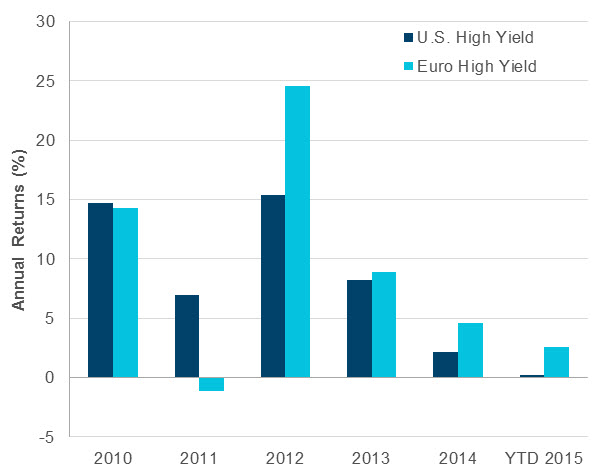
In high yield, Europe continues to look attractive compared with the US (Figure 1). A key factor here is
that a fifth of outstanding US high yield debt has been lent to the highly vulnerable oil and gas industry, whereas few energy companies have issued in the European high yield market. Defaults among US energy companies appear likely as companies that borrowed when they could sell oil for more than US$100 a barrel struggle to adjust to prices below US$50. As of 2015 according to JP Morgan, some 62% of the European high yield market is composed of BB rated companies, including many ”fallen angels” that were previously rated investment grade. In the US, ratings are distributed further down the spectrum toward the CCC segment, with less than 50% rated BB.
Figure 1: Euro High Yield Outperformed US High Yield Since 2012
As of 31 October 2015
Past performance is not a reliable indicator of future performance.
Sources: J.P. Morgan Domestic HY Index and BofA Merrill Lynch European Currency
High Yield Constrained Excluding Subordinated Financials Index hedged to the euro
CENTRAL BANK DIVERGENCE TO PERSIST FOR MEDIUM TERM
The relative attractiveness of the European credit market over the US market should persist through most of 2016 and possibly beyond, depending on how aggressively the Fed hikes interest rates and the precise nature of any further easing from the ECB. Higher target rates set by the Fed will send US bond yields higher and prices lower, making it more expensive for US companies to borrow. By contrast, an extension to quantitative easing from the ECB will keep yields at very low levels for the foreseeable future, maintaining highly favourable conditions for European issuers. Eventually, further rate rises in the US will attract investors seeking higher yields and the European credit cycle will mature, but this a longer-term scenario.
2015-GL-2946
重要情報
当資料は、ティー・ロウ・プライス・アソシエイツ・インクおよびその関係会社が情報提供等の目的で作成したものを、ティー・ロウ・プライス・ジャパン株式会社が翻訳したものであり、特定の運用商品を勧誘するものではありません。また、金融商品取引法に基づく開示書類ではありません。当資料における見解等は資料作成時点のものであり、将来事前の連絡なしに変更されることがあります。当資料はティー・ロウ・プライスの書面による同意のない限り他に転載することはできません。
資料内に記載されている個別銘柄につき、売買を推奨するものでも、将来の価格の上昇または下落を示唆するものでもありません。また、当社ファンド等における保有・非保有および将来の組入れまたは売却を示唆・保証するものでもありません。投資一任契約は、値動きのある有価証券等(外貨建て資産には為替変動リスクもあります)を投資対象としているため、お客様の資産が当初の投資元本を割り込み損失が生じることがあります。
当社の運用戦略では時価資産残高に対し、一定の金額までを区切りとして最高1.265%(消費税10%込み)の逓減的報酬料率を適用いたします。また、運用報酬の他に、組入有価証券の売買委託手数料等の費用も発生しますが、運用内容等によって変動しますので、事前に上限額または合計額を表示できません。詳しくは契約締結前交付書面をご覧ください。
「T. ROWE PRICE, INVEST WITH CONFIDENCE」および大角羊のデザインは、ティー・ロウ・プライス・グループ、インクの商標または登録商標です。
ティー・ロウ・プライス・ジャパン株式会社
金融商品取引業者関東財務局長(金商)第3043号
加入協会:一般社団法人日本投資顧問業協会/一般社団法人投資信託協会


