

Global Equities: Bifurcated Market Environment Likely to Persist in 2016
Executive Summary
Structural factors could create an interesting and potentially rewarding environment for stock pickers:
- Market environment for energy and industrials likely to remain difficult; consumer stocks could benefit from favourable disposable income trends.
- Global merger and acquisition boom should continue and could strengthen as companies seek to lock in low financing costs. US corporate share buybacks should also remain high.
- Year-over-year earnings trends should become more favourable in the second half of 2016. Modestly positive earnings per share growth appears achievable.
- Financials, health care, technology, and consumer discretionary all present opportunities. However, pervasive disruption will make strong bottom-up fundamental research essential.
Over the past year, the global equity story has been a tale of two markets: for many consumer and commodity-consuming sectors, 2015 offered, if not the best of times, at least a relatively supportive economic environment. For industrial and commodity-producing sectors, however, it was a year of slumping demand and declining profits. In our view, these stories are unlikely to change directionally in 2016.
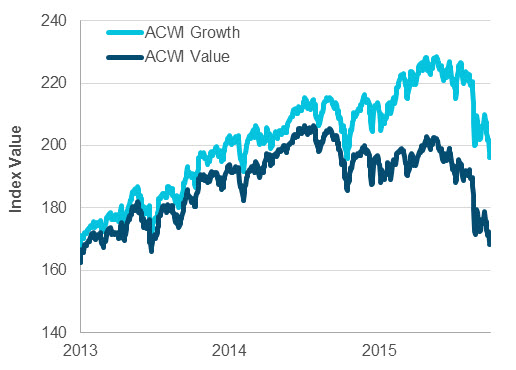
The bifurcation in global equity performance is captured by the sharp divergence between value and growth in 2015, after several years in which the two styles largely tracked each other (Figure 1). A quick reversal of this style divergence is unlikely, in our judgement, barring a substantial acceleration in global economic growth and a recovery in commodity prices. Neither is likely before the second half of 2016—or even the first half of 2017.
Figure 1: MSCI All Country World Growth and Value Indexes
Through 30 Sept 2015
Past performance is not a reliable indicator of future performance.
Source: MSCI.
Nevertheless, there are several reasons to take a cautiously optimistic view about equity returns overall:
- Although the Federal Reserve is likely to continue gradually raising interest rates, following its initial move in December, the monetary environment should remain supportive, as the European Central Bank, the Bank of Japan, and a number of emerging market countries continue to pursue stimulative policies.
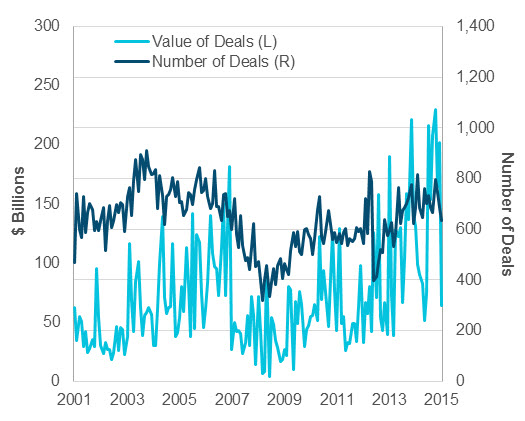
- A global merger and acquisition (M&A) boom is constricting the supply of public equities (Figure 2), as are heavy corporate share buybacks. We see both trends continuing, and perhaps even accelerating, in 2016 as companies try to lock in attractive funding costs.
- Year-over-year earnings comparisons should grow less onerous for many industrial and energy-related companies as we move into the second half of 2016—assuming commodity prices and exchange rates stabilise around current levels.
- Low energy prices, employment and income growth, and (for US consumers) the effects of the strong US dollar on import prices all should boost consumer spending, offsetting continued weakness in industrial demand.
Figure 2: Number and Value of US M&A Deals
30 Sept 2001 Through 30 Sept 2015
Sources: Citi Research, FactSet, and Deutsche Bank.
REGIONAL OUTLOOK FAVOURS DEVELOPED MARKETS
Given the macroeconomic outlook, the most likely 2016 scenario is for modest but positive earnings growth across most developed equity markets, possibly accelerating in the second half. The outlook for emerging equities is both more uncertain and more diverse, reflecting their varying exposures to changes in commodity prices. Our views on some key regions:
- United States: Recent consensus estimates have projected 9% year-over-year growth in earnings per share for the companies in the S&P 500 Index in 2016, which is probably too high given the profit recessions in the energy, materials, and related industries. However, earnings growth in the mid-single digits seems attainable, assuming (as we do) that consumer spending remains robust. At 15x forward earnings, the S&P 500 appears neither expensive nor inexpensive on a historical basis, although it could be argued that US equity valuations are still attractive in a context of low inflation and low interest rates.
- Developed Europe: Many of the cyclical and structural trends at work in the US are also underway in Europe, although unfolding at a slower pace. Consumer spending is picking up, bank lending is reviving, and the weaker euro is helping offset the impact of the global commodity bust on exports. Relative cost reductions in the peripheral countries have improved competitiveness. We see more room in southern Europe for earnings to accelerate from deeply depressed levels. Valuations appear reasonable overall, but many quality companies are selling at premium multiples.
- Japan: Our outlook for Japanese equities remains subdued, as weak wage growth and the threat of deflation continue to weigh on the domestic economy. While steps have been taken to improve corporate governance and shareholder returns, structural reforms to the economy have been slow to materialise. Valuations are well below historical averages, but those averages are also quite high relative to the other major developed markets. However, we continue to find select Japanese companies with attractive fundamentals, primarily in the export sector.
- China: There is a risk that the slowdown in industrial growth will spread to the consumer and service sectors. However, Chinese policymakers can be expected to use all the stimulus tools at their disposal to support spending. Although the sharp correction this past summer deflated many of the smaller speculative names favoured during the bubble, valuations for larger, more established companies are still not cheap by historical standards. Select consumer stocks, such as Internet retailers, continue to see rapid share growth, but intense competition is holding down profit margins.
- Other Emerging Markets: As has been the case for the past several years, earning trends in emerging equity markets are likely to reflect divergences in the global economy. For the commodity-producing and -exporting countries, such as Brazil and Russia, the outlook remains weak. Major energy-consuming countries, such as India, or markets with export exposure to US consumer demand, such as Mexico, should benefit. However, periods of volatility can be expected.
SECTOR OPPORTUNITIES IN 2016
Cyclical and structural trends are expected to create a friendly environment for active stock picking in 2016, as technological and market disruption is challenging old business models and creating new ones across a host of industries.
As portfolio managers, our primary focus is on using bottom-up fundamental research to identify attractive growth companies at reasonable valuations. That said, we believe opportunities are likely to be found in these global sectors:
- Financials: Even modest further rate increases by the Fed could exert powerful positive leverage on net interest margins (and thus earnings) for US banks and nonbank lenders, many of which still trade at historically depressed multiples. The regulatory climate appears to be stabilising, potentially clearing the way for the major US money centre banks to pursue M&A opportunities and boost share buybacks.
- Health Care: The sector is benefiting from a surge in profitable innovation in biotech and health sciences—just as millions of consumers are being added to the health care market by the US Affordable Care Act. Historically low correlation to economic growth could also give the sector defensive appeal if the global economy slows further. Mergers and cost consolidation in the managed care industry should be positive for earnings. Outside of small- and mid-cap biotech, valuations still appear reasonable.
- Technology: Cloud storage and the shift to software-as-a-service are disrupting enterprise software and hardware vendors and related companies, while facilitating the explosive growth in broadband technologies, social media, and mobile application-based commerce. Rapid shifts in market share should ensure that growth opportunities are plentiful in 2016.
- Consumer Discretionary: Rising disposable income and low energy prices should continue to support spending growth in 2016, but here, again, disruption is creating winners and losers. Mass market retailers are exposed to sluggish demand growth among lower-income consumers and are under siege from e-commerce competitors. On the other hand, restaurants, Internet media, and Internet retail all appear to present attractive opportunities.
CONCLUSION
The equity market trends seen over the past year reflect an underlying shift in the global economy, as an industrial expansion led by rising commodity prices and capital investment in China and the other emerging markets has turned to consolidation. At the same time, however, lower energy prices, dollar appreciation, and gradual tightening of labour market conditions have improved the outlook for US consumers. A modest acceleration in growth in developed Europe should further support consumer demand.
Under these conditions, specific global industries and individual companies can do reasonably well in 2016, even as others continue to struggle. However, stock selection will be critical. Careful bottom-up research and analysis will remain the key to identifying both opportunities and risks.
2015-GL-2864
重要情報
当資料は、ティー・ロウ・プライス・アソシエイツ・インクおよびその関係会社が情報提供等の目的で作成したものを、ティー・ロウ・プライス・ジャパン株式会社が翻訳したものであり、特定の運用商品を勧誘するものではありません。また、金融商品取引法に基づく開示書類ではありません。当資料における見解等は資料作成時点のものであり、将来事前の連絡なしに変更されることがあります。当資料はティー・ロウ・プライスの書面による同意のない限り他に転載することはできません。
資料内に記載されている個別銘柄につき、売買を推奨するものでも、将来の価格の上昇または下落を示唆するものでもありません。また、当社ファンド等における保有・非保有および将来の組入れまたは売却を示唆・保証するものでもありません。投資一任契約は、値動きのある有価証券等(外貨建て資産には為替変動リスクもあります)を投資対象としているため、お客様の資産が当初の投資元本を割り込み損失が生じることがあります。
当社の運用戦略では時価資産残高に対し、一定の金額までを区切りとして最高1.265%(消費税10%込み)の逓減的報酬料率を適用いたします。また、運用報酬の他に、組入有価証券の売買委託手数料等の費用も発生しますが、運用内容等によって変動しますので、事前に上限額または合計額を表示できません。詳しくは契約締結前交付書面をご覧ください。
「T. ROWE PRICE, INVEST WITH CONFIDENCE」および大角羊のデザインは、ティー・ロウ・プライス・グループ、インクの商標または登録商標です。
ティー・ロウ・プライス・ジャパン株式会社
金融商品取引業者関東財務局長(金商)第3043号
加入協会:一般社団法人日本投資顧問業協会/一般社団法人投資信託協会


