
What’s behind gold’s surge—and what could end it
February 2026, Markets and Economy
- Key Insights
-
- Gold’s surge reflects changing demand dynamics rather than a traditional inflation hedge.
- Inelastic supply has amplified the impact of rising central bank and investor demand.
- As momentum builds, price action may become more reflexive—and more fragile.
All that glistens is not gold—gilded tombs do worms infold.
The Prince of Morocco from “The Merchant of Venice”
Gold’s enduring appeal lies in its physical properties. Its distinctive shine and longstanding association with wealth have turned it into a status symbol in many cultures. Crucially, gold is chemically inert—what scientists sometimes call an “antisocial” element—and does not react easily with other elements. This physical permanence has sustained gold’s reputation of being, in the words of Spandau Ballet’s 1983 hit, “indestructible.”
In financial circles, gold is traditionally regarded as something of a soothsayer. It is supposed to be a harbinger of inflation, deflation, all forms of geopolitical uncertainty, war, famine, pestilence, and plague. More recently, however, you may have been better off reading the entrails of a sacrificial goat.
"..gold’s current rally looks less like a traditional hedge and more like a trade shaped by structural demand...."
Why? Because gold’s current rally looks less like a traditional hedge and more like a trade shaped by structural demand and momentum. This distinction matters: one tends to be durable, the other more reflexive. Understanding which force is dominant can help to explain both gold’s remarkable run—and the risks that come with it.
Gold’s recent surge does not fit the script
For decades, there has been a relatively stable inverse relationship between the U.S. dollar price of gold and real interest rates. Broadly speaking, spot gold prices have behaved as a safe asset, rising as real yields fall and inflation fears rise. Yet gold’s recent parabolic move—and the accompanying upshift in volatility—suggests that this relationship has weakened, if not temporarily broken.
This matters, because over more than two centuries since 1800, gold has outperformed equities and bonds in only three decades: the 1930s, the 1970s, and the 2000s. As the best-performing major asset class in both 2024 and 2025, and with a year-to-date price chart resembling an Indian rope trick—rising sharply and seemingly defying gravity—gold has enjoyed a remarkable start to the 2020s. It would, however, be highly irregular if it were to dominate for three years running. This raises two related questions: What is driving gold’s extraordinary run—and what, ultimately, would end it?
Like so many puzzles in financial markets, the answer is part science (fundamentals) and part art (momentum). Let’s look at the science first.
It’s not just the dollar
The theme of de‑dollarization has resurfaced repeatedly in recent financial history. Contrary to many post‑financial crisis warnings, however, the dollar has in fact strengthened its role since 2008, consolidating its dominance in international debt issuance, trade invoicing, and central bank reserves. That said, it is worth considering whether gold’s recent upward trajectory does reflect a process of de‑dollarization—or, more broadly, debasement—as investors and central banks diversify portfolios and reserves away from fiat currencies (paper money).
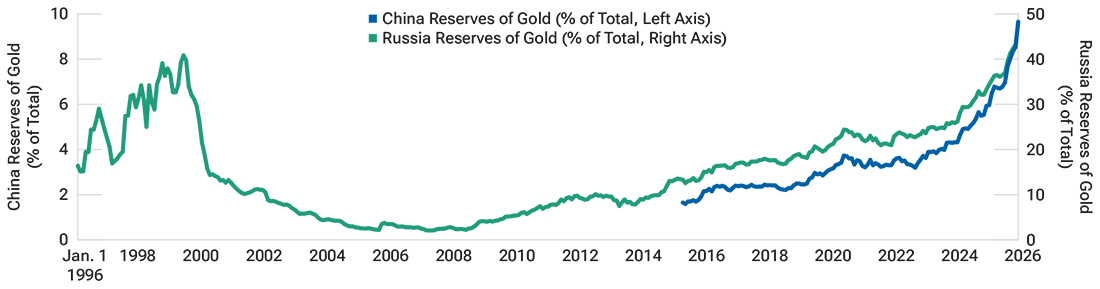
Since Russia’s full-scale invasion of Ukraine in 2022, an increase in demand for gold has been evident, driven in large part by central bank purchases (Figure 1). In China’s case, these volumes are likely underreported. As a neutral reserve asset, gold sidesteps the risks of default, counterparty exposure, and sanctions—risks that are heightened in a more geopolitically fraught environment. Debasement, however, is not unique to the U.S. dollar. If a structural trend is emerging, it may be better understood as a broader hedge against fiat currencies globally, driven less by excessively loose monetary policy than by the growing jeopardy of fiscal largesse.
Whether this is causality or correlation, the net effect has been a structural bid for gold for investment purposes. That bid has, until recently, been offset by declining consumption of jewelery, which still accounts for roughly half of global gold demand. According to the World Gold Council, total gold demand in 2025 exceeded 5,000 tons for the first time—a 1% rise by volume. Meanwhile, annual gold supply also grew by just 1%. What is remarkable is the lack of a meaningful supply response to a 67% rise in the U.S. dollar gold price.
Central banks have continued to add gold reserves
(Fig. 1) Russia and China are aggressively diversifying away from the dollar
As at January 1, 2026.
From January 1, 1996.
Source: Bloomberg Finance LP.
close
When science gives way to art
Those are the fundamentals, or the science: Marginal demand is being driven by central banks, while supply remains stubbornly inelastic. On their own, however, these factors struggle to explain the recent “pop” in prices as gold has diverged so sharply from its historical trend.
That is where the art of investing comes in.
Gold’s seemingly unstoppable rise in 2025 attracted momentum-driven and trend-following flows, with rising prices themselves becoming a key reason new investors entered the market. Performance bred attention; attention bred inflows. As is often the case, price momentum became self-reinforcing.
How far this dynamic can run—and what ultimately breaks it—is difficult to judge. At some point, either the fundamental narrative will weaken or investors will decide that the price already discounts too much good news. Perhaps, then, the only honest forecast would be this: Gold will continue to glisten until enough investors conclude it has become fool’s gold. And by the time this point has been reached, the real money will already have been made.
 Justin Thomson
Head, Investment Institute and CIO
Justin Thomson
Head, Investment Institute and CIO
What's ahead?
Gain valuable perspective on the markets and what’s ahead.
Risks: The price of gold can be volatile, and it may fluctuate significantly over short periods. This can make it difficult to predict its value and can make it a risky investment.
Additional Disclosure
For U.S. investors, visit troweprice.com/glossary for definitions of financial terms.
Important Information
Outside of the United States, this is intended for investment professional use only. Not for further distribution.
This material is being furnished for informational and/or marketing purposes only and does not constitute an offer, recommendation, advice, or solicitation to sell or buy any security.
Prospective investors should seek independent legal, financial and tax advice before making any investment decision. T. Rowe Price group of companies including T. Rowe Price Associates, Inc. and/or its affiliates receive revenue from T. Rowe Price investment products and services.
Past performance is not a guarantee or a reliable indicator of future results. All investments involve risk, including possible loss of principal.
Information presented has been obtained from sources believed to be reliable, however, we cannot guarantee the accuracy or completeness. The views contained herein are those of the author(s), are as of February 12, 2026 are subject to change, and may differ from the views of other T. Rowe Price Group companies and/or associates. Under no circumstances should the material, in whole or in part, be copied or redistributed without consent from T. Rowe Price.
All charts and tables are shown for illustrative purposes only. Actual future outcomes may differ materially from any estimates or forward‑looking statements provided.
The material is not intended for use by persons in jurisdictions which prohibit or restrict the distribution of the material and in certain countries the material is provided upon specific request.
USA—Issued in the USA by T. Rowe Price Investment Services, Inc., distributor and T. Rowe Price Associates, Inc., investment adviser, 1307 Point Street, Baltimore, MD 21231, which are regulated by the Financial Industry Regulatory Authority and the U.S. Securities and Exchange Commission, respectively.
© 2026 T. Rowe Price. All Rights Reserved. T. Rowe Price, INVEST WITH CONFIDENCE, the Bighorn Sheep design, and related indicators (see troweprice.com/ip) are trademarks of T. Rowe Price Group, Inc. All other trademarks are the property of their respective owners. Use does not imply endorsement, sponsorship, or affiliation of T. Rowe Price with any of the trademark owners.
202602-5198586