
Looking beyond tight credit spreads: The opportunity in high yield bonds
June 2026, Fixed Income
- Key Insights
-
- Attractive all-in yields, low default rates, and improved credit quality and liquidity help explain tighter credit spreads while continuing to support the case for global high yield bonds.
- Higher average credit quality, fewer lower-rated issuers, and stronger company fundamentals highlight the strength of today’s high yield market.
- A larger, more global high yield universe may help investors diversify through exposure to different economic and credit cycles.
Tight corporate credit spreads1 may continue to dominate the narrative across global high yield markets—but they don’t tell the full story. All‑in yields remain high, default rates are low, and improved credit quality and liquidity paint a compelling picture. Taken together, these four factors not only help explain spread compression, but also make a strong case for allocating to high yield bonds.
All‑in yield matters
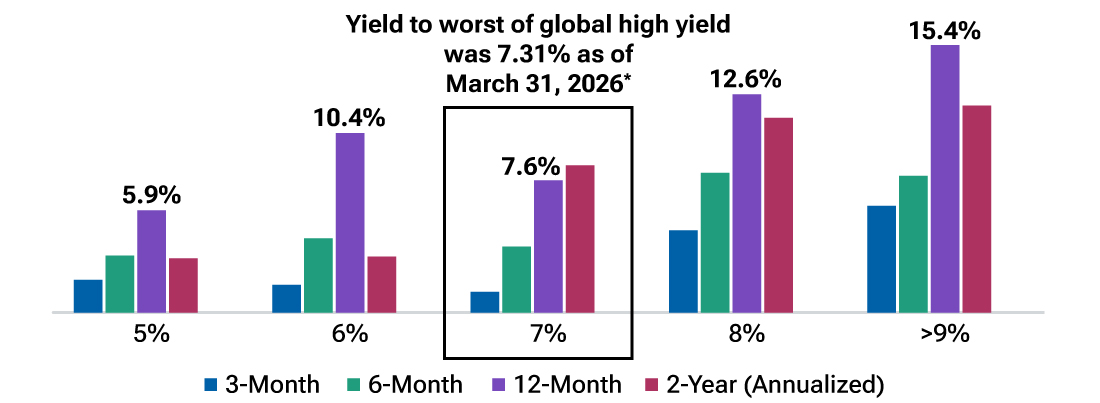
All‑in yields remain high and appealing from an income generation perspective. Historically, investing at such levels has been a precursor to attractive returns in subsequent periods (see Fig. 1).
Interestingly, these yields can sometimes understate the true return potential. In sub‑investment‑grade markets, bonds are often refinanced prior to maturity—a dynamic that can meaningfully impact expected yields yet is usually not reflected in quoted yield‑to‑maturity figures. Accounting for this early takeout for bonds trading below par typically results in total returns higher than advertised yields, further enhancing the appeal of high yield on an absolute basis.
Higher yields have often been a precursor of higher returns
(Fig. 1) Global high yield returns once yields reached various thresholds.
As of March 31, 2026.
Past performance is not a guarantee or a reliable indicator of future results.
Median forward (subsequent) returns from January 1, 2012. Performance periods shown once index yields moved through the stated yield threshold and had not been at that level for the preceding 30 business days.
* As of March 31, 2026, yield to worst (the lowest possible yield on a bond with an early redemption feature) of the ICE BofA Global High Yield Index (see additional disclosures). Yields are measured daily.
Global high yield market is represented by the ICE BofA Global High Yield Index.
Specific numbers are only provided for the subsequent 12 month period, as this tends to be a good horizon for predictions. The performance figures for the 3-month, 6-month and 2-year periods are not negative.
Sources: ICE BofA, T. Rowe Price Analysis. Please see Additional Disclosures.
close
A comparison with other asset classes, such as equities, is compelling too. As of May 21, the J.P. Morgan Domestic High Yield Index offered a 7.13% yield to worst, more than three percentage points higher than the earnings yield on the S&P 500 Index2. The gap is notable not only from an income perspective, but also because equity volatility has historically exceeded high yield bonds. Superior yield, meaningfully lower volatility, and potentially lower downside risk relative to equities present a strong case for the asset class.
Improved credit quality
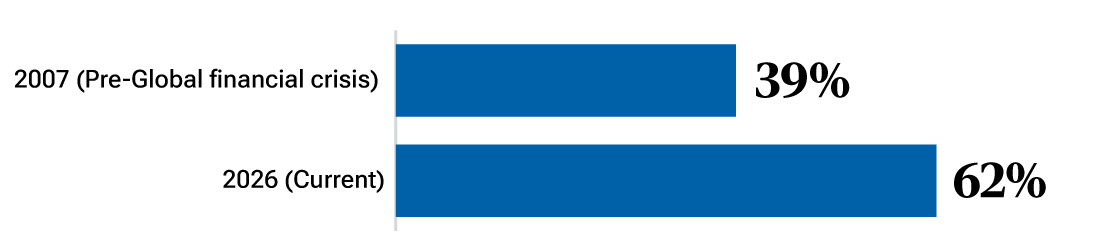
The overall credit quality of high yield corporate credit indexes has improved considerably over the last 15 to 20 years. Using the ICE BofA Global High Yield Index as a proxy, 62% of bonds are rated BB (the highest sub investment grade rating) as of March 31, 2026, up from only 39% in 2007. This improvement in credit quality is also evident at the other end of the high yield credit spectrum. CCC-rated issuers fell from an average of around 15% of the index in 2007 to just 7% at the end of March this year.3
High yield markets ratings quality “migrates up”
(Fig. 2) Increase in number of issuers rated BB
As of March 31, 2026.
Credit ratings do not remove market risk and are subject to change. The ratings are the average ratings from Moody’s, S&P, and Fitch. The date used for pre-GFC is January 31, 2007.
For illustrative purposes only.
Source: ICE BofA Global High Yield Index.
close
Another indication of improved credit quality is the increase in secured bond issuance. This suggests higher recovery rates4 as investors can claim on specific assets or collateral. Furthermore, a key post global financial crisis (GFC) trend has been a sharp decline in the amount of smaller deals. This matters because smaller deals tend to be more speculative, as the issuers are often earlier‑stage and more leveraged, which means credit profiles are usually weaker. Fewer small deals point to healthier market conditions.
Superior yield, meaningfully lower volatility, and potentially lower downside risk relative to equities present a strong case for the asset class.
Additionally, high yield companies are generating higher earnings on average than they did prior to the GFC, providing them with greater financial flexibility. The average maturity and duration profile of high yield issuers have also declined meaningfully over time, reducing both volatility and the risk premium required by investors. Overall, improvements in credit quality of the high yield market have contributed to tighter credit spreads.
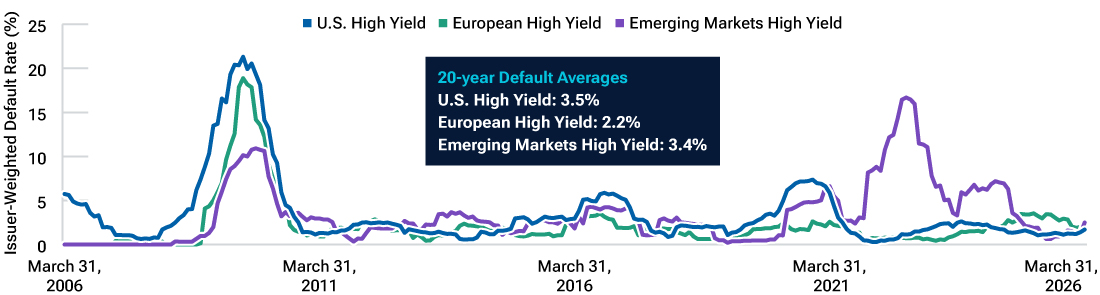
Current default rates remain below historical averages
(Fig. 3) Historical high yield default rates in the U.S., Europe, and emerging markets.
As of March 31, 2026.
For illustrative purposes only. Index constituents default rates were determined monthly. Default rate calculation is par-weighted and issuer default‑weighted trailing-12 months, including bankruptcies, missed payments, and liability-management exercises.
Source: BofA Merrill Lynch, J.P. Morgan Chase & Co., Moody’s Investors Services.
close
Low default rates
Default rates remain below historical averages across global high yield markets, a trend we expect to continue. While concerns around the software sector and private credit are currently elevated, we do not believe this signals broader issues in credit markets. High yield companies are underpinned by robust fundamentals. Cash ratios (a measure of liquidity that shows a company’s ability to cover its short‑term obligations) are elevated, while leverage ratios (which show how much of a company’s capital comes from debt) remain relatively healthy.
High yield companies have also demonstrated considerable resiliency in recent years, absorbing multiple shocks, from Covid, to the 2022 energy crisis, to tariffs. Taken together, these attributes are supportive of high yield companies and should help them navigate this year’s energy price shock.
…improvements in credit quality of the high yield market have contributed to tighter credit spreads.
Enhanced liquidity
In addition to default risk, high yield investors should be compensated for volatility and illiquidity risk. However, liquidity in the global high yield market has improved markedly in recent years, driven by the proliferation of electronic and portfolio trading. Bid/ask spreads (the gap between what buyers will pay and sellers will accept) have also narrowed, a further sign of liquidity improvement.
Therefore, structurally better liquidity implies a lower required liquidity premium. This is another factor contributing to spreads tightening.
Benefits of a global approach in today’s markets
The global high yield market has undergone a meaningful transformation over the last two decades. It is now approximately six times larger than it was in 2000—an expansion that has created a more global and varied investment universe spanning a wide range of countries, sectors, and issuers. This broader opportunity set may enhance diversification5 by providing exposure to different economic and credit cycles, which is especially important for investors in today’s markets.
There is no disputing that spreads are tight relative to historical levels. However, this must be viewed in the context of meaningful structural changes to the global high yield market. Credit quality has improved, companies are generally in robust health, and liquidity is better. These factors, combined with attractive and competitive all‑in yields, make a compelling case for the asset class.
 Michael Connelly, CFA
Portfolio Manager
Michael Connelly, CFA
Portfolio Manager
 Anton Dombrovskiy, CFA
Portfolio Specialist
Anton Dombrovskiy, CFA
Portfolio Specialist
Insights for every stage.
Practical guidance to support your journey—from saving to investing to retirement.
1 Credit spread is the difference in yield between securities with similar maturity but different credit quality. Widening spreads generally indicate deteriorating creditworthiness of corporate borrowers, and narrowing spreads indicate improving creditworthiness.
2 Earnings yield is 12‑month consensus forward earnings divided by price. Source: Bloomberg Finance L.P.
3 CCC-rated issuers fall within one of the lowest credit-rating categories, but are not in default.
4 Recovery rates are the percentage amount that an investor recovers of their principal in the event of a default.
5 Diversification cannot assure a profit or protect against loss in a declining market.
T. Rowe Price cautions that economic estimates and forward-looking statements are subject to numerous assumptions, risks, and uncertainties, which change over time. Actual outcomes could differ materially from those anticipated in estimates and forward‑looking statements, and future results could differ materially from historical performance. The information presented herein is shown for illustrative, informational purposes only. Any historical data used as a basis for analysis is based on information gathered by T. Rowe Price and from third-party sources that have not been verified. Forecasts are based on subjective estimates about market environments that may never occur. Any forward-looking statements speak only as of the date they are made. T. Rowe Price assumes no duty to, and does not undertake to, update forward-looking statements.
Risks
Fixed-income securities are subject to credit risk, liquidity risk, call risk, and interest-rate risk. As interest rates rise, bond prices generally fall. Investments in high-yield bonds involve greater risk of price volatility, illiquidity, and default than higher-rated debt securities. International investments can be riskier than U.S. investments due to the adverse effects of currency exchange rates, differences in market structure and liquidity, as well as specific country, regional, and economic developments. These risks are generally greater for investments in emerging markets.
Additional Disclosures
For U.S. investors, visit troweprice.com/glossary for definitions of financial terms.
Please see vendor indices for more information, including definitions and source data: troweprice.com/marketdata.
Important Information
This material is being furnished for informational and/or marketing purposes only and does not constitute an offer, recommendation, advice, or solicitation to sell or buy any security.
Prospective investors should seek independent legal, financial and tax advice before making any investment decision. T. Rowe Price group of companies including T. Rowe Price Associates, Inc. and/or its affiliates receive revenue from T. Rowe Price investment products and services.
Past performance is not a guarantee or a reliable indicator of future results. All investments involve risk, including possible loss of principal.
Information presented has been obtained from sources believed to be reliable, however, we cannot guarantee the accuracy or completeness. The views contained herein are those of the author(s), are as of June 2026, are subject to change, and may differ from the views of other T. Rowe Price Group companies and/or associates. Under no circumstances should the material, in whole or in part, be copied or redistributed without consent from T. Rowe Price.
All charts and tables are shown for illustrative purposes only. Actual future outcomes may differ materially from any estimates or forward‑looking statements provided.
The material is not intended for use by persons in jurisdictions which prohibit or restrict the distribution of the material and in certain countries the material is provided upon specific request.
Issued in the USA by T. Rowe Price Investment Services, Inc., distributor and T. Rowe Price Associates, Inc., investment adviser, 1307 Point Street, Baltimore, MD 21231, which are regulated by the Financial Industry Regulatory Authority and the U.S. Securities and Exchange Commission, respectively.
© 2026 T. Rowe Price. All Rights Reserved. T. Rowe Price, INVEST WITH CONFIDENCE, the Bighorn Sheep design, and related indicators (see troweprice.com/ip) are trademarks of T. Rowe Price Group, Inc. All other trademarks are the property of their respective owners. Use does not imply endorsement, sponsorship, or affiliation of T. Rowe Price with any of the trademark owners.
- 202606-5542664