
Four reasons to select an actively managed ETF for international equities
May 2026, Equity
- Key Insights
-
- An actively managed exchange-traded fund (ETF) combines professional security selection with the flexibility of the ETF structure.
- International markets can offer a broader set of opportunities for active managers because company quality, third-party analyst coverage, currencies, and policy settings vary widely across countries.
- For investors seeking international exposure, an active approach can offer a more flexible way to navigate the limits of a static benchmark.
Both active and passive ETFs can give investors diversified exposure. The difference is how the portfolio is built. A passive ETF seeks to track an index. An actively managed ETF relies on portfolio managers and analysts to decide what to own and how much to own based on the fund’s objective.
That distinction can matter even more in international markets. Outside the U.S., benchmarks may be less selective, third-party research coverage can be thinner, and market conditions can differ sharply across countries and currencies. Those differences create more room for active decisions to potentially add value and manage risk.
#1: Quality of benchmarks
A key difference between many U.S. and international benchmarks is the bar for inclusion. The S&P 500 Index requires listed companies to meet a financial viability test. Many widely used international benchmarks do not apply the same screen.
In the benchmark comparison below, the Morgan Stanley Capital International Europe, Australasia, Far East Index (MSCI EAFE) had a higher share of companies with negative earnings and a higher share with return on equity below 8% than the S&P 500 Index over the December 2020 to December 2025 period. That does not make passive international investing ineffective, but it does highlight why an active manager has more opportunities to avoid weaker businesses.
For investors, the takeaway is straightforward: When the benchmark itself is more uneven, manager judgment seems to matter more.
Varying qualities of investment benchmarks highlights the potential value of active management
(Fig. 1) Quality Comparison: S&P 500 Index versus MSCI EAFE Index, Quarterly, December 2020 to December 2025
| S&P 500 | MSCI EAFE | |
|---|---|---|
| Average % of companies reported negative earnings | 7% | 9% |
| Peak % of companies reported negative earnings | 16 | 19 |
| Average % of companies reported Return on Equity less than 8% | 22 | 35 |
| Peak % of companies reported Return on Equity less than 8% | 33 | 53 |
Past performance is not a guarantee or a reliable indicator of future results. Index performance is for illustrative purposes only and is not indicative of any specific investment. Investors cannot invest directly in an index.
Sources: Standard & Poor’s, MSCI (see Additional Disclosures). Analysis by T. Rowe Price.
#2: Analyst coverage and insights
Many large U.S. companies are followed very closely by third-party analysts. International companies often receive less coverage. As of December 31, 2025, the top 10 stocks in the S&P 500 Index averaged 54 analysts each, versus 27 for the top stocks in the MSCI EAFE Index.
When fewer analysts follow a company, information gaps can persist longer. That can create more opportunities for active managers with their own research analysts, deep fundamental research, and local market knowledge.
International markets can offer more scope for active insights when managers bring their own research capabilities to a less heavily covered part of the market.
An active manager can adjust country, sector, and security weights as conditions change and is better positioned to respond when markets shift.
#3: Complexity of international markets
International investing involves more moving parts than investing in a single-country benchmark. A U.S. large-cap index operates within one currency and one broad monetary and fiscal backdrop. An international benchmark spans multiple central banks, governments, regulations, tax systems, and currencies.
That added complexity can create both risk and opportunity for investors. Exchange rates can affect returns. Policy changes can shape industries differently from one country to another. Economic cycles rarely move in sync across regions.
A passive index accepts those exposures as they come. An active manager can adjust country, sector, and security weights as conditions change and is better positioned to respond when markets shift.
#4: Limitations of passive strategies
Passive indexes are rules-based. They reflect market values, sector weights, and index eligibility at a given point in time. By design, that makes them backward looking.
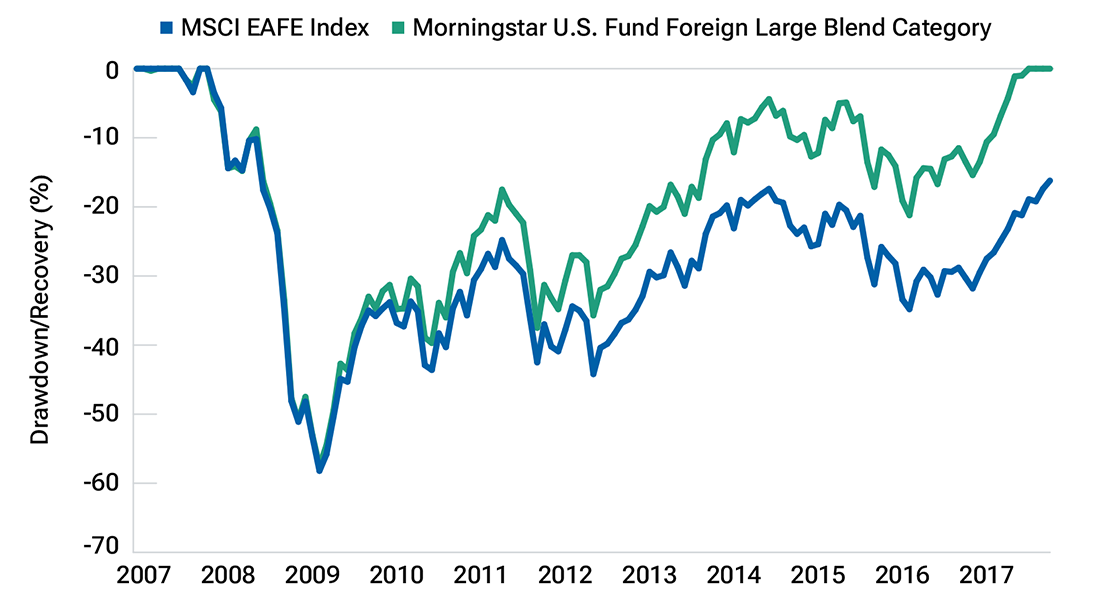
History offers useful examples. Japan reached 60% of the MSCI EAFE Index in 1989, just before its asset bubble burst. The financials sector represented more than 30% of the index in 2007, ahead of the global financial crisis (GFC). More recently, passive indexes were underweight financials after the sector’s 2021 trough and did not fully reflect its recovery as global interest rates moved higher.
The post-global financial crisis comparison in figure 2 shows that the Morningstar U.S. Fund Foreign Large Blend category, which was mostly active strategies, recovered faster than the MSCI EAFE Index over that period. This example illustrates how an active portfolio can respond differently than a static index.
Active managers collectively recovered faster from the global financial crisis (GFC) than the passive MSCI EAFE Index1
(Fig. 2) Post‑GFC drawdown and recovery (monthly), December 2006 to October 2017
Past performance is not a guarantee or a reliable indicator of future results.
Sources: MSCI, Morningstar (see Additional Disclosures). Analysis by T. Rowe Price.
1 Morningstar U.S. Fund Foreign Large Blend category comprised 80% active strategies as of June 25, 2025.
close
Why the ETF structure matters
We believe the case for active management is stronger today because investors have more ways to access it through ETFs. International ETFs can offer intraday trading, tax efficiency, and, in many cases, lower costs than comparable active mutual funds.
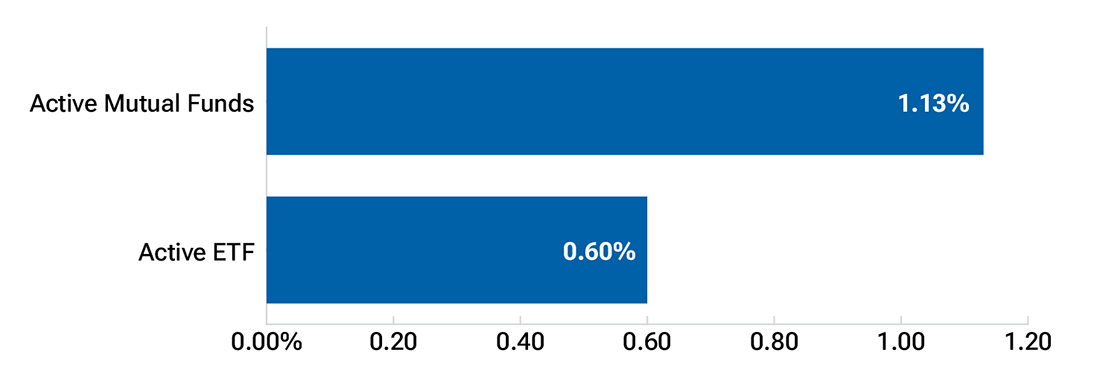
Active international ETFs are still fewer in number than active mutual funds, but the category is growing. Figure 3 shows average expense ratios of 0.60% for active ETFs versus 1.13% for comparable active mutual funds as of December 2025.
Another practical feature is trading access. Investors can buy or sell an international ETF during U.S. market hours even when overseas markets are closed. That convenience does not remove market risk, but it can make the vehicle easier to use.
Lower expense ratios than comparable mutual funds suggest that active ETFs may offer more cost-efficient exposure to international equities
(Fig. 3) Average expense ratio of active mutual funds versus active ETFs as of December 31, 2025
Source: ETF Action.
close
T. Rowe Price began investing in international equities in 1980 and now offers more than 30 global, international, and emerging markets strategies.
Not all managers are created equal: The T. Rowe Price difference
Choosing an active ETF is not only about choosing active management. It is also about choosing a manager with the experience and research depth to operate across markets.
T. Rowe Price began investing in international equities in 1980 and now offers more than 30 global, international, and emerging markets strategies. As of December 31, 2025, the firm had 43 portfolio managers covering global equities, with an average of 23 years of investment experience, alongside 82 dedicated analysts with an average of 13 years of experience.
That kind of research footprint matters in international markets, where local competitive dynamics, regulation, currency moves, and policy changes can shape outcomes quickly.
T. Rowe Price International and Global Equity ETFs
(Fig. 4)
| Fund name | Ticker symbol | Expense ratio1 | Description |
|---|---|---|---|
| T. Rowe Price Active Core International Equity ETF | TACN | 0.0%2 | Provides exposure to international developed markets equities through a core approach that combines fundamental and quantitative research. |
| T. Rowe Price Emerging Markets Equity Research ETF | TEMR | 0.40% | A research-driven portfolio offering exposure to emerging markets equities that seeks to leverage fundamental insights to identify investment opportunities. |
| T. Rowe Price Global Equity ETF | TGLB | 0.46% | Concentrated portfolio of global equities that seeks to invest in durable growth themes while balancing risk. |
| T. Rowe Price International Equity ETF | TOUS | 0.50% | Provides exposure to international developed markets equities with a focus on individual security selection. |
| T. Rowe Price International Equity Research ETF | TIER | 0.38% | A sector- and factor-neutral, research-driven portfolio offering exposure to international equities that strives to isolate security selection as a primary driver. |
1 As of March 31, 2026.
2 Waived until January 30, 2027 and 0.20% thereafter.
The bottom line
While passive indexes can offer simplicity and cost advantages, active management provides distinct benefits for international equity exposure.
For investors, the key question is where active judgment can make the biggest difference. In international markets, benchmark quality, thinner third-party analyst coverage, and changing regional conditions make a strong case for active management. For many investors, an actively managed ETF can be a practical way to approach international stocks, whether investing directly or with a financial advisor.

Confidence runs deeper with a trusted advisor by your side
Get expert advice on investing, retirement, and tax-smart approaches, so you can have greater clarity and confidence in your financial future.
Additional Disclosures
© 2026 Morningstar, Inc. All rights reserved. The information contained herein: (1) is proprietary to Morningstar and/or its content providers; (2) may not be copied or distributed; and (3) is not warranted to be accurate, complete, or timely. Neither Morningstar nor its content providers are responsible for any damages or losses arising from any use of this information. Past performance is no guarantee of future results.
MSCI and its affiliates and third‑party sources and providers (collectively, “MSCI”) makes no express or implied warranties or representations and shall have no liability whatsoever with respect to any MSCI data contained herein. The MSCI data may not be further redistributed or used as a basis for other indices or any securities or financial products. This report is not approved, reviewed, or produced by MSCI. Historical MSCI data and analysis should not be taken as an indication or guarantee of any future performance analysis, forecast or prediction. None of the MSCI data is intended to constitute investment advice or a recommendation to make (or refrain from making) any kind of investment decision and may not be relied on as such.
The S&P 500 Index is a product of S&P Dow Jones Indices LLC, a division of S&P Global, or its affiliates (“SPDJI”), and has been licensed for use by T. Rowe Price. Standard & Poor’s® and S&P® are registered trademarks of Standard & Poor’s Financial Services LLC, a division of S&P Global (“S&P”); Dow Jones® is a registered trademark of Dow Jones Trademark Holdings LLC (“Dow Jones”). T. Rowe Price’s products are not sponsored, endorsed, sold or promoted by SPDJI, Dow Jones, S&P, their respective affiliates and none of such parties make any representation regarding the advisability of investing in such product(s) nor do they have any liability for any errors, omissions, or interruptions of the S&P 500 Index.
Important Information
Consider the investment objectives, risks, and charges and expenses carefully before investing. For a prospectus or, if available, a summary prospectus containing this and other information, call 1-800-564-6958 or visit troweprice.com. Read it carefully.
ETFs are bought and sold at market prices, not NAV. Investors generally incur the cost of the spread between the prices at which shares are bought and sold. Buying and selling shares may result in brokerage commissions that will reduce returns.
Risk Considerations
All investments are subject to market risk, including the possible loss of principal. Active investing may have higher costs than passive investing and may underperform the broad market or passive peers with similar objectives.
Diversification cannot assure a profit or protect against loss in a declining market.
International investments can be riskier than U.S. investments due to the adverse effects of currency exchange rates, differences in market structure and liquidity, as well as specific country, regional, and economic developments. These risks are generally greater for investments in emerging markets.
Past performance is not a guarantee or a reliable indicator of future results. All charts and tables are shown for illustrative purposes only.
The views contained herein are those of authors as of May 2026 and are subject to change without notice; these views may differ from those of other T. Rowe Price associates. This material is provided for general and educational purposes only and not intended to provide legal, tax, or investment advice. This material does not provide recommendations concerning investments, investment strategies, or account types; it is not individualized to the needs of any specific investor and not intended to suggest any particular investment action is appropriate for you. T. Rowe Price group of companies, including T. Rowe Price Associates, Inc., and/or its affiliates, receive revenue from T. Rowe Price investment products and services.
T. Rowe Price Investment Services, Inc.
© 2026 T. Rowe Price. All Rights Reserved. T. Rowe Price, INVEST WITH CONFIDENCE, the Bighorn Sheep design, and related indicators (see troweprice.com/ip) are trademarks of T. Rowe Price Group, Inc. All other trademarks are the property of their respective owners. Use does not imply endorsement, sponsorship, or affiliation of T. Rowe Price with any of the trademark owners.
- 202605‑5466853