
AI in China: A parallel ecosystem with cost efficiency and scale
July 2026, Equity
- Key Insights
-
- China is building an AI ecosystem through an open-source approach, with a focus on rapid iteration and low-cost deployment.
- While U.S. large language models maintain a leading position in the enterprise market, Chinese models are well-positioned to monetize through massive consumer scale and broad industrial applications.
- Infrastructure build-out presents immediate opportunities, while we closely evaluate how opportunities in the model and application layers are evolving.
For years, the prevailing narrative was that the U.S. would lead the development of frontier artificial intelligence models, while China would remain stronger in applications and commercialization. Over the past 18 months, that picture has become more nuanced.
The emergence of companies such as DeepSeek, Moonshot, MiniMax and Zhipu has prompted investors to reassess China’s position in the global AI landscape. Rather than converging around a single AI ecosystem, the industry increasingly appears to be developing along two parallel paths. Chinese models have become increasingly competitive alongside frontier U.S. models while demonstrating strengths in areas including coding, agentic workflows and cost efficiency (Figure 1).
The result is a more nuanced picture than the binary “China versus America” story that has often dominated headlines. The more relevant question for investors may be how these two ecosystems evolve, where they overlap, and where they address different customer needs.
China’s AI ecosystem
(Fig. 1) Built for cost‑efficient innovation and rapid adoption
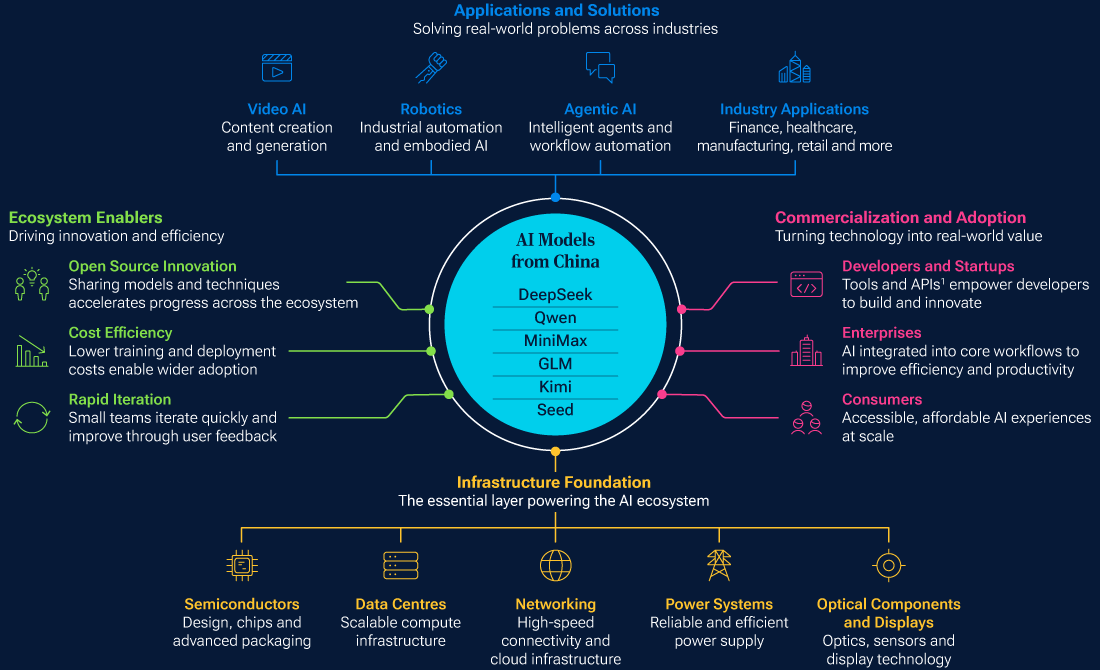
As of June 30, 2026.
1 Application programming interfaces
Source: T. Rowe Price.
For illustrative purposes only. The specific securities identified and described are for informational purposes only and do not represent recommendations.
close
Open source innovation and a pragmatic approach
Open‑source development, where models and techniques are shared publicly, has played a key role in accelerating China’s progress in AI. By allowing many teams to build on each other’s advances simultaneously, it has compressed years of development into months and accelerated innovation across the ecosystem.
These advances have challenged the long‑held assumption that success in AI depends primarily on access to ever‑larger amounts of computing power. While leading U.S. companies continue to focus on pushing the frontier of model intelligence and pursuing increasingly capable foundation models, many Chinese developers have concentrated on improving efficiency, reducing deployment costs and accelerating adoption. The approaches are not mutually exclusive, but they reflect different market incentives and operating environments.
More broadly, the two ecosystems may resemble patterns seen in earlier technology cycles. In the United States, value creation has often consolidated around a small number of dominant platforms that capture a disproportionate share of industry profits. In China, technological innovation has tended to diffuse more rapidly across the ecosystem, creating a broader range of participants and applications. While this can result in more fragmented economics, it may also accelerate adoption and create a wider set of investment opportunities.
That does not mean the gap has disappeared entirely. Although model performance has improved rapidly, this does not mean the systems built around them have kept pace. Developing reliable AI agents capable of executing complex, multi‑step tasks in real‑world environments remains difficult, and leadership in this area may depend as much on workflow integration and user feedback as on model quality alone.
…many Chinese developers have concentrated on improving efficiency, reducing deployment costs and accelerating adoption.
Two ecosystems, different priorities
At the same time, the narrowing gap has prompted a broader debate about what ultimately matters most in AI: Absolute intelligence, or the ability to deliver useful outcomes at scale and at an attractive cost. Rather than focusing solely on building the most capable models, many Chinese companies have concentrated on maximizing efficiency, reducing costs and improving scalability. This reflects both necessity and opportunity. Constraints around computing resources have encouraged innovation, while the sheer size and competitiveness of China’s technology ecosystem rewards solutions that can be deployed widely and economically.
This raises an interesting possibility: China may not need to produce the world’s most advanced model to play a significant role in the future AI landscape. If Chinese developers can deliver competitive performance at substantially lower cost, they may capture significant demand across a wide range of use cases. For many businesses deploying AI at scale, economics may matter more than marginal differences in capability.
China may not need to produce the world’s most advanced model to play a significant role in the future AI landscape.
Where value may accrue
Different segments of the market are likely to create value in different ways. U.S. model providers appear particularly well positioned in premium enterprise use cases where performance, reliability and compliance command a high willingness to pay. Chinese developers, meanwhile, have gained traction among developers, startups and cost‑sensitive users by offering compelling cost‑performance characteristics.
Multimodal AI1 offers another area of differentiation. Chinese developers have established strong positions in areas such as video generation and content creation, where rapid iteration and cost‑effective deployment may matter as much as frontier‑level model performance.
Another area to watch is physical AI, including robotics, industrial automation and autonomous systems. While U.S. companies may retain an advantage in some foundational technologies, China may be particularly well positioned to drive large‑scale adoption.
Agentic applications, multimodal AI and physical AI are likely to create demand for models with different capabilities, performance levels and pricing. Rather than converging on a single dominant model, the ecosystem may increasingly consist of specialised models optimized for different tasks and customer needs.
Where investors may find opportunities
For investors, the most immediate opportunities may not lie in selecting individual model winners. Infrastructure providers, semiconductor suppliers, networking equipment manufacturers, power systems providers and data‑centre operators have already benefited from rising AI investment across both ecosystems.
Areas such as optical components, printed circuit boards (PCBs), power systems and data‑centre equipment have already benefited from rising AI investment. In several of these segments, Chinese manufacturers hold meaningful global market share and have been direct beneficiaries of the global AI infrastructure build‑out. Rising AI capital expenditure from Chinese internet platforms is also supporting the development of a domestic AI compute supply chain—including chip design, foundries and semiconductor manufacturing equipment—reinforcing the emergence of a parallel AI ecosystem.
As AI models become increasingly interchangeable, sustainable competitive advantages may emerge elsewhere in the ecosystem. Companies that own the workflow, customer relationship or application layer may ultimately prove more difficult to displace than those competing solely on model performance.
Beyond technology
Yet the implications of AI extend far beyond the companies building the technology itself. As AI tools become more capable and more widely adopted, they could reshape industries ranging from manufacturing and logistics to financial services and consumer businesses.
AI may also reshape how consumers discover information, products and services. As agents become more capable, they could increasingly act as intermediaries between users and businesses, influencing everything from product searches to travel bookings and online purchases. Companies whose competitive advantage rests primarily on attracting traffic may face greater disruption, while businesses that control transactions, logistics, payments or customer relationships may prove more resilient.
Major technological shifts create new winners and challenge incumbents. For investors, some of the most compelling opportunities may ultimately lie outside the AI sector itself.
Looking ahead
China’s AI story is evolving rapidly. The debate is no longer simply about whether Chinese companies can compete. Increasingly, investors are evaluating the emergence of two distinct AI ecosystems, each with its own strengths, business models and pathways to commercialization.
U.S. firms may capture value through frontier model development, premium enterprise offerings and foundational technology. China’s opportunity may be driven more by consumer scale, cost‑efficient deployment, hardware integration and industry‑specific applications.
While the ultimate winners remain uncertain, one conclusion is becoming clearer: AI is likely to develop through multiple ecosystems, business models and commercialization paths. Investors should remain flexible about where value accrues, as the next phase of the opportunity may be driven as much by adoption and integration as by technological leadership.
 Wenli Zheng
Portfolio Manager
Wenli Zheng
Portfolio Manager
 Bill Bai
Investment Analyst
Bill Bai
Investment Analyst
Experience you can act on.
See how our approach to planning and investing can help guide your progress toward achieving your financial goals.
1 Artificial intelligence systems that can understand and work with multiple types of data (“modalities”) at the same time—not just text.
Risks:
Investing in technology stocks entails specific risks, including the potential for wide variations in performance and usually wide price swings, up and down. Technology companies can be affected by, among other things, intense competition, government regulation, earnings disappointments, dependency on patent protection and rapid obsolescence of products and services due to technological innovations or changing consumer preferences.
International investments can be riskier than U.S. investments due to the adverse effects of currency exchange rates, differences in market structure and liquidity, as well as specific country, regional, and economic developments. The risks of international investing are heightened for investments in emerging market and frontier market countries. Emerging market countries tend to have economic structures that are less diverse and mature, and political systems that are less stable, than those of developed market countries.
Additional Disclosures
For U.S. investors, visit troweprice.com/glossary for definitions of financial terms.
Please see vendor indices for more information, including definitions and source data: troweprice.com/marketdata.
Important Information
This material is being furnished for informational and/or marketing purposes only and does not constitute an offer, recommendation, advice, or solicitation to sell or buy any security.
Prospective investors should seek independent legal, financial and tax advice before making any investment decision. T. Rowe Price group of companies including T. Rowe Price Associates, Inc. and/or its affiliates receive revenue from T. Rowe Price investment products and services.
Past performance is not a guarantee or a reliable indicator of future results. All investments involve risk, including possible loss of principal.
Information presented has been obtained from sources believed to be reliable, however, we cannot guarantee the accuracy or completeness. The views contained herein are those of the author(s), are as of July 2026, are subject to change, and may differ from the views of other T. Rowe Price Group companies and/or associates. Under no circumstances should the material, in whole or in part, be copied or redistributed without consent from T. Rowe Price.
All charts and tables are shown for illustrative purposes only. Actual future outcomes may differ materially from any estimates or forward‑looking statements provided.
The material is not intended for use by persons in jurisdictions which prohibit or restrict the distribution of the material and in certain countries the material is provided upon specific request.
Issued in the USA by T. Rowe Price Investment Services, Inc., distributor and T. Rowe Price Associates, Inc., investment adviser, 1307 Point Street, Baltimore, MD 21231, which are regulated by the Financial Industry Regulatory Authority and the U.S. Securities and Exchange Commission, respectively.
© 2026 T. Rowe Price. All Rights Reserved. T. Rowe Price, INVEST WITH CONFIDENCE, the Bighorn Sheep design, and related indicators (see troweprice.com/ip) are trademarks of T. Rowe Price Group, Inc. All other trademarks are the property of their respective owners. Use does not imply endorsement, sponsorship, or affiliation of T. Rowe Price with any of the trademark owners.
- 202607‑5718365