
What the regulatory backdrop means for private assets in DC plans
October 2026, Retirement
- Key Insights
-
- The Labor Department’s 2026 proposal maintains ERISA’s asset‑neutral approach, neither endorsing nor prohibiting any particular asset class in DC plans.
- The proposal’s process‑based safe harbor may ease concerns over private assets, but certain investment traits still warrant extra attention in ERISA contexts.
- Any private asset allocation must result from a prudent, informed, and well‑documented process conducted solely in plan participants’ best interests.
Recent policy shifts and evolving investment capabilities have opened the door for greater use of private assets in defined contribution (DC) plans. However, fiduciaries continue to operate in a litigation‑sensitive environment, raising concerns that legal considerations may be unfairly outweighing the investment case for private assets.
As DC plans navigate this complex backdrop, we detail the following considerations for those assessing the potential benefits and risks of private asset investments:
- Key factors influencing the debate over private assets
- The Employee Retirement Income Security Act’s (ERISA’s) fiduciary framework and requirements for investment selections
- Potential implications of the Department of Labor’s (DOL’s) proposed regulation, Fiduciary Duties in Selecting Designated Investment Alternatives1
Setting the stage: What’s driving momentum for private asset inclusion?
A growing number of plan fiduciaries, policymakers, and investment professionals are evaluating whether private market investments can play a prudent role in DC plans, particularly given private assets’ potential to enhance diversification and long‑term returns. This question has gained urgency as private markets have expanded rapidly (Fig. 1) and as public markets have reached historic levels of concentration.2
Private markets have grown much faster than public markets in recent decades
(Fig. 1) Assets under management by private asset class (USD billions)
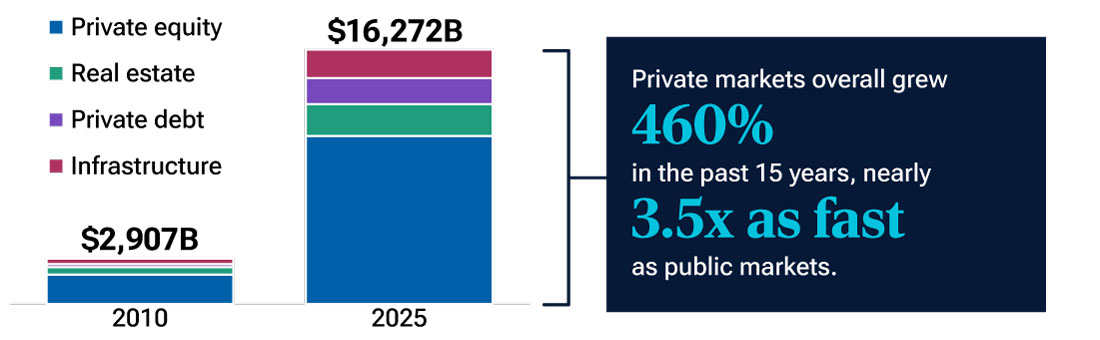
Sources: Preqin, SIFMA Research: 2026 Capital Markets Fact Book, Bank for International Settlements, World Federation of Exchanges, T. Rowe Price.
To avoid double counting of available capital and unrealized value, fund of funds and secondaries are excluded.
However, unlike traditional public market investments, private assets often involve limited liquidity, less frequent or model‑based valuation, higher fees, more complex structures, and additional administrative demands. Those features require careful analysis in a DC environment—where plans often include default investments and typically offer daily valuation to support participant‑directed transactions.
Due in part to these complexities, the DC community continues to debate the merits of private asset implementation. Yet the debate is moving from whether private assets may be considered to how fiduciaries can assess them in a way that aligns with the goal of improving participant outcomes.
Two key factors are driving this shift:
1. The evolution of target date strategies
The widespread adoption of professionally managed target date strategies as qualified default investment alternatives, or QDIAs, has fueled interest in incorporating private assets into DC plans.
Whereas DC plans historically have faced operational hurdles in meaningfully implementing private assets, defined benefit (DB) plans have used them regularly throughout the life of ERISA. This reflects DB plans’ longer investment horizons, ability to manage liquidity at the total‑plan level, and centralized decision‑making by institutional investors.
Similarly, as target date strategies have evolved to include highly sophisticated designs and a broader range of asset classes, many investment professionals have also come to view them as a compelling option for private markets exposure,3 particularly given participants’ multi‑decade investment horizons.
Moreover, because target date and other diversified strategies can address liquidity, valuation, and portfolio construction more holistically, DC‑focused investment professionals generally have advocated for private asset allocations within these strategies rather than through stand‑alone options. This approach seeks to provide participants with institutional‑quality investment opportunities while minimizing the complexity associated with direct participant investment decisions.
Diversification capabilities continue to evolve
(Fig. 2) Stages of diversification in the target date industry
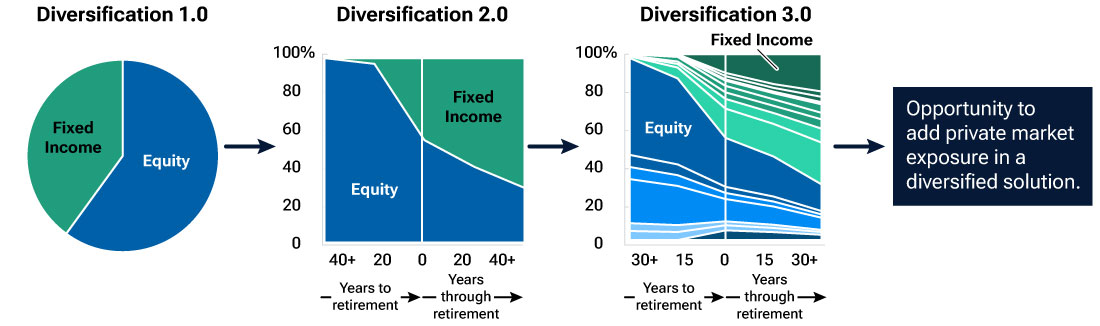
Source: T. Rowe Price.
2. Policy developments
Recent steps by federal policymakers—most notably the regulatory proposal from the DOL—have also driven interest in private market access. If approved, the regulation would establish a process‑based fiduciary safe harbor framework for the selection of designated investment alternatives, including those with exposure to private asset classes.4
(See details in the sections titled “How do private assets fit within the ERISA framework?” and “What are the potential implications of the DOL proposal?”)
How should plan investments be evaluated from a fiduciary perspective?
For DC plans, the key question remains whether private assets can be incorporated in a manner that both enhances retirement outcomes and satisfies ERISA’s demanding fiduciary standards.5
ERISA has roots in trust law, and trustees are held to a higher standard than those operating in a normal market transaction. In fact, ERISA’s fiduciary duty is recognized as the “highest known to the law."6
Core requirements under ERISA
(Fig. 3) Responsibilities on behalf of participants and beneficiaries
| Duty of loyalty | Duty of care | |
|---|---|---|
| What this means | Fiduciaries must act solely in the interests of the plan's participants and beneficiaries and for the exclusive purpose of providing benefits and paying only reasonable plan expenses—a standard often referred to as the "exclusive benefit rule." | Fiduciaries must act "with the care, skill, prudence, and diligence under the circumstances then prevailing that a prudent man acting in a like capacity and familiar with such matters would use in the conduct of a like character and with like aims." This standard is known as the "prudent person rule." |
| What else? | When it comes to investment selection, ensuring that the plan pays only reasonable expenses can also take into account the total costs of participation to participants—inclusive of investments and plan administration, whether paid for separately or through revenue generated by plan investments. | The prudence requirement focuses on the fiduciary's decision-making process rather than the ultimate performance of a particular investment. |
Analysis by T. Rowe Price.
Ultimately, the fiduciary framework governing ERISA DC plan investments emphasizes procedural prudence, ongoing oversight, and participant protection. Fiduciaries are expected to employ a disciplined and well‑documented investment process that balances risk, return, diversification, cost, and operational considerations. They must also follow plan documents and diversify the plan’s investments so as to minimize the risk of investment losses.7
...ERISA does not require fiduciaries to select the cheapest possible investment.
ERISA does not prescribe a single investment lineup or prohibit fiduciaries from considering more complex or less traditional strategies. Instead, it focuses on fiduciary obligations and the prudence of the decision‑making process. Furthermore, ERISA does not require fiduciaries to select the cheapest possible investment.
Digging deeper into ERISA
Regarding the prudence requirement (i.e., the duty of care), courts have consistently recognized that fiduciaries are not guarantors of investment success. Rather, fiduciaries must undertake an objective investigation of available investment options, evaluate their risks and expected returns, compare costs and fees, and determine whether each investment is appropriate in light of the plan’s objectives and participant population.8
The duty of prudence is accompanied by a duty to diversify plan investments. Unless clearly imprudent under the circumstances, fiduciaries must diversify plan assets to minimize the risk of large losses.9
- In the DC space, this obligation extends not only to the plan’s overall investment menu, but also to the design of professionally managed investment options, such as target date strategies, that may serve as participants’ default investments.
- Diversification requires fiduciaries to evaluate how individual investments interact within a portfolio rather than assessing each investment in isolation.
ERISA also imposes a duty to ensure that plan expenses are reasonable. Fiduciaries must carefully evaluate investment management fees, administrative expenses, revenue‑sharing arrangements, and other costs because excessive fees can significantly diminish participants’ retirement savings over time.
The Supreme Court has emphasized that fiduciaries have a continuing obligation to monitor plan investments and remove imprudent options, including investments that were appropriate at the time of selection but later become unsuitable.10
- This ongoing duty requires periodic review of investment performance, fee competitiveness, manager qualifications, and changing market conditions.
For participant‑directed individual account plans, ERISA provides fiduciaries with limited protection from liability for participants’ investment decisions if the plan satisfies specific regulatory requirements.11
- To qualify for this protection, participants must be provided with a broad range of investment alternatives, sufficient information to make informed investment decisions, and the opportunity to exercise meaningful control over their accounts.
- Although this provision may shield fiduciaries from losses resulting directly from participants’ own investment choices, it does not relieve fiduciaries of their responsibility to prudently select and monitor the investment options offered under the plan.
How do private assets fit within the ERISA framework?
Importantly, ERISA does not endorse or prohibit investments in private markets—or in any particular asset class. Private assets should be analyzed through the same fiduciary lens as any other investment12 but with heightened attention to certain features that are especially relevant in a DC context.
In its proposal, the DOL states:
[P]roviding guidance only with respect to those asset allocation funds that invest in alternative assets could create the impression that those asset allocation funds are either favored or disfavored. They are not. They are subject to the same requirements as any other investment. This is consistent with the Department’s historical practice of providing neutral guidance that does not favor or disfavor any particular type of investment or investment strategy.13
Despite potential investment benefits and an expected safe harbor, many DC plan sponsors continue to express concerns about the inclusion of private assets, especially regarding higher fees and reduced liquidity (Fig. 4).
Fees remain the biggest barrier to private asset integration
(Fig. 4) Top reasons preventing implementation in DC plans
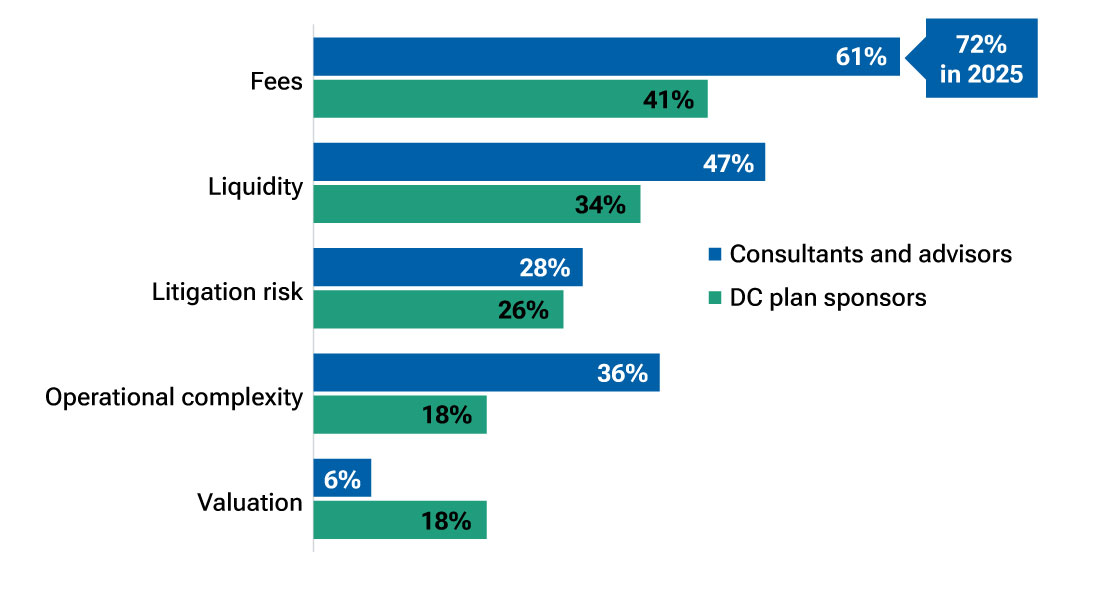
Sources: T. Rowe Price’s 2026 Defined Contribution Consultant Study and 2026 DC Plan Sponsor Retirement Trends (see Appendix).
Note: Respondents were asked to select their top two reasons. Other responses from consultants/advisors: highly complex; need to evaluate emerging options; lack of plan sponsor interest; one‑sided risk/reward—advisors take fiduciary liability while fund companies get majority of revenue; transparency and regulatory guidance needed; value‑add to justify operational/valuation/fee concerns; who owns the design within a partnership.
Because investment costs directly impact participants’ retirement savings, ERISA fiduciaries must carefully evaluate whether the anticipated benefits justify the additional expense. Failure to prudently assess investment fees, liquidity constraints, or valuation methodologies may expose fiduciaries to potential liability for breach of their duties of prudence and loyalty under ERISA.
What are the potential implications of the DOL proposal?
Under the Labor Department’s proposed regulation, the distinctive features of private asset investments (and all other investment options) would be addressed through a process‑based fiduciary framework rather than any categorical judgment on their use in DC plans.
The proposal expressly states that ERISA Section 404(a)(1)(B) “does not require or restrict any specific type of designated investment alternative,” including asset allocation funds with exposure to alternative assets, provided the fiduciary follows a prudent process. To that end, the proposal identifies performance, fees, liquidity, valuation, performance benchmarking, and complexity as core factors fiduciaries must “objectively, thoroughly, and analytically consider” when selecting a designated investment alternative.
Analyzing the proposed safe harbor
While the safe harbor is still in proposed form and cannot be relied upon unless it is included in a final rule, its six core factors give a good indication of the DOL’s perspective and could serve as a road map for analyzing DC plan private asset investments.
1. Performance
Diversification is a key consideration in the evaluation of investment performance. The proposal emphasizes that fiduciaries should assess performance on a risk‑adjusted basis and consider how a private asset sleeve—when included in a professionally managed, multi‑asset solution—may improve overall portfolio efficiency rather than focusing solely on stand‑alone returns.
2. Fees
Cost considerations also warrant added attention, as private investment vehicles frequently charge higher management fees and performance‑based compensation than traditional investment products.
The existence of higher fees does not necessarily render a private investment imprudent. However, fiduciaries must determine whether the anticipated benefits—including enhanced diversification, improved risk‑adjusted returns (net of fees and expenses), or access to unique investment opportunities—reasonably justify the additional expense.
The DOL proposal validates this assertion, adding that fiduciaries must compare a reasonable number of similar alternatives.
3. Liquidity
Recognizing that DC plans involve withdrawals, loans, reallocation activity, and possible plan‑level redemption demands, the proposal requires fiduciaries to evaluate whether the investment can meet both participant‑level and plan‑level liquidity needs.
While target date solutions and other multi‑asset portfolios can manage liquidity within a diversified framework—i.e., portfolio inflows and outflows may not necessitate transactions in the private allocation—fiduciaries should carefully evaluate whether the liquidity profile of an investment option with private market exposure is compatible with the plan’s operational requirements.
4. Valuation
The valuation uncertainty14 generally associated with private asset investments complicates the daily pricing of the investment alternative and participant transactions that characterize DC plans.
The proposal requires fiduciaries to determine that a designated investment alternative has adequate measures to ensure it can be timely and accurately valued in accordance with plan needs.
For private assets, the proposal points to conflict‑free, independent valuation processes as a positive example, while warning against conflicted proprietary valuation methods, such as those used in certain continuation fund structures.
5. Performance benchmarking
Consistent with performance‑related considerations, the proposal requires fiduciaries to determine that a designated investment alternative has a meaningful benchmark15 and to compare the investment’s risk‑adjusted expected net returns with that benchmark.
This requirement reflects the principle that fiduciaries must use a comparator that meaningfully corresponds to the investment under review rather than relying on a generic or mismatched index. Thus, a broad public equity index may be unsuitable for a target date or asset allocation vehicle whose objectives, glide path, or risk exposures differ materially from that index.
By contrast, a custom composite benchmark may be appropriate where it reflects the designated investment alternative’s actual asset mix and strategy, including where the investment includes both public market exposures and a private asset sleeve. In that context, the proposal recognizes that fiduciaries may rely on qualified investment professionals in benchmark construction and analysis, provided the fiduciary reads, critically reviews, and understands the analysis offered in support of the benchmark.
6. Complexity
The proposal likewise recognizes that private assets and other alternative strategies may involve a degree of structural, operational, and analytical complexity beyond that of traditional public market investments.
It provides that fiduciaries must appropriately consider the complexity of the designated investment alternative and determine whether they have the skills, knowledge, experience, and capacity to understand it sufficiently to discharge their obligations under ERISA and the governing plan documents. If they do not, they must seek assistance from a qualified investment advice fiduciary, investment manager, or other appropriate professional.
This principle is particularly important if the investment involves specialized fee arrangements, private market valuation methodologies, bespoke benchmark construction, or implementation features that require careful oversight.
The relevant inquiry is not whether the investment is sophisticated, but whether fiduciaries can demonstrate that it has been evaluated with the rigor, expertise, and documentation that ERISA requires.
Additional considerations
While the proposal gives a strong indication of how the DOL is thinking about the inclusion of private assets in DC plans, it only addresses the duty of care and not the duty of loyalty or the duty to monitor. As such, fiduciaries may also consider the following:
(Fig. 5) Practical issues for fiduciaries
| Topic | Key questions |
|---|---|
| Plan alignment | Do the plan documents permit this type of investment, and is the contemplated use of private assets consistent with the plan’s stated investment objectives, mandates, and fiduciary framework? |
| Fiduciary process | Has a regular, disciplined, and well‑documented process been established for evaluating whether private assets are appropriate for the plan? |
| Operational feasibility | Are the operational demands—including administration, recordkeeping, custody, valuation, and daily participant activity—manageable for the plan? |
| Ongoing monitoring | What monitoring framework will be used on an ongoing basis, and how frequently will fiduciaries review the investment? |
| Participant communication | How will the plan communicate the investment’s features, risks, liquidity characteristics, and expected role in the portfolio to participants? |
| Participant interests | Does the use of private assets support better retirement outcomes in a way that is prudent, understandable, and implementable? |
Source: T. Rowe Price.
Final thoughts
As investment opportunities continue to evolve, ERISA’s principles of prudence and loyalty remain the central legal standards by which fiduciary decisions are evaluated.
The DOL’s 2026 proposal reinforces those principles by applying a neutral, process‑based framework that requires fiduciaries to evaluate performance, fees, liquidity, valuation, benchmarking, and complexity with rigor and care.
For some plans, a limited allocation to private assets—particularly within professionally managed, diversified vehicles such as target date solutions—may be capable of satisfying ERISA’s standards and improving long‑term participant outcomes. For others, the operational burdens, cost structure, or participant profile may counsel against inclusion.
The bottom line for DC plans is that the path forward is defined by process rather than labels. It is up to fiduciaries to thoughtfully assess private market opportunities while maintaining a clear focus on participant interests, reasonable costs, effective oversight, and the long‑term purpose of retirement investing.
 Aliya Robinson
Director, Congressional Affairs

- Aug 2026
- From the Field
A behavioral case for annuities

Contact us
1 See 91 Federal Register 16088 (March 31, 2026).
2 For reference, see “The great rotation: AI, deadweight loss, and the end of easy compounding,” T. Rowe Price, April 2026. Additionally, World Bank Group data show that the number of publicly listed U.S. companies declined from 8,090 in 1996 to 3,908 in 2025.
3 The overwhelming majority of respondents in our 2026 Defined Contribution Consultant Study (see Appendix) indicated that target date portfolios—either custom or off the shelf—are the most likely implementation method for private credit and several other private asset class allocations.
4 The proposal follows earlier statements by the DOL that first encouraged the use of private assets and then subsequently cautioned against reading the statements as broadly endorsing private asset investments in DC plans.
5 See ERISA § 404(a), 29 U.S.C. § 1104(a).
6 Donovan v. Bierwirth, 680 F.2d 263, 272 n. 8 (2d Cir. 1985).
7 ERISA § 404(a)(1)(A)–(B), 29 U.S.C. § 1104(a)(1)(A)–(B).
8 See Fifth Third Bancorp v. Dudenhoeffer, 573 U.S. 409, 425 (2014); Tibble v. Edison International, 575 U.S. 523, 529–30 (2015).
9 ERISA § 404(a)(1)(C), 29 U.S.C. § 1104(a)(1)(C).
10 Tibble, 575 U.S. at 529–30.
11 29 U.S.C. § 1104(c); 29 C.F.R. § 2550.404c‑1.
12 This idea is reinforced by the DOL’s proposal, which would create a safe harbor that applies to all investment assets equally.
13 91 Federal Register at 16093, Section 3.2.
14 Investment options with private asset allocations can lack readily observable market prices for private holdings and may instead rely upon periodic appraisals or valuation models.
15 A meaningful benchmark is defined as an investment, strategy, index, or other comparator with similar mandates, strategies, objectives, and risks to the designated investment alternative.
Appendix
Study Methodologies:
2026 DC Plan Sponsor Retirement Trends
This study was conducted from October 21, 2025, to December 4, 2025. Responses are from 136 DC plan sponsors that describe their company’s structure as a corporation or partnership, union, government organization, nonprofit educational institution, health care organization, or other nonprofit organization or foundation; are involved in any DC retirement plan(s) that either their organization sponsors or they personally advise on; and have a role in overseeing and/or selecting their organization’s DC plan investment offerings. Among the respondents, 54% described their department as finance/investments, 29% as human resources, and 17% as other. Survey respondents were not aware that the research was sponsored by T. Rowe Price, and they are not necessarily T. Rowe Price clients.
2026 Defined Contribution Consultant Study
This study was conducted from January 12, 2026, to March 11, 2026. Responses are from 36 consulting and advisor firms with over 160,000 DC plan sponsor clients and over $10.3 trillion in DC plan assets.
Risks
Diversification cannot assure a profit or protect against loss in a declining market.
Private investments are typically speculative and exposed to a high degree of business and financial risk. They may be leveraged and engage in speculative practices that increase the risk of investment loss and cause performance volatility.
Additional Disclosure
For U.S. investors, visit troweprice.com/glossary for definitions of financial terms.
Please see vendor indices for more information, including definitions and source data: troweprice.com/marketdata.
Important Information
This material is being furnished for general informational and/or marketing purposes only. The material does not constitute or undertake to give advice of any nature, including fiduciary investment advice. Prospective investors are recommended to seek independent legal, financial and tax advice before making any investment decision. T. Rowe Price group of companies including T. Rowe Price Associates, Inc. and/or its affiliates receive revenue from T. Rowe Price investment products and services. Past performance is not a guarantee or a reliable indicator of future results. The value of an investment and any income from it can go down as well as up. Investors may get back less than the amount invested. Diversification cannot assure a profit or protect against loss in a declining market.
The material does not constitute a distribution, an offer, an invitation, a personal or general recommendation or solicitation to sell or buy any securities in any jurisdiction or to conduct any particular investment activity. The material has not been reviewed by any regulatory authority in any jurisdiction.
Information and opinions presented have been obtained or derived from sources believed to be reliable and current; however, we cannot guarantee the sources’ accuracy or completeness. There is no guarantee that any forecasts made will come to pass.
The views contained herein are as of October 2026 and are subject to change without notice; these views may differ from those of other T. Rowe Price group companies and/or associates. Under no circumstances should the material, in whole or in part, be copied or redistributed without consent from T. Rowe Price.
The material is not intended for use by persons in jurisdictions which prohibit or restrict the distribution of the material and in certain countries the material is provided upon specific request.
T. Rowe Price Investment Services, Inc., distributor. T. Rowe Price Associates, Inc., investment adviser. T. Rowe Price Investment Services, Inc., and T. Rowe Price Associates, Inc., are affiliated companies.
© 2026 T. Rowe Price. All Rights Reserved. T. Rowe Price, INVEST WITH CONFIDENCE, the Bighorn Sheep design, and related indicators (see troweprice.com/ip) are trademarks of T. Rowe Price Group, Inc. All other trademarks are the property of their respective owners. Use does not imply endorsement, sponsorship, or affiliation of T. Rowe Price with any of the trademark owners.
- 202610-5966858