
Fixed Income Capabilities
Independent in thought, disciplined in action
T. Rowe Price fixed income experts rely on active questioning, independent thinking, and a disciplined approach to find opportunities with the potential to deliver better client outcomes.
At a glance
55+
240+
$341.4B
Our fixed income experts think independently and stay disciplined—always with client solutions in mind
Independent thinking for fresh ideas
Disciplined process for lasting confidence
Rigorous research for an investing edge
Our insights on issues shaping the fixed income market

War-driven energy price spike increases risk of central bank policy errors

- Jun 2026
- Fixed Income
Manufacturing revival complicates inflation fight
Markets may be underestimating longer-term inflation risks.

- Apr 2026
- Fixed Income
When markets twist and turn, flex your fixed income
Three key reasons to consider an allocation to fixed income.
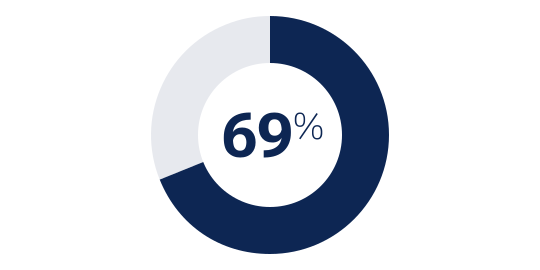
Our fixed income funds have outperformed their Morningstar peers
69% of our I class fixed income mutual funds were in the top two Morningstar quartiles over the past 10 years1.
That’s the T. Rowe Price difference.
Past performance cannot guarantee future results. All investments are subject to market risk, including the possible loss of principal.
1 Performance based on all fixed income I Class shares available at time of reporting. 27 of 39 (69%), 25 of 39 (64%), 24 of 39 (62%), and 27 of 39 (69%) of our I Class share fixed income mutual funds with at least a 10-year history were in the top two Morningstar quartiles in their respective Morningstar categories for the 1-, 3-, 5-, and 10-year periods ended December 31, 2025.
Funds in the 1st or 2nd quartile are likely to outperform the peer group average.
When compared to fund evaluation tools that are frequently used in the industry, and which can be scaled to compare all (or nearly all) funds, Morningstar's Scorecards have been tested to demonstrate an increased likelihood of selecting the best performers on a risk-adjusted basis over future five-year periods.
An unexpected opportunity from the developing world
Learn how T. Rowe Price became an early investor in a bond designed to help children in underserved countries.
- The Children and Youth Bond is designed to direct capital toward projects supporting children in Latin America and the Caribbean.
- T. Rowe Price chose to be a primary investor, validating the bond's goals and innovative structure.
- Our independent thinking and disciplined approach led us to an investment designed to benefit both clients and society.
Over the course of my investing career, I've learned that it helps to stay curious because opportunities often come from unexpected places.
In 2025, I became aware of an innovative bond focused on improving the lives of children in the developing world.
The Development Bank CAF plan to issue a new Children and Youth Bond designed to direct capital towards education, healthcare and other social projects within Latin America and the Caribbean.
The bond was a bit untraditional, but I saw potential and wondered how T. Rowe Price might get involved.
I started by asking questions.
What kind of returns might our clients expect from this bond?
What kind of positive impact might this bond deliver?
I put our fixed income teams to work following our discipline structured process.
They analyzed the bond from every angle, debating the pros and cons and relying on the full strength of our research platform.
We learned that the Children and Youth Bond was the first ever bond structure to align with UNICEF's child-lens investing framework.
It represented an innovative structure while at the same time addressing persistent underinvestment in children.
Digging deeper, we learned that the United Nations reports more than 115 million children in Latin America and the Caribbean live in poverty and that every dollar invested in early childhood can generate between US $4 and US $16 in additional economic benefits.
To me, this bond demonstrated how debt markets can be used to deliver durable value to both clients and society.
So T. Rowe Price chose to be a primary investor.
This allowed us to get favorable terms for our clients while also validating the bond's unique structure and objectives.
Other investors may have overlooked this opportunity, but at T. Rowe Price, we are encouraged to follow our rigorous curiosity, to think independently and to challenge consensus to find sound investment opportunities for our clients.
Now we see this child lens bond as a template for future transactions to be adopted across public debt markets, serving to crowd in more capital towards these critical developmental objectives.
T. Rowe Price has reaffirmed its commitment to asking better questions to seek better outcomes for clients and society.
With an average of 22 years’ experience, our fixed income professionals are dedicated to helping you achieve your investment goals across market cycles
 Arif Husain, CFA
Head, Global Fixed Income and CIO
Arif Husain, CFA
Head, Global Fixed Income and CIO
Arif Husain is the head of Global Fixed Income and chief investment officer of the Fixed Income Division. He is chairman of the Fixed Income Steering Committee and a member of the firm’s Management Committee. Arif is lead portfolio manager for the Global Government Bond High Quality Strategy and the Global Government Bond Ex-Japan Strategy. He is a vice president of T. Rowe Price Group, Inc., and T. Rowe Price International Ltd.
 Samy Muaddi, CFA
Head of Emerging Markets
Samy Muaddi, CFA
Head of Emerging Markets
Samy Muaddi is the head of Emerging Markets in the Fixed Income Division. He is the portfolio manager of the Emerging Markets Bond Strategy and co-manages the Global High Income Bond Strategy. Samy also manages a range of customized separately managed accounts in emerging market debt and is a member of the Fixed Income Steering Committee and Asset Allocation Committee. He previously managed the firm’s Emerging Markets Corporate Bond Strategy from 2015 to 2024 and the firm’s Asia Credit Bond Strategy from its inception until 2020. Samy also is a vice president of T. Rowe Price Group, Inc., T. Rowe Price Associates, Inc., and T. Rowe Price International Ltd.
 Matthew Lawton, CFA
Head, Impact Fixed Income
Matthew Lawton, CFA
Head, Impact Fixed Income
Matt Lawton is head of Impact Fixed Income and a portfolio manager in the Fixed Income Division. He manages the Global Impact Credit Strategy, the Global Impact Short Duration Bond Strategy and co-manages the Emerging Markets Blue Economy Bond Strategy. He also is a member of the ESG Committee. Matt is a vice president of T. Rowe Price Group, Inc., and T. Rowe Price Associates, Inc.
 Kenneth A. Orchard, CFA
Head, International Fixed Income
Kenneth A. Orchard, CFA
Head, International Fixed Income
Kenneth Orchard is head of International Fixed Income. He is portfolio manager for the Global Multi-Sector Bond and Diversified Income Bond Strategies and co-portfolio manager for the International Bond and Global Aggregate Bond Strategies. Kenneth is a member of the Fixed Income Steering Committee and the European and UK Asset Allocation Committees. He is a vice president of T. Rowe Price Group, Inc., and T. Rowe Price International Ltd.
We can help your investments thrive in an ever-changing world
Insights
Call
A broad range of solutions designed to meet your fixed income needs
For investors who want to manage risk and seek to minimize loss by focusing on stable, low-risk investments that can better withstand market volatility.
Ultra Short-Term Bond Strategy
A cash alternative strategy that seeks a high level of income above that of a money market with minimal fluctuations in principal value
Stable Value Common Trust Fund
A conservative investment option that seeks to provide maximum current income while maintaining stability of principal

QM U.S. Bond Index Strategy
Pursues total return that seeks to match or incrementally exceed the performance of the U.S. investment-grade bond market
For investors who want to diversify against correlations across their portfolio to help manage risk and reduce volatility.
Dynamic Global Bond Fund
Seeks high current income and consistent performance by exploiting inefficiencies in the full universe of global fixed income and currency markets
Global Multi-Sector Bond Fund
A broadly diversified portfolio of domestic and foreign debt instruments that seeks to provide high income and some capital appreciation
Emerging Markets Corporate Bond Fund
Invests primarily in bonds issued by companies in emerging market countries to seek high current income and, secondarily, capital appreciation
For investors aiming to grow their investments via exposure to higher return (non-investment grade) bonds.
Tax-Free High Yield Fund
Invests primarily in long-term low- to upper-medium-grade municipal securities to seek a high level of income exempt from federal income taxes
U.S. High Yield Strategy
Aims to deliver greater income and total return potential by investing primarily in high yield bonds
Floating Rate Strategy
Seeks high current income and, secondarily, capital appreciation by investing primarily in floating-rate bank loans
For investors who need a reasonable and reliable income from their investments as a contribution to total returns.
Tax-Free High Yield Fund
Invests primarily in long-term low- to upper-medium-grade municipal securities to seek a high level of income exempt from federal income taxes
U.S. High Yield Strategy
Aims to deliver greater income and total return potential by investing primarily in high yield bonds
Tax-Free Short-Intermediate Fund
Seeks to provide a high level of income exempt from federal income taxes with modest price fluctuation by investing primarily in short- and intermediate-term investment-grade municipal securities
For investors who seek to mitigate the impact of interest rate risk by focusing on strategies with low and dynamic duration approaches.
Ultra Short-Term Bond Strategy
A cash alternative strategy that seeks a high level of income above that of a money market with minimal fluctuations in principal value
Dynamic Global Bond Fund
Seeks high current income and consistent performance by exploiting inefficiencies in the full universe of global fixed income and currency markets
Floating Rate Strategy
Seeks high current income and, secondarily, capital appreciation by investing primarily in floating-rate bank loans
Discover investment capabilities that can complement your fixed income goals
Learn more about our investment capabilities designed to meet a full range of client needs.
Frequently asked questions
We are an active, global fixed income management firm that is relentlessly pursuing investment excellence through:
- Expertise and dedicated resources in every major global fixed income sector
- Fundamentally driven, in-depth research processes
- A culture that promotes collaboration and sharing of best ideas
- A focus on pursuing strong risk-adjusted, long-term returns
Lead portfolio managers set sector allocation, risk budget, currency, country/duration, and yield curve exposures. They are fully accountable for security selection working with sector teams and for the strategy’s performance. Sector portfolio managers work with the lead portfolio manager to incorporate the top-down view and contribute high-conviction security selection and execution in coordination with their respective credit research and trading teams. Each sector portfolio manager is supported by a dedicated team of research analysts and traders. Leveraging the global research teams, our experienced portfolio managers work together to strive to construct an optimal fixed income portfolio. Our experienced professionals cover all time zones and are immersed in local markets to identify and explore investment opportunities for our clients.
Our rigorous research platform includes dynamic perspectives and differentiated insights from firmwide collaboration across asset classes, sectors, and regions including directors of research, credit analysts, economists, quantitative portfolio managers, and quantitative analysts.
We have a process we call Policy Week. Policy Week is a set of monthly meetings designed to promote collaboration, challenge assumptions, and improve decisions. Top-down discussions of Policy Week complement our fundamental credit research process. Conviction scores, quantitative tools, and market forecasts facilitate the Policy Week process. The meeting typically covers global economics, global interest rate and currency strategy, global sector strategy, and global forecasting.
We integrate risk management through:
- Proprietary research to seek attractive compensation for security-level risks
- Portfolio construction to efficiently use portfolio risk budget
- Portfolio risk assessment to reveal portfolio risks under normal and adverse markets
- Oversight to ensure portfolio risks are aligned with mandates
High-yield bonds are issued by companies with lower credit ratings and offer higher yields to compensate for credit risk. They carry a higher risk of default compared to investment-grade bonds.
By investing across multiple sectors, investors can spread risk and reduce the impact of any single sector's downturn on their overall portfolio. This approach provides the flexibility to shift allocations based on changing market conditions, interest rates, and economic outlooks, potentially enhancing returns.
Fixed income ETFs give investors access to bonds and other fixed income securities, such as US Treasuries, corporate debt, municipal bonds, and floating rate notes. Some potential benefits of fixed income ETFs include liquidity, portfolio transparency, and diversification.
Many investors use fixed income ETFs to generate income. Some use fixed income ETFs to seek portfolio stability in periods of equity market volatility. Some investors use specialized fixed income ETFs—like high yield and floating rate—to potentially diversify income sources, credit exposure, and duration risk.
Risks
Credit is the chance that any of the portfolio's holdings will have their credit ratings downgraded or will default (fail to make scheduled interest or principal payments), potentially reducing the portfolio's income level and share price.
Fixed Income: Fixed-income securities are subject to credit risk, liquidity risk, call risk, and interest-rate risk. As interest rates rise, bond prices generally fall.
Inflation : high or sustained inflation levels will erode the purchasing power of distributions and the value of an investment.
Interest rate : the decline in bond prices that accompanies a rise in the overall level of interest rates.
Reinvestment : in a declining interest rate scenario, investors will reinvest distributions at a lower interest rate.
Risk Considerations:
All investments are subject to market risk, including the possible loss of principal. Fixed-income securities are subject to credit risk, liquidity risk, call risk, and interest-rate risk. As interest rates rise, bond prices generally fall. Investments in bank loans may at times become difficult to value and highly illiquid; they are subject to credit risk such as nonpayment of principal or interest, and risks of bankruptcy and insolvency. Investments in high-yield bonds involve greater risk of price volatility, illiquidity, and default than higher-rated debt securities. International investments can be riskier than U.S. investments due to the adverse effects of currency exchange rates, differences in market structure and liquidity, as well as specific country, regional, and economic developments. These risks are generally greater for investments in emerging markets. Some income may be subject to state and local taxes and the federal alternative minimum tax (AMT).
Important Information
*All data as of March 31, 2026 unless otherwise stated.
1The total fixed income assets managed by T. Rowe Price Associates, Inc., and its investment advisory affiliates. Total fixed income assets include all fixed income separate accounts and funds along with a portion of certain T. Rowe Price U.S.-registered multi-asset funds in U.S. dollars (USD) as of March 31, 2026.
For more information on the methodology of this analysis, please visit troweprice.com/complete-performance-study.
Past performance cannot guarantee future results. All investments are subject to market risk, including the possible loss of principal. All investments are subject to risk, including the possible loss of principal. Results from other time periods may differ. Active investing may have higher costs than passive investing and may underperform the broad market or passive peers with similar objectives. Passive investing may lag the performance of actively managed peers as holdings are not reallocated based on changes in market conditions or outlooks on specific securities. Results for other time periods will differ.
Download a mutual fund prospectus; each includes investment objectives, risks, fees, expenses, and other information that you should read and consider carefully before investing.
The T. Rowe Price common trust funds (Trusts) are not mutual funds; rather, the Trusts are operated and maintained so as to qualify for exemption from registration as mutual funds pursuant to Section 3(c)(11) of the Investment Company Act of 1940, as amended. The Trusts are established by T. Rowe Price Trust Company under Maryland banking law, and their units are exempt from registration under the Securities Act of 1933. Investments in the Trusts are not deposits or obligations of, or guaranteed by, the U.S. government or its agencies or T. Rowe Price Trust Company and are subject to investment risks, including possible loss of principal. Although the T. Rowe Price Stable Value Common Trust Fund seeks to preserve the value of your investment at $1.00 per unit, it cannot guarantee to do so. It is possible to lose money by investing in the Trust.
202605-5451548