
A behavioral case for annuities
August 2026, Retirement
- Key Insights
-
- Most retirees manage savings to preserve or increase their assets by lowering their spending or lifestyle. Wealthier retirees decrease their spending the most.
- To avoid dipping into their savings, retirees adjust their essential spending to match their level of guaranteed income.
- More positive framing of annuities as a way for retirees to preserve assets and maintain lifestyle—rather than to prevent running out of money—could help adoption.
Conversations about money are usually dominated by savings—how much to save, how to invest, how much savings is enough to retire, and so on. Comparatively, very little attention is paid to how to spend savings. Yet, one might argue that spending down retirement savings is more challenging, at least from a decision‑making point of view.
The challenge of deciding how to spend retirement savings comes from different directions. First, there are the big uncertainties—longevity, health shocks, inflation, market volatility, etc. Then there are personal preferences—desire to leave an inheritance, ticking some bucket list items, etc. But above all, spending down savings must be constantly weighed against the possibility of running out of money. As a result, retirees might start to question every spending decision—is it too much?
Annuities can alleviate a large part of this decision‑making burden because they provide the following advantages.
Longevity Protection: As noted above, retirees face many uncertainties, but from a planning perspective, the biggest of them all is the uncertain lifespan. This generates the fear of running out of money. Although Social Security guarantees that retirees will never run out of money, Social Security income alone is often not enough for many retirees to maintain their lifestyle and could mean a drastic change in lifestyle that many retirees might associate with an unsuccessful retirement. For them, peace of mind may come from having additional guaranteed income that sustains their lifestyle as long as they live—in other words, annuities.
Different Income Guarantees: In their simplest form, annuities provide a fixed level of guaranteed income for the lifetime of an individual. But different individuals have different needs and fears. Some may need such a guarantee only if they live a very long life; others could fear that they might not live long enough to make the purchase of an annuity worthwhile. Annuities have evolved to address these concerns. For example, deferred annuities provide late‑life income protection, and period‑certain annuities along with variable annuities provide protection against an early demise while also maintaining income for life. Bottom line, different annuities provide different types of guarantees that meet the needs of different people.
Hedging Sequence of Returns Risk: One of the key benefits of annuities is that they help to hedge against “sequence of returns” risk. If a retiree follows a relatively fixed withdrawal strategy, such as the 4% rule, then her portfolio could become more vulnerable to sequence of returns risk if the markets experience large drops in the initial years of retirement. But if she could fund her spending needs with annuity income, then her portfolio would have the time to recover and could avoid untimely liquidation.
Tax Advantage: Annuities can provide several tax benefits. Income and investment gains from nonqualified contributions made to variable annuities grow tax‑deferred and, in certain cases, could even be withdrawn with tax‑favorable distributions. In addition, investment changes or annual rebalancing of a portfolio might not trigger a taxable event. Finally, an existing variable annuity contract can be exchanged for a new one, when appropriate and suitable, without paying any taxes on the income and investment gains from the existing contract.
Preserve Assets: This is probably the least publicized advantage of annuities, and one that we’ll focus on. There are two channels through which annuities can help preserve assets. The first is mechanical, a product feature of newer annuities. These days, annuity contract holders who want to generate guaranteed income from their annuities have two options—annuitization or use of a guaranteed income rider. Annuitization involves giving up control of one’s funds, but those utilizing guaranteed income riders can maintain control of their funds. The trade‑off is usually lower monthly payments. But this helps people overcome a key fear associated with annuitization—losing their money.
However, our focus for this paper will be on the second channel through which annuities can help preserve assets—by controlling retirement spending.
Retirees want to preserve their assets
For a long time, we had an oversimplified understanding of how retirees spend down their savings. Economists predicted that retirees will systematically spend down their savings to fund retirement. So financial professionals came up with efficient ways of doing it, such as the 4% rule. However, a body of new research on retiree behavior suggests that many of the commonly held assumptions are not, in fact, what people do.
78% of retirees say it’s important to maintain a certain retirement account balance.
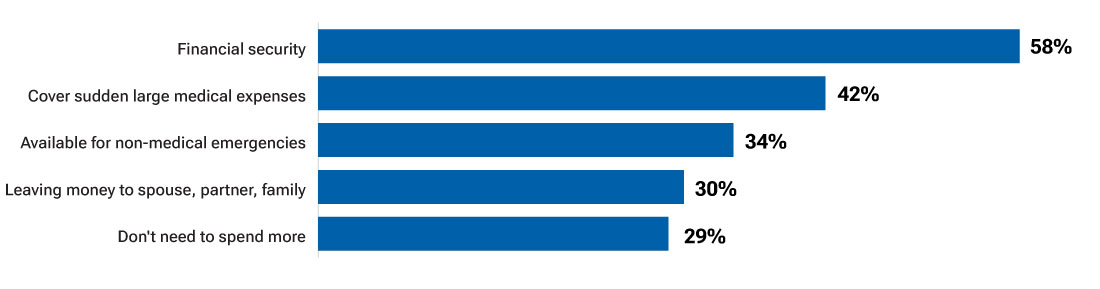
To better understand this, as part of our annual Global Retirement Savers Study, we asked retirees how important it was to maintain a certain retirement account balance and why. More than three‑quarters (78%) said it was important to do so, and nearly three‑in‑five said that it gave them a sense of financial security (Figure 1). Data on retirees’ drawdown patterns support this. In a recent study,1 the Employee Benefit Research Institute (EBRI) found that retirees continued to spend down their assets very slowly, even after two decades in retirement. The research also showed that more than 30% of retirees with more than $500,000 in non‑housing wealth (2025 dollars) had increased their assets during this period. Other studies2 have also reported very little change in asset levels during retirement years.
Why retirees maintain their retirement savings
(Fig. 1) Retirees cite several motivations, with financial security topping the list.
Source: T. Rowe Price Retirement Savings and Spending Study (2024).
Question: Which of the following are motivations for maintaining a certain balance in your retirement savings accounts?
How do retirees preserve their assets?
This raises the obvious question: How do retirees manage to do this? If they don’t have earnings from work and if they are reluctant to spend down their savings, how are they funding their spending needs?
The answer is both simple and complicated. The simple answer is: Retirees cut down their spending.
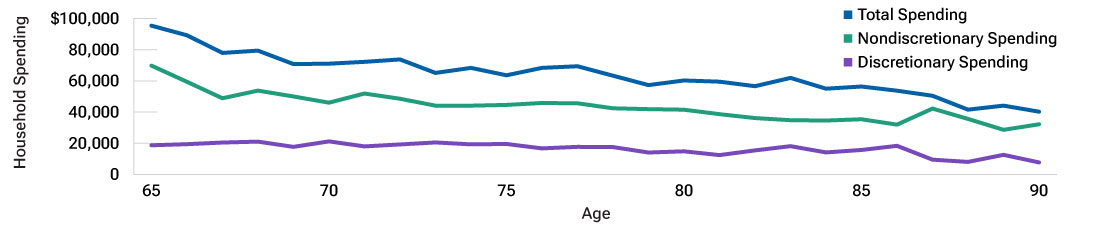
On average, we estimate inflation‑adjusted retiree spending goes down by 2.3% every year. This helps retirees to maintain their savings. Moreover, wealthy households that were in the top 20% in terms of their net worth (total assets minus total debt), i.e., a net worth of $892,500 or more in 2025 dollars, cut down their annual spending even more aggressively, by 3.2% (Figure 2). This helps them to slow down their asset decumulation.
Reduced spending in high‑net‑worth households is driven by reduced nondiscretionary spending
(Fig. 2) Median household spending declines 3.2% ($2,138) annually for the top 20% of net worth
Source: Author’s calculations using the Consumption and Activities Mail Survey (CAMS), 2001–2023. Most recent available data.
But how do retirees decide how much to spend? This is where it gets slightly complicated and where annuities could enter the picture.
Retirees match essential spending to guaranteed income
Nondiscretionary (see Appendix for details) items, such as mortgage or rent, groceries, gas, health care, etc., make up the bulk of retiree spending. On average, they account for 75% to 80% of total spending throughout retirement.
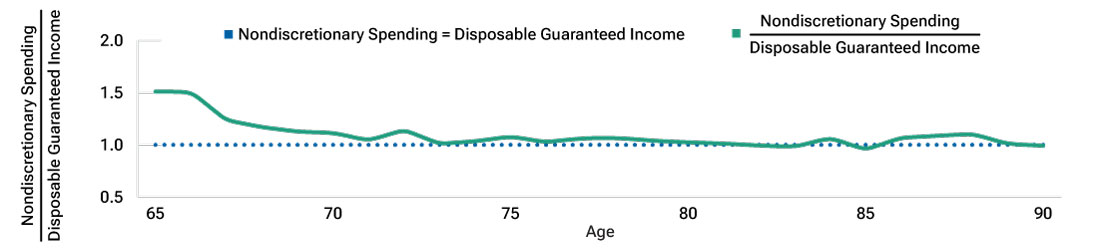
Retirees adapt their spending to match their income and do so by matching their nondiscretionary or essential spending to their guaranteed income, which includes Social Security income and if they have any pension or other annuity income. We demonstrate this by estimating the ratio of nondiscretionary spending to guaranteed income. This ratio quickly approaches one after retirement and remains there for the rest of the retiree’s life (Figure 3). This implies that rather than dipping into their savings for their day‑to‑day spending needs, retirees adjust their essential spending to match their guaranteed income.
Retirees adapt spending to their income
(Fig. 3) After age 65, nondiscretionary spending quickly becomes aligned with disposable guaranteed income
Source: T. Rowe Price Retirement Savings and Spending Study (2024).
Question: Which of the following are motivations for maintaining a certain balance in your retirement savings accounts?
Can annuities help to preserve assets?
Our research tells us two things. First, a vast majority of retirees either want to maintain their level of assets or increase it. Second, spending patterns suggest that retirees use guaranteed income as an anchor for their essential spending. This keeps them from using their savings to fund their day‑to‑day expenses.
To show the extent to which annuities might help retirees preserve their assets, we look at pensions. After all, pensions are, in fact, annuities.
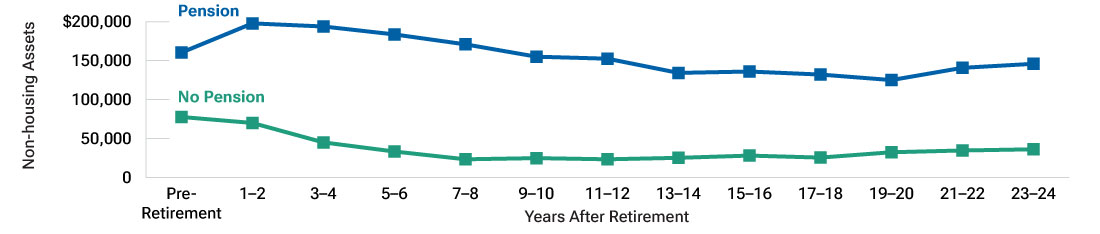
Comparing two groups of retirees, those with and those without pensions, the EBRI study3 showed that after 24 years of retirement, non‑housing assets of pensioners dropped by only 26% compared with a 48% drop for those without a pension (Figure 4).
Guaranteed income helps retirees preserve assets
(Fig. 4) Median non‑housing assets before and after retirement for households with and households without pension income*
Source: Employee Benefit Research Institute estimates from the Health and Retirement Study (HRS), 1992–2022.
* Numbers measured in 2022 dollars. Most recent available data.
This is not an obvious finding and, to some extent, is counterintuitive. If the fear of running out of money is the primary driver of asset preservation, then households with higher levels of guaranteed lifetime income should spend down their savings more freely. Instead, we find the opposite happening. This has two implications. First, households have a strong preference for asset preservation, i.e., in addition to consumption, they also derive satisfaction from the level of assets they hold. Second, higher levels of guaranteed income help them preserve assets more successfully.
Final thoughts
Annuities have long been projected as the best hedge against longevity risk. They can protect people from running out of money late in life. This type of framing could make people think that they will not benefit from annuities if they don’t live long enough. But annuities can be marketed in a more positive way, i.e., they can help retirees to preserve their assets. Such a framing might help people rethink the utility of annuities and use them as a tool to achieve their current financial goals, rather than as a fail‑safe in the event of an extreme outcome.
It is also clear from the data that, to a large extent, the lifestyle of retirees is determined by the level of their guaranteed income. So, if an individual wants to maintain a certain lifestyle, they should maintain a level of guaranteed income that can support that lifestyle. Simply having the money in the form of savings will not help because, in that case, preserving the savings would take precedence over maintaining a certain lifestyle.
About our research
We use data from the Health and Retirement Study (HRS)4 and its supplement Consumption and Activities Mail Survey (CAMS). CAMS started in 2001, and we used data from 2001 through 2023. Income data corresponding to each CAMS wave are used from HRS.
The sample focused on individuals between ages 65 and 90. To reduce the influence of spending outliers, we excluded observations in the top and bottom 1% of the total spending distribution and households whose total household spending exceeded three times their total household income in any given year. To calculate disposable income, we assumed the top quintile pays an effective tax rate of 19%, the bottom quintile pays an effective tax rate of 0%, and everyone in between pays an effective tax rate of 16%. Our final analysis sample consisted of 11,320 households.
All spending and income numbers were inflation adjusted using the consumer price index and presented in 2025 dollars.
Appendix
Nondiscretionary Spending: Mortgage, rent, utilities, homeowners’ or renters’ insurance, property taxes, home repairs and maintenance, housekeeping supplies, auto payments, auto insurance, auto maintenance, clothing and apparel, health insurance (including supplemental insurance), prescription and nonprescription medication, health care services, medical supplies, food and beverages (excluding dining out), gasoline.
Discretionary Spending: Trips and vacations; household furnishings and small equipment; charitable and political contributions; cash or gifts to family or friends; dry cleaning and laundry services; home cleaning services; supplies and services for gardening and yard; personal care products and services; tickets to movies, sporting events, and art performances; gym and other sports activities; hobbies and leisure equipment; dining out and takeout food.
2025 T. Rowe Price Global Retirement Savers Study (GRSS): The study was conducted between June 24, 2025, and July 31, 2025. It surveyed 7,010 adults age 18+, representative of the population of workers (on age, gender, and region) contributing to a defined contribution (DC) or similar account-based workplace retirement plan. 1,000 (or slightly more) adults per market were surveyed, except in the U.S., where 3,001 adults were surveyed. The data are weighted to provide equal representation across all countries.
2024 T. Rowe Price Retirement Savings and Spending Study: The study was conducted between July 17, 2024, and August 7, 2024. It included 3,005 401(k) participants, full‑time or part‑time workers who never retired, currently age 18 or older, and either contributing to a 401(k) plan or eligible to contribute and have a balance of $1,000+. The survey also included 1,012 retirees who have retired with a Rollover IRA or a left‑in‑plan 401(k) balance.

- Aug 2026
- From the Field
Understanding the evolving opportunity for financial advice

Contact us
1 Leslie Muller, “Asset Decumulation Over Retirement and the Role of Guaranteed Income Streams,” EBRI Issue Brief, no. 656 (Employee Benefit Research Institute, April 30, 2026).
2 James Poterba, Steven Venti, and David Wise, “What Determines End‑of‑Life Assets? A Retrospective View,” in D. Wise, ed., Insights in the Economics of Aging (Chicago, University of Chicago Press, 2017), 127–157.
3 Leslie Muller, “Asset Decumulation Over Retirement and the Role of Guaranteed Income Streams,” EBRI Issue Brief, no. 656 (Employee Benefit Research Institute, April 30, 2026).
4 Health and Retirement Study, public use dataset. Produced and distributed by the University of Michigan with funding from the National Institute on Aging (grant number NIA U01AG009740). Ann Arbor, MI.
Important Information
Important Information on Annuities: Earnings are taxed as ordinary income when withdrawn. There may be a 10% federal tax penalty on withdrawals before age 59½.
An annuity is a long‑term, tax‑deferred investment designed for retirement. It will fluctuate in value. It allows you to create a fixed or variable stream of income through a process called annuitization. It provides a variable rate of return based on the performance of the underlying investments. An annuity isn’t intended to replace emergency funds or to fund short‑term savings goal.
You should also know that an annuity contains guarantees and protections that are subject to the issuing insurance company’s claims paying ability. But these guarantees don’t apply to any variable accounts that are subject to investment risk, including possible loss of your principal.
An annuity is a contract between you and an insurance company, and it’s sold by prospectus. You should read these documents. They describe risk factors, fees and charges that may apply to you. Variable annuities have fees and charges that include mortality and expense, administrative fees, contract fees and the expense of the underlying investment options.
Riders may be available to help you customize your policy and provide additional benefits. Riders are optional and available at an additional cost. There is no guarantee that the benefits received under the terms of rider may not exceed the cost to include the rider on your policy.
All withdrawals or partial surrenders will reduce the death benefit. Additionally, once in the income phase, excess withdrawals will reduce subsequent future payments.
Variable annuities are sold by prospectus. Both the product and underlying fund prospectuses can be obtained by contacting the issuing insurance company directly. Before investing in this fund or any competing fund, carefully read and consider the fund’s investment objectives, risks, charges, expenses, and other important information contained in this and the underlying funds’ prospectuses.
T. Rowe Price does not issue or distribute any annuity products. This material is provided for general and educational purposes only and is not intended to provide legal, tax, or investment advice. This material does not provide fiduciary recommendations concerning investments; it is not individualized to the needs of any specific benefit plan or retirement investor, nor is it intended to serve as the primary basis for investment decision‑making.
The views contained herein are those of the authors as of August 2026 and are subject to change without notice; these views may differ from those of other T. Rowe Price associates.
This information is not intended to reflect a current or past recommendation concerning investments, investment strategies, or account types, advice of any kind, or a solicitation of an offer to buy or sell any securities or investment services. The opinions and commentary provided do not take into account the investment objectives or financial situation of any particular investor or class of investor. Please consider your own circumstances before making an investment decision.
Information contained herein is based upon sources we consider to be reliable; we do not, however, guarantee its accuracy.
All investments involve risk. All charts and tables are shown for illustrative purposes only.
T. Rowe Price Investment Services, Inc., distributor. T. Rowe Price Associates, Inc., investment adviser. T. Rowe Price Investment Services, Inc., and T. Rowe Price Associates, Inc., are affiliated companies.
© 2026 T. Rowe Price. All Rights Reserved. T. Rowe Price, INVEST WITH CONFIDENCE, the Bighorn Sheep design, and related indicators (see troweprice.com/ip) are trademarks of T. Rowe Price Group, Inc. All other trademarks are the property of their respective owners. Use does not imply endorsement, sponsorship, or affiliation of T. Rowe Price with any of the trademark owners.
- 202608‑5721969