
Understanding the evolving opportunity for financial advice
Retirement
- Key Insights
-
- Financial advice is expanding to meet competing priorities and multigenerational needs, with strong demand for retirement planning and holistic support.
- While advice is being delivered across a growing array of formats, the workplace remains the primary source of guidance for retirement savers.
- Tech‑enabled, personalized, and scaled advice is poised to play a growing role in the retirement income landscape.
Financial advice has traditionally been viewed through an investment lens, with asset allocation, rebalancing, and investment selection seen as the main drivers of success. Yet as financial lives have grown more complex, it’s become clear that investment recommendations are only one part of a much larger picture.
Tax optimization, Social Security planning, financial coaching, and help with health care and lifestyle decisions are becoming core expectations of a more comprehensive and personalized advice model.
Put simply, financial advice is evolving into holistic lifetime guidance.
This evolution is strengthening the value of advice; reinforcing demand for human‑led guidance; and driving the need for closer alignment between advisors, plan sponsors, recordkeepers, and others across the retirement ecosystem.
Confidence beyond investing: Why advice needs are expanding
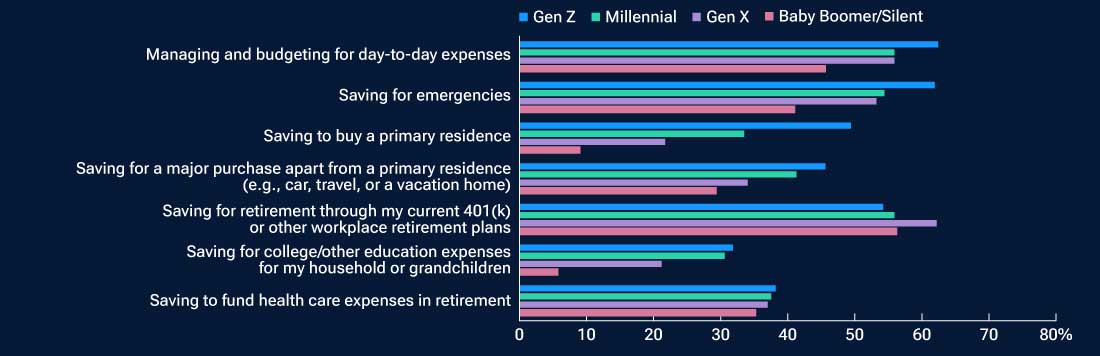
While advice needs naturally evolve alongside life factors, our research indicates that the case for a more comprehensive advice model remains strong across the accumulation and decumulation stages (Fig. 1).
Competing and evolving financial priorities underscore the need for holistic lifetime advice
(Fig. 1) Major financial objectives by generation
Source: T. Rowe Price, 2025 Global Retirement Savers Study. Base: U.S. retirement
savers (n=3,001).
Q: For each financial objective below, please indicate how important it is to your household. Ranked by percent of respondents who selected the objective as a major objective.
Note: Chart does not reflect all objectives.
In our 2025 study of workplace retirement savers and retirees,1 savers ranked short- and medium-term priorities, including building emergency savings and buying a home, closely alongside retirement objectives. Helping individuals strategically navigate these competing priorities—rather than allowing them to crowd out long-term retirement goals—is a defining benefit of holistic advice.
The need for comprehensive guidance in retirement is equally strong, as longer life expectancy and a growing reliance on defined contribution plans and personal savings have increased the complexity of retirement decision‑making.
- 53% of retirees in our study reported challenges drawing down their savings—e.g., concerns about longevity risk—amid uncertainty surrounding health care, long‑term care, and living expenses.
- 49% said they rely on a financial advisor for retirement income information, reflecting the need for guidance on withdrawal strategies, income solutions, and health care planning.
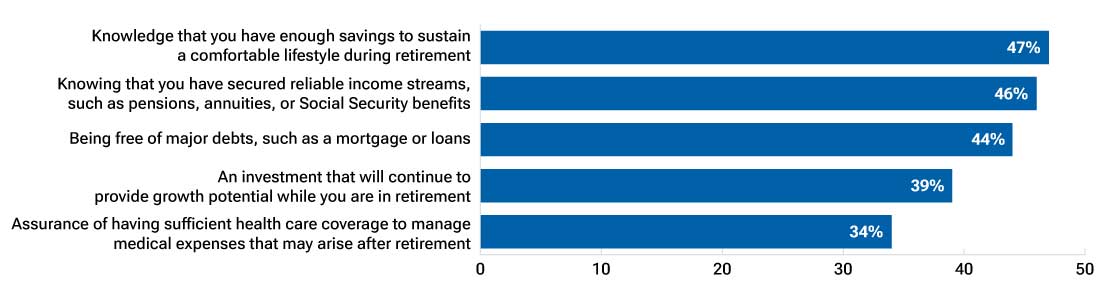
At the same time, many individuals are looking to optimize their financial resources and are seeking assurance that they can retire confidently (Fig. 2).
People want financial peace of mind in their retirement
(Fig. 2) Factors that gave individuals more confidence in their ability to retire
Source: T. Rowe Price, 2025 Global Retirement Savers Study. Base: U.S. (n=3,001).
Q: What would provide you with more confidence in your ability to retire?
Note: Chart only reflects the top five options selected by respondents. Figures shown represent percentage of respondents that selected the given option.
Our study indicates that retirement savers who work with an advisor report substantially higher levels of retirement preparedness and optimism than self‑directed savers.
- 80% said they had made a serious effort to plan for financial aspects of retirement, while 59% said the same about nonfinancial aspects, such as lifestyle, psychological, and emotional considerations. Among self‑directed savers, the corresponding figures were 55% and 38%, respectively.
- 51% of advised retirement savers were excited about retirement compared with just 34% of self‑directed savers.
- 46% were confident about retirement versus 24% of self‑directed savers.
While the data show that confidence and excitement are correlated with household assets, the role of the advisor cannot be discounted, particularly in helping people understand what their money can do for them.
Which advice services do individuals value most?
The financial advice industry is already recognizing the demand for a more integrated and behaviorally oriented approach. Firms in our sixth annual Defined Contribution Consultant Study identified “evaluating financial wellness programs” as the fastest-growing non‑investment service they offer to clients.2
The question, then, is how this evolution could shape the full suite of services that advisors offer. Data from our 2025 retirement savers study provide useful insights, highlighting the extent to which different attributes of financial advice are valued.
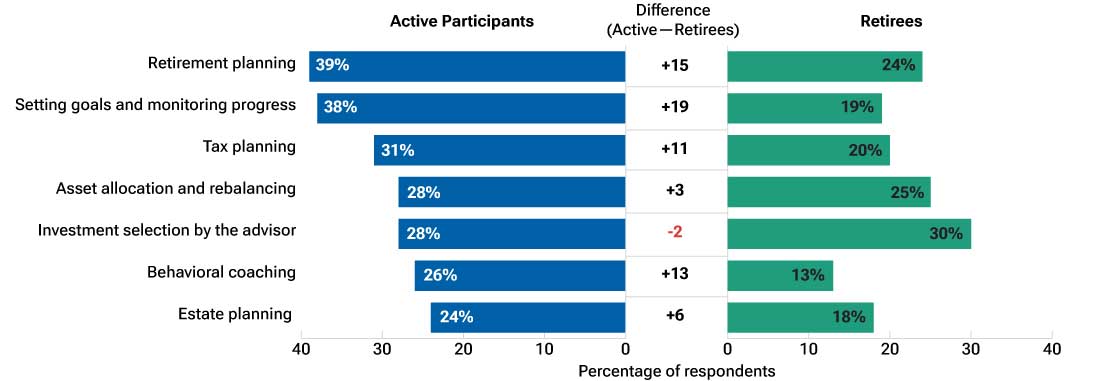
Active plan participants rank retirement planning and goal-setting/progress monitoring as top attributes, while retirees show a modest preference for investment‑related services (Fig. 3). Still, retirees signal a strong desire for holistic guidance, with retirement planning being one of their most valued advice attributes.
Advice preferences highlight a wide range of needs
(Fig. 3) “Very valuable” advice attributes for active plan participants and retirees
Source: T. Rowe Price, 2025 Global Retirement Savers Study. Base: U.S. active participants (n=3,001); U.S. retirees (n=1,003).
Q: How valuable are these aspects of advice to you (very valuable, somewhat valuable, not very valuable, not valuable at all)? Results shown for very valuable.
Note: Retirement planning includes budgeting, withdrawal strategy, Social Security, health care expenses, and annuities. Behavioral coaching includes ongoing help with decision-making, including maintaining a strategy, encouraging saving, and handling setbacks such as market volatility.
Tax and estate planning are also highly valued across the accumulation and decumulation stages, signaling opportunities for advisors who can directly provide these services or integrate outside expertise into a client’s financial plan.
What this means for advisors and plan sponsors: Advice delivery models built primarily around asset accumulation may miss opportunities to address deeper financial concerns and aspirations. For advice to be truly impactful, it must evolve alongside an individual’s needs, connecting to and balancing all aspects of their financial life—from saving and investing to income generation, tax optimization, health care funding, and legacy planning.
Advice delivery: The future is human‑led, tech‑enhanced, and multisource
As the scope of advice broadens, advice delivery is becoming increasingly consequential.
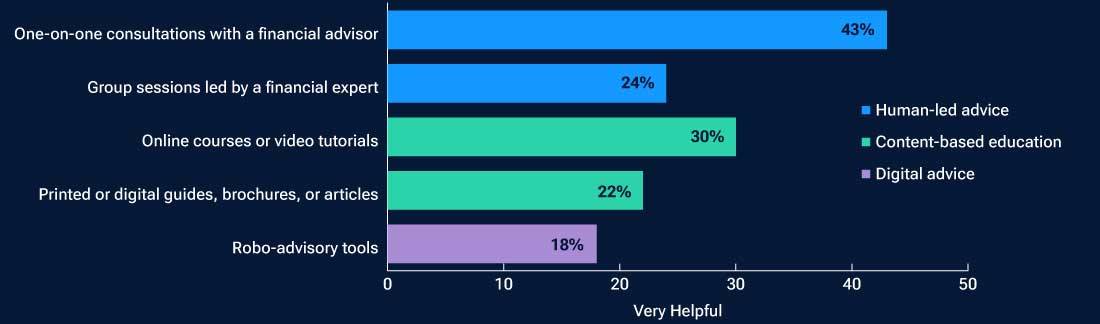
Human connection is still at the heart of the advice experience
(Fig. 4) Percentage of retirement savers who described these programs or formats as very helpful
Source: T. Rowe Price, 2025 Global Retirement Savers Study. Base: U.S. (n=3,001).
Q: When trying to learn more about retirement, how helpful would each of the following programs or formats be (very helpful, somewhat helpful, not so helpful, not helpful at all)? Results shown for very helpful.
The rapid adoption of artificial intelligence (AI) has raised longer‑term questions about how advice is provided. However, our research indicates that human guidance remains the preferred foundation of the advice experience, with technology playing a key, complementary role (Fig. 4).
Generational differences suggest that advice will continue to evolve toward a “human + tech” model (Fig. 5) in which advice, content, and tools are integrated across a wide range of formats.
Generational shifts reinforce a tech‑enhanced, multisource model
(Fig. 5) Reliance on sources of financial advice and support, by generation
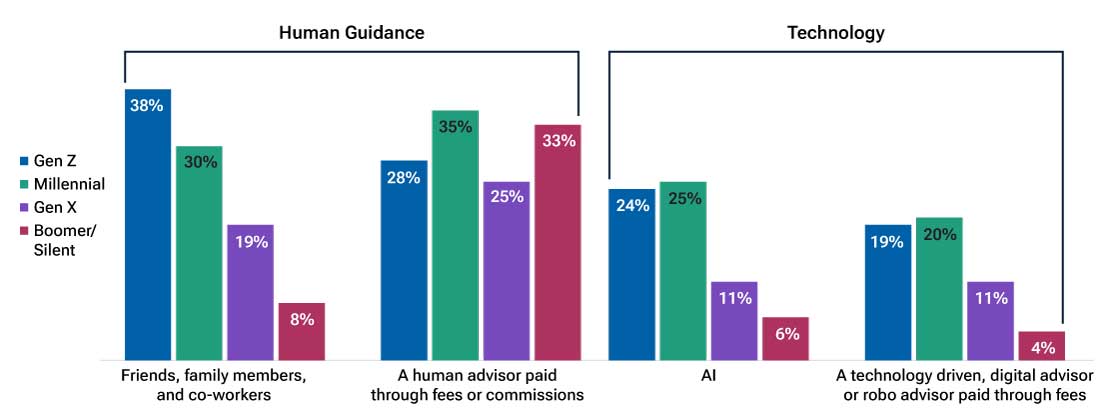
Source: T. Rowe Price, 2025 Global Retirement Savers Study. Base: U.S. (n=3,001).
Q: When it comes to financial advice and support, to what extent do you rely today on each of the following sources (great deal, somewhat, not very much, not at all, unsure)?
Note: Chart shows combined responses for “great deal.” It does not reflect all sources of advice selected by respondents.
Younger savers, for example, are more likely to participate in group advice sessions, potentially reflecting changing norms about information sharing and the role of social networks in tackling common financial challenges. They are also more likely to use digital tools, though technology is not solely the domain of younger investors. Rather, individuals tend to access advice through multiple channels as their needs change:
- Based on our recordkeeping data, use of digital tools is likely to rise sharply as plan participants approach retirement age, highlighting the growing demand for guidance during a period marked by important decisions around savings, asset allocation, and retirement income.
- The data also show that our Retirement Income Planner—a retirement income estimator and planning tool—is especially popular with younger participants, signaling that many are already focused on retirement outcomes and value tools that support comprehensive, long‑term planning.
What this means for plan sponsors, recordkeepers, and advisors: While advice delivery is evolving, we expect the need for trusted advice to remain high. The future of advice will likely feature a combination of human expertise, traditional digital formats, and newer technologies rather than relying heavily on any single approach. As this delivery model takes shape, advice and education must be relevant and consistent across sources, giving individuals the right information in the right manner at the right time.
The workplace remains central to retirement advice
Despite the abundance of financial content online—including through social media, digital tools, and AI‑powered resources—the workplace continues to stand out as a trusted source of retirement guidance.
More than three in four (77%) retirement savers said they rely on the company that manages their employer‑sponsored retirement plan for advice, placing it above all other sources. Notably, demand for workplace advice appears to be strong across generations, even among younger cohorts who are generally comfortable receiving advice and education through AI platforms.
Of course, retail direct advice, or out‑of‑plan advice, continues to play a large role in the retirement landscape. For retirees, especially those age 65 and older, “a human advisor paid through fees or commissions” is the most relied‑upon source of financial advice and support, consistent with the expectation that a person’s reliance on workplace plan resources naturally declines once their working years end.
Still, many retirees (43%) look for advice and support from the company that manages their former employer’s retirement plan.
These findings point to a powerful opportunity for plan sponsors and providers to deliver education, guidance, and personalized support.
Closing gaps in workplace advice
Analysis of our recordkeeping data found that users of advice and/or education resources saved at a rate 29% higher than nonusers and had twice the average account balance.3 Yet despite the appeal and potential benefits of workplace‑based advice, there are notable gaps in the availability and awareness of key resources.
One‑on‑one consultations with a financial professional are the most helpful advice format, according to active participants. However, the availability of one‑on‑one advice lags demand. While 43% of participants in our retirement savers study considered one‑on‑one consultations to be “very helpful,” only 39% indicated that they were offered by their workplace.
Benefits planning highlights another gap in workplace advice:
- Only 32% of retirement savers reported that their retirement account provider offers consultations or other help with health care planning and Social Security claiming, while another 32% reported being unaware of any such resources.
What this means for advisors, plan sponsors, and plan providers: The case for in‑plan advice is compelling. Realizing its full potential will require a broader set of capabilities that reflect plan sponsor priorities and participant delivery preferences.
When and how to deliver personalization
Participant behavior suggests that the need for personalization grows as retirement nears. While younger investors tend to exhibit relatively similar savings and investment patterns, our recordkeeping data show that older participants are more likely to make active decisions reflecting their individual circumstances, goals, and preferences.4 Figure 6 highlights several relevant findings.
Older participants signal a preference for personalization
(Fig. 6) Findings on participant behaviors
| Key finding | |
|---|---|
| Savings rate increases | Savings rates for participants in their 50s and 60s increased by an average of 1.4% annually, exceeding typical automatic escalation defaults.1 |
| Digital engagement | Engagement with web resources increased 2.7x during the two years leading up to retirement or plan termination before declining below prior levels.2 |
| Target date reallocations | 23% of target date investors age 63 and older were invested in a vintage other than their age-based default.3 |
Source: T. Rowe Price’s recordkeeping platform.
1 Based on data over the calendar year ended December 31, 2025.
2Analysis is based on total average visits to online financial wellness tools among plan participants retiring or terminating from their plan between January and June 2024. Data observed monthly from 24 months before the event (month 0) through 17 months after.
3 Point-in-time data as of January 31, 2026.
Taken together, these findings suggest that participants value more information, decision support, and tailored investment solutions as they approach retirement. While standardized savings and investment defaults can be highly effective during the accumulation stage, retirement often introduces highly personal needs that cannot be met solely through age‑based approaches.
Identifying these needs can be challenging, but technology improvements are creating the potential to pinpoint retirement obstacles, deliver targeted guidance, and expand access to personalized income solutions at scale.
What this means for the retirement industry: As individuals age and manage a growing set of financial decisions, the industry’s ability to combine personalized advice with efficient delivery models could become a larger component of retirement success. This presents an added opportunity for solutions to be integrated and accessible in and out of workplace plans, thus ensuring a seamless client experience.
Final thoughts
The next generation of retirement advice is poised to be more comprehensive and more focused on individual needs.
As participants and retirees look to make interconnected decisions across all areas of their financial life, the retirement ecosystem has an opportunity to respond with compelling services and solutions.
Technology will play a pivotal role in this effort, but no single tool can address an individual’s unique financial challenges, preferences, and aspirations.
Human understanding and holistic service will be central to the advice experience.
 Rachel Weker
Retirement Strategist
Rachel Weker
Retirement Strategist

- May 2026
- From the Field
Evolving auto features to improve retirement adequacy

Contact us
1 The 2025 Global Retirement Savers Study surveyed over 7,000 retirement savers across the five largest retirement markets, including the U.S., as well as over 1,000 U.S. retirees. Study findings cited in this article are specific to U.S. survey respondents (3,001 retirement savers, or “active plan participants,” and 1,003 retirees).
2 Source: T. Rowe Price, 2026 Defined Contribution Consultant Study. This study was conducted from January 12, 2026, to March 11, 2026. Responses are from 36 consulting and advisor firms with over 160,000 DC plan sponsor clients and over $10.3 trillion in DC plan assets.
3 See T. Rowe Price’s 2026 Reference Point, a report that breaks down data and findings as of December 31, 2025, from more than 2 million active workplace retirement plan participants with T. Rowe Price as their recordkeeper.
4 See Louisa Schafer, Taha Choukhmane, and Tim de Silva, “Age, evolving allocation preferences, and the case for personalized solutions,” T. Rowe Price, 2025.
Investment Risks
The principal value of target date strategies is not guaranteed at any time, including at or after the target date, which is the approximate year an investor plans to retire. These products typically invest in a broad range of underlying strategies that include asset classes such as stocks, bonds, and short‑term investments and are subject to the risks of different areas of the market. A substantial allocation to equities both prior to and after the target date can result in greater volatility over short‑term horizons. In addition, the objectives of target date strategies typically change over time to become more conservative. Annuity guarantees are subject to the claims paying ability of the insurer and certain guarantee features may come at an additional cost from the standard contract.
Additional Disclosure
For U.S. investors, visit troweprice.com/glossary for definitions of financial terms.
Please see vendor indices for more information, including definitions and source data: troweprice.com/marketdata.
Important Information
This material is provided for informational purposes only and is not intended to be investment advice or a recommendation to take any particular investment action. The material does not constitute or undertake to give advice of any nature, including fiduciary investment advice. Prospective investors are recommended to seek independent legal, financial and tax advice before making any investment decision. T. Rowe Price group of companies including T. Rowe Price Associates, Inc. and/or its affiliates receive revenue from T. Rowe Price investment products and services.
The views contained herein are those of the authors as of July 2026 and are subject to change without notice; these views may differ from those of other T. Rowe Price associates.
This information is not intended to reflect a current or past recommendation concerning investments, investment strategies, or account types, advice of any kind, or a solicitation of an offer to buy or sell any securities or investment services. The opinions and commentary provided do not take into account the investment objectives or financial situation of any particular investor or class of investor. Please consider your own circumstances before making an investment decision.
Any tax-related discussion contained in this material is not intended or written to be used, and cannot be used, for the purpose of (i) avoiding any tax penalties or (ii) promoting, marketing, or recommending to any other party any transaction or matter addressed herein. Please consult your independent legal counsel and/or tax professional regarding any legal or tax issues raised in this material.
Information contained herein is based upon sources we consider to be reliable; we do not, however, guarantee its accuracy. Actual future outcomes may differ materially from any estimates or forward-looking statements provided.
Past performance is not a guarantee or a reliable indicator of future results. All investments are subject to market risk, including the possible loss of principal. All charts and tables are shown for illustrative purposes only.
T. Rowe Price Investment Services, Inc., distributor. T. Rowe Price Associates, Inc., investment adviser. T. Rowe Price Investment Services, Inc., and T. Rowe Price Associates, Inc., are affiliated companies.
© 2026 T. Rowe Price. All Rights Reserved. T. ROWE PRICE, INVEST WITH CONFIDENCE, the Bighorn Sheep design, and related indicators (see troweprice.com/ip) are trademarks of T. Rowe Price Group, Inc. All other trademarks are the property of their respective owners. Use does not imply endorsement, sponsorship, or affiliation of T. Rowe Price with any of the trademark owners.
- 202607‑5758454