
The case for active sector ETFs in an AI‑driven economy
April 2026, Equity
- Key Insights
-
- Passive sector exposure can increase single‑stock concentration risk, especially in market cap‑weighted indexes.
- When dispersion rises within a sector, security selection can meaningfully influence outcomes beyond simply owning the sector index.
- Advisors can use targeted sector or diversified innovation sleeves for artificial intelligence (AI) exposure, based on client objectives, risk tolerance, and portfolio overlap.
Active sector exchange-traded funds (ETFs) combine sector exposure with research‑driven security selection. These strategies aim to capture shifting leadership and manage risks that static, index‑tracking sector ETFs may not adapt to quickly.
Sector ETFs have long been a core tool for advisors seeking targeted exposure, diversification, and tactical flexibility. What has changed is not how advisors use sector ETFs, but how sectors themselves behave. As leadership within sectors becomes more concentrated and more dynamic, static sector exposure may no longer reflect the opportunity set advisors intend to access.
Opportunity remains as AI leadership evolves
The early phase of AI investing rewarded broad exposure, but the next phase is likely to be defined by widening gaps between leaders and laggards within sectors. While investor enthusiasm may ebb and flow, many of the structural changes associated with AI adoption appear durable. Innovation continues to spread across technology, energy, financials, and health care, reshaping competitive dynamics within sectors.
For advisors, this shift reinforces the need to move beyond headline exposure and consider how AI‑related risks and opportunities show up within individual sectors. Active sector ETFs can help position client portfolios toward potential beneficiaries of change while managing exposure to laggards as leadership evolves.
How advisors use sector ETFs in portfolios
Advisors often use sector ETFs for thematic exposure, diversification, tax‑loss harvesting, and tactical sector tilts. As market concentration increases and factor behavior becomes more volatile, these use cases may require closer attention to underlying holdings, overlaps, and implementation risk at the client level.
Thematic exposure
Sector ETFs allow advisors to express targeted views on emerging themes such as technology innovation, health care advancement, or infrastructure modernization without taking single-stock risk that often accompanies thematic trades.
Diversification
Rather than building baskets of individual stocks, sector ETFs provide exposure to dozens of companies within a given industry through a single allocation. However, headline diversification can mask underlying concentration in a small number of mega-cap stocks.
Tax-loss harvesting
Because sector ETFs can experience higher volatility and wider dispersion than broad market funds, they can be effective tools for tax-loss harvesting and portfolio rebalancing.
Tactical sector tilts
Advisors may tilt sector exposure based on relative strength, the economic cycle, inflation regimes, and changes in growth expectations.
Passive still dominates sector ETFs, creating structural drawbacks
Historically, sector ETFs have been primarily passive. Roughly 99% of U.S. equity sector ETF assets are still invested in passive strategies.1 While passive exposure remains a core building block for many client portfolios, market cap‑weighted sector indexes can embed structural risks that may be less visible in broad market allocations.
As AI‑driven growth has increased market concentration and tilted index exposure toward higher‑beta stocks, these effects can become magnified within sector ETFs that rely on rigid classification rules and static weighting schemes.
Passive sector ETFs are designed to mirror static indexes with limited flexibility as business models evolve. This can expose clients to:
- Mega‑cap concentration
- Narrow sub‑industry exposure
- Structural index lag
Not all sector ETFs are diversified: Concentration risk hidden beneath the surface
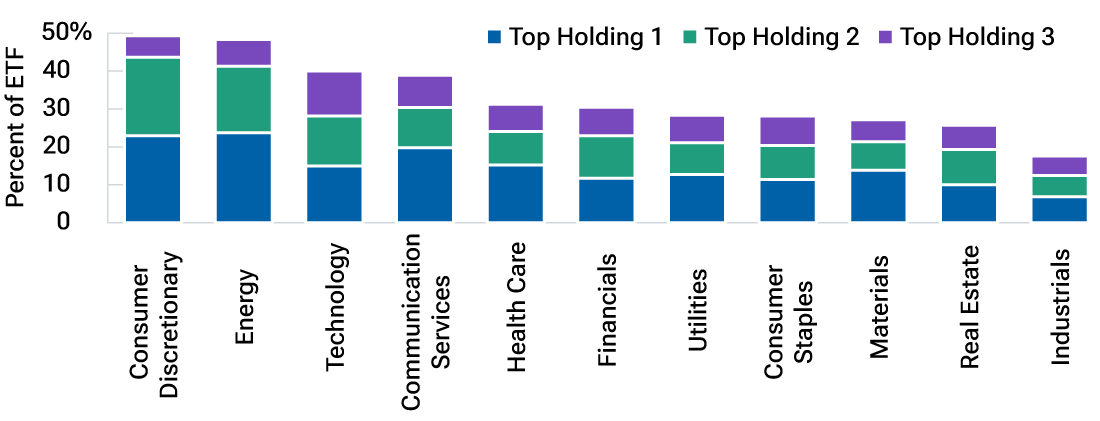
Source: SectorSPDRs.com, as of March 31, 2026.
Hidden concentration risk in passive sector ETFs
While sector ETFs are often viewed as diversified building blocks, many are more concentrated than clients expect.
Across multiple equity sectors, the top three holdings can represent an outsized share of total sector ETF exposure. This mirrors broader market trends in which a small number of companies
increasingly dominate index risk and performance.
In Technology, concentration risk can become especially visible when a single company grows to dominate benchmark weights. NVIDIA’s market capitalization and index weight illustrate how marketcap weighting can increase single‑name influence inside sector exposure.
These dynamics reinforce a broader challenge for advisors: passive exposure is not risk‑neutral, and client portfolios may accumulate unintended concentrations unless
actively managed.
Concentration risk: NVIDIA now rivals entire sectors
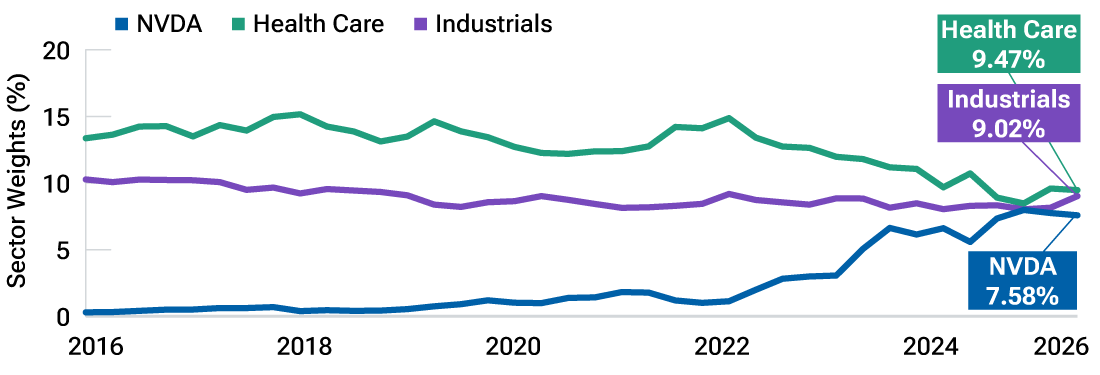
Source: S&P, as of March 31, 2026.
Why active management matters more at the sector level
Rising intra‑sector dispersion can increase the value of security selection. When winners and losers diverge within the same sector, research‑driven positioning may matter more than owning the sector index alone.
At the same time, elevated factor volatility has increased the contribution of sector and stock selection to overall portfolio outcomes. Active sector ETFs can serve as a targeted implementation tool for managing concentration and security‑level risk within individual sectors.
Active mandates may also offer flexibility beyond rigid classifications, adjusting exposure as sector lines blur and business models evolve. This flexibility becomes more important as AI‑driven innovation spans traditional sector boundaries.
The active advantage in sector investing
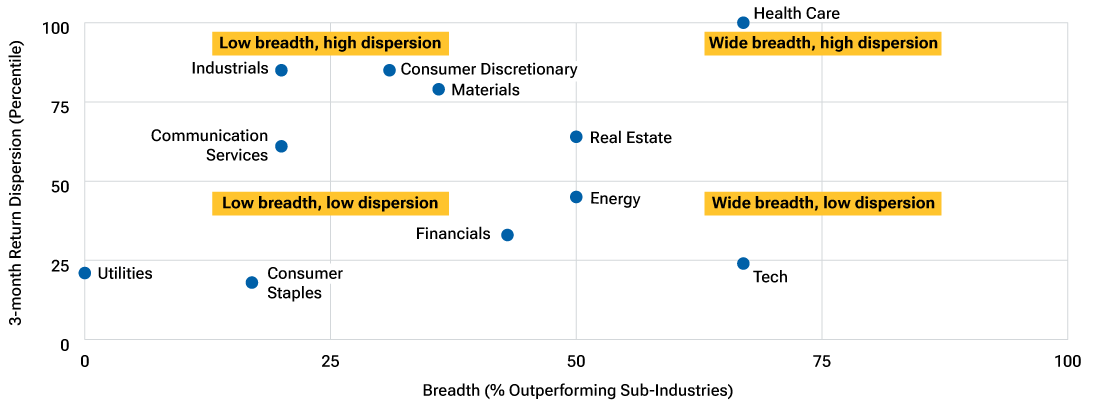
Source: FactSet, as of December 31, 2025.
Breadth is measured by the percentage of GICS industry in the same sector that outperformed the S&P Composite 1500.
The specific securities identified and described are for informational purposes only and do not represent recommendations.
AI is a cross‑sector growth engine
AI is not a single‑sector story. It is accelerating innovation across the economy and reshaping competitive dynamics within sectors.
The following sector perspectives highlight where AI‑related opportunities may emerge, why dispersion may widen, and how active selection can help advisors manage client exposure.
Technology: The engine of the AI cycle and the real economy
Dominic Rizzo, CFA, Portfolio Manager
Key takeaway
Technology remains central to the AI investment cycle, but leadership within the sector continues to evolve.
Where innovation may show up
- Evolution of chip architectures and component mix
- Advances in networking and interconnect within the data center
- Shifting compute requirements as AI moves toward agents and physical AI
Why active selection can matter
As generative AI evolves, profit pools are shifting toward suppliers rather than spenders and extending well beyond the graphics processing unit (GPU). Beneficiaries increasingly include high‑bandwidth memory, advanced packaging, optical components, power and thermal management, semiconductor capital equipment, and even central processing units (CPU) as agentic workloads scale. As models grow more complex and inference intensity rises, bottlenecks move across the value chain, reinforcing pricing power in critical infrastructure layers.
Implementation idea: T. Rowe Price Technology ETF (TTEQ)
Natural resources: “Physical AI” power and materials demand
Rick de los Reyes, Portfolio Manager
Key takeaway
Power is a gating factor for AI. AI‑driven electrification and data center build-out can increase demand for energy, metals, and infrastructure, creating differentiated winners within natural resources.
Where innovation may show up
- Energy and metals that feed the power supply chain supporting AI infrastructure and data centers
- Infrastructure build-out to expand electricity generation, transmission, and storage
- A growing emphasis on domestic and ally‑sourced supply as countries prioritize reliability and security alongside cost
Why active selection can matter
AI is driving one of the most meaningful shifts in power demand in decades, and that demand is colliding with a long period of underinvestment across parts of energy and metals. In our view, this can widen dispersion as supply constraints, rising costs, and jurisdictional advantages separate leaders from laggards. That backdrop increases the importance of company fundamentals, asset quality, cost structure, and location.
Implementation idea: T. Rowe Price Natural Resources ETF (TURF)
Financial services: AI-driven efficiency and data advantage
Matt Snowling, CFA, Portfolio Manager
Key takeaway
AI can lower costs, but it can also reshape competitive dynamics across financial services.
Where innovation may show up
- AI applied to servicing, underwriting, and claims
- Scaled platforms using customer data to improve risk selection
Why active selection can matter
As AI adoption spreads, competitive advantages may shift from cost efficiency alone toward proprietary data, underwriting discipline, and execution quality. This can increase dispersion within the sector and elevate the importance of security selection.
Implementation idea: T. Rowe Price Financials ETF (TFNS)
Health care: Drug discovery, diagnostics, and workflow efficiency
Sal Rais, M.D., Portfolio Manager
Key takeaway
AI has the potential to accelerate drug discovery and improve diagnostics, but adoption is likely to be uneven.
Where innovation may show up
- AI‑enabled molecule identification and optimization
- Improved diagnostics and earlier detection
- Administrative automation and reimbursement workflows
Why active selection can matter
Regulatory complexity, reimbursement dynamics, and long development timelines can lead to uneven adoption. This dispersion reinforces the role of active research in identifying companies able to translate AI investment into durable outcomes.
Implementation idea: T. Rowe Price Health Care ETF (TMED)
Putting it into practice: Sector sleeves vs. a broad innovation sleeve
For advisors reassessing how AI exposure is implemented within client portfolios, active sector ETFs can complement broader allocation decisions.
Option A: Target innovation by sector
Active sector ETFs can be used to emphasize where innovation is most visible within specific sectors while managing single‑stock and sub‑industry concentration risk.
Option B: Broad innovation exposure across sectors
For clients who prefer not to make explicit sector allocation decisions, a diversified innovation sleeve can provide exposure across industries within a single allocation.
Implementation idea: T. Rowe Price Innovation Leaders ETF (TNXT)
Importantly, sector sleeves and innovation strategies are not substitutes for asset allocation. Rather, they represent implementation choices that sit within a broader framework focused on diversification, risk awareness, and long‑term resilience.
Conclusion
AI‑driven innovation has reshaped market structure, increased concentration, and altered how sectors behave. While these changes create new opportunities, they also raise the importance of how exposure is implemented.
Active sector ETFs offer advisors a way to engage with innovation while addressing concentration and dispersion risks that can arise within passive sector exposure. By combining sector focus with research‑driven security selection, they can help advisors align portfolios with evolving leadership in an AI‑driven economy.
 Christopher Murphy, CIMA®
Head of ETF Specialists
Christopher Murphy, CIMA®
Head of ETF Specialists

- Feb 2026
- From the Field
Smarter alpha: Get more from a portfolio’s core
1 Source: ETF Action, as of October 24, 2025.
Risks
Active investing may have higher costs than passive investing and may underperform the broad market or passive peers with similar objectives. Each person’s investing situation and circumstances differ. Investors should take all considerations into account before investing.
Banks and financial services companies: A fund that focuses its investments in specific industries or sectors is more susceptible to adverse developments affecting those industries and sectors than a more broadly diversified fund.
Health sciences firms are often dependent on government funding and regulation and are vulnerable to product liability lawsuits and competition from low‑cost generic product.
Technology companies: A fund that focuses its investments in specific industries or sectors is more susceptible to adverse developments affecting those industries and sectors than a more broadly diversified fund. Because the fund invests significantly in technology companies, the fund may perform poorly during a downturn in the technology industries. Technology companies can be adversely affected by, among other things, changes in government regulations or increased government scrutiny, dependency on patent protection and intellectual property rights, intense competition, earnings disappointments, and rapid obsolescence of products and services due to technological innovations or changing consumer preferences.
Commodities are subject to increased risks such as higher price volatility, geopolitical and other risks. Commodity prices can be subject to extreme volatility and significant price swings.
Because of the cyclical nature of natural resource companies, their stock prices and rates of earnings growth may follow an irregular path.
Diversification cannot assure a profit or protect against loss in a declining market.
Additional Disclosure
For U.S. investors, visit troweprice.com/glossary for definitions of financial terms.
Please see vendor indices for more information, including definitions and source data: troweprice.com/marketdata.
CFA® and Chartered Financial Analyst® are registered trademarks owned by CFA Institute.
FactSet—Financial data and analytics provider FactSet. Copyright. © 2026 FactSet Research Systems Inc. All rights reserved.
Important Information
ETFs are bought and sold at market prices, not NAV. Investors generally incur the cost of the spread between the prices at which shares are bought and sold. Buying and selling shares may result in brokerage commissions which will reduce returns.
Consider the investment objectives, risks, and charges and expenses carefully before investing. For a prospectus or, if available, a summary prospectus containing this and other information, visit troweprice.com. Read it carefully.
This material is provided for informational purposes only and is not intended to be investment advice or a recommendation to take any particular investment action.
The views contained herein are those of the authors as of April 2026 and are subject to change without notice; these views may differ from those of other T. Rowe Price associates.
This information is not intended to reflect a current or past recommendation concerning investments, investment strategies, or account types, advice of any kind, or a solicitation of an offer to buy or sell any securities or investment services. The opinions and commentary provided do not take into account the investment objectives or financial situation of any particular investor or class of investor. Please consider your own circumstances before making an investment decision.
Information contained herein is based upon sources we consider to be reliable; we do not, however, guarantee its accuracy. Actual future outcomes may differ materially from any estimates or forward-looking statements provided.
Past performance is not a guarantee or a reliable indicator of future results. All investments are subject to market risk, including the possible loss of principal. All charts and tables are shown for illustrative purposes only.
T. Rowe Price Investment Services, Inc.
© 2026 T. Rowe Price. All Rights Reserved. T. ROWE PRICE, INVEST WITH CONFIDENCE, the Bighorn Sheep design, and related indicators (see troweprice.com/ip) are trademarks of T. Rowe Price Group, Inc. All other trademarks are the property of their respective owners. Use does not imply endorsement, sponsorship, or affiliation of T. Rowe Price with any of the trademark owners.
- 202604‑5214255