
Smarter alpha: Get more from a portfolio’s core
February 2026, Equity
- Key Insights
-
- Passive strategies are common building blocks for the core of a diversified portfolio. But they entail an opportunity cost: potential alpha.
- A well-designed strategy that seeks benchmark-plus returns with benchmark-like risk could help investors get more from their portfolio’s core.
- An investment engine that integrates fundamental research and quantitative analysis should be well positioned to pursue consistent, risk-adjusted alpha.
Modest fees and more than a decade of strong market returns have made passive strategies that track large‑cap equity indexes simple and increasingly common building blocks for the core of a diversified investment portfolio.
But passive exposure to the broader market comes at an opportunity cost: alpha, or potential outperformance relative to the benchmark.
How can investors get more from their portfolio’s core while accounting for risk and expense budgets?
A well‑designed active-core strategy could help clients use portfolio capital more efficiently by adding the potential for consistent, risk‑adjusted alpha.
Why a little alpha from a portfolio’s core can make a big difference
The core/satellite approach to equity portfolio construction has become a common structure for investors to help balance expense and risk budgets as they pursue long‑term financial objectives.
Within this framework (Figure 1), the core typically consists of a strategic mix of passive funds that offer the prospect of a low‑cost, market‑like return. As the largest part of the portfolio, the core aims to limit fee‑related performance drag while alleviating the challenge of picking the right active manager. It also avoids the potential for subpar returns versus a benchmark. Satellite strategies orbiting this core take more active risk in the pursuit of stronger outperformance.
How a core/satellite portfolio structure seeks to balance cost and risk
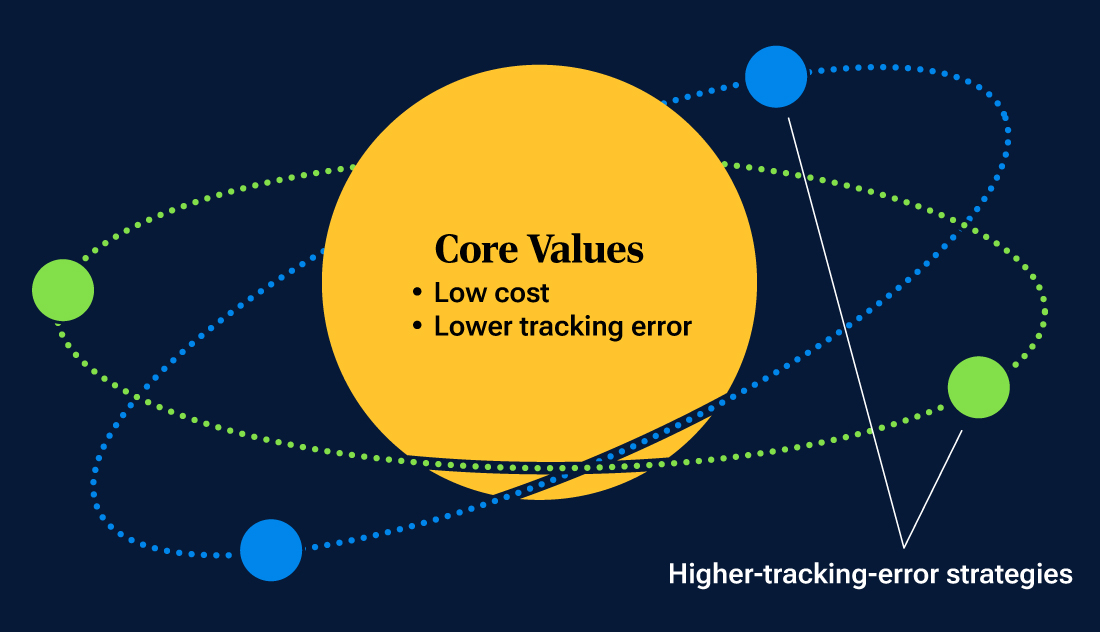
For illustrative purposes only.
As passive‑core exposures have grown, so has the opportunity to use this portfolio capital more effectively. Producing even a modest excess return from a core allocation can make a significant difference to an investor’s long‑term outcome.
Our analysis, for example, suggests that an additional 25 basis points (bps) in return over 40 years of savings could result in an additional two years of retirement spending. Increasing the excess return to 50 basis points could add five additional years of spending (Figure 2).
In this instance, the frequency of outperformance is key to compounding value. When applied to such a large base of portfolio capital over longer time frames, the prospect of generating steady, if not necessarily heady, excess returns can be very compelling.
How risk-controlled alpha can add value vs. passive index trackers
Clients who want to get more from their portfolio’s core can choose from a small but growing universe of active-core strategies that seek to integrate the best attributes of active and passive investing:
1. Alpha potential: An active and repeatable investment process is built on a source of edge/insight that creates the potential for excess returns across different market environments.
2. Controlled, but active risk: Targeting 50 to 100 basis points in tracking error can help with consistency versus a benchmark and to minimize exposure to factor hot spots. It also has the potential to reduce the risk of underperforming the benchmark by a wide margin.
3. Competitive fees: An affordable expense ratio lowers the drag on potential returns.
For prospective investors, the critical question is whether the underlying investment engine can consistently generate benchmark‑plus returns with minimal active risk.
Even modestly higher returns potentially can improve retirement outcomes
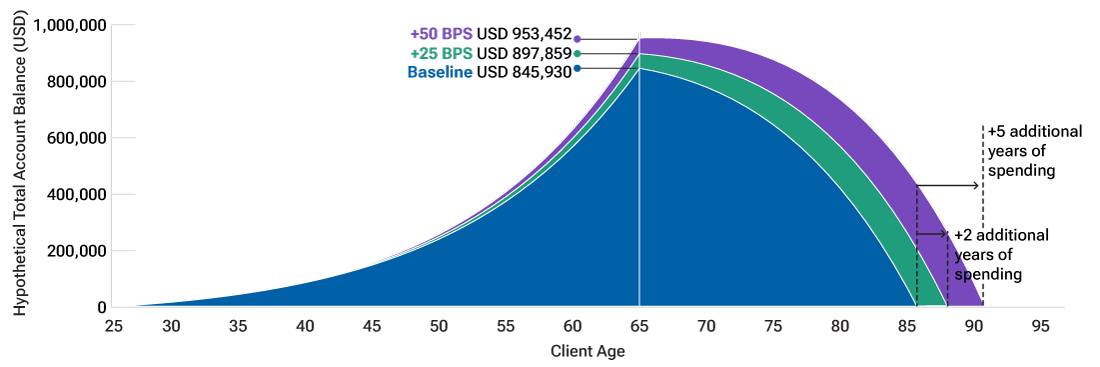
| Demographic Assumptions | Scenario Assumptions | Baseline | +25 BPS | +50 BPS | |
|---|---|---|---|---|---|
| Starting Balance | USD 0 | Returns Before 65 | 7.00% | 7.25% | 7.50% |
| Starting Age | 25 | Returns After 65 | 5.00% | 5.25% | 5.50% |
| Starting Salary | USD 30,000 | Account Balance at 65 | USD 845,930 | USD 897,859 | USD 953,452 |
| Annual Salary Growth Rate | 3% | Withdrawal (% of Ending Salary) | 50% | 50% | 50% |
| Annual Contribution Rate | 9% | Annual Withdrawal Amount | USD 48,931 | USD 48,931 | USD 48,931 |
| Retirement Age | 65 | Withdrawal Increase | 3% | 3% | 3% |
| Ending Salary | USD 97,861 |
The results shown above are hypothetical, do not reflect actual investment results, and are not a guarantee or reliable indicator of future results. Hypothetical results were developed with the benefit of hindsight and have inherent limitations. Hypothetical results do not reflect actual trading or the effect of material economic and market factors on the decision-making process. Results do not include the impact of fees, expenses, or taxes. Results have been adjusted to reflect the reinvestment of dividend and capital gains. Actual returns may differ significantly from the results shown.
The demographic assumptions, returns, and ending balances are shown for illustrative purposes only and are not intended to provide any assurance or promise of actual returns and outcomes. One basis point is 0.01 percentage point.
Source: T. Rowe Price.
The power of an investment engine with two alpha drivers
Markets are dynamic and continually evolve. But recurring behavioral biases can lead to persistent market inefficiencies.
- Shrinking time horizons: As markets increasingly focus on short‑term outcomes, the resulting dislocations can create favorable risk/reward setups for investors who focus on what creates value over the longer term.
- Perspective skew: Markets often struggle to properly weigh inside and outside views. The inside view uses the specifics of an individual situation to understand what’s likely to happen; the outside view uses relevant historical precedents to understand the most likely outcome.
We believe an investment engine that integrates two distinct but complementary sources of insight—deep fundamental research and rigorous quantitative analysis—should be well positioned to take advantage of these inefficiencies in the pursuit of consistent, risk‑adjusted alpha.
- Fundamental research: Talented analysts with a deep understanding of individual companies’ growth prospects should be well positioned to add value when uncertainty is high or there is a wide dispersion of returns in an industry or sector. This inside view provides expert insight and forward‑looking judgment, which can be a difference‑maker in fast‑changing areas such as artificial intelligence (AI) or biotechnology.
- Quantitative analysis: Rigorous analysis of historical market and financial data related to key factors such as growth durability, business quality, capital deployment, momentum, and valuation provides an outside view. This data‑driven approach adds empirical grounding, pattern recognition, and behavioral discipline to the investment process.
With this design, performance isn’t the result of a single lens or philosophy but rather two independent investment approaches that can be even more powerful when combined.
Thoughtfully integrating fundamental and quantitative analysis helps to reduce blind spots, challenge assumptions, and improve investment decision‑making across market cycles.
Pursuing alpha while limiting tracking error
Low-tracking-error strategies seek to provide a similar risk profile to the benchmark while allowing diversified stock picking to drive relative returns.
By design, these products don’t make large, concentrated bets. Instead, smaller overweight and underweight positions are spread across a broad universe of securities. The sizes of these active bets, which are tightly controlled to limit tracking error, reflect the level of confidence in the investment thesis.
For a strategy that systematically integrates fundamental and quantitative analysis, conviction could reflect the convergence of the two approaches:
- Overweight: Stocks where both the analyst and the quantitative rating suggest a favorable risk/reward profile.
- Underweight: Companies whose fundamental and quantitative ratings appear less favorable.
When only a quantitative rating is available, the hurdle for making a meaningful active bet in a stock should be higher.
Limiting position sizes is only one way to limit tracking error. Guarding against unintended risks or style biases in the portfolio is also critical.
Managers backed by strong fundamental research and quantitative teams may be better positioned to spot and adjust to evolving risk factors where clusters of stocks start to trade in a similar manner. Some of these correlations can be related to macroeconomic developments, such as the direction of interest rates or where a company generates its earnings. In other instances, dislocations may emerge in companies with negative earnings or groups of stocks that offer exposure to popular themes, such as AI, nuclear power, or space technology.
Balancing individual alpha opportunities with top‑down risk management requires constant vigilance.
Choosing the right partner: Scale, culture, and capabilities
A strategy that has the potential to generate excess returns consistently without taking on too much tracking error can create material advantages as a core portfolio holding.
Evaluating the people and process is critical to identifying solutions with the potential to deliver above-benchmark returns with benchmark-like risk. We believe that well‑designed active-core strategies that combine human and machine insights—two distinct sources of potential alpha—should be well positioned to compound long‑term value.
A global asset manager with demonstrated fundamental and quantitative investment capabilities should have an advantage in creating core strategies that meet clients’ needs for potential returns, risk, and cost—think of this as smarter alpha.
 Laurence Taylor, CFA
Equity Solutions Portfolio Manager
Laurence Taylor, CFA
Equity Solutions Portfolio Manager
 Andrew W. Tang, CFA, CAIA®
Co-Portfolio Manager
Andrew W. Tang, CFA, CAIA®
Co-Portfolio Manager

- November 2025
- From the Field
Why the stock market could broaden sustainably beyond U.S. large-cap growth
The AI arms race could contribute to a sustainable broadening in the equity markets.

Contact us
Investment Risks:
Quantitative models: Relying on quantitative models and the analysis of specific metrics in constructing a portfolio could cause an investor to be unsuccessful in selecting companies for investment or determining the weighting of particular stocks in the portfolio.
Fundamental approach: There is risk that an active manager may make a wrong call regarding a particular security or sector.
Active investing may have higher costs than passive investing and may underperform the broad market or passive peers with similar objectives.
Passive investing may lag the performance of actively managed peers as holdings are not reallocated based on changes in market conditions or outlooks on specific securities.
Diversification cannot assure a profit or protect against loss in a declining market.
There is no assurance that any investment objective will be achieved.
Financial Terms Definitions:
Tracking error is the divergence between the price behavior of an investment and an index.
Alpha is the excess return of an investment relative to its benchmark. Positive alpha means outperformance of an investment relative to its benchmark.
Active risk is risk is the relative risk incurred by deviating from a benchmark in the pursuit of higher returns.
Factors or factor analysis is an investment approach that involves targeting quantifiable firm characteristics or “factors” that can explain differences in stock returns. Over the last 50 years, academic research has identified hundreds of factors that impact stock returns.
For U.S. investors, visit troweprice.com/glossary for definitions of additional financial terms.
Important Information
This material is being furnished for informational and/or marketing purposes only and does not constitute an offer, recommendation, advice, or solicitation to sell or buy any security.
Prospective investors should seek independent legal, financial and tax advice before making any investment decision. T. Rowe Price group of companies including T. Rowe Price Associates, Inc. and/or its affiliates receive revenue from T. Rowe Price investment products and services.
Past performance is not a guarantee or a reliable indicator of future results. All investments involve risk, including possible loss of principal.
Information presented has been obtained from sources believed to be reliable, however, we cannot guarantee the accuracy or completeness. The views contained herein are those of the author(s), are as of February 2026, are subject to change, and may differ from the views of other T. Rowe Price Group companies and/or associates. Under no circumstances should the material, in whole or in part, be copied or redistributed without consent from T. Rowe Price.
All charts and tables are shown for illustrative purposes only. Actual future outcomes may differ materially from any estimates or forward‑looking statements provided.
The material is not intended for use by persons in jurisdictions which prohibit or restrict the distribution of the material and in certain countries the material is provided upon specific request.
Issued in the USA by T. Rowe Price Investment Services, Inc., distributor and T. Rowe Price Associates, Inc., investment adviser, 1307 Point Street, Baltimore, MD 21231, which are regulated by the Financial Industry Regulatory Authority and the U.S. Securities and Exchange Commission, respectively.
© 2026 T. Rowe Price. All Rights Reserved. T. Rowe Price, INVEST WITH CONFIDENCE, the Bighorn Sheep design, and related indicators (see troweprice.com/ip) are trademarks of T. Rowe Price Group, Inc. All other trademarks are the property of their respective owners. Use does not imply endorsement, sponsorship, or affiliation of T. Rowe Price with any of the trademark owners.
- 202602-5202880