
The greatest fixed income investment opportunity in decades?
Fixed Income
- Key Insights
-
- Fiscal concerns, higher inflation, and the prospect of global growth holding up should put upward pressure on Treasury yields, with the potential for the 10‑year yield to hit 6%.
- This scenario would create a historic investment opportunity in fixed income, with significant implications for asset allocation, as bonds could offer equity‑like returns with less volatility.
- In the current evolving market environment, we suggest investors consider a curve steepening bias, adding exposure to inflation‑linked bonds, and exploring strategies with a global remit that offer greater flexibility and potential diversification.
Are you ready for a world where the 10‑year U.S. Treasury yield goes to 6%? According to our Head of Global Fixed Income and CIO Arif Husain, this scenario—unthinkable just a few years ago—has become a real possibility in the next 18 months due to U.S. fiscal expansion and the potential for tariffs to drive inflation higher.
Let’s explore why such a shift may occur, what the asset allocation implications are, and what strategies may help effectively navigate this landscape.
The path to higher bond yields—three key drivers
- Fiscal concerns: The recently enacted “One Big Beautiful Bill” looks likely to keep the U.S. deficit elevated for at least the next two to three years, as stimulus is frontloaded and spending cuts are backloaded. Consequently, fiscal concerns will persist, as the deficit must be financed through Treasury debt issuance. This will occur at a time when other developed markets also need to issue more government debt to finance deficits, creating competition for buyers and pressuring yields higher.
- Upside inflation risks: The pass-through to consumer prices from tariffs is likely to be greater than markets anticipate, driving inflation higher in the second half of this year. Blerina Uruçi, our chief U.S. economist, estimates that a 15% effective tariff rate could increase annual headline inflation by between 1.0 and 1.6 percentage points.
- Global growth to hold up: While tariff policy may keep global growth below trend, a recession is unlikely. All three of the world’s largest economies—the U.S., the eurozone, and China—are fiscally expanding right now, which should be supportive. The effects may take time to feed through, however.
(Fig.1) Three key reasons Treasury yields should go higher
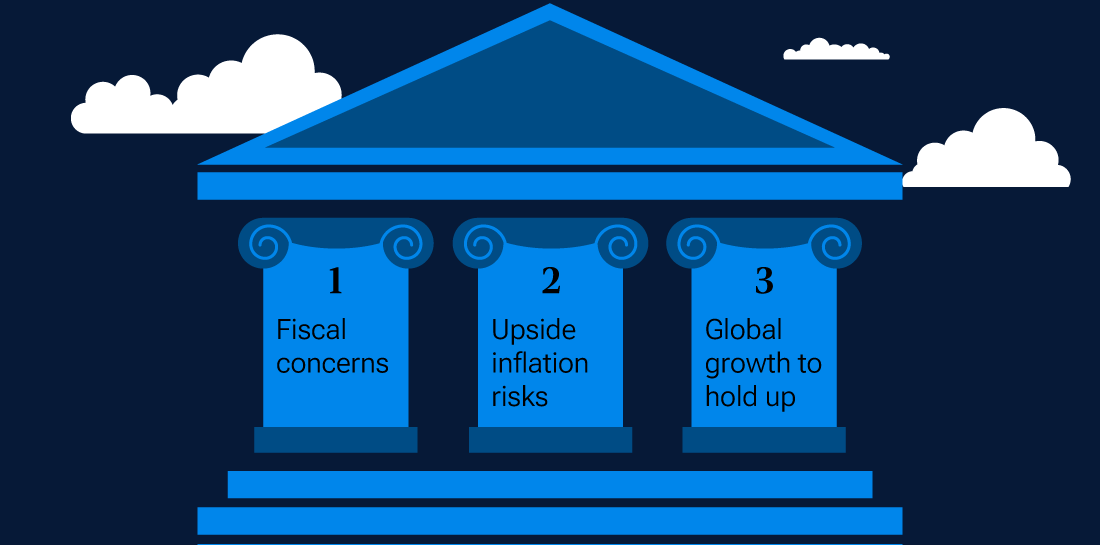
As of July 2025. For illustrative purposes only.
Source: T. Rowe Price.
The confluence of these three factors means that Treasury yields should go higher, with a 6% 10‑year yield within the realm of possibility. The path to that level will be volatile. However, it’s worth highlighting how far the 10‑year Treasury yield has already moved. In March 2020, it was below 0.5%; now it’s above 4%.1 With this context, a move to 5% or even 6% doesn’t seem so large. If it happens, we believe it would create a historic investment opportunity in fixed income, with meaningful implications for asset allocation. We think it’s crucial to begin planning now.
Potential implications
The share of fixed income in asset allocation has been growing in recent years thanks to higher bond yields. A rise in the 10‑year yield to above 6% would amplify this trend as it would offer investors a generational opportunity to earn the most attractive income from bonds in decades. For example, the yield on the Bloomberg U.S. Aggregate Bond Index (Agg)—a widely used benchmark for U.S. investment grade bonds—would likely surpass 6% in that scenario, a level not seen since the early 2000s.
For perspective, the Agg averaged a yield of just above 2% between December 29, 2011, and December 31, 2021. During this period, investors were compelled to take on more risk in equity and alternative markets to help them meet their return goals. Although bond yields have risen in recent years, leading to investors adding back to fixed income, they still remain an underweight allocation for many. This dynamic could change if the 10‑year yield increases to 6% as sectors sensitive to Treasuries—such as investment grade and high yield—would also likely increase, potentially offering equity‑like returns. This would appeal to investors not only from a total return perspective, but also due to the stability of income as bonds are historically less volatile than stocks. Nonetheless, fundamental research remains crucial to reduce default risk.
"From an asset allocation perspective, the potential implications are significant, as investors might not need to hold as much equity."
Jeff Helsing, Institutional Fixed Income Strategist
From an asset allocation perspective, the potential implications are significant, as investors might not need to hold as much equity. For example, if an investor is seeking a return goal of, say 7%, this could hypothetically be achieved through a higher allocation to bonds, which are typically less volatile than equities. However, investors would be exposed to more duration risk if they increase their fixed income allocation.2
Considerations for navigating this evolving fixed income landscape
A higher fixed income allocation seems like an obvious choice if yields get to 6%, but what about the intervening period? Navigating the rising yield path is as important as what to do when the destination is reached.
In the current evolving market environment, we recommend investors consider adopting a curve steepening bias. The prospect of U.S. interest rate cuts should anchor the short‑end of the U.S. yield curve, while expectations for higher inflation, robust growth, and fiscal dynamics are likely to drive long‑term Treasury yields higher. Additionally, consider adding inflation‑linked bonds and exploring opportunities in markets or sectors that are potentially less correlated to core markets.
Regarding approaches, consider strategies with a global remit that can invest across a wide range of geographies, sectors, and security types as this may help with diversification. Furthermore, a flexible strategy, particularly in managing duration, is crucial as volatility is expected. Therefore, the ability to respond to the market environment and make changes will be important.
Conclusion
We believe that a rise in the 10‑year Treasury yield to 6% would present a historic investment opportunity in fixed income with significant implications for asset allocation. Investors might not need as much equity or equity-like exposure to achieve return goals in such a scenario as bonds could offer stock-like returns with potentially less volatility. This doesn’t mean that investors should sit and wait for this big shift to happen—there are strategies they can consider now in preparation. This includes adding inflation‑linked bonds and implementing a steepening bias as investors are not being compensated yet for the duration risk further out the curve. As yields move closer to 6%, longer maturities should start to become attractive again.
"Navigating the rising yield path is as important as what to do when the destination is reached."
Som Priestley, CFA, Head of Multi Solutions—North America
 Jeff Helsing
Institutional Fixed Income Strategist
Jeff Helsing
Institutional Fixed Income Strategist
 Som Priestley, CFA
Head, Global Investment Solutions
Som Priestley, CFA
Head, Global Investment Solutions

- From the Field
Asset location can play a key role in tax-efficient investing
Financial advisors can help investors create an effective asset location strategy designed to enhance tax efficiency and after‑tax returns.

Contact us
Important Information
This material is being furnished for informational and/or marketing purposes only and does not constitute an offer, recommendation, advice, or solicitation to sell or buy any security.
Prospective investors should seek independent legal, financial and tax advice before making any investment decision. T. Rowe Price group of companies including T. Rowe Price Associates, Inc. and/or its affiliates receive revenue from T. Rowe Price investment products and services.
Past performance is not a guarantee or a reliable indicator of future results. All investments involve risk, including possible loss of principal.
Information presented has been obtained from sources believed to be reliable, however, we cannot guarantee the accuracy or completeness. The views contained herein are those of the author(s), are as of September 2025, are subject to change, and may differ from the views of other T. Rowe Price Group companies and/or associates. Under no circumstances should the material, in whole or in part, be copied or redistributed without consent from T. Rowe Price.
All charts and tables are shown for illustrative purposes only. Actual future outcomes may differ materially from any estimates or forward‑looking statements provided.
The material is not intended for use by persons in jurisdictions which prohibit or restrict the distribution of the material and in certain countries the material is provided upon specific request.
Issued in the USA by T. Rowe Price Investment Services, Inc., distributor and T. Rowe Price Associates, Inc., investment adviser, 1307 Point Street, Baltimore, MD 21231, which are regulated by the Financial Industry Regulatory Authority and the U.S. Securities and Exchange Commission, respectively.
© 2025 T. Rowe Price. All Rights Reserved. T. Rowe Price, INVEST WITH CONFIDENCE, the Bighorn Sheep design, and related indicators (see troweprice.com/ip) are trademarks of T. Rowe Price Group, Inc. All other trademarks are the property of their respective owners.
202509‑4794091