

Global Equities: What to do With Emerging Markets
Executive Summary
- For many global equity investors, their exposure to emerging markets (EM) continues to disappoint, challenging both their patience and risk tolerance.
- However, for investors with a long term time horizon, there is still much to like within the EM world if you truly search the full opportunity set.
- Embracing the complexity of the ‘new’ EM story, including the fundamental evolution tied to the end of the commodity super cycle, is a necessity so thata clear thesis and strong conviction is held when top down ‘Emerging Market’ sentiment is challenged.
- The dispersion of fundamentals across regions, countries and sectors may prove disconcerting for some, but for those able to embrace the full investible universe, this evolution and complexity naturally creates opportunity. We see this today as some investors capitulate on even the best demographic and consumption trends within the EM world.
- The next decade will not follow the same path as the last. It is therefore crucial that investors are correctly positioned to capture the trends that will define the next period of investing. This implies an active approach to avoid areas of the index whose significance is tied to the past and not the future.
Emerging markets investing has been challenging over the past few years, and this disappointment has been apparent in investor flows as some have begun to throw in the towel on EM investing. While this summer’s bout of volatility has been a catalyst for sentiment capitulation, it is important to be clear that longer term underperformance has been driven mainly by fundamental factors, most notably the trend of the EM versus DM GDP growth premium narrowing, as well as EM earnings growth disappointing. This latter factor remains the primary driver of EM stocks over the long term. For many investors, the EM world has delivered a harsh combination over the past five years: less return for more volatility.
WHAT HAPPENED TO THE BRICS OF GROWTH?
For some time we have spoken about the likely slowdown in the economic growth profile of the “BRIC” nations, with the key drivers being the adjustment in the Chinese economy away from fixed-asset investment, and hence the downward pressure upon commodity prices. These are structural changes that investors need to incorporate within their investment framework given the long duration impact on the emerging world.
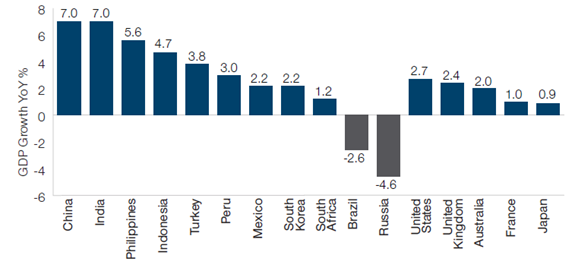
As we have made our way through the year, further deceleration in EM growth has evolved, and, in many respects has occurred at a much faster pace than even we predicted. Economic recessions have developed in Russia and Brazil (Figure 1), while China’s policy decisions in the summer clearly indicated that the Chinese authorities were concerned about their ability to maintain an economic growth rate of ‘around 7%1. Meanwhile, while pockets of economic strength remain apparent, several other EM countries have seen growth decelerate to similar levels in comparison to DM peers.
FIGURE 1: EM growth premium continues to narrow
As at 30 June 2015
Source: UBS
CHINA’S EVOLUTION REMAINS PARAMOUNT, INTERNALLY AND EXTERNALLY
China’s evolution has been central to this broader EM growth slowdown as the economy shifts away from an infrastructure and fixed asset investment-led growth model, to one where consumption and the services sector are growing by necessity to pick up the slack. While a reasonable approach to long term economic prosperity and stability, consumption growth is not a direct policy tool and cannot be controlled with any degree of efficacy. This shift remains a multiple decade aspiration by the Chinese government and the period of transition will not be a smooth ride.
While Chinese macro watchers remain concerned by the industrial output and growth data, there are numerous signs that China has been successful in its efforts to spur wage growth and consumption over the past decade, and that a solid foundation is in place for this theme to continue. These trends are apparent in the earnings growth of many consumer-led sectors within China, together with vast innovation and change that tends to be unique to industries which evolve at a rapid pace.
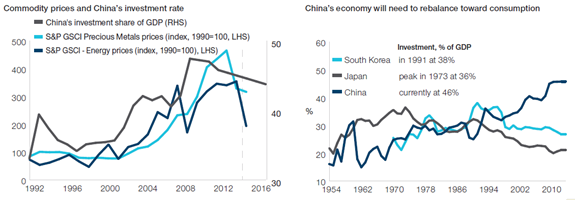
Export dependency for the Chinese economy has also fallen in recent years, but investment as a percentage of GDP remains unsustainably high when looking at historical precedents, such as the peak of industrialization of Japan and South Korea (Figure 2).
Medium term, fundamentals point to a slowdown in China’s economic growth backdrop and this has become a central focus for investors over the summer, despite this trend being apparent for some time. However, a growth slowdown should not be confused with a growth ‘crisis’ in our view. While the summer past has revealed that policy measures can be poorly communicated, and at times badly directed (the attempt to support the domestic equity market certainly sits in this latter camp), we believe that China still has the ability and willingness to apply a magnitude of policy action that will prevent its economic and debt dynamics from becoming disorderly.
FIGURE 2: China’s evolution – we are cautious on commodities
As at 31 December 2014
Sources: FactSet, Credit Suisse Research
Investor concerns have not been limited to China. In Brazil and Russia, the economic situation has deteriorated, but at a much faster pace. GDP growth in Russia and Brazil declined respectively by 4.6% and 2.6%YoY in the second quarter. Both countries are set for a growth contraction in 2015. While their economies are vastly different, one commonality is the impact of falling commodity (including oil) prices upon growth, as China slows its investment program and steps back from being the incremental source of demand for a wide range of base materials. Spurred also by the growing supply of oil on a global basis, weaker commodity prices are likely to persist in our view, and are now only being digested by many corporates and governments around the world.
With oil and many other commodity prices 30%-50% lower year on year, Brazil and Russia appear to be caught in the toughest economic situations of the major EM economies. When added to the inflationary impact of extreme currency weakness, which has driven inflation to high levels, positive catalysts for Brazil and Russia seem absent in the short term. While we believe that the economic data may stabilize in 2016 and ‘get less’ bad, which could signal the time to be contrarian, we remain cautious at this stage given opportunities elsewhere.
THE GOOD NEWS
We are still very constructive on the potential to find attractive EM stocks amid a period of fundamental change and investor concern. Indeed, it is often periods of uncertainty and change which give rise to the ability to invest in superior growth at a favorable valuation, and this is where our focus remains today.
Key to our broad outlook is that the dispersion of EM fundamentals is as great today as it has been for over a decade. Few investors would group Japan, the UK, France, the U.S. and Australia together under a single banner, but since the emergence of emerging markets as an asset class twenty years ago, the fundamentals of India and Brazil have always been seen as very relevant to the fundamentals of the Philippines or Turkey. We believe that, with the changes occurring in the emerging world, now is the time to fully understand the evolution of the EM story in order to re-establish conviction in what is owned and why.
Our approach has always been to look at economies and stocks in a very granular way. This makes a succinct summary of our views more challenging, but nevertheless we would aggregate our views into the following categories:
China’s evolution both domestically and internationally - we favor domestic consumer names, especially where we see positive change at an industry growth or consolidation level.
Materials and energy-levered economies in EMs - we continue to like Peru, but we do have a high hurdle for investment elsewhere given the overhang of prolonged commodity price weakness.
Parts of EM which look more ‘developed’ than emerging - we remain very selective in South Korea and Taiwan, which make up a large part of the EM index.
Higher growth, consumption oriented, demographically-driven countries – these still ‘fit’ many of the EM characteristics that investors sought a decade ago. We continue to favor India, Indonesia, Philippines and Turkey. We have taken the opportunity to add to our favored names amid the volatility in the last quarter.
IS THE MARKET BEGINNING TO SEE THE DISPERSION OF EM FUNDAMENTALS?
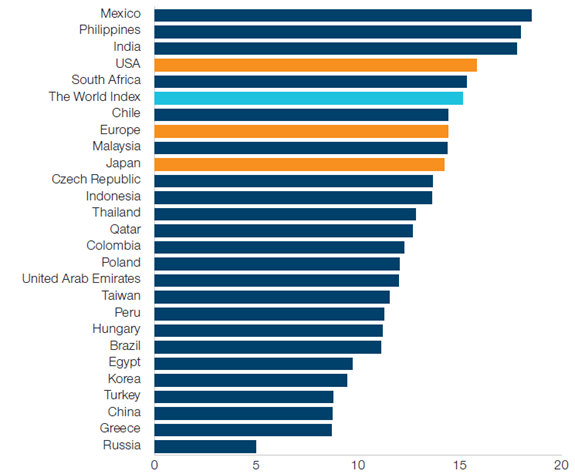
We have previously discussed the bifurcation of individual country and sector returns over the past decade, and how, regardless of short term correlation spikes, it is crucial to be on the right side of secular change over the long term. In many respects, valuations are now reflecting dispersed fundamentals and the reality facing EM investors today (Figure 3). Nations inside and outside of the “BRIC” banner that have largely delivered on the promise of the EM thesis put forth over a decade ago, have generally held onto premium multiples. Countries such as Mexico, the Philippines, India, and to a lesser degree, Indonesia, have broadly delivered on the promise of superior economic and earnings growth, backed by young and growing working populations. Add in solid policy reforms at points when the market was looking for policymakers to seriously address economic issues, and these countries have navigated the economic environment of the past ten years in a solid way.
FIGURE 3: Dispersion of EM fundamentals – A fact Current 12 month forward P/E
As at 31 August 2015
Sources: FactSet, Empirical Research Partner Analysis
By contrast, disappointment and elevated risks surrounding China, Russia and Brazil can clearly be seen in the market’s valuation, and brings out the need to look at EM markets more individually. While the MSCI EM Index P/E remains at a below average level of 10.7-times2 forward earnings, this is heavily influenced by some of the larger benchmark constituents in the index (Brazil, China, Russia and South Korea especially). The extreme valuation opportunity is narrower and now centered predominantly on those countries that are struggling to encapsulate the essence of the original EM thesis.
When considering the most fertile growth economies, valuations have now largely normalized. For those stocks and markets where valuations have rebounded, the risk and opportunity is centered on the power of compounded earnings growth over the long term.
COMPOUNDING RETURNS CAN BE EXTREMELY POWERFUL
In part, the current backdrop is central to why we continue to favour consumer-oriented sectors (including financials) in growing, demographically advantaged economies. Valuations for consumer companies remain at a premium compared to underlying markets given the durability and consistency of growth. Financials remain much more reasonably priced, especially in areas that involve controversy at the macro level, such as Turkey, Egypt and Indonesia. Even when considering the highest quality, durable growth names, valuations are still reasonable versus history, and more importantly versus our expectations of growth delivery over the next 3-5 years.
However, this is neither a time horizon or an investment perspective that is most important to a market racked with risk aversion today. This is key because if economic development and income growth remain durable themes in the very best segments of the emerging world, then companies levered to those themes should be able to grow their earnings base at advantaged levels for some time. This is ultimately the central point of the ‘EM thesis’ and what will drive stock prices over time.
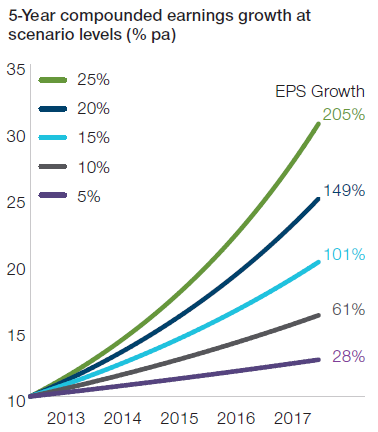
Of greatest importance for us though is to recognize that these companies are not just growing due to a change in macro factors including demographics. There are a large number of companies in the EM space that delivered changes to the professionalism of management teams, systems, scale and distribution that makes them unrecognizable from a decade ago. In many countries there is still huge potential for change and market share gains. In other words, the runway for growth remains long for many companies, in a world where growth has become scarce. Those companies that can deliver robust and compounded earnings growth for a number of years (Figure 4) are often underestimated by the market, and hence, remain fertile sources of return for patient investors. The key is to be able to identify those companies capable of delivering those economic returns.
FIGURE 4: From multiple expansion to growth delivery
As at 30 June 2015
Source: FactSet.
THE EM DEMOGRAPHIC CASE REVISITED
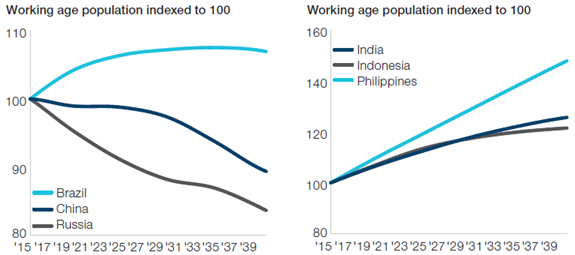
While overall demographics continue to favor EMs, as shown by the working age population growth ranking favorably against almost all developed markets, it is no longer an even trend. Figure 5 reflects how the working age population is predicted to fall sharply in both China and Russia, but remains on a steady upwards trajectory in India, Indonesia and the Philippines. This affirms our conviction on where we have long duration tailwinds in place that will help to support ongoing wage, consumption and earnings growth.
FIGURE 5: Demographics favor EMs, but some more than others
As at 30 June 2015
Sources: Oxford Economics, FactSet. Working age is defined as 15 to 64 years old.
We also continue to meet companies on a regular basis in EM and DM countries around the world, and in many sectors the desire to keep investing in the emerging world remains strong. In sympathy with our view, those economies that appear the most attractive are demographically driven ones, especially when shareholder friendly policy intentions at both a macro and micro level are in place. This will to invest by corporates stems from the potential noted above: long duration earnings growth potential in a world where growth and consumption prospects are lower.
THE EVOLUTION OF EMERGING MARKETS AND THE NEED FOR CHANGE
Ultimately, for those investors that have sought to gain their EM exposure predominantly through the BRIC markets within a global equity approach, we believe there is a better way. The end of the commodity super cycle and the evolution taking place within many economies is real and will have meaningful implications, both negative and positive. Investors should think in a more granular way to capture these trends. Time horizon and having an information edge are key to delivering the best returns within the EM world. Having the ability to focus on the power of compounding returns is also important.
Dispersion will remain a feature, but this more complex environment should provide more opportunities for thoughtful investors. Central to the principal of extracting the best returns will be the ability to put the benchmark to one side when making stock decisions. For us, the key remains our focus on the best of the opportunity set, in a new era for the emerging world.
1 Source: State Council of China
2 As at 30 September 2015. Source: Factset.
2015-GL-2790
重要情報
当資料は、ティー・ロウ・プライス・アソシエイツ・インクおよびその関係会社が情報提供等の目的で作成したものを、ティー・ロウ・プライス・ジャパン株式会社が翻訳したものであり、特定の運用商品を勧誘するものではありません。また、金融商品取引法に基づく開示書類ではありません。当資料における見解等は資料作成時点のものであり、将来事前の連絡なしに変更されることがあります。当資料はティー・ロウ・プライスの書面による同意のない限り他に転載することはできません。
資料内に記載されている個別銘柄につき、売買を推奨するものでも、将来の価格の上昇または下落を示唆するものでもありません。また、当社ファンド等における保有・非保有および将来の組入れまたは売却を示唆・保証するものでもありません。投資一任契約は、値動きのある有価証券等(外貨建て資産には為替変動リスクもあります)を投資対象としているため、お客様の資産が当初の投資元本を割り込み損失が生じることがあります。
当社の運用戦略では時価資産残高に対し、一定の金額までを区切りとして最高1.265%(消費税10%込み)の逓減的報酬料率を適用いたします。また、運用報酬の他に、組入有価証券の売買委託手数料等の費用も発生しますが、運用内容等によって変動しますので、事前に上限額または合計額を表示できません。詳しくは契約締結前交付書面をご覧ください。
「T. ROWE PRICE, INVEST WITH CONFIDENCE」および大角羊のデザインは、ティー・ロウ・プライス・グループ、インクの商標または登録商標です。
ティー・ロウ・プライス・ジャパン株式会社
金融商品取引業者関東財務局長(金商)第3043号
加入協会:一般社団法人日本投資顧問業協会/一般社団法人投資信託協会
