

European Equities: Muted European Recovery Calls for Selective Approach
Executive Summary
A muted market and economic environment suggests that stock selection will be critical going forward.
- Europe’s economy started to grow again in 2015, but the recovery remains modest and vulnerable.
- Corporate earnings have yet to recover, but they have room to grow if the economic recovery continues.
- Stock valuations vary widely by sector. Some consumer staples and health care stocks look richly priced, while select financials and consumer discretionary names look more reasonable.
- Fundamental research and effective stock selection will be important in this uncertain, slow-growth environment.
ECONOMIC RECOVERY REMAINS MODEST AND VULNERABLE
Europe’s economy edged into expansive territory in 2015. The European Central Bank’s (ECB) quantitative easing (QE) program weakened the euro and helped eurozone exporters become more competitive in the global marketplace. In addition, low energy costs are boosting consumer pocketbooks, and some observers are optimistic that businesses will eventually increase capital spending amid the increased liquidity and reduced financing costs resulting from QE.
Several factors suggest that the recovery remains modest and fragile, however. Despite the easy-money environment, many businesses are reluctant to spend due to the potential for slowing growth in China and other emerging markets to weigh further on an already modest recovery. Additionally, the flip side of low financing costs is that they may allow inefficient “zombie” companies to hang on longer than is healthy for the region’s economy. Although core inflation has risen since the beginning of 2015, it remains well below the ECB’s 2% target rate. While a few European governments have made progress on economic restructuring—Italy and Spain, for instance—overall progress has been spotty, and some countries, such as France, have made little headway.
Recent data reflect the uneven backdrop: second-quarter 2015 gross domestic product (GDP) growth in the eurozone was revised up to a 1.6% annualised rate, but full-year growth is likely to remain below 1%, and expectations for 2016 have been revised modestly lower according to the ECB. The euro area’s year-over-year seasonally adjusted unemployment rate inched down in 2015, but the overall rate remains elevated, and conditions vary widely between individual countries.
EARNINGS AND VALUATIONS ARE A MIXED BAG
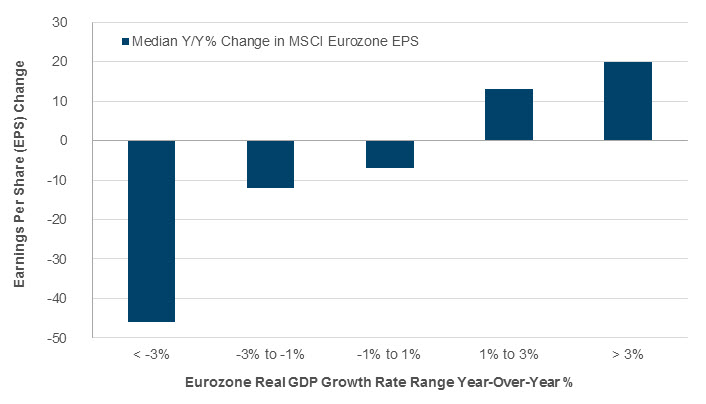
Earnings and profit margins for European companies are still well below pre-global financial crisis levels, and a meaningful earnings recovery remains elusive. In the most recent earnings season, enthusiasm over companies that beat expectations was largely offset by earnings disappointments and profit warnings. However, many European companies have slashed costs in recent years by moving operations to lower-cost locations, rationalising their business models, and refinancing debt at lower interest rates. As a result, we are optimistic that even modest revenue growth could generate sizable earnings gains for companies with strong operating leverage. A close relationship has historically existed between European economic growth and earnings for European companies. Improved operating leverage suggests room to grow earnings if economic recovery can be sustained.
As of November 2015, the forward price-to-earnings ratio of the MSCI Europe Index is around 15x, but there are major differences between sectors. The traditionally defensive consumer staples and health care sectors have had a good run over recent years, but both sectors appear richly priced as a result. Stock-specific opportunities can still be found, however. For instance, a number of health care stocks have been hurt due to their exposure to slowing economic growth in emerging markets. Nevertheless, growth prospects for many of these names remain solid as recent economic weakness is unlikely to weigh heavily on the growing secular demand for better health care in developing economies.
Valuations are more reasonable in select European financial companies, and we are looking for opportunities that should benefit if business and consumer loan demand improve along with the region’s economy. Concerns about China’s slowing growth and global overcapacity have weighed on some industrial stocks, but we continue to search for high-quality companies able to separate themselves from the pack through stronger balance sheets, better technology, and greater efficiency. Softer demand from China and other emerging markets has also hurt some of the larger multinational companies in the consumer discretionary space, and opportunities are becoming harder to find. However, the recent weakness has resulted in a number of well-managed companies selling at favourable valuations.
Elsewhere, weak global demand growth and overcapacity concerns will continue to weigh on commodities prices and materials-related companies. Energy and utilities shares have also been hit hard by a global supply/demand imbalance and sluggish economic growth, and we do not expect a meaningful reversal of these trends over the near term. With that said, we are always interested in companies with strong business models and good growth prospects that may get caught in a broader downdraft.
Figure 1: A Close Relationship Has Historically Existed Between European Economic Growth and Earnings For European Companies. Improved Operating Leverage Suggests Room to Grow Earnings If Economic Recovery Can Be Sustained.
(1992 to June 2015)
Past performance is not a reliable indicator of future performance.
Source: J.P. Morgan.
FINDING OPPORTUNITIES IN A MODEST RECOVERY
We expect Europe’s economic recovery to slog ahead with muted overall growth. At the same time, we are keeping a watchful eye on potentially disruptive near-term risks, including a sharper-than-expected economic slowdown in China and other emerging markets. Longer-term challenges include social and political unrest associated with rising immigration, as well as the mountain of debt burdening several countries, particularly France.
In this uncertain market and economic environment, we are focused on high-quality, domestically oriented businesses and potentially oversold global franchises. As always, our decision to invest in a particular stock depends on a detailed analysis of a company’s fundamentals where we look for well-managed companies with healthy balance sheets, attractive business models, and the potential to grow earnings over time.
2015-GL-2955
重要情報
当資料は、ティー・ロウ・プライス・アソシエイツ・インクおよびその関係会社が情報提供等の目的で作成したものを、ティー・ロウ・プライス・ジャパン株式会社が翻訳したものであり、特定の運用商品を勧誘するものではありません。また、金融商品取引法に基づく開示書類ではありません。当資料における見解等は資料作成時点のものであり、将来事前の連絡なしに変更されることがあります。当資料はティー・ロウ・プライスの書面による同意のない限り他に転載することはできません。
資料内に記載されている個別銘柄につき、売買を推奨するものでも、将来の価格の上昇または下落を示唆するものでもありません。また、当社ファンド等における保有・非保有および将来の組入れまたは売却を示唆・保証するものでもありません。投資一任契約は、値動きのある有価証券等(外貨建て資産には為替変動リスクもあります)を投資対象としているため、お客様の資産が当初の投資元本を割り込み損失が生じることがあります。
当社の運用戦略では時価資産残高に対し、一定の金額までを区切りとして最高1.265%(消費税10%込み)の逓減的報酬料率を適用いたします。また、運用報酬の他に、組入有価証券の売買委託手数料等の費用も発生しますが、運用内容等によって変動しますので、事前に上限額または合計額を表示できません。詳しくは契約締結前交付書面をご覧ください。
「T. ROWE PRICE, INVEST WITH CONFIDENCE」および大角羊のデザインは、ティー・ロウ・プライス・グループ、インクの商標または登録商標です。
ティー・ロウ・プライス・ジャパン株式会社
金融商品取引業者関東財務局長(金商)第3043号
加入協会:一般社団法人日本投資顧問業協会/一般社団法人投資信託協会


