

Emerging Markets: Looking Past Short-Term Volatility for Long-Term Opportunities
Executive Summary
A number of headwinds, from China’s yuan devaluation to Brazil’s rating downgrade, have hit emerging markets (EM) debt recently. With the Federal Reserve moving closer toward tightening monetary policy, investors fear that the first U.S. interest rate hike in almost a decade could trigger a full-blown crisis in the asset class. Although it is likely that a Fed rate hike will lead to higher volatility, we do not anticipate that EM will suffer a large-scale fallout as investor positioning is lighter and valuations cheaper than during previous turbulent periods, such as the 2013 “taper tantrum.” Rather, with long-term fundamentals in the asset class remaining solid, we view any further short-term weakness as a good buying opportunity for investors.
In this Price Point, Mike Conelius, emerging markets debt portfolio manager, examines the investment case for EM debt and discusses how investors should take advantage of any Fed-induced market dislocations.
IS EM READY FOR THE START OF U.S. MONETARY POLICY NORMALIZATION?
The Fed has long telegraphed its plans to lift rates off near zero, and while there is uncertainty over when it will happen, the action itself will come as no surprise. In fact, some EM central banks have sent strong signals that they are ready to act as soon as the Fed moves. For example, Mexico—a country with close ties to the U.S. economy—has shifted its monetary policy meetings for the remainder of the year to ensure they take place after the Fed’s policy meetings. South Africa’s central bank has gone even further and already raised rates, in part because of inflationary pressures, but also in a bid to protect its economy from potential capital outflows that could occur when the Fed raises rates. Turkey’s central bank has also taken preemptive action in unveiling a series of liquidity-boosting measures aimed at countering any possible fallout from the beginning of interest rate normalization in U.S. monetary policy.
LESS DOLLARIZATION, STRONGER FUNDAMENTALS
EM countries have evolved over the past few decades; most now have free-floating exchange rates and ample foreign exchange reserves. Debt-to-gross-domestic-product ratios have been reduced and, in most cases, are lower than developed markets, and there is much less dollarization in EM than in the past. Before the Asian crisis of 1997–1998, several countries in the region had accumulated large amounts of U.S. dollar-denominated debt that they could not service when their currencies declined in value. Now that most have more domestic debt profiles and floating exchange rates, the currency mismatch is considerably more limited, so there is significantly less potential for a repeat of the violent adjustment seen in Asia during the late 1990s.
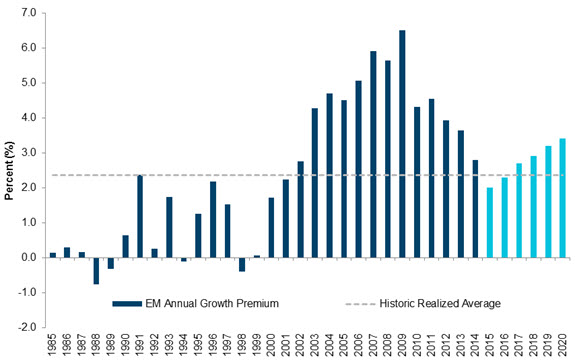
Economic growth in EM is expected to continue outpacing developed economies, presenting further compelling long-term support for EM bonds and currencies. The International Monetary Fund has forecast that emerging market and developing economies will grow by 4.0% this year and 4.5% in 2016. That far exceeds the respective growth levels of 2.0% and 2.2% it forecasts for advanced economies over the same period. Within EM, however, growth rates differ markedly. Countries such as the Philippines are expected to grow in excess of 5.0% in 2015. By contrast, two of the biggest developing economies—Russia and Brazil—will contract. At the same time, China, the world’s second-largest economy, is decelerating, which is having a negative impact on commodity-linked countries. Although we recognize that these factors will suppress overall EM growth this year, there remain plenty of good opportunities in the asset class. For example, Sri Lanka is set to grow by more than 6% in 2015 and Vietnam by around 6%.
Real GDP Growth Rate Differential: EM Premium Over DM
(2015–2020 IMF Estimates)
As of October 2015
Past performance is not a reliable indicator of future performance.
Source: International Monetary Fund (IMF) World Economic Outlook, October 2015.
THE UNEVEN BUT RELENTLESS ROAD TO REFORM
Across EM, several countries are making difficult adjustments and undertaking structural reforms. This should enhance economic growth in the future, which, in turn, should improve their investment prospects. Political sentiment in countries such as India and Indonesia, for example, has improved following 2014 election results. This has already led to structural reforms in these countries, with Indonesian President Joko Widodo slashing the fuel subsidy last November and more recently unveiling a series of measures intended to boost investment and growth. India’s Prime Minister Narendra Modi has also made progress, with fuel subsidies largely being abolished and some barriers to foreign direct investment lifted. Growth has slowed in India more recently, but the country remains on an improving trend, with the Modi administration pursuing reforms at the state level now after encountering difficulties passing bills through its upper house of parliament.
In emerging Europe, Serbia’s government has made fiscal improvements and pursued structural reforms since being elected last April. This looks set to continue as the government seeks European Union membership. Within Latin America, Mexico stands out as the archetypal reformer, having opened up its oil industry to private investment for the first time in almost 80 years. Mexico’s President Peña Nieto has also introduced much-needed reforms in the telecommunications sector.
China, which has been at the forefront of recent negative headlines in EM, is also working through notable reforms and fighting corruption. In foreign exchange, we believe that a key motivation in China’s decision to devalue, aside from boosting growth, was its intention to move toward a more flexible, market-oriented currency. Longer term, the country aims to fully open up its capital markets and currency to foreigners. Such a development would clearly be positive, but it will take a long time to achieve, and we anticipate that China will face significant obstacles on the way, each of which will be keenly observed by the markets. Nevertheless, we expect China’s government to successfully engineer a soft economic landing. Although execution risk will remain high as the transition takes place, we take comfort in China’s deep fiscal and financial resources to counter unintended weakness.
In some countries, reforms are being forced by market pressures. Brazil and Turkey are in this group: While both countries are slowly moving in the right direction, we recognize it will be challenging for them and thus anticipate slippages on this road. Indeed, efforts by Brazil’s Finance Minister Joaquim Levy to implement reforms and austerity measures have already been hindered by Congress. Such political challenges were highlighted by Standard & Poor’s when it downgraded Brazil’s long-term foreign currency sovereign debt in September to BB+, the highest rating in the below investment-grade category.
ATTRACTIVE YIELDS AND CHEAP VALUATIONS
With an index-level yield-to-maturity of 6.74%1 in external debt and just over 7.00%2 in local currency bonds, EM is much more attractive than almost every other asset class from a pure yield standpoint. For example, in many developed sovereign markets, the average index yield is not much above 1.00%.3
In foreign exchange, valuations have broadly cheapened, with some currencies such as the Turkish lira and South African rand falling to record low levels against the U.S. dollar. Across EM regions and countries, almost all currencies have come under pressure from an extended period of U.S. dollar strength—the MSCI Emerging Market Currency Index, which tracks the performance of 25 EM currencies, has slumped to a six-year low. There is potential for this U.S. dollar appreciation trend to extend further in the near term, with opportunities in fundamentally attractive currencies becoming more viable once we get past the Fed’s first rate hike since 2006.

From a technical perspective, EM positioning is less today than it was before the Fed signaled that it was planning to reduce its support for the U.S. economy in 2013. Prior to this, large numbers of investors had flocked into EM assets in search of higher yields. The same investors exited very rapidly once the Fed hinted that it would begin tapering quantitative easing, and to a large extent, they have not returned to the asset class since. Although the wave of recent negative EM headlines has caused an increase in outflows from EM debt, we do not anticipate a reprise of the taper tantrum turbulence. Generally, positioning is supported by institutional investors who tend to be focused on the long term and are less prone to panic selling.
Bond issuance is lower this year, which provides a further technical support for the asset class. For example, J.P. Morgan forecasts only U.S. $251 billion of annual issuance in EM corporate debt, a drop of over U.S. $100 billion from 2014’s record-breaking year. This is partly due to idiosyncratic factors in larger EM countries like Russia and Brazil, which are making issuers less active than in previous years.
These technical positives reflect the extreme bearish sentiment regarding emerging markets. Historically, taking a contrarian stance against the consensus has been a rewarding approach for investors with a long-term investment perspective.
A NECESSARY ADJUSTMENT
We feel the current headwinds affecting emerging markets are part of an adjustment process that, in the long term, will be positive for the asset class. China, for example, is rebalancing its economy toward domestic services and consumption, a secular shift that will take many years and would be a positive development when it happens. In the meantime, China will continue to decelerate as its economy matures and becomes more balanced.
The sharp decline in EM currencies will also play a critical part in the adjustment process for developing countries by helping improve current account balances. South Africa, for example saw its deficit narrow to a four-year low in the second quarter of this year as a weaker rand boosted the country’s exports and curtailed domestic demand for imports. More broadly across EM, however, the adjustment is mostly coming from import contraction rather than export growth, which in most countries has only been moderate so far. Nonetheless, the adjustment taking place through exchange rate depreciation is still a positive development as EM current account balances are improving and should continue to do so. By contrast, several developed countries are putting off making painful adjustments by continuing to run wide current account deficits. Essentially, all that these countries are doing is kicking the can further down the road while EM countries make adjustments, which will be beneficial for EM in the medium to long term.
DIVERGENCE AND OPPORTUNITY
There are a number of supportive idiosyncratic stories across EM and, similar to developed markets, countries are at different stages of the monetary policy cycle due to divergent growth and inflation trends. For example, below-target inflation has enabled Serbia’s central bank to cut interest rates seven times this year to boost its economy. By contrast, Brazil’s central bank has tightened monetary policy five times year-to-date to curtail inflationary pressures. From a growth perspective, there are large deviations among EM countries and even regions. For instance, Russia is suffering a deep recession, while there is sustained growth in the rest of emerging Europe. The variations throughout EM are creating alpha opportunities in bonds and currencies.
Overall, however, EM remains universally unloved at the moment, with a lot of pessimism priced in. Credit spreads have widened to levels last seen five years ago, and EM currencies have sharply depreciated over the past year. However, we feel this is part of the adjustment process, and while there may be more weakness to come in the short term, the asset class’s long-term positive secular trends remain intact. Broadly, EM countries have large foreign exchange reserves and stronger balance sheets than most developed markets. Technicals are also strong as bond issuance is relatively low and EM remains underinvested as an asset class. With potential for Fed tightening to cause further weakness, investors should view market dislocations as buying opportunities on the basis of attractive long-term value, good diversification potential, and access to a large and ever-growing part of the world’s total output.
1 J.P. Morgan Emerging Markets Bond Index Global.
2 J.P. Morgan Government Bond Index–Emerging Markets (GBI–EM) Global Diversified.
3 Barclays Global-Aggregate excluding the U.S. dollar index.
MSCI makes no express or implied warranties or representations and shall have no liability whatsoever with respect to any MSCI data contained herein. The MSCI data may not be further redistributed or used as a basis for other indices or any securities or financial products. This report is not approved, reviewed, or produced by MSCI.
2015-GL-2819
重要情報
当資料は、ティー・ロウ・プライス・アソシエイツ・インクおよびその関係会社が情報提供等の目的で作成したものを、ティー・ロウ・プライス・ジャパン株式会社が翻訳したものであり、特定の運用商品を勧誘するものではありません。また、金融商品取引法に基づく開示書類ではありません。当資料における見解等は資料作成時点のものであり、将来事前の連絡なしに変更されることがあります。当資料はティー・ロウ・プライスの書面による同意のない限り他に転載することはできません。
資料内に記載されている個別銘柄につき、売買を推奨するものでも、将来の価格の上昇または下落を示唆するものでもありません。また、当社ファンド等における保有・非保有および将来の組入れまたは売却を示唆・保証するものでもありません。投資一任契約は、値動きのある有価証券等(外貨建て資産には為替変動リスクもあります)を投資対象としているため、お客様の資産が当初の投資元本を割り込み損失が生じることがあります。
当社の運用戦略では時価資産残高に対し、一定の金額までを区切りとして最高1.265%(消費税10%込み)の逓減的報酬料率を適用いたします。また、運用報酬の他に、組入有価証券の売買委託手数料等の費用も発生しますが、運用内容等によって変動しますので、事前に上限額または合計額を表示できません。詳しくは契約締結前交付書面をご覧ください。
「T. ROWE PRICE, INVEST WITH CONFIDENCE」および大角羊のデザインは、ティー・ロウ・プライス・グループ、インクの商標または登録商標です。
ティー・ロウ・プライス・ジャパン株式会社
金融商品取引業者関東財務局長(金商)第3043号
加入協会:一般社団法人日本投資顧問業協会/一般社団法人投資信託協会

