

Asian Diary - April 2015
Asia ex Japan equities rose 7.2% in April[i], comfortably outperforming developed markets, but lagging the rally in Latin America and EMEA. Asian markets lead the S&P500 by 10% YTD. The strong performance in April was driven by a gain of 17% in Chinese equities, both in the H share and mainland A share market. Whilst the A shares have been rising steeply for a year (over 100% return), the catalyst for the rally in the H shares was a broadening of access to the southbound link of the Shanghai-Hong Kong Stock Connect program, allowing mainland investors to arbitrage away the valuation gaps between A and H shares. Hong Kong stocks rose 9% in the month as a result of spill over from the H share move, and South Korean stocks rose in line with the region on better earnings momentum. Conversely, India (-7%) and Indonesia (-10%) underperformed sharply on weaker corporate earnings, concerns about reform momentum, and the sudden spike in oil prices.
It’s fair to say that China has dominated discussion amongst the team in recent weeks. The big moves in index heavyweights like banks and SOEs listed in Hong Kong has been very painful for many of our portfolios that have sizeable investments in China. Broadly speaking the moves in Chinese equities have been driven a confluence of events; (a) government promotion of the stock market as a place to invest instead of property and wealth management products, (b) access to margin financing, (c) the expansion of the Stock Connect, and (d) monetary easing in China via rate cuts and reserve requirement ratio cuts.
There are nuanced opinions amongst the team, but our view broadly is that the big picture outlook for China has not changed. We expect the economy to slow gradually over time as the government focuses on the quality of growth rather than the quantum of growth, and tries to rebalance in favour of consumption and services. Recent stimulus is very small by comparison to the huge effort in 2009 (which was 12-13% of GDP!) and we believe is designed to stabilise the economy and prevent too rapid a slowdown. That being said, momentum is against us, and many Chinese stocks which were optically cheap before this rally certainly don’t look expensive even now. But we are sticking to our focus on fundamentals, looking for earnings growth delivery, so few changes in portfolio positioning have taken place.
On a related note, the rally in China shares and ongoing interest in access to the A share market has renewed speculation about when MSCI will begin to include A shares in their global indices. There is a clear disconnect with China being the world’s second largest economy and yet mainland listed A shares are not part of the strategic benchmark for most global investors. MSCI recently released this projection of what the MSCI EM index would look like today if A shares were included at full weight. For the Asia ex Japan region, China would likely become 50-60% of the regional index.
Fig 1. Hypothetical weight of China A shares inclusion into MSCI Emerging Markets Index
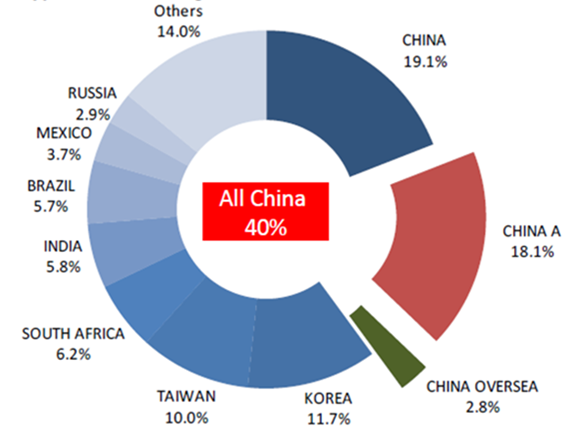
Source: MSCI as at 31 March 2015. Based on the hypothetical scenario of full inclusion of A-shares into the MSCI Emerging Markets Index and the announced inclusion of overseas China (e.g. Baidu and Alibaba). There is no suggestion here on if and when the inclusion will happen.
Of course, this is all hypothetical at this stage. MSCI may begin to include A shares in their global indices in a constrained way from 2016 (assuming access continues to improve), but it will likely take several years for full inclusion. However, this is an interesting glimpse of what the future might look like.
There were a number of trips this month. Our Asia banks/insurance specialistwas back in Beijing to look at China financials along with one of our fixed income sovereign analysts. They met economic advisors to the government, regulators and local officials (PBOC, CBRC, MOF, DRC of State Council, NDRC, CASS, Ministry of Housing, IMF, US Embassy) to get updates on policy and the macro-economic outlook after some very weak growth data. Despite the euphoria in markets, nothing has changed their view from the broad stance outlined above. Good progress has been made in containing some systemic risks (such as shadow banking and local government debt) which had troubled investors a couple of years ago. But in other areas such as corporate sector indebtedness and industrial overcapacity, the government continues to ‘extend and pretend’ without taking the pain that should be taken for true adjustments to happen.
Our Indian small cap analyst joined US colleagues in India to look at the largely unlisted internet space in India. A number of portfolios across the firm (though not our Asian portfolios) own small positions in private placements in Indian internet companies, and one or two have listed holdings as well. Some standard metrics like India’s high population, very low internet penetration and exponential growth in these companies’ revenues off a low base make the sector look very attractive on a 5 to 10 year view. E-commerce could leapfrog the development of organised retail in India (which has been slow) given its convenience, product accessibility and attractive pricing. On the other hand, our analyst noted a number of reasons to be cautious, such as high levels of competition (including from global players, something that has been much of less of an issue for a number of the Chinese internet plays), poor quality infrastructure/logistics, a lack of local language websites and, importantly, low levels of income and an under-banked population (very low credit card penetration).
Another two analysts from the team were also in India in April, looking at Indian pharmaceutical companies. These stocks have generally been strong performers in recent years and the trip served to reinforce conviction in the execution capability of the leading players. Price increases and strong demand in their domestic market lead to healthy margins. A number of portfolios have topped up positions post trip.
Finally, at the end of the month Portfolio Managers Anh Lu and Eric Moffett, were joined by one of our analyst team on a visit to Macau. After booming between 2011 and 2013, Macau gaming stocks have been hit hard by the anti-corruption campaign in China. The team came away continuing to believe that the outlook for the next year remains highly uncertain. However, we also continue to believe that the Chinese government wants to make a success of Macau as a gaming and tourism destination. Even if the VIP gamers fail to return, mass and premium mass gamblers should grow again once anxiety around the corruption crackdown eases. Something we’ll watch closely for in the months ahead.
2015-GL-2034
重要情報
当資料は、ティー・ロウ・プライス・アソシエイツ・インクおよびその関係会社が情報提供等の目的で作成したものを、ティー・ロウ・プライス・ジャパン株式会社が翻訳したものであり、特定の運用商品を勧誘するものではありません。また、金融商品取引法に基づく開示書類ではありません。当資料における見解等は資料作成時点のものであり、将来事前の連絡なしに変更されることがあります。当資料はティー・ロウ・プライスの書面による同意のない限り他に転載することはできません。
資料内に記載されている個別銘柄につき、売買を推奨するものでも、将来の価格の上昇または下落を示唆するものでもありません。また、当社ファンド等における保有・非保有および将来の組入れまたは売却を示唆・保証するものでもありません。投資一任契約は、値動きのある有価証券等(外貨建て資産には為替変動リスクもあります)を投資対象としているため、お客様の資産が当初の投資元本を割り込み損失が生じることがあります。
当社の運用戦略では時価資産残高に対し、一定の金額までを区切りとして最高1.265%(消費税10%込み)の逓減的報酬料率を適用いたします。また、運用報酬の他に、組入有価証券の売買委託手数料等の費用も発生しますが、運用内容等によって変動しますので、事前に上限額または合計額を表示できません。詳しくは契約締結前交付書面をご覧ください。
「T. ROWE PRICE, INVEST WITH CONFIDENCE」および大角羊のデザインは、ティー・ロウ・プライス・グループ、インクの商標または登録商標です。
ティー・ロウ・プライス・ジャパン株式会社
金融商品取引業者関東財務局長(金商)第3043号
加入協会:一般社団法人日本投資顧問業協会/一般社団法人投資信託協会
