

Asian Diary - March 2015
Stock markets in Asia ex Japan once again outperformed broader EM and the MSCI ACWI in March with a return of 0.42%, making a gain of 4.90% for Q11. It was a V-shaped month, with uncertainty around the US policy outlook creating volatility on the downside and the upside. However, within Asia there continues to be wide dispersion in performance. China was the top performing market (2.4%), though MSCI China lagged the domestic A-Share market which continued its strong run (+16% in the month as the government continues to actively encourage retail investors into the market). Economic data out of China continues to be weak, and at the National People’s Congress in early March, Premier Li Keqiang highlighted they expect growth to be “around 7%” this year, signaling a further slowdown. The market is expecting ongoing policy easing as a result. India was the worst performing market (-4.1%) despite an interest rate cut and some successes in terms of reform momentum. Investors were a little nervous in the face of still weak economic data and disappointing earnings from several sectors.
As for our team diary, whilst Hong Kong hosted one of the largest regional investment conferences of the year for a week at the end of the month, March was a less active month for travel by the team.
Our technology analyst was in Barcelona at the start of the month, along with the rest of our global technology team, for one of the key tech conferences of the year. Her attendance at the Samsung Galaxy S6 launch gave her advance visibility into likely strong orders for Samsung Electronics’ new phone.
Portfolio Managers Gonzalo Pángaro and Mark Edwards from our Emerging Markets team, were in the ASEAN region. They came away confident about the outlook for the Philippines, given growth momentum there, but expect 2016 to be a better year for Thailand and Indonesia than 2015 as it will take more time for reforms to come through.
WHAT HAPPENS TO ASIA WHEN US RATES RISE?
With a little less to talk about on the travel front this month, I have decided instead to look at the key issue facing the Asia region this year…What happens to Asia when US rates go up? We have had many discussions around this theme so far this year and what follows is a summary of why we believe Asia is relatively well placed to deal with any (gradual) rate rises coming from the Fed:
- The gap between real rates in Asia and the US is very high by historical standards, providing some room for Asian economies to continue easing policy even if the US hikes.
- Compared to 2013, when we had the ‘taper tantrum’ in response to the Fed’s announcement about an end to QE, some of Asia’s external vulnerabilities have closed – especially Current Account deficits (see Thailand and India)
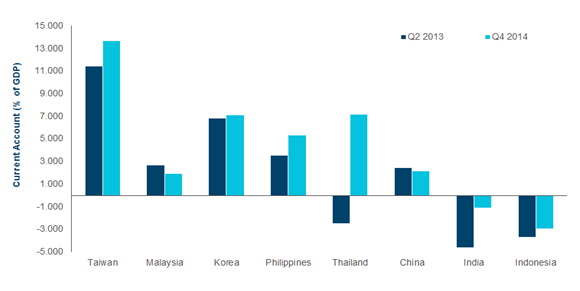 Source: Haver Analytics, as at 31 December 2014
Taking a view on the current environment compared to 1996 (ie pre the Asian Financial Crisis)…
- The region now runs a current account surplus in aggregate compared to a deficit back then.
- One of the key channels through which the Fed impacts EM is portfolio flows. Debt flows have been substantial into some markets in Asia in recent years. Indonesia, Malaysia, Thailand and South Korea look most at risk from a reversal in flows. India and China are better placed as controls limit foreign bond participation.
- A key difference between now and 1997 is that exchange rates are now freely floating in the region. Whilst some Asian currencies appear a little over-valued on Real Effective Exchange Rates, they are in aggregate less over valued than in 1997. However, we should not rule out more currency weakness in Asia / USD strength. Policy makers will likely allow their currencies to take much of the strain of any outflow, just as they did in 2013.
The real question facing us is how fast the hiking cycle is, and what the terminal rate is. Gradual hikes with a terminal rate at fairly low levels by historical standards should be digestible for us in Asia. But we need to be aware that the market could be surprised by more aggressive hikes, and that will then transmit to more volatility in Asia (and broader EM). Under such a scenario, we would seek to use any downside volatility to buy good long term growth stories, especially in places like India.
2015-GL-2034
重要情報
当資料は、ティー・ロウ・プライス・アソシエイツ・インクおよびその関係会社が情報提供等の目的で作成したものを、ティー・ロウ・プライス・ジャパン株式会社が翻訳したものであり、特定の運用商品を勧誘するものではありません。また、金融商品取引法に基づく開示書類ではありません。当資料における見解等は資料作成時点のものであり、将来事前の連絡なしに変更されることがあります。当資料はティー・ロウ・プライスの書面による同意のない限り他に転載することはできません。
資料内に記載されている個別銘柄につき、売買を推奨するものでも、将来の価格の上昇または下落を示唆するものでもありません。また、当社ファンド等における保有・非保有および将来の組入れまたは売却を示唆・保証するものでもありません。投資一任契約は、値動きのある有価証券等(外貨建て資産には為替変動リスクもあります)を投資対象としているため、お客様の資産が当初の投資元本を割り込み損失が生じることがあります。
当社の運用戦略では時価資産残高に対し、一定の金額までを区切りとして最高1.265%(消費税10%込み)の逓減的報酬料率を適用いたします。また、運用報酬の他に、組入有価証券の売買委託手数料等の費用も発生しますが、運用内容等によって変動しますので、事前に上限額または合計額を表示できません。詳しくは契約締結前交付書面をご覧ください。
「T. ROWE PRICE, INVEST WITH CONFIDENCE」および大角羊のデザインは、ティー・ロウ・プライス・グループ、インクの商標または登録商標です。
ティー・ロウ・プライス・ジャパン株式会社
金融商品取引業者関東財務局長(金商)第3043号
加入協会:一般社団法人日本投資顧問業協会/一般社団法人投資信託協会
