

Global Fixed Income: With Greater Volatility on the Horizon, Investors may Need a Different View.
EXECUTIVE SUMMARY
- As markets contend with the prospect of reduced support from the U.S. Federal Reserve, especially at a time when global growth is fragile, we anticipate higher volatility in rates, spreads, and currencies.
- In this new environment, sourcing income and managing risks will be crucial. Investors may do better if they have exposure to a broader spectrum of investment opportunities.
- There should also be more focus on the active use of different opportunities in countries that issue government bonds, as well as credit markets to build a more robust fixed income portfolio.
- Maintaining the traditional values of fixed income, by providing steady income, a lower correlation to equities, but also affording protection against potentially higher interest rates should remain important.
How the U.S. Federal Reserve manages its exit from emergency liquidity programs will have important implications for all asset markets and could increase volatility. Meanwhile, monetary policies are also becoming less synchronized globally. Even among the major economies, which coordinated emergency monetary policy easing in 2008, there is currently more dispersion between macroeconomic cycles and fiscal and monetary responses. In practice, this means greater decoupling from the Federal Reserve. The complexity of the environment will require investors to be more flexible and innovative with their fixed income solutions.
REMOVE THE SHACKLES
A crucial element of any asset allocation exercise is the identification of the relevant opportunity set. The ability to be agnostic and look beyond a predefined opportunity set can help to create added value. An approach that considers the full spectrum of the fixed income universe can help to provide access to countries which behave independently to the U.S. and other major markets. Currently, there is a mixed picture for economic growth and inflation on a country-by-country basis. In markets where interest rates are rising, income opportunities can be sourced by exploiting steep yield curves, while more volatile foreign exchange markets can also offer opportunities.
Increasing the opportunity set to create a continuum between developed market sovereign bonds and emerging market sovereign bonds has many benefits. Emerging markets can sometimes offer the higher yields investors are yearning for, while the sheer diversity available to investors is also very appealing.
Of course, moving into these different areas can increase risks. However, these positions should, in our opinion, only ever represent a manager’s highest conviction and most compelling investment ideas.
GOING GLOBAL
Globalization has led to the tremendous expansion of opportunities available to fixed income investors. In the context of the global fixed income marketplace, regional or domestic-only approaches can be restrictive. Without access to different country bond markets, each having distinct economic and interest rate cycles, investors could miss potential performance enhancement and diversification.
The expanding global opportunity set has also seen the rise of new fixed income sectors, which are continuing to evolve and develop. Since the 2008 financial crisis, more companies in Europe are accessing the public debt markets for their financing needs, leading to the significant growth of the euro high yield asset class. Similar trends are occurring among companies in the emerging markets; the emerging market corporate debt market is the fastest growing fixed income asset class. In an increasingly diverging world, it is important for investors to use growth to their advantage.
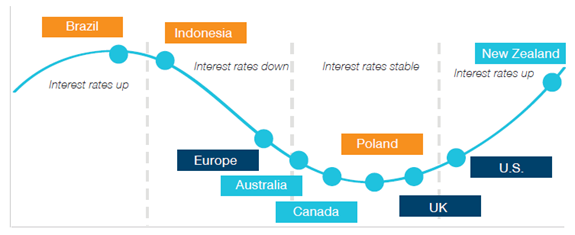
Figure 1 illustrates a hypothetical interest rate cycle between a selected number of developed and emerging markets. It shows how investors can benefit from countries at different stages of the interest rate cycle. Essentially, an investor can take advantage of relative country exposures in markets where interest rates are falling or stable versus countries where interest rates are rising.
Figure 1: Central banks are not all marching to the same beat
Illustrative Interest Rate Cycle
As of 31 December 2014
Sources: T. Rowe Price.
This not only allows investors to exploit interest rate differentials between countries, but investors can also adjust duration (a measure of price sensitivity to changes in interest rates) and yield curve exposures within the individual countries. If yields are attractive but currency valuations are not, currency risk can be neutralized to focus exclusively on country selection.
MORE THAN ONE WAY TO MANAGE DURATION RISK
With rates likely to rise in some countries, managing duration risk to shield income has become a prominent investment theme. Investors can take different approaches to achieve this goal. One option is to buy securities toward the front end of the curve, where rate sensitivity is low. With short rates in many developed markets anchored near zero, this means sacrificing yield. Still, short-dated, high-quality corporate credits can provide modest incremental yield over comparable sovereign debt, with a modicum of credit risk.
Investors can also purchase floating rate notes, such as bank loans, which feature near-zero duration. With resetting coupons, these assets should fare well in a rising rate environment—particularly if rates are climbing due to stronger economic growth. However, as investors move down in quality to earn higher yields, they exchange interest rate risk for credit and liquidity risk.
Tightening cycles should not always be viewed negatively though. Investors need to consider how much tightening the yield curve has discounted to look for valuation opportunities at different maturity points. Local rates are driven primarily by domestic economic conditions and policy responses. With individual countries at much different points in their rate cycles, investors can take advantage of this diversity with targeted duration exposures.
Rates are already rising in certain developing countries contending with higher inflation and depreciating currencies. In countries like Brazil and South Africa, the interest rate cycle is nearing a peak. Real yields are attractive, and cuts will begin at some point to stimulate sluggish economies. Other countries are experiencing muted inflation, providing scope for softer monetary policy. Eastern European countries such as Hungary and Romania, for example, are feeling the continent’s disinflationary trend while offering higher yields than in the eurozone’s periphery. Meanwhile, some local markets typically have low volatility compared with global rates. These stable local markets, which include Israel, Malaysia, and Thailand, should fare relatively well even when rates are rising elsewhere.
DOWNSIDE PROTECTION: WHAT GOES UP MUST COME DOWN
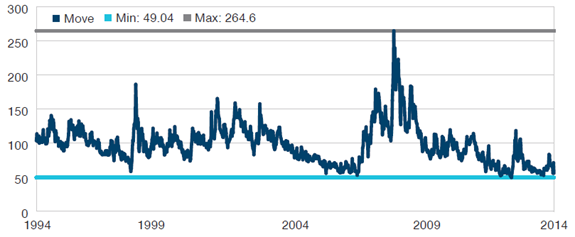
A prolonged stretch of highly accommodative monetary policy and the resultant hunt for yield have left bond valuations at fairly expensive levels across sovereign and credit markets. As major central banks have suppressed rates to quicken economic recoveries, bond investors have enjoyed low volatility and meaningful price appreciation. But now, with the U.S. Federal Reserve concluding its asset purchase program and potentially the first major developed market central bank to begin hiking rates (although this may be delayed due to the continued fall in oil prices), investors should be prepared for a more volatile ride.
DIVERSIFIED APPROACH TO EQUITY MARKET VOLATILITY
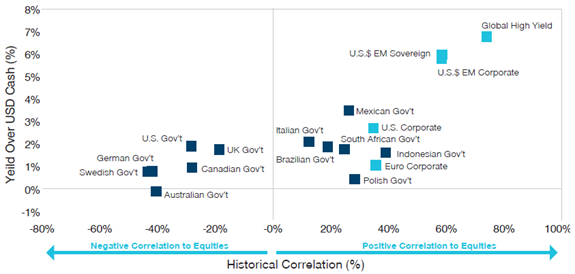
It is also important to remember why investors choose exposure to fixed income; they wish a diversification from equities. Figure 3 shows that lower-risk fixed income assets, such as high-quality government bonds (Australia, U.S., and Germany, for example), have a lower or even negative correlation to equities. This inverse relationship helps to smooth a portfolio’s volatility during periods of equity market weakness. High yield and emerging market debt have a higher correlation to equities. During times of market stress, however, they may not provide the same level of diversification as higher-quality fixed income assets.
Figure 3: Diversification should still be important for investors
Current yield above USD Cash vs. Historical Correlation
As of 31 December 2014
Last 10 Years
Sources: UBS, Barclays, J.P. Morgan, Bank of America/Merrill Lynch, S&P, MSCI, and T. Rowe Price. Yield shown is on a hedged basis in U.S. dollars. Volatility is based on the monthly returns each asset class hedged into U.S. dollars.
Credit also has a higher correlation to equities than global sovereign bonds. It diversifies within fixed income, but not against equities. Therefore, during times of market stress, credit’s ability to diversify and protect capital can be compromised. By relying too heavily on a credit allocation, investors may miss the defensive characteristics that a bond portfolio typically provides through more turbulent markets.
GLOBAL GROWTH DIVERGENCE WILL DRIVE EXCHANGE RATES
With economic growth in many countries remaining fragile, we have seen greater volatility in currency markets. A key question is whether the U.S. dollar can maintain its recent strength. Having rallied against nearly every global currency in 2014, widely held long positions in the dollar may be due for some consolidation. However, appreciation is still a distinct possibility if prevailing forces remain in place.
The euro looks vulnerable despite the currency bloc’s current account surplus. International flows into European assets have slowed, and if interest rate differentials between Europe and the U.S. widen, as they will at some point, the euro should weaken further. Meanwhile, after significant depreciation, the Japanese yen has become less enticing as a short candidate. The yen has declined dramatically since the Bank of Japan embarked on large scale quantitative easing. However, we are mindful of the possibility of safe-haven flows into the yen if risk-aversion rises.
Some of the most interesting trades are found outside of the major currencies. Pairing less-traded currencies—the Chinese renminbi versus the Australian dollar, for instance—provides a way to isolate relative value discrepancies. There are also compelling growth stories in smaller currency markets. The Mexican peso and Indian rupee should benefit over the long term from efforts to reform economies that have been performing below potential. Meanwhile, a less well-known currency, the Zambian kwacha, possesses a very high yield and is supported by strong growth and improving government finances.
Currencies can provide uncorrelated sources of return and add diversification to a portfolio. However, performance can be volatile and this creates pricing inefficiencies. Valuation anomalies need to be considered alongside fundamental factors.
WINNERS & LOSERS
Identifying a macro theme or a trend does not necessarily make a successful investment. Returns within the same country and industry can exhibit notable dispersion. Therefore, it is important to spend a great deal of one’s research efforts figuring out who really is winning in these markets.
Historically, it has been shown that it pays to be active when making country decisions. Performance data over the last decade indicates that not all sovereign bond markets win at the same time during a single calendar year period. This dispersion of returns offers opportunities for dynamic country selection. Indeed, rather than abandoning government bonds and removing duration risk, investors should embrace the sovereign markets’ income capabilities and its diversification benefits.
FINDING A BALANCE
The changing fixed income environment and the expanse of the global fixed income universe demands flexibility and a go-anywhere approach. Traditional approaches to bond market investing are often constrained to benchmarks that are dominated by the largest issuers of debt. That is not always the most optimal way to invest, particularly when interest rate cycles are turning. Investors need the tools to respond quickly in a world of multi-speed economic growth profiles and interest rate cycles.
Investors can still retain a high-quality portfolio, but they will need to be agile to manage risks. A portfolio built on the best investment ideas, which is less constrained by a benchmark, should fulfill fixed income’s role as a diversifier and provider of sustainable income and capital preservation.
The ultimate goal should be producing a balanced portfolio—finding the right diversification between duration, country allocation, bottom-up security selection as well as currency positioning to optimize returns—while also managing downside risk.
2015-GL-1237
重要情報
当資料は、ティー・ロウ・プライス・アソシエイツ・インクおよびその関係会社が情報提供等の目的で作成したものを、ティー・ロウ・プライス・ジャパン株式会社が翻訳したものであり、特定の運用商品を勧誘するものではありません。また、金融商品取引法に基づく開示書類ではありません。当資料における見解等は資料作成時点のものであり、将来事前の連絡なしに変更されることがあります。当資料はティー・ロウ・プライスの書面による同意のない限り他に転載することはできません。
資料内に記載されている個別銘柄につき、売買を推奨するものでも、将来の価格の上昇または下落を示唆するものでもありません。また、当社ファンド等における保有・非保有および将来の組入れまたは売却を示唆・保証するものでもありません。投資一任契約は、値動きのある有価証券等(外貨建て資産には為替変動リスクもあります)を投資対象としているため、お客様の資産が当初の投資元本を割り込み損失が生じることがあります。
当社の運用戦略では時価資産残高に対し、一定の金額までを区切りとして最高1.265%(消費税10%込み)の逓減的報酬料率を適用いたします。また、運用報酬の他に、組入有価証券の売買委託手数料等の費用も発生しますが、運用内容等によって変動しますので、事前に上限額または合計額を表示できません。詳しくは契約締結前交付書面をご覧ください。
「T. ROWE PRICE, INVEST WITH CONFIDENCE」および大角羊のデザインは、ティー・ロウ・プライス・グループ、インクの商標または登録商標です。
ティー・ロウ・プライス・ジャパン株式会社
金融商品取引業者関東財務局長(金商)第3043号
加入協会:一般社団法人日本投資顧問業協会/一般社団法人投資信託協会
