

Global Equities: Embracing Uncertainty
- While equity investors have enjoyed strong gains indicating a maturing bull market, the equity cycle has not reached its end. It is, however, normal and natural for the drivers of return to evolve over a market cycle.
- We are now at a point of inflection for those drivers, which will create both volatility and opportunity.
- Valuations rising from crisis levels have accounted for the majority of returns for equity investors. However, this is largely a theme of the past as multiples have reached previous cyclical highs in many cases. We are now entering a more complex and stock/industry specific environment.
- Investors remain cautious of stocks with cyclical exposure, and have done so through much of this bull market which has demonstrated an unusually defensive tone. However, increasing exposure to stocks with earnings sensitivity at this point in the market cycle should reap rewards. Defensive stocks retain premium valuation levels, implying selectivity is important to avoid disappointment.
- The ability to apply contrarian decision-making in a period where top-down concerns will re-emerge will be important. Challenging data points ahead for the global economy will present opportunities to refresh portfolios as volatility rises.
GLOBAL GROWTH—FROM RECOVERY TO CONFUSION
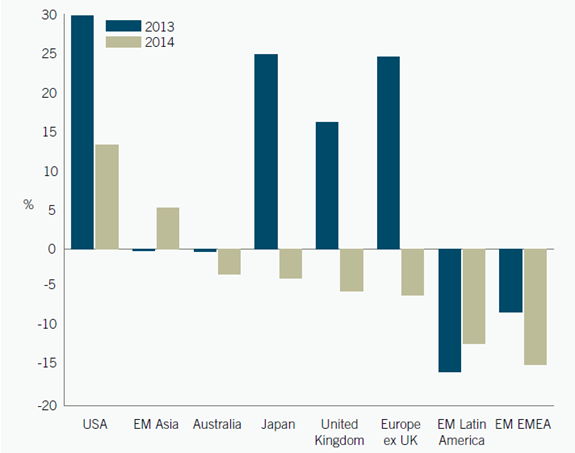
As we begin a new year, the uneven nature of global economic health is beginning to raise understandable questions about whether the equity cycle is coming to an end, or merely entering a new phase. US economic improvement continues to stand out versus peers, and this was reflected in yet another year of outperformance for US equities (Figure 1).
Figure 1: US markets lead the way
MSCI ACWI regional performance (USD)
Calendar Year Returns, as of 31 December 2014
Source: Factset, MSCI.
Elsewhere, economic data has softened in a period when many felt the developed world would start to show more encouraging signs of growth. Europe has seen its momentum stall, while the likelihood that we are entering a period of deflation has also increased, leading to the decision by the ECB to initiate QE until inflation is on a more stable path.
In Asia, Japan’s consumption tax rise has impacted business and consumer sentiment meaningfully, and after the initial boost to sentiment from shock and awe policymaking, 2014 signified an awkward period for ‘Abenomics’ as wages rose, but not as fast as inflation. Meanwhile, with the emerging world delivering a degree of economic dispersion unrivalled in over two decades, an increasingly complex backdrop for markets has shattered what was an unusually subdued volatility environment. In many respects, these trends are now injecting into stock prices the reality of what remains an uncertain outlook for the global economy.
SHOW ME THE PROFITS!
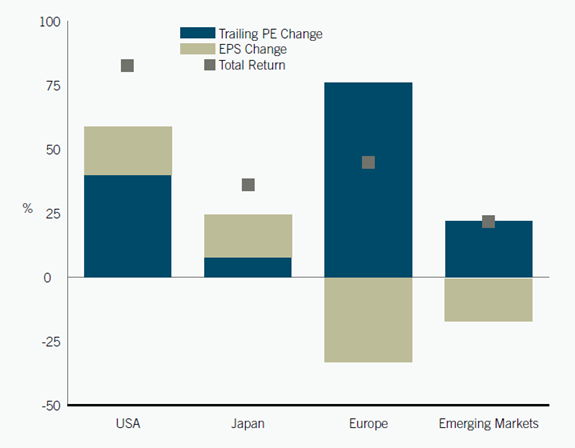
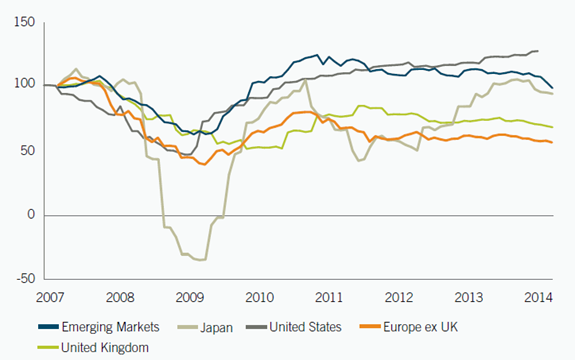
One source of this inflection in volatility is the realization that the recovery in stock markets has been driven largely by pessimism turning to optimism, as expressed by three years of rising valuations (Figure 2). We believe that this trend has been drawing to a conclusion for over a year, but is only now being given due recognition by the market. Multiple expansion has been particularly noticeable in Europe compared to other regions, as investors have placed more weight on the hope of a durable shift to growth and profitability in the region. This hope has yet to show itself in practice, with the likelihood that after two previous years of profit declines, corporate profits in Europe fell again in 2014. Figure 3 shows regional EPS growth since the height of the last global earnings peak in 2007, with very clear divergence in regional results.
Figure 2: What has been driving equity returns?
Regional returns and change in valuation and earnings
(3 Years Ending December 2014)
Source: Factset, MSCI. Calendar year returns in US dollars.
Figure 3: Earnings reality is very uneven
Regional profits (EPS) since last cycle peak
As of 31 December 2014
Sources: Goldman Sachs, Factset, Citi research, MSCI
The highlight clearly remains the US, where corporate profits are now approximately 30% above their previous cycle high, providing some foundation for what has been a spectacular market rally. Corporate America has squeezed business models to deliver record profitability, in spite of the anaemic recovery in economic growth.
The lack of fundamental improvement from the European corporate sector, taken in tandem with strong market appreciation, has now become a central risk to European stock returns, however. While sentiment has started to waver in Europe, we have begun to find more cause for optimism (albeit from a very cautious starting point), given a belief that we may be entering a period that proves to be more fertile for European corporate profits. Quantitative easing, a weakening euro, and easing austerity measures will certainly help, as will a strengthening US economy.
What is clear is that individually and collectively, a pattern of improving global corporate profits is central to equities offering investors enough return to compensate for the added volatility that the maturing equity cycle will bring. Encouragingly, there are ample examples of companies capable of delivering such improvement at this stage of the cycle, although the uneven nature of profits delivery is highlighting a need to be selective.
VALUATIONS—NOT A BARRIER IN ISOLATION
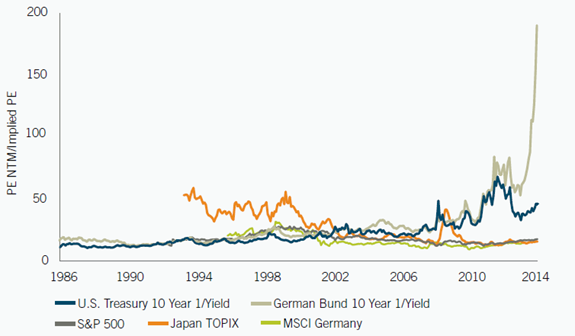
While many would disagree, we believe valuations are best described as ‘reasonable’ for where we are in the economic cycle. We would stress that this view is premised on our belief that we will see more broad-based global earnings growth. Figure 4 reflects developed and emerging market valuations on a forward-looking P/E basis versus history. With developed world equities trading around 15-times earnings, led by US equities trading on 17-times earnings, the days of extreme low valuations are firmly behind us.
Despite this, we do not believe that current valuations should be seen as a barrier to an outlook of further, albeit more modest, returns from global equities. We would strongly disagree with statements that equity valuations are excessive, and take comfort that there have been few signs of extreme capital flows that usually signify a bubble and an extreme valuation backdrop.
For those that view equity valuations as ‘extreme’, the comparison of equity valuations and sovereign bond valuations in Figure 4 (we show implied P/E’s for the US and German sovereign bond markets taking the inverse of the bond yield) gives some perspective.
The risk of a crisis disrupting the equity cycle is ever present however, with Greece’s unsustainable debt burden and Russia’s economic and political stresses creating genuine cause for concern. These are risks, together with the evolution of corporate profits, which we will monitor closely.
Figure 4: Equity valuations are reasonable
Price/Earnings Ratio (X)
As of 31 December 2014
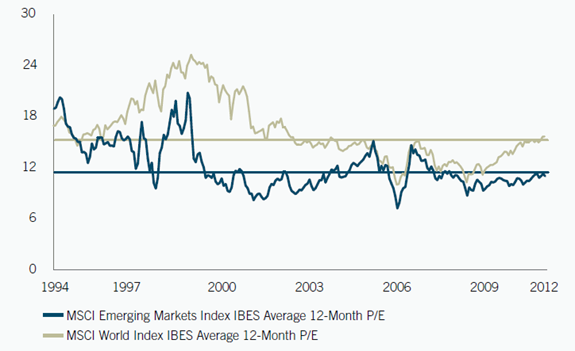
Comparing equity and bond P/E ratios As of 31 December 2014
Sources: IBES, Factset, MSCI.
BE ACTIVE IN THESE MARKETS
Accommodative monetary policy, a recovering US economy and low to negative cost inflation for corporates (aided by the collapse in oil prices) should all play a role in stimulating global growth and in assisting companies in their efforts to derive better results. While such a foundation is a solid starting point when thinking about global equity returns overall, especially when factoring in capital return from cash-rich corporate balance sheets, the outlook is inherently more stock-specific than it has been for some time. Policy stimulus will take time before we see any positive impact, raising the spectre of the backdrop softening before economic fundamentals improve.
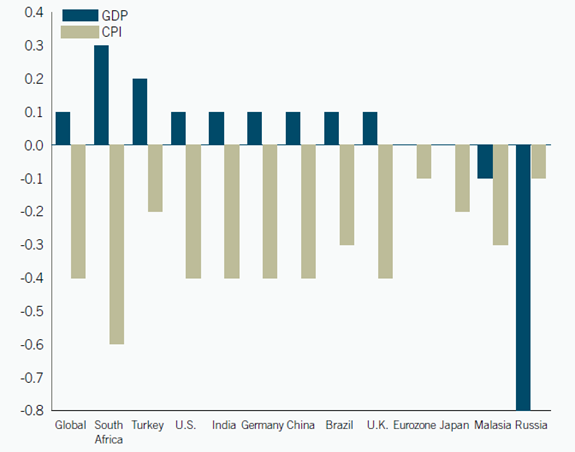
Therefore, for many active investors, 2015 is likely to present opportunities to invest on bouts of stock-specific volatility. This is certainly likely if disinflation in Europe turns to deflation this year, and weakness in global energy sector earnings on the recent halving of oil prices precedes any boost to global GDP growth (Figure 5, page 4). There will certainly be data points for market bears to point to in the coming months, but we maintain a positive view that we will see a slowly improving global economy.
Figure 5: Cheaper oil—Who benefits
Impact of a $10 fall in oil prices
As of 31 December 2014
Sources: BP Review of World Energy, Empirical Research Partners Analysis, and Citigroup.
US LEADING THE WAY
An important factor underlying our stable to improving outlook, is that the US economy continues to show signs of strength. Indeed, the economy recorded its fastest expansion in more than a decade in the third quarter of 2014, underlining a recovery which had faced renewed scepticism (and outright confusion) given severely weather affected data a year ago. While economic growth has continued to improve, we are now seeing wage, capex and consumption data trend higher. This has deepened our conviction in the self-sustaining nature of the recovery.
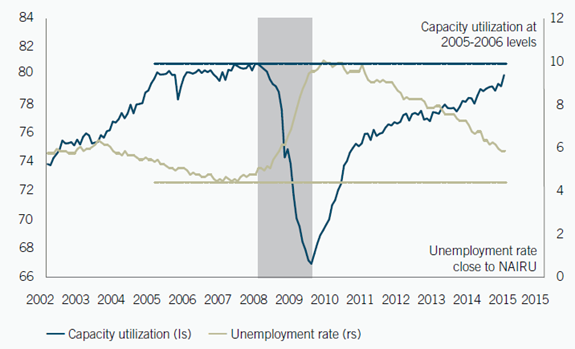
As capacity utilization and unemployment approach 2007 levels (Figure 6), wage inflation may prove a catalyst for the much debated interest rate rises in the second half of 2015. While it is reasonable to assume that the added disinflationary pressure of the recent oil price collapse may lead to an easing of cost inflation and a deferral of the first rate rise, the trend of US economic improvement is the more important factor to monitor in our view. While the market is intensely focused on the timing of the first Fed rate hike, the absence of any such hike would likely indicate a softening of economic data, a factor that will weigh more heavily and permanently on equity fundamentals and stock valuations.
Figure 6: The US backdrop is still improving
US capacity utilization and unemployment versus last cycle
As of 31 December 2014
Source: Fed, BLS, Haver Analytics, DB Global Markets Research.
ECONOMIC WEAKNESS AND QE
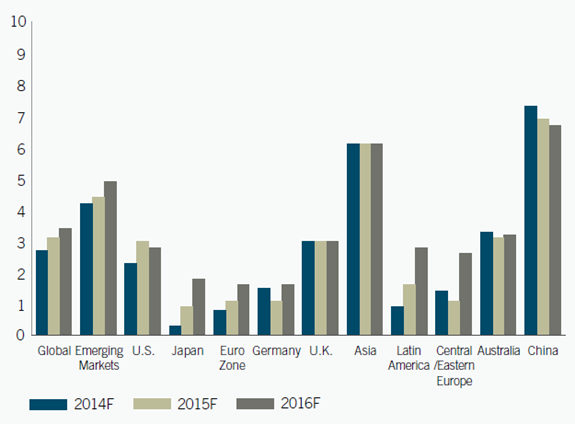
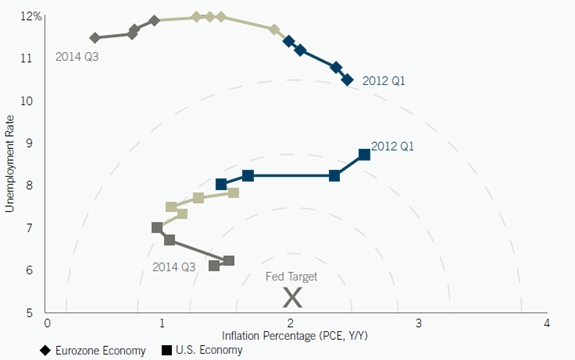
However, scepticism has been rising that a broadening of US economic strength translates to any benefit outside of the US, and by implication, whether there is a second stage to the global economic and equity cycle. This is understandable given the divergent growth backdrop in Europe (Figure 7, page 5), and the contrasting pictures of labor markets/job creation over the past three years (Figure 8, page 5). With the ECB now facing real risks to its primary policy objective of price stability (the avoidance of deflation) monetary policy is being eased to buy time for sentiment to improve among consumers and corporates who have remained more cautious than their US peers. While the effectiveness of further easing is unknown, the recognition among European policy makers of the need to act is a positive, as is the weakening of the euro for the corporate sector which may face anaemic domestic demand trends over the medium term.
In Japan, easy monetary policy has continually surpassed even the most extreme expectations; the yen has declined materially and inflation expectations have risen, while Prime Minister Abe has delivered a positive wealth effect on the back of a rising stock market. Investor sentiment, however, remains mixed. Despite aggressive monetary policy and a weaker, more export-friendly yen there is ongoing scepticism over the lack of structural change needed to address Japan's lack of domestic demand and consumption. Evidence of change will be necessary for investors to be assured that Japan is capable of leaving its ‘lost decades’ behind, but this is likely to be a multi-year process and inherently unsatisfying for those looking for near-term signs of change.
Figure 7: Global growth remains uneven
Real GDP growth estimates by country/region
As of 30 November 2014
Source: Citigroup, IMF.
Figure 8: Diverging monetary paths
Unemployment and inflation since 2012 in the US and Europe
As of 30 September 2014
Sources: Evercore ISI, Factset.
WHERE ARE THE OPPORTUNITIES GIVEN THE POSITION IN THE MARKET CYCLE?
There are clear concerns in the market that beyond QE, there is no fundamental improving 'bull' case for global equities. However, this aggregate top-down perspective on the world belies the ongoing breadth of stock-specific fundamentals that indicate meaningful return opportunities. While it is very common for sentiment to soften in the mid-stages of the equity market cycle, our view has consistently been that drivers are in place for economic stability and improvement. Linking this backdrop to stocks, companies which deliver improving business fundamentals still present excellent return opportunities.
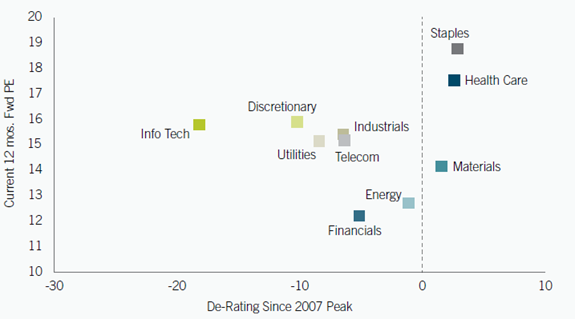
While cyclical sentiment has been tested in recent months, a focus on areas of the stock universe with above-average economic sensitivity emerged in 2013, balancing what had previously been an unusually defensive equity market rally. With investors now expressing renewed concerns over drivers of economic growth causing a dampening of return-seeking behavior, we believe that stock specific opportunities are once again emerging in high-quality cyclical businesses. Even without the consideration of earnings expectations, when comparing industrials and consumer discretionary stocks to more defensive peers, valuations are favorable (Figure 9).
Poor performance of many emerging markets, has also led to EM indices looking optically cheap versus DM indices. It has certainly been unusual in the context of history to see EM stocks perform so badly in what has been a very strong period for global equities (see EM section on page 7 for further opinion). We believe the unusually defensive pattern of this market rally speaks in part to elevated conservatism post the shock of 2008. One question over the longer term is whether risk appetites will return. Perhaps more important than investor sentiment, we are waiting for evidence of normalized risk appetites at the corporate level, given management teams have remained cautious of investing in a period where returning capital to investors has been so rewarded via stock prices. A return to risk seeking behavior by corporates is necessary to assume a normalization of global demand trends.
Figure 9: Defensives retain previous valuations
Global sectors—Valuations and comparison to 2007 peak
As of 31 December 2014
Sources: FactSet, Wilshire Atlas, MSCI/S&P GICS Sectors. Analysis by T. Rowe Price Associates, Inc.
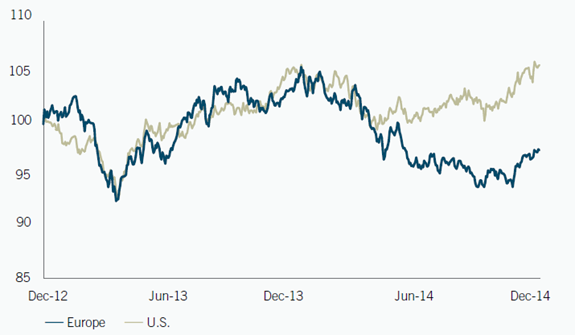
In the meantime, we believe caution is creating opportunity within areas that remain unloved by the market, including cyclical growth stocks in both the developed and emerging world. To evidence this caution, European cyclical stocks have been weak for much of the last year (Figure 10), even when European stocks as a whole were rising. This latter trend prompted us to add to high-quality European-listed industrials (to add to an existing overweight in the sector), as well as selective consumer discretionary stocks as the market reached a point of elevated fear last autumn.
We have also maintained an overweight position in emerging Asian stocks, in economies and industries that remain fertile with respect to year-on-year compounded profits delivery (see EM section). Such growth may merit a larger premium as investors acknowledge the end of the multiple expansion stage of the equity cycle and look to other drivers to stock returns. Elsewhere, we remain very selective (and underweight) the most defensive segments of the market, believing valuations for the most defensive businesses will continue to normalize versus the market over the next stage of the cycle.
Figure 10: Shifting sentiment in 2014
Cyclical vs. Defensive Index
As of 31 December 2014
Sources: Citigroup. Factset.
WHERE DO WE GO FROM HERE?
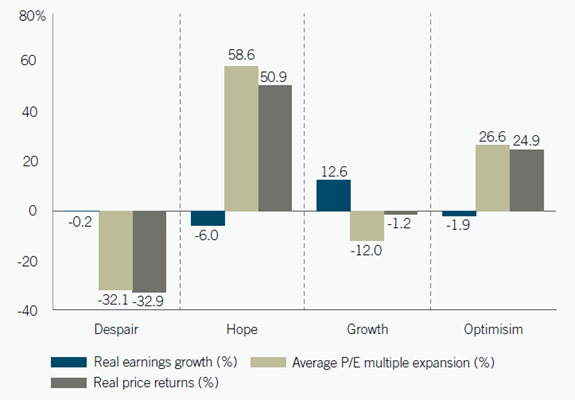
We have enjoyed a remarkable period for equity investing over the last six years, with the opportunity to buy exceptional companies at prices we are unlikely to see again in our generation. One key foundation to success in recent years has been the ability to stay engaged with stocks during periods of distressed sentiment in order to benefit from swift transitions from “Despair” to “Hope.” While it is always tempting to wait for patterns of recovery to be established, history reflects that the early identification of fundamentals stabilizing, or the ‘stop getting worse’ point, is key to return generation (Figure 11).
History also suggests that as we move into the “Growth” phase of the market cycle, investors may lose faith as economic momentum lulls and some companies disappoint versus raised expectations. The reality remains that corporate fundamentals over the next 12−24 months will dominate any near-term uncertainty, and we believe the equity cycle has room to continue. Specifically, we believe we are in the ‘Growth’ phase of the equity cycle—a world of dispersed valuations and corporate outcomes where sentiment will provide opportunity as it shifts stock prices more aggressively. It will therefore be important to be active when market sentiment overreacts to disappointment. A contrarian stance will be required at times, but with a focus on stock fundamentals this should ultimately reap long-term rewards for global investors.
Figure 11: Anatomy of an equity market cycle
Phases of the "typical" US equity market cycle
As of 31 December 2014
Source: DataStream, Goldman Sachs Global Investment Research.
IS THE CYCLE TURNING FOR EMERGING MARKETS?
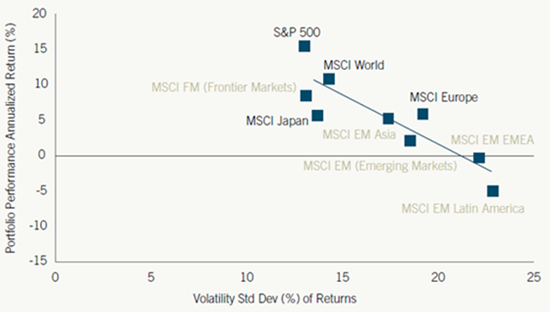
Emerging market investors have suffered more than most in a period that has been extremely profitable for global equity market participants. Indeed, so bad has the trend of underperformance been that “Emerging Markets” have defied investment theory over the five years ending 2014, with the delivery of consistently higher volatility for consistently lower returns (Figure 12).
Figure 12: Emerging markets—More risk for less return
EM and DM returns and volatility by region
(1 January 2010-31 December 2014, in USD)
Sources: Robert Shiller, DataStream, Goldman Sachs Global ECS Research, FactSet, MSCI, Zephyr Style Advisor.
We believe this period is unusual, with many developed market stocks having been through a phenomenal period of re-rating from the trough, in a period when the emerging market growth premium has been normalizing from an unsustainable peak. The emerging market equity story has evolved and today, fundamentals are now arguably as diverse as ever. This evolution and fracturing of the EM story certainly requires understanding. Importantly, uncertainty and disappointment has already created opportunities to acquire hitherto much sought after stocks at extreme valuations during the height of the emerging market "taper tantrum crisis" in 2013. Selectivity is key, however, as is a clear understanding of what stocks are best positioned for the next leg of the emerging market story.
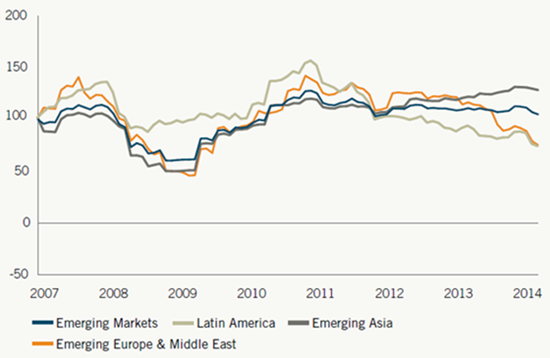
One key factor to consider is the likely end to the tailwind delivered by the commodity super cycle. With Chinese capital investment now trending downward after a decade defining period for commodity prices (and producers), we view fundamentals within segments of the EM opportunity as permanently altered versus history. This change in landscape has already weighed on commodity producing nations that have become reliant on revenues, especially where policymaking has been seen as ignoring the changing global backdrop. Taking Latin America as an example, the combination of waning sentiment, together with the reality of rapidly decelerating corporate profits (Figure 13), has made for an unpleasant cocktail.
China itself remains a source of scepticism given the economies slowing growth. However, we view this soft landing as a natural by-product of the country’s transition away from an economy driven by a government funded (and increasingly debt funded) infrastructure build out. Growth rates will undoubtedly be lower going forward, but at more sustainable levels driven to a larger degree by consumption growth. As a result, we believe that many mass-consumer segments will continue to expand rapidly even as the Chinese economy slows in aggregate.
Figure 13: Latin America and EMEA markets prove a drag on overall EM profits
Regional EM profits (EPS) since last cycle peak
As of 31 December 2014
Sources: FactSet, Citi Research, MSCI.
2015-SS-61
重要情報
当資料は、ティー・ロウ・プライス・アソシエイツ・インクおよびその関係会社が情報提供等の目的で作成したものを、ティー・ロウ・プライス・ジャパン株式会社が翻訳したものであり、特定の運用商品を勧誘するものではありません。また、金融商品取引法に基づく開示書類ではありません。当資料における見解等は資料作成時点のものであり、将来事前の連絡なしに変更されることがあります。当資料はティー・ロウ・プライスの書面による同意のない限り他に転載することはできません。
資料内に記載されている個別銘柄につき、売買を推奨するものでも、将来の価格の上昇または下落を示唆するものでもありません。また、当社ファンド等における保有・非保有および将来の組入れまたは売却を示唆・保証するものでもありません。投資一任契約は、値動きのある有価証券等(外貨建て資産には為替変動リスクもあります)を投資対象としているため、お客様の資産が当初の投資元本を割り込み損失が生じることがあります。
当社の運用戦略では時価資産残高に対し、一定の金額までを区切りとして最高1.265%(消費税10%込み)の逓減的報酬料率を適用いたします。また、運用報酬の他に、組入有価証券の売買委託手数料等の費用も発生しますが、運用内容等によって変動しますので、事前に上限額または合計額を表示できません。詳しくは契約締結前交付書面をご覧ください。
「T. ROWE PRICE, INVEST WITH CONFIDENCE」および大角羊のデザインは、ティー・ロウ・プライス・グループ、インクの商標または登録商標です。
ティー・ロウ・プライス・ジャパン株式会社
金融商品取引業者関東財務局長(金商)第3043号
加入協会:一般社団法人日本投資顧問業協会/一般社団法人投資信託協会
