

Are Central Banks Becoming Less Predictable?
EXECUTIVE SUMMARY
Investors are finding it harder to predict the actions of global central banks. Having previously provided forward guidance and clear targets, investors are now left to deal with less information and more uncertainty. This has had the tendency to create more volatility within markets.
In this Price Point, Arif Husain, Head of International Fixed Income for T. Rowe Price, highlights that investors will need to be more flexible when it comes to central bank actions, but, at the same time, opportunities will be created for fixed income investors.
By now, it is obvious to most observers that central banks have departed a long way from orthodox monetary policy. Many central banks have become more efficient in their approach by releasing regular official forecasts on growth and inflation, but in many ways, it has become increasingly difficult to anticipate their short-term actions. At the same time, monetary policies have become less synchronized globally. Even among the major economies, which coordinated emergency monetary policy easing in 2008, there is currently more dispersion between macroeconomic cycles and fiscal and monetary responses. In practice, this means greater decoupling between major central banks and, in particular, against the trend set by the U.S. Federal Reserve (Fed).
A MOVE AWAY FROM CONVENTION
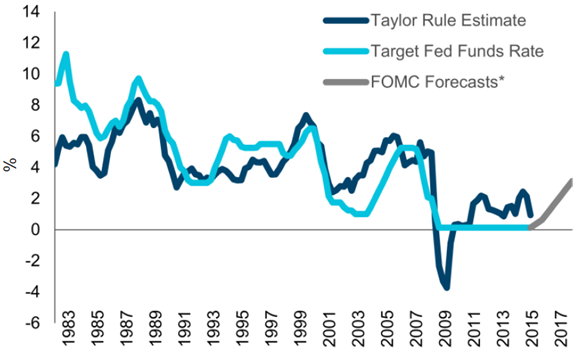
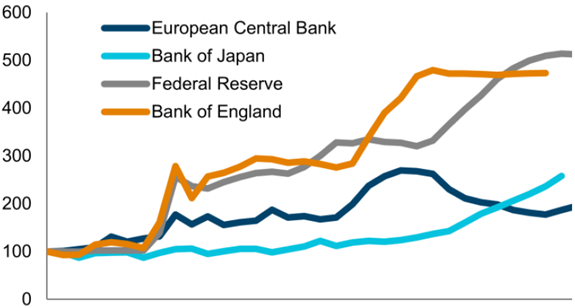
Historically, we have been able to anticipate with some certainty central bank action. In the past, central banks have been more accommodating with clear formal targets making their responses more measurable. In the U.S., the Fed would target economic growth and inflation, while the European Central Bank (ECB) and the Bank of England (BoE) would target an explicit inflation rate. But the financial crisis forced central banks to move away from their traditional monetary approach (Figure 1). Much of this stemmed not only from the need to deal with the crisis, but also to fulfil their new role of sustaining liquidity and supporting the recovery of the financial system. This resulted in the adoption of extraordinary monetary policy across the financial world, with huge amounts being taken onto central bank balance sheets (Figure 2).
Figure 1: Not Following the Rule—Taylor Rule Approach
Sources: Federal Reserve, Haver Analytics, and T. Rowe Price (as of April 30, 2015)
Increasingly, though, we have seen a more divergent world, with some central banks hiking rates to deal with higher inflation, while others have cut rates and adopted quantitative easing (QE) as their economies have slowed and, for some, entered a disinflationary cycle. Many developing countries have also abandoned exchange rate pegs and allowed their currencies to float more freely, effectively untethering domestic monetary policy from foreign central banks.
Figure 2: Whatever It Takes! Evolution of Central Bank Balance Sheets
Base 100 = December 31, 2006
Sources: European Central Bank (as of March 31, 2013), Federal Reserve (as of March 31, 2015), Bank of England (as of September 30, 2014), and Bank of Japan (as of December 31, 2014)
UNCERTAINTY REMAINS THE BUZZ WORD
For investors today, we have to rethink the way we anticipate central banks actions. Do central banks continue with the QE experiment and negative interest rates? Does pre-emptive easing mean that central banks will do whatever it takes to avoid a crisis? Or are some central banks now just following the QE path adopted by some of the largest central banks in the world, and if it is good enough for some, then it is good enough for others?
Whether central banks can revert back to “normal monetary policy” remains to be seen. In the U.S., the timing of the first interest rate hike continues to loom ominously over asset markets. The concern over this decision is understandable— after six years of the fed funds rate being virtually 0%, any move to a nonzero rate represents a major regime change for the economic and investment backdrop. Once the process starts, markets will become increasingly worried about the contours of the full rate hike cycle and will begin to ask some further questions: (1) When will the next hike occur? (2) How often will there be additional rate increases? (3) At what level will the cycle end? (4) And more importantly, can historical models still help to predict the degree of interest rate moves central banks are prepared to carry out?
This last point is causing much anxiety, and the Fed has struggled with the concept of official forward guidance and, therefore, decided to abandon it back in 2013. At the same time, the BoE also decided to halt its forward guidance policy in February 2014, just six months after its initial introduction. The Fed recently said that the timing of the first interest rate increase will be determined by data, but it is uncertain how policymakers will react to individual data points.
Several participants have judged that economic data already warrants normalization of monetary policy. However, others are now anticipating that the effects of energy price declines, lukewarm job numbers, and the dollar's appreciation will continue to weigh on sentiment and inflation in the near term, suggesting that conditions would not be appropriate enough to begin raising rates until later this year. Speaking for the committee, Chair Yellen stated at her March 18 press conference that, “We don’t want to and don’t think it’s appropriate at this point to provide calendar-based guidance.” However, all this is doing is causing greater conjecture and uncertainty and, therefore, more market volatility.
JUMP BEFORE YOU ARE PUSHED
Meanwhile, the ECB has now faced up to the real risks to its primary policy objective of price stability (the avoidance of deflation) by adopting full-blown QE. While the effectiveness of QE and easing are yet unknown, we can expect the ECB to follow it through, at least until September 2016. What will be a concern, however, is when we approach the end of QE as we did with the U.S. “taper tantrum” back in 2013. What does an ECB “taper” look like? Will markets react the same way or has a precedent been created for markets to react in a much more sanguine way?
What is interesting is the number of central banks outside of the ECB jumping on the easing bandwagon. The Nordic countries have been especially busy, with Norway, Denmark, and Sweden all cutting their interest rates. Denmark reduced its lending rate to 0.05%, while Sweden’s repo rate has actually moved into negative territory. In a similar move, the Swiss Central Bank has cut its target range repeatedly. The policy rate target range is now set at -1.25% to -0.25% compared with -0.7% to +0.25%1 previously. Meanwhile, across Eastern Europe, we have also seen several countries ease monetary policy.
EUROZONE— POSITIVE DRIVERS ALREADY IN PLACE
Regardless of QE, there are forces coming together that should be supportive for the eurozone:
Weaker euro — The real trade-weighted value of the euro has declined by more than 10% since March 20142. Admittedly, QE has helped to weaken the currency, but the notion that the ECB would remain ultra-dovish for years to come by keeping interest rates near zero has pushed the common currency lower. Consensus estimates are for the depreciation of the euro to add approximately 0.6% to real GDP over the next two years.
Lower oil prices — The euro price of oil has fallen by almost 50% since last summer. Granted, the forward curve implies that about a quarter of this decline will be unwound over the next two years. Nevertheless, even taking this into account, the IMF estimates that lower oil prices will boost GDP in the euro area by around 0.9% as a result.
Fiscal policy neutral/positive — With the primary balance of the eurozone now in surplus, there should be less fiscal drag across large parts of Europe, helping consumer sentiment.
Easing of deleveraging pressures — The flow of credit to the private sector is picking up. This is partly because borrowing yields have declined sharply and banks are relaxing lending standards, but it is also because the dearth of lending over the past few years has generated pent-up demand for new credit.
ILLIQUIDITY + UNCERTAINTY = VOLATILITY + OPPORTUNITY
Quantitative easing, preemptive monetary actions, negative interest rate policies, and also less guidance, have all contributed to greater uncertainty in investors’ minds and have increased volatility. However, as experienced investors, we know that volatility creates opportunity. At the same time, investors may find less liquidity in markets, which is a concern for which we have to be prepared.
However, the increase in volatility has seen, and will continue to see, opportunities being created in a number of different countries. For example, certain Asian central banks have recently been reluctant to cut interest rates despite a clear disinflationary environment, creating investment opportunities to overweight local bond markets in countries like South Korea and Thailand. Other markets, on the other hand, have tended to overprice the risk of further central bank easing, leading, in some cases, to stretched valuations. The rapid correction witnessed in April in the German bond market is also a good reminder that we should not get carried away. The important point to make is that in a more uncertain environment, there still remain many opportunities for fixed income investors.
What is crucial, though, is that investors have the tools to respond quickly in a world of multispeed economic growth profiles, interest rate cycles, and inflationary/deflationary environments. Investors can still retain a high-quality portfolio, but they will need to be agile to manage risks. In the end, the main objective should be to produce a balanced portfolio and to find the right harmony of market exposure between countries, duration, and curve positioning while also generating diversification and managing downside risk to deal with this more uncertain world.
Footnotes
*Median of FOMC participants’ forecasts as presented in the Summary of Economic Projections (SEP). Glenn Rudebush Methodology. “The Fed’s Monetary Policy Response to the Current Crisis,” May 22, 2009, FRBSF Economic Letter
The “Taylor rule” is a formula developed by Stanford economist John Taylor. It was designed to provide “recommendations” for how a central bank like the Federal Reserve should set short-term interest rates as economic conditions change to achieve both its short-run goal for stabilizing the economy and its long-run goal for inflation. Specifically, the rule states that the “real” short-term interest rate (that is, the interest rate adjusted for inflation) should be determined according to three factors: (1) where actual inflation is relative to the targeted level that the Fed wishes to achieve, (2) how far economic activity is above or below its “full employment” level, and (3) what the level of the short-term interest rate is that would be consistent with full employment. The rule “recommends” a relatively high interest rate (that is, a “tight” monetary policy) when inflation is above its target or when the economy is above its full employment level and a relatively low interest rate (“easy” monetary policy) in the opposite situations. It has served not only as a gauge of interest rates, inflation, and output levels, but also as a guide to gauge proper levels of the money supply since money supply levels and inflation meld together to form a perfect economy. It allows us to understand money versus prices to determine a proper balance because inflation can erode the purchasing power of the dollar if it’s not levelled properly.
2015-GL-1914
重要情報
当資料は、ティー・ロウ・プライス・アソシエイツ・インクおよびその関係会社が情報提供等の目的で作成したものを、ティー・ロウ・プライス・ジャパン株式会社が翻訳したものであり、特定の運用商品を勧誘するものではありません。また、金融商品取引法に基づく開示書類ではありません。当資料における見解等は資料作成時点のものであり、将来事前の連絡なしに変更されることがあります。当資料はティー・ロウ・プライスの書面による同意のない限り他に転載することはできません。
資料内に記載されている個別銘柄につき、売買を推奨するものでも、将来の価格の上昇または下落を示唆するものでもありません。また、当社ファンド等における保有・非保有および将来の組入れまたは売却を示唆・保証するものでもありません。投資一任契約は、値動きのある有価証券等(外貨建て資産には為替変動リスクもあります)を投資対象としているため、お客様の資産が当初の投資元本を割り込み損失が生じることがあります。
当社の運用戦略では時価資産残高に対し、一定の金額までを区切りとして最高1.265%(消費税10%込み)の逓減的報酬料率を適用いたします。また、運用報酬の他に、組入有価証券の売買委託手数料等の費用も発生しますが、運用内容等によって変動しますので、事前に上限額または合計額を表示できません。詳しくは契約締結前交付書面をご覧ください。
「T. ROWE PRICE, INVEST WITH CONFIDENCE」および大角羊のデザインは、ティー・ロウ・プライス・グループ、インクの商標または登録商標です。
ティー・ロウ・プライス・ジャパン株式会社
金融商品取引業者関東財務局長(金商)第3043号
加入協会:一般社団法人日本投資顧問業協会/一般社団法人投資信託協会
