

Protecting Income in a Challenging Rate Environment
EXECUTIVE SUMMARY
- A prolonged stretch of highly accommodative monetary policy and the resultant hunt for yield have left bond valuations at fairly expensive levels across sovereign and credit markets. As major central banks suppressed rates to quicken economic recoveries, bond investors enjoyed low volatility and meaningful price appreciation. But now, with the US Federal Reserve concluding its asset purchase program and poised to begin hiking rates next year, we should all prepare for a rockier path ahead.
- If tighter Fed policy pulls global rates higher, investors will need to protect income streams against falling bond prices. We believe a risk-aware approach to investing in fixed income securities can help deliver steady income during periods of both strong investor sentiment and potential risk aversion. This entails building a robust portfolio that is selective in its country, currency and credit exposures—targeting risk in areas that offer the most attractive value propositions while maintaining a range of defensive positions to protect against downside scenarios.
MORE THAN ONE WAY TO MANAGE DURATION RISK
With rates likely to rise, neutralizing duration risk to shield income has become a prominent investment theme. Investors can take different approaches to achieve this goal.
One option is to buy securities toward the front end of the curve, where rate sensitivity is low. With short rates in many developed markets anchored near zero, this means sacrificing yield. Still, short-dated, high-quality corporate credits can provide modest incremental yield over comparable sovereign debt, with a modicum of credit risk.
Investors can also purchase floating rate notes, such as bank loans, which feature near-zero duration. With resetting coupons, these assets should fare well in a rising rate environment—particularly if rates are climbing due to stronger economic growth. But as investors move down in quality to earn higher yields, they exchange interest rate risk for credit and liquidity risk. In addition, bank loans are not invulnerable to rising rates if a reduction in global liquidity softens risk appetite and induces credit spread volatility.
An alternative to minimizing duration—and the trade-offs it involves—is to source it from carefully selected sovereign markets. This has more appeal in our view: Today, individual countries are experiencing different growth and inflation trajectories, and central banks are at varied stages of the policy cycle. This high degree of differentiation creates opportunities.
In certain local markets, rates are already elevated. Brazil, for example, appears to be near the peak of its policy cycle. The central bank has hiked its official rate by almost 4% since early 2013 in order to rein in high inflation and stabilize a depreciating currency. While local Brazilian bonds have been volatile due to uncertainty about the competitive October presidential election, the market has begun to look attractive with nominal yields near 12%.
Other markets may not feel the full brunt of external policy shifts. The United Kingdom, like the US, may soon begin raising rates as labor market slack diminishes. However, the Bank of England (BoE) will not necessarily follow the Fed in lock step. Inflation in the UK has been tame amid tepid wage growth. And the housing market—a driver of the economic rebound—has shown signs of cooling. The BoE will be inclined to tighten policy at a cautious pace given high household debt and the prevalence of variable rate mortgages. Anemic growth in the nearby Eurozone could also restrain British growth potential and, by extension, gilt yields. Indeed, even as the BoE looks ready to tighten, the European Central Bank seems likely to remain highly accommodative for the foreseeable future.
A PRUDENT RELATIVE VALUE APPROACH
In recent years, investors have benefited from broad market gains that often required little discretion. Momentum-driven rallies occurred in both credit and sovereign debt markets as risk premiums abated and investors chased yield. At the current juncture, many of these so-called beta trades have little room to run. We recommend a smarter approach that emphasises relative value over outright positions, thereby neutralising market beta as much as possible.
In Europe, we favour certain smaller markets over the Continent’s heavyweights. Yields in the debt-troubled periphery have plunged dramatically as rhetoric from the European Central Bank eased financial system stress. Our sovereign analysts see better valuations and fundamentals in smaller, less crowded markets like Romania and Slovenia. Slovenia’s fundamentals are firmer than many of its Eurozone counterparts, with stable debt metrics, a current account surplus and growth forecast to exceed 2% this year. Its credit quality is comparable to Italy while offering more substantial yield. As shown in the accompanying chart, the country’s 10-year bonds have outperformed Italy’s over the past 12 months.
Figure 1: Slovenia vs. Italy: 10-Year Euro-Denominated Yield Since December 2012
Data to 30 Sept 2014
Sources: Reuters and T. Rowe Price.
In Asia, Malaysian local currency debt offers attractive value versus Japanese government bonds. Both markets exhibit low volatility, an appealing trait. But in contrast with Japan, Malaysia offers more generous compensation for investors across its term structure. Therefore, financing a long position in Malaysia with a short position in Japan makes sense.
BALANCING OFFENSE AND DEFENSE
In addition to seeking relative value opportunities, under researched stories can sometimes generate meaningful alpha. Inflation-linked Asian bonds are a small, but growing, sector, with low analytical coverage. As such, there are inefficiencies that active managers with a local presence can exploit. There are also overlooked currencies such as the high-yielding Zambian new kwacha. The currency plummeted earlier this year, forcing the central bank to raise its benchmark rate to 12% to stabilize it. Zambia has a large budget deficit, but the government has committed to cutting public spending, and the growth outlook is positive, which ultimately is supportive for the currency.
While our research team is constantly on the lookout for these types of attractive risk/return opportunities to play offense, we believe it is critical to also hold defensive positions to protect income. The global macroeconomic environment will soon become much less certain as the Fed begins to tighten policy, and we have little doubt that it will lead to periods of heightened volatility.
Credit spreads have significantly tightened amid strong risk appetite and investor demand for yield. At current levels, investment-grade and high yield spreads offer investors little buffer if macro events or deteriorating fundamentals send them wider. A way to hedge credit risk is combining long positions in the highest-conviction names with short positions in various credit derivative indexes. This allows portfolio managers to extract credit alpha from well-researched individual names while neutralising market risk.
Along similar lines, we may hold small positions that are likely to lose money in a benign market environment but should perform well if risk aversion were to suddenly intensify. “Safe haven” currencies—namely, the US dollar and Japanese yen—have historically risen in value during periods of investor fear. Having modest exposure to these top-tier reserve currencies can potentially limit losses from higher-risk positions if investor sentiment turns negative.
Conversely, as risk-aware investors, we typically underweight certain “carry” currencies that attract speculators who borrow in low-yielding currencies, such as the euro and yen, to capture the yield differential. New Zealand and Turkey have recently been popular destinations. These crowded carry trades can quickly unwind when there are signs of market stress or a change in the fundamental story. A case in point is the New Zealand dollar, which has sharply depreciated since July, losing 11% against the US dollar in the third quarter, as plunging dairy prices caused the nation’s current-account gap to widen.
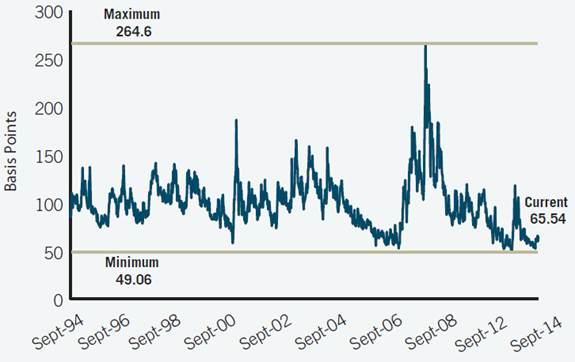
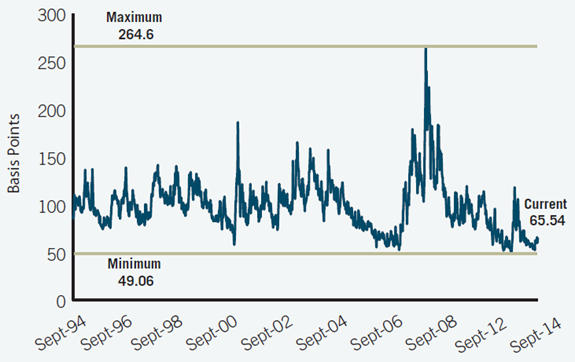
Finally, investors should take greater advantage of the market underpricing volatility. Implied volatility is currently very low based on the pricing of bond and currency options (see chart below). As such, these instruments can be used as an inexpensive insurance policy against large market swings. For example, although we hold a generally favorable long-term view of Mexico given its economic reform efforts, an out-of-the-money put option on the Mexican peso is a good way to provide low-cost protection should there be a sudden decline in sentiment toward emerging markets currencies more generally
Figure 2: MOVE INDEX
Implied Volatility Index on One-Month US Treasury Options, Last 20 Years
Data to 30 Sept 2014
Source: BoA Merrill Lynch.
2014-GL-940
CONCLUSION
As we enter a period of potential rising rates, coupons will be more critical to generating positive total return, and investors will need to make sure that income is not eroded by declining bond prices. Constructing a diversified portfolio with a variety of income sources is, in our view, the most prudent approach as the environment grows more uncertain. There will be opportunities to take risk in well-researched, attractively valued ideas, but defensive positions will also be valuable. While this may require giving up some yield and performance, it also reduces downside risk and threats to income—which should be of utmost concern for most bonds investors when yields are low and volatility is subdued. While the precise timing and catalyst are difficult to predict, we can be sure that both will rise at some point.
重要情報
当資料は、ティー・ロウ・プライス・アソシエイツ・インクおよびその関係会社が情報提供等の目的で作成したものを、ティー・ロウ・プライス・ジャパン株式会社が翻訳したものであり、特定の運用商品を勧誘するものではありません。また、金融商品取引法に基づく開示書類ではありません。当資料における見解等は資料作成時点のものであり、将来事前の連絡なしに変更されることがあります。当資料はティー・ロウ・プライスの書面による同意のない限り他に転載することはできません。
資料内に記載されている個別銘柄につき、売買を推奨するものでも、将来の価格の上昇または下落を示唆するものでもありません。また、当社ファンド等における保有・非保有および将来の組入れまたは売却を示唆・保証するものでもありません。投資一任契約は、値動きのある有価証券等(外貨建て資産には為替変動リスクもあります)を投資対象としているため、お客様の資産が当初の投資元本を割り込み損失が生じることがあります。
当社の運用戦略では時価資産残高に対し、一定の金額までを区切りとして最高1.265%(消費税10%込み)の逓減的報酬料率を適用いたします。また、運用報酬の他に、組入有価証券の売買委託手数料等の費用も発生しますが、運用内容等によって変動しますので、事前に上限額または合計額を表示できません。詳しくは契約締結前交付書面をご覧ください。
「T. ROWE PRICE, INVEST WITH CONFIDENCE」および大角羊のデザインは、ティー・ロウ・プライス・グループ、インクの商標または登録商標です。
ティー・ロウ・プライス・ジャパン株式会社
金融商品取引業者関東財務局長(金商)第3043号
加入協会:一般社団法人日本投資顧問業協会/一般社団法人投資信託協会

