

After This Year’s Big Rally, Do EM Debt Markets Still Offer Value?
Q: After a rough 2013, emerging market (EM)debt has rebounded sharply so far this year.What accounts for this recovery?
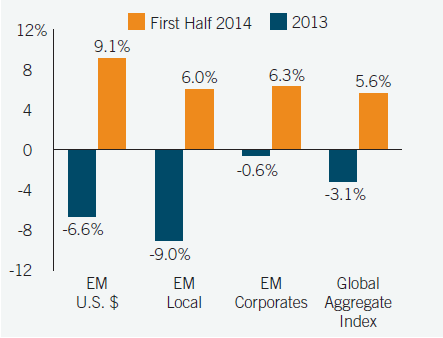
A: Mike Conelius: EM debt was the one asset class that really underperformed in 2013. We saw some fairly indiscriminate outflows—just as we saw a headlong rush into EM debt in the aftermath of the financial crisis. So coming into 2014, EM debt was about the only asset class that you could say was cheap. Some of that cheapness was justified by a shaky geopolitical environment and economic vulnerabilities in certain countries, but the markets overreacted. As we worked through some of the political uncertainties, the mood shifted and investors started focusing on the opportunities again. So generally it was valuation support and technical support from investors who had become underweight in EM debt after being overweight a year or so ago.
Figure 1: EM Debt Markets Have Rebounded Strongly
Total Returns in 2013 and First Half 2014
Sources: Barclays and J.P. Morgan
Q: Overall, does EM debt still look attractiveon a risk-adjusted basis?
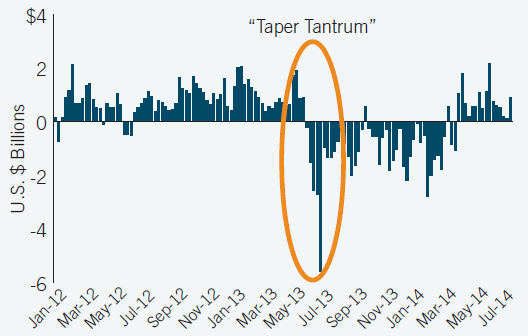
A: Mike Conelius: Valuations are certainly not as attractive as they were six months ago, but yields, on average, are still higher than they were before the “taper tantrum” of early 2013, when markets reacted to the Fed’s first warning that it would begin to slow its quantitative easing purchases. We think EM debt still offers attractive value relative to developed markets. However, we don’t see much room for further spread compression. The balance of 2014 is probably going to be a coupon clipping exercise.
Q: What are the key external risks that are driving EM debt markets today?
A: Andrew Keirle: One issue that’s obviously on a lot of minds is the possibility that U.S. interest rates will be going higher as the Fed withdraws its quantitative easing support. The first half of 2014 was a bit of a surprise in that U.S. Treasury yields actually fell rather than rose, but that was due to some temporary factors such as uncertainty about the economic growth trend. Going forward, we expect U.S. yields to retrace their steps, which could be a short-term headwind for EM debt markets.
Q: What about monetary policy in the emerging markets themselves? Is it likely to be supportive for EM debt or another short-term headwind?
Q: The geopolitical instability we’ve seen this year— like the conflicts in Ukraine and the Middle East and Argentina’s technical default—didn’t curb the rally in EM debt. Why?
A: Mike Conelius: Those events have generated periods of volatility along the way, but I think investors ultimately decided they were country specific, not systemic, which is very different from how we’ve seen markets respond in the past. I think the people who are most involved day to day with the asset class—including asset managers such as ourselves—are focused on the fundamentals and are willing to discriminate among countries, sectors, and companies. That’s helped the markets weather some of the idiosyncratic geopolitical issues.
Q: There was a lot of talk in 2013 about the so-called Fragile Five—Brazil, India, Indonesia, South Africa, and Turkey. Are they still a topic of concern?
A: Andrew Keirle: Much of the worry last year about the Fragile Five was based on a combination of economic vulnerability—from large current account and/or fiscal deficits—and political risk, as all five countries were facing elections. Since then, voters in India, Indonesia, South Africa, and Turkey have gone to the polls, with outcomes that were viewed as either positive or at least neutral by the markets. Elections are still pending in Brazil, and the results are likely to shape the macroeconomic outlook for many years to come. Meanwhile, a number of EM countries have seen their internal and external weaknesses improve, which provides a more supportive backdrop.
Figure 2: Investors Have Returned to EM Debt Markets
Weekly EM Fund and ETF In ows and Out ows, rough 16 July 2014
Sources: EPFR Global
Q: Currency moves were obviously a big issue for EM local currency markets last year. What impact are they likely to have on returns over the balance of 2014 and into next year?
A: Andrew Keirle: The yield differential, or carry, for maintaining exposure to EM currencies remains quite high—almost five percentage points for a U.S. dollar based investor as of June 30, 2014, based on the J.P. Morgan EM Currency Index. This provides a cushion against renewed EM currency depreciation, which is certainly possible versus the U.S. dollar as the Fed removes monetary accommodation. We are more positive on the outlook for a number of EM currencies versus other developed world currencies, notably the euro and the Japanese yen, in part because we expect to see additional easing moves by the European Central Bank and the Bank of Japan.
Q: As global monetary policies diverge, is that creating opportunities to generate excess return and alpha through active currency overlays?
A: Andrew Keirle: Yes. We’ve been taking net short positions in low-carry, low-volatility developed world currencies to fund our EM allocations for some time now. We are long the U.S. dollar and could see some strength there, but we view most other developed currencies as likely to underperform select EM currencies. We’re currently using the euro, British pound, Swiss franc, Australian dollar, Canadian dollar and the Japanese yen for funding purposes, and, more recently, we opened a net short position in the New Zealand dollar. But we’re also taking advantage of opportunities within EM currency markets themselves—for example, by pairing a long position in the Malaysian ringgit with a short position in the Philippine peso. The basic theme is to be long currencies that have appreciation potential through either growth, interest rate, or reform-based tailwinds, and short the currencies of countries that exhibit soft monetary policy and that we believe could see exchange rate weakness.
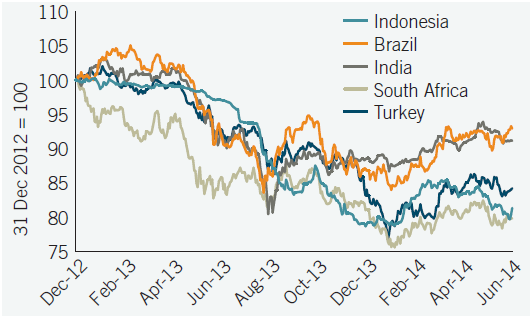
Figure 3: Key EM Currencies Have Stablized or Appreciatedin 2014
Versus the U.S. Dollar, rough 30 June 2014
Sources: FactSet and IMF
Q: Which U.S. dollar sector appears to offer better value: sovereign debt or corporates?
A: Mike Conelius: Coming into 2014, EM sovereigns appeared quite attractive on a relative basis. But that tilt basically reached its natural end this summer as sovereigns rallied and the valuation gap disappeared. If anything, we think EM corporates now have the edge, with better access to growth and direct exposure to EM consumers. They also feature shorter duration, on average. So if you believe rising rates are the most important risk going forward, you’re probably better off in EM corporates. That said, it’s a very bottom-up sector, very company specific. So fundamental analysis and security selection are both critical.
Q: Where are you currently finding the most attractive opportunities in EM corporates?
A: Mike Conelius: I would say the Asian consumer sector, China in particular, and that ranges from home building to wireless broadband use. We’re more cautious on the EM energy sector, given our expectation for modestly weaker oil prices and rising U.S. production. We think India might be the next Mexico in terms of better macroeconomic policies, so we could see a second wave of companies coming from there. Brazil is more of a policy question mark, but there are some globally active infrastructure companies there that we like.
Q: Are you still confident in the long-term secular case for EM debt as a core asset class?
A: Mike Conelius: Absolutely. It’s 80% of the world’s population and accounts for over one-third of the world’s GDP today. It’s where the lion’s share of future global growth is going to come from. Developed world yields—government bond yields in particular—are not going to meet the needs of developed world investors. Yet global institutional investors overall are still markedly underweight to EM debt relative to its size and importance in the global fixed income opportunity set.
Q: What are some of the risks investors need to keep in mind?
A: Andrew Keirle: In terms of fiscal deficits, public debt, and foreign exchange reserves, EM governments overall are in a much stronger positions than they were even a decade ago. But EM central banks are also pursuing more sophisticated monetary policies. They’re using their currencies as policy tools, which requires exchange rate flexibility. Long term, we think EM currencies should benefit from positive growth and real interest rate differentials. But when capital flows reverse, as they did last year, currencies could still weaken, perhaps dramatically. That’s something EM debt investors—and not just investors in EM local currency debt—will have to keep in mind.
2014-GL-717
重要情報
当資料は、ティー・ロウ・プライス・アソシエイツ・インクおよびその関係会社が情報提供等の目的で作成したものを、ティー・ロウ・プライス・ジャパン株式会社が翻訳したものであり、特定の運用商品を勧誘するものではありません。また、金融商品取引法に基づく開示書類ではありません。当資料における見解等は資料作成時点のものであり、将来事前の連絡なしに変更されることがあります。当資料はティー・ロウ・プライスの書面による同意のない限り他に転載することはできません。
資料内に記載されている個別銘柄につき、売買を推奨するものでも、将来の価格の上昇または下落を示唆するものでもありません。また、当社ファンド等における保有・非保有および将来の組入れまたは売却を示唆・保証するものでもありません。投資一任契約は、値動きのある有価証券等(外貨建て資産には為替変動リスクもあります)を投資対象としているため、お客様の資産が当初の投資元本を割り込み損失が生じることがあります。
当社の運用戦略では時価資産残高に対し、一定の金額までを区切りとして最高1.265%(消費税10%込み)の逓減的報酬料率を適用いたします。また、運用報酬の他に、組入有価証券の売買委託手数料等の費用も発生しますが、運用内容等によって変動しますので、事前に上限額または合計額を表示できません。詳しくは契約締結前交付書面をご覧ください。
「T. ROWE PRICE, INVEST WITH CONFIDENCE」および大角羊のデザインは、ティー・ロウ・プライス・グループ、インクの商標または登録商標です。
ティー・ロウ・プライス・ジャパン株式会社
金融商品取引業者関東財務局長(金商)第3043号
加入協会:一般社団法人日本投資顧問業協会/一般社団法人投資信託協会

