

Global Growth Equity Strategy: A Truly Global Approach, Extending the Horizons and Delving Deeper
EXECUTIVE SUMMARY
Many global equity managers limit their exposure mainly to developed markets, ignoring the full opportunity set available to them as investors.
A detailed look at these issues may help fund investors and consultants evaluate the merits of an individual global equity manager.
OUR APPROACH: EXTEND YOUR HORIZONS AND DELVE DEEPER
For global managers, the ability to diverge and look beyond the index helps to produce the best opportunity set for a portfolio, while a benchmark-unconstrained approach can help to create added value.
When evaluating a global equity manager, ensuring the portfolio is exploring the full opportunity set is crucial. In the last few years, I have visited nearly 50 countries looking for stock ideas. For the Global Growth Equity Strategy, I currently invest in 31 different countries, and of those, 16 are emerging markets.1 This relates, in part, to the way the strategy manages risk. I intentionally spread risk across those different emerging countries as there is always the potential for some type of event that would have a strong impact on individual stock markets.
THE NEED TO BE ACTIVE
Some argue that you have to have a highly concentrated portfolio to generate alpha. By contrast, I believe that such an argument confuses portfolio concentration with active share.2 To my mind, it is active share, not concentration, that is most important. Therefore, while the strategy has around 130 stocks in 31 countries, it ends up still being a very active portfolio with approximately 88% active share versus the MSCI ACWI Index. By pushing the opportunity set as wide as possible and leveraging the deep research resources of T. Rowe Price, I can discover more companies
that meet my demanding criteria for inclusion in the portfolio. I believe this approach will allow the Global Growth Equity Strategy to generate meaningful alpha over time, but without taking excessive factor or individual stock risk that can come with more concentrated approaches.
Investing in emerging markets (EMs) and searching for opportunities further down the market-cap scale can also help in the search for greater alpha. When we examine what is happening in the world today, whether “decoupling” exists or not, what is evident is that advanced economies are enduring a period of below-trend economic growth. Meanwhile, because of much stronger domestic structural drivers, EMs continue to drive global growth.
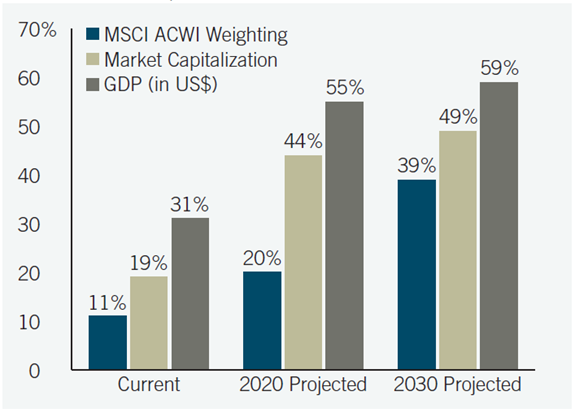
Global indices are still failing to recognise this, however. Although EMs now account for 11.1%3 of the MSCI ACWI Index (this weighting has increased over 130% since 2002, due to strong relative returns and a broadening of the EM investible opportunity set), it still does not fully represent how important EMs are to us as global investors.
The projected changes in the global significance of Ems are expected to be even more dramatic over the next 10 to 20 years (Figure 1). This will require investors to seek a much greater exposure to the EM world than ever before. Many global equity managers have not fully grasped this.
Figure 1: EM Share of Global Totals
IMF Current and Projected as of 31 Dec 2013
Sources: FactSet, IMF, World Bank, World Federation of Exchanges,
MSCI, Goldman Sachs Global ECS Research
Increasing the opportunity set to include mid-cap equities also has many benefits. Medium-sized companies can be attractive, as they are often at a stage where their business model is proven and the strongest years of market share gains are still ahead of them. Generally, mid-cap companies are also much better able to tap in to the local growth story, with these companies tending to have a much greater domestic focus compared with most large caps.
WHAT IS THE BEST WAY TO GAIN FROM THE HIGHER GROWTH THAT EMS GENERATE?
There has been much debate about the best way to gain exposure to the huge growth in these markets, whether that is going direct or indirect. The short answer is both.
EMs are a significant source of earnings growth for many developed world companies—large-cap industrial and consumer multinationals in particular. Good examples are luxury-related companies where their brand power cannot be easily duplicated in the EM world. China is now one of the largest markets for a number of luxury goods companies. Richemont, the producer of Cartier watches, is a good example of this, with over 60% of its sales going to emerging market consumers.
Additionally, in sectors dominated by global players, such as industrials, energy, materials and information technology, direct investment into emerging markets can sometimes be unnecessary and may result in owning inferior companies that are often at times run for the benefit of the state and not shareholders. This is not a flexibility afforded to dedicated EM-only managers.
So why do investors therefore need to hold EM equities (and the higher volatility associated with them) when indirect exposure to EM growth can be obtained via developed markets? The answer, of course, is that there are growth opportunities in EM that can only be accessed by investing in local EM companies. Indeed, one can find EM growth opportunities in the developed markets—and there will be times when these opportunities appear more attractive, due to relative valuations or other factors. However, indirect exposure can, in some cases, be an incomplete substitute for direct EM investment and may not allow the portfolio manager to capture the investment thesis in the purest manner. In less consolidated sectors such as utilities, consumer discretionary, financials and telecoms, direct investment can be crucial to capturing the premium growth stories within the local market.
Additionally, a “virtual” EM portfolio of developed multinationals inevitably will be biased toward some sectors (technology, industrials) and away from others (utilities, financials, telecoms) where local companies are dominant. An interesting example is Baidu, one of China’s largest and most powerful Internet companies, with 99% of China’s online population using its search engine. The only real way to access the online search activity of over a billion people in China is through Baidu. Another example is in EM financials, where the business models are simple and as an investor you are making a direct play on a growing economy—something you cannot do through a multinational.
Therefore, when looking for the best opportunities to benefit from the growth in the EM world, it is important not to limit yourself to either direct or indirect investment. Additionally, casting your net wider is also crucial. For example, frontier markets have been some of the best-performing markets over the last few years. The overall goal with emerging markets should be to access the pools of returns without limits. The best way to do this is through bottom-up active research, identifying the best opportunities in both developed and emerging market companies. Importantly, for us as active stock pickers, this recent period of elevated risk has resulted in a number of stocks being unduly punished in the near term, despite fundamentals remaining strong. I am excited by this as it presents me with a great opportunity to add or to initiate positions in companies at lower valuations that I believe will deliver superior long-term gains for my clients.
WHAT DOES THE GLOBAL GROWTH EQUITY STRAT EGY PROVIDE FOR INVESTORS?
The strategy is constructed to emphasise T. Rowe Price’s primary competitive strength—stock selection. The aim is to own approximately 130 holdings, and these positions represent my highest-conviction, most compelling investment ideas. Drilling down further, the strategy focuses on investing in high-quality growth companies with sustainable competitive advantages that are underappreciated by the market. I seek companies with strong business models, proven management, good corporate governance and prospects for market share gains. I believe these qualities lead to strong and sustainable earnings and free cash flow growth. I believe this approach will result in a portfolio that can weather multiple market environments and generate meaningful returns over time.
Additionally, with the Global Growth Equity Strategy, you are receiving non-traditional emerging markets exposure with little overlap with the MSCI Emerging Markets Index. In fact, the active share of the strategy’s emerging markets holdings is 96% compared with the MSCI Emerging Markets Index. The strategy also provides a good complement of emerging market exposure relative to many dedicated emerging market portfolios. This is because we often include peripheral and frontier emerging countries, and our sector orientation is often less
diversified than dedicated EM managers due to our focus on long-term, secular growth opportunities in areas such as financials and consumer.
Additionally, if there is a robust theme that I wish to favour, I will often have a number of holdings that play to this idea. This may be different from other global equity portfolios. Such an approach increases the opportunities to add value from stock selection, and indeed this has been the main component of outperformance so far since the inception of the strategy.
Overall, I believe that active management driven by bottom-up, fundamental research is best at uncovering and exploiting anomalies in equity markets. One of the core tenets of our investment philosophy at T. Rowe Price is that quality growth stocks are frequently mispriced because the market underappreciates the durability of long term earnings stream. This is especially true in emerging markets where the demographic and secular drivers are very long term in nature. Another fundamental principle is that stock-specific factors are the key driver of stock prices over the long term. Macroeconomic, political and social factors are inherently less predictable compared with fundamental company factors, and as such, we rely on them less in the decision-making process.
The Global Growth Equity Strategy has enjoyed strong performance because it ultimately seeks to construct a diversified and growth-oriented portfolio of stocks, with bottom-up research driving the stock selection.
The volatility that equity investors are currently enduring is undoubtedly challenging, but having an understanding of short-term volatility is integral to equity investing. Our philosophy remains that successful long-term investing demands consistent adherence to a sustainable investment process. In particular, at T. Rowe Price we know that we best serve our clients by looking beyond transient factors by adopting a constant focus on fundamentals. Ultimately, identifying the best investment opportunities in a stock universe, and applying conviction to those ideas within a diversified portfolio, provides me with the best platform to deliver superior returns over the long run for my clients.
1 As of 30 Sept 2014.
2 Active share is the percentage of the portfolio that does not overlap with the benchmark. Each stock weight in the portfolio is subtracted from its benchmark weight and the sum is the difference.
GLOBAL GROWTH EQUITY STRATEGY HIGHLIGHTS
- The breadth and quality of our fundamental research is the foundation of our high-conviction approach.
- By identifying companies with superior and sustainable growth characteristics, we can create a framework for outperformance.
- Near-term trends are often overemphasized by the market.
- The broad opportunity set available underpins a borderless, best-ideas portfolio.
- Synthesize regional and industry knowledge to incorporate high-conviction stock ideas into the portfolio.
- Risk management is essential; valuation always matters.
- Deliver a truly global bottom-up fund through leveraging our research platform and via our footprint around the world.
重要情報
当資料は、ティー・ロウ・プライス・アソシエイツ・インクおよびその関係会社が情報提供等の目的で作成したものを、ティー・ロウ・プライス・ジャパン株式会社が翻訳したものであり、特定の運用商品を勧誘するものではありません。また、金融商品取引法に基づく開示書類ではありません。当資料における見解等は資料作成時点のものであり、将来事前の連絡なしに変更されることがあります。当資料はティー・ロウ・プライスの書面による同意のない限り他に転載することはできません。
資料内に記載されている個別銘柄につき、売買を推奨するものでも、将来の価格の上昇または下落を示唆するものでもありません。また、当社ファンド等における保有・非保有および将来の組入れまたは売却を示唆・保証するものでもありません。投資一任契約は、値動きのある有価証券等(外貨建て資産には為替変動リスクもあります)を投資対象としているため、お客様の資産が当初の投資元本を割り込み損失が生じることがあります。
当社の運用戦略では時価資産残高に対し、一定の金額までを区切りとして最高1.265%(消費税10%込み)の逓減的報酬料率を適用いたします。また、運用報酬の他に、組入有価証券の売買委託手数料等の費用も発生しますが、運用内容等によって変動しますので、事前に上限額または合計額を表示できません。詳しくは契約締結前交付書面をご覧ください。
「T. ROWE PRICE, INVEST WITH CONFIDENCE」および大角羊のデザインは、ティー・ロウ・プライス・グループ、インクの商標または登録商標です。
ティー・ロウ・プライス・ジャパン株式会社
金融商品取引業者関東財務局長(金商)第3043号
加入協会:一般社団法人日本投資顧問業協会/一般社団法人投資信託協会
