
Why the price of capital is rising | 2027 Global Market Outlook
November 2026, Fixed Income
The post‑financial crisis era of cheap, abundant capital has given way to one in which funding is scarcer and more expensive. Government borrowing and artificial intelligence (AI)‑related funding are both now sources of enormous, inelastic demand for capital that are competing for the same pool of global savings. To attract enough buyers for the growing supply of government debt, yields have had to rise, pushing up the term premium—and there is little sign of this structural pressure easing.
Deficits and government debt free float continue to increase
Unlike some emerging markets, which are taking steps toward fiscal responsibility, government deficits as a percentage of GDP remain historically large across many developed markets. This is most notable in the U.S. with its global benchmark Treasury market. Politicians are naturally reluctant to cut spending or raise taxes, sensing that either would lose votes.
As the amounts of government debt outstanding have increased, so has the percentage of those totals held outside of central banks and other government‑related institutions (the “free float”). Central banks have been slowing or reversing the aggressive quantitative easing programs in which they were price‑insensitive government bond buyers. This has left asset managers, hedge funds, and other price‑sensitive institutional investors having to absorb more of the outstanding government bonds. In the U.S., for example, the free float of Treasury debt climbed to about 63% as of October 2025 from 50% in April 2020.1
Hyperscaler issuance increases pressure on bond markets
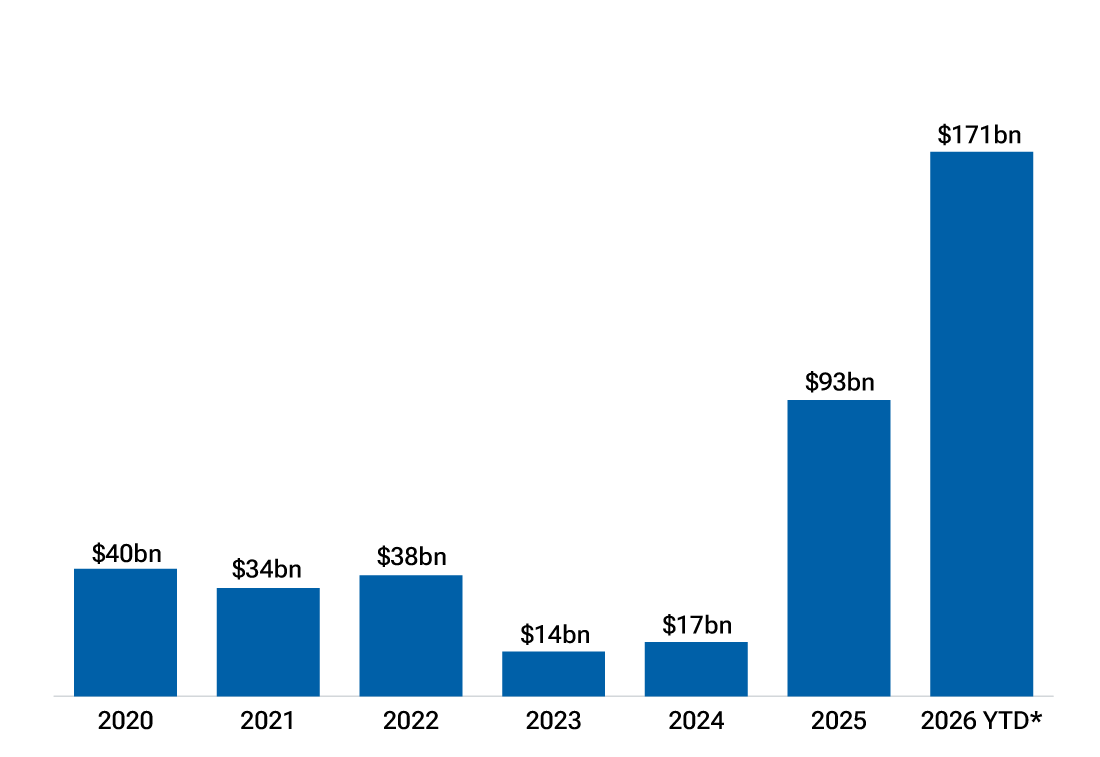
A large share of 2026’s long‑term U.S. investment grade corporate debt new supply has come from hyperscaler issuance (Figure 1). This growing supply is entering the market at the same time as substantial long duration issuance from the Treasury Department, intensifying competition for investor capital. As borrowers compete to attract buyers, yields may need to rise, putting downward pressure on existing bond prices.
Hyperscaler investment‑grade debt issuance has surged since 2024
(Fig. 1) The sector represents about 5% of outstanding investment‑grade debt1
Source: Bloomberg Finance L.P.
1 As of September 30, 2026.
* Through October 31, 2026. bn=billion; YTD=year‑to‑date. The chart shows new issuance in U.S. dollars of U.S. corporate investment‑grade new supply from hyperscalers.
Looking at duration times spread (DTS)—a measure of credit risk that reflects both spread sensitivity and credit spreads—hyperscaler bonds account for about the same percentage of total benchmark DTS2 as energy‑sector bonds in that industry’s 2013 issuance boom. Most of the hyperscaler bond DTS stems from their extended duration rather than credit spreads. Also, the increasingly complex connections between AI issuers present another aspect of risk that was not nearly as meaningful for energy issuers in 2013.
Have yields peaked?
So far, the market has been absorbing each incremental AI‑related bond deal, albeit with increasing credit spread concessions. This additional spread is largely irrelevant to the issuers, but it is meaningful for the term premium and yields on the Treasury securities competing for investor demand—it will keep upward pressure on yields throughout the high‑quality fixed income market.
This makes it unlikely that Treasury yields have peaked over the secular horizon. The Treasury sell‑off has been generally orderly and consistent with increasing nominal growth. While we may tactically take an overall long duration stance in the short term based on valuations and growth signals, we still maintain the view that the market is underpricing the outlook for higher long‑term nominal growth and the increasing capital intensity of this industrial cycle.
How high can yields go before they peak? It’s difficult to say with precision because of the various crosscurrents of inflation, growth, and central bank monetary policy. Long‑term yields are unlikely to peak and begin falling until investors become more confident in the outlook for economic growth and less concerned about government deficits.
For bond investors, the priority is to capture the higher income now available while remaining selective about duration and credit risk.
Global macro and monetary policy guide 2027
| Growth | Inflation | Monetary Policy | |
|---|---|---|---|
U.S. | AI investment is expected to remain a key driver of growth, although higher energy costs and interest rates could test the economy’s resilience. | Higher energy prices could keep inflation elevated, delaying its return to the Fed’s 2% target, especially as higher transportation costs feed through to core goods and services prices. | The Fed is expected to continue raising interest rates, with the pace and extent of further hikes depending on inflation and the economy’s ability to withstand higher rates. |
Eurozone | While improving trade conditions could support manufacturing growth, macrofinancial instability and higher gas prices could pose risks to the outlook. | Higher energy costs are likely to push core inflation higher, although it is expected to remain below 3%. | The European Central Bank is likely to proceed cautiously as it balances inflation, economic growth, and financial stability risks. |
Japan | The outlook is constructive, with manufacturing activity, resilient consumer spending, and rising real wages expected to support growth. | While the government’s food sales tax cut will mechanically lower inflation, rising food prices are expected to partially offset this effect, keeping inflation above consensus expectations. | The Bank of Japan is likely to take a cautious approach to raising interest rates due to concerns about a potential slowdown in domestic economic growth. |
Emerging Markets | Economic growth is expected to remain resilient and outperform developed markets, although tighter financial conditions and elevated oil prices could pose headwinds. | Higher energy prices and a potentially strong El Niño could push food and headline inflation higher. | Emerging market central banks are expected to follow a gradual tightening path in 2027 in response to rising inflationary pressures. |
China | Stimulus measures should support growth, though a material boost is unlikely due to ongoing structural challenges. | Weak domestic demand is expected to keep consumer prices low. | Despite weak credit growth, the People’s Bank of China is unlikely to cut interest rates, favoring a cautious approach to monetary policy. |
Key takeaway
While there may be periods when yields decrease, relentless new supply from both governments and AI‑related issuers will likely push rates even higher in the longer run.
Market value of holdings shown are illustrative and may differ from the values used to calculate the fund’s net asset value (“NAV”). For information on valuation of portfolio assets used to calculate NAV, please see the prospectus.
ETFs/ETPs are bought and sold at market prices, not NAV. Investors generally incur the cost of the spread between the prices at which shares are bought and sold. Buying and selling shares may result in brokerage commissions which will reduce returns.
202611- 6051971
 Adam Marden
Portfolio Manager
Strategies to Consider

- Nov 2026
When AI starts doing the work | 2027 Global Market Outlook

- Nov 2026
2027 Global Market Outlook

Contact us
1 Data source: International Monetary Fund. October 2025 is the latest available data.
2 Bloomberg U.S. Aggregate Bond Index. DTS calculations by T. Rowe Price.
Appendix
T. Rowe Price cautions that economic estimates and forward-looking statements are subject to numerous assumptions, risks, and uncertainties, which change over time. Actual outcomes could differ materially from those anticipated in estimates and forward-looking statements, and future results could differ materially from any historical performance. The information presented herein is shown for illustrative, informational purposes only. Any historical data used as a basis for this analysis are based on information gathered by T. Rowe Price and from third-party sources and have not been independently verified. Forward-looking statements speak only as of the date they are made, and T. Rowe Price assumes no duty to and does not undertake to update forward-looking statements.
Financial terms: Investors in the U.S. and Canada, for a glossary of financial terms, please go to troweprice.com/glossary.
Investment risks:
Active investing may have higher costs than passive investing and may underperform the broad market or passive peers with similar objectives. Each person’s investing situation and circumstances differ. Investors should take all considerations into account before investing.
International investments can be riskier than U.S. investments due to the adverse effects of currency exchange rates, differences in market structure and liquidity, as well as specific country, regional, and economic developments. The risks of international investing are heightened for investments in emerging market and frontier market countries. Emerging and frontier market countries tend to have economic structures that are less diverse and mature, and political systems that are less stable, than those of developed market countries.
Commodities are subject to increased risks such as higher price volatility and geopolitical and other risks. Commodity prices can be subject to extreme volatility and significant price swings.
Inflation‑linked bonds (Treasury inflation protected securities in the U.S.): In periods of no or low inflation, other types of bonds, such as U.S. Treasury bonds, may perform better than Treasury inflation protected securities (TIPS).
Investing in technology stocks entails specific risks, including the potential for wide variations in performance and usually wide price swings, up and down. Technology companies can be affected by, among other things, intense competition, government regulation, earnings disappointments, dependency on patent protection, and rapid obsolescence of products and services due to technological innovations or changing consumer preferences.
Because of the cyclical nature of natural resource companies, their stock prices and rates of earnings growth may follow an irregular path.
Financial services companies may be hurt when interest rates rise sharply and may be vulnerable to rapidly rising inflation. Health sciences firms are often dependent on government funding and regulation and are vulnerable to product liability lawsuits and competition from low‑cost generic products.
The value approach to investing carries the risk that the market will not recognize a security’s intrinsic value for a long time or that a stock judged to be undervalued may actually be appropriately priced. Growth stocks are subject to the volatility inherent in common stock investing, and their share price may fluctuate more than that of income‑oriented stocks.
Small‑cap stocks have generally been more volatile in price than the large‑cap stocks. Investing in private companies involves greater risk than investing in stocks of established publicly traded companies. Risks include potential loss of capital, illiquidity, less available information, and difficulty in valuating private companies. They are not suitable, nor available, for all investors.
All investments involve risk, including possible loss of principal. Diversification cannot assure a profit or protect against loss in a declining market. Index performance is for illustrative purposes only and is not indicative of any specific investment. Investors cannot invest directly in an index.
Fixed income securities are subject to credit risk, liquidity risk, call risk, and interest rate risk. As interest rates rise, bond prices generally fall. Investments in high yield bonds involve greater risk of price volatility, illiquidity, and default than higher‑rated debt securities. Investments in bank loans may at times become difficult to value and highly illiquid; they are subject to credit risk, such as nonpayment of principal or interest, and risks of bankruptcy and insolvency. Some or all alternative investments, such as private credit, may not be suitable for certain investors.
Investments in private markets are speculative and involve a substantial degree of risk, including the possible loss of all or a substantial portion of an investment. Private market investments may be illiquid, difficult to value and subject to restrictions on transfer, and there may be no readily available secondary market. They may also employ leverage or other investment techniques that can increase the risk of loss. Fees and expenses associated with private market investments may be higher than those of traditional investments and will reduce investment returns. Private market investments may not be suitable for all investors and generally require a long‑term investment horizon and the ability to tolerate limited liquidity and substantial fluctuations in value. Investors should carefully consider their investment objectives, financial circumstances, risk tolerance and the specific risks of an investment before investing.
Important Information
This material is being furnished for informational and/or marketing purposes only and does not constitute an offer, recommendation, advice, or solicitation to sell or buy any security.
Prospective investors should seek independent legal, financial and tax advice before making any investment decision. T. Rowe Price group of companies including T. Rowe Price Associates, Inc. and/or its affiliates receive revenue from T. Rowe Price investment products and services.
Past performance is not a guarantee or a reliable indicator of future results. All investments involve risk, including possible loss of principal.
Information presented has been obtained from sources believed to be reliable, however, we cannot guarantee the accuracy or completeness. The views contained herein are those of the author(s), are as of November 2026, are subject to change, and may differ from the views of other T. Rowe Price Group companies and/or associates. Under no circumstances should the material, in whole or in part, be copied or redistributed without consent from T. Rowe Price.
All charts and tables are shown for illustrative purposes only. Actual future outcomes may differ materially from any estimates or forward‑looking statements provided.
The material is not intended for use by persons in jurisdictions which prohibit or restrict the distribution of the material and in certain countries the material is provided upon specific request.
Issued in the USA by T. Rowe Price Investment Services, Inc., distributor and T. Rowe Price Associates, Inc., investment adviser, 1307 Point Street, Baltimore, MD 21231, which are regulated by the Financial Industry Regulatory Authority and the U.S. Securities and Exchange Commission, respectively.
© 2026 T. Rowe Price. All Rights Reserved. T. Rowe Price, INVEST WITH CONFIDENCE, the Bighorn Sheep design, and related indicators (see troweprice.com/ip) are trademarks of T. Rowe Price Group, Inc. All other trademarks are the property of their respective owners. Use does not imply endorsement, sponsorship, or affiliation of T. Rowe Price with any of the trademark owners.
- 202610‑6005119