
Are higher interest rates here to stay?
Multi-Asset
- Key Insights
-
- The conflict in the Middle East has accelerated the recent rise in interest rates through its impact on oil prices and inflation expectations.
- However, the broader upward pressure on yields appears to reflect deeper structural forces, particularly the steady rise in the Treasury term premium.
- Even if energy markets stabilize, long-term interest rates may not fully return to the levels investors have been accustomed to over the last 10 years.
The sharp rise in interest rates over the past three months has many investors asking an important question: Is this simply a temporary spike tied to the conflict in the Middle East, or the beginning of a more durable move higher in long-term rates?Concerns about inflation have been a major driver of the recent increase. But a closer look at the bond market suggests recent geopolitical tensions may only be amplifying an underlying trend that was already in place.
The recent surge in oil prices has contributed to higher Treasury yields.Investors seem to understand that higher energy prices eventually feed through into broader inflation measures. That creates a difficult environment for the Federal Reserve, because elevated inflation reduces the Fed’s willingness to cut rates—and could even force policymakers to consider raising rates again if inflation pressures intensify.
If we compare oil prices with the futures-market-implied federal funds rate for December 2026, the relationship has been striking. Since fighting in Iran intensified in late February, the two series have moved closely together. As oil prices climbed, markets steadily priced in a higher path for Fed policy rates.
At first glance, it might appear that a durable reopening of the Strait of Hormuz would solve this problem. But there are reasons to believe the story may not be that simple.
First, oil prices may not fully return to prior levels even if shipping traffic normalizes. A geopolitical risk premium is likely to remain embedded in energy markets for some time, while shipping insurance costs, supply disruptions, and transportation bottlenecks may persist well after the Strait formally reopens.
Historically, confidence and supply chains normalize much more slowly than headline events suggest.
More importantly, if we zoom out beyond the recent conflict, we can see that the broader rise in Treasury yields has not primarily been driven by Fed expectations.
Instead, it has been driven by a steady increase in what is known as the term premium.
This becomes clear when we compare Treasury yields today versus two years ago.
On May 27, 2024, the 10-year U.S. Treasury yield stood at 4.47%. Two years later, the yield was exactly the same.
But the underlying composition changed dramatically.
Two years ago, Treasury yields were driven almost entirely by expectations for future Fed policy. At that time, the average federal funds rate implied by futures markets over the next 10 years was approximately 4.52%.
Today, that same figure has fallen considerably—to just 3.69%.
Ordinarily, such a decline in Fed expectations would have pushed Treasury yields much lower. But that decline has been offset almost entirely by a sharp increase in the term premium.
The term premium is essentially the additional yield investors demand for locking money into longer-term Treasury bonds instead of shorter-term securities.
That premium has risen for several reasons.
Large federal budget deficits mean the Treasury Department must issue enormous quantities of long-term bonds, increasing supply that markets must absorb.
At the same time, the Federal Reserve is no longer acting as a major buyer of Treasury securities. And investors have become increasingly concerned about future inflation, interest-rate volatility, and broader political uncertainty. As those risks rise, investors demand greater compensation for owning long-duration bonds.
The conflict in the Middle East has clearly accelerated the recent rise in interest rates through its impact on oil prices and inflation expectations.
But the broader upward pressure on yields appears to reflect deeper structural forces—particularly the steady rise in the Treasury term premium.
This suggests that even if energy markets stabilize, long-term interest rates may not fully return to the lower levels investors became accustomed to during the past decade.
As a result, our Asset Allocation Committee continues to maintain an underweight position in long-term U.S. Treasury bonds and a lower-duration stance more broadly across fixed income.
For office use only: 202606-5529174
The sharp rise in interest rates over the past three months has many investors asking an important question: Is this simply a temporary spike tied to the conflict in the Middle East, or the beginning of a more durable move higher in long‑term rates? Concerns about inflation have been a major driver of the recent increase. But a closer look at the bond market suggests recent geopolitical tensions may only be amplifying an underlying trend that was already in place.
Oil prices are pressuring the Fed
The recent surge in oil prices has contributed to higher Treasury yields. Investors seem to understand that higher energy prices eventually feed through into broader inflation measures. That creates a difficult environment for the Federal Reserve, because elevated inflation reduces the Fed’s willingness to cut rates—and could even force policymakers to consider raising rates again if inflation pressures intensify.
The relationship between oil prices and the futures‑market‑implied federal funds rate for December 2026 has been striking. Since fighting in Iran intensified in late February, the two series have moved closely together. As oil prices climbed, markets steadily priced in a higher path for Fed policy rates.
Oil prices have moved closely with Fed funds rate expectations
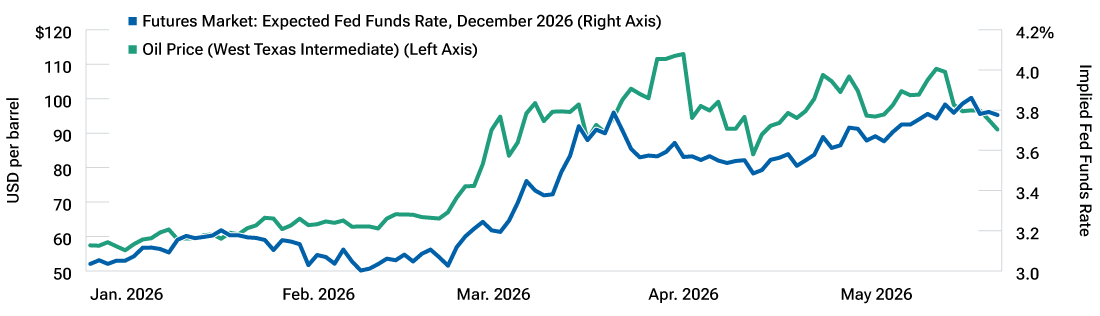
January 1, 2026 through May 27, 2026.
Source: Bloomberg Finance L.P.
Why lower oil prices might not fully reverse the move
At first glance, it might appear that a durable reopening of the Strait of Hormuz would solve this problem. But there are reasons to believe the story may not be that simple. First, oil prices may not fully return to prior levels even if shipping traffic normalizes. A geopolitical risk premium is likely to remain embedded in energy markets for some time, while shipping insurance costs, supply disruptions, and transportation bottlenecks may persist well after the Strait formally reopens. Historically, confidence and supply chains normalize much more slowly than headline events suggest.
The bigger story: Rising term premiums
More importantly, if we zoom out beyond the recent conflict, we can see that the broader rise in Treasury yields has not primarily been driven by Fed expectations. Instead, it has been driven by a steady increase in what is known as the term premium.
A steady increase in term premiums
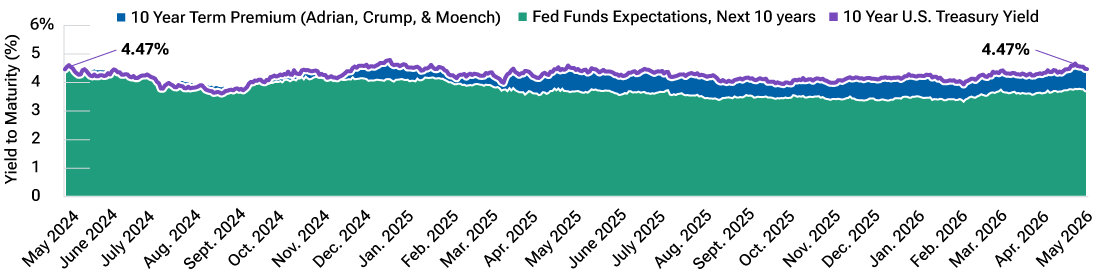
Two years ending May 27, 2026.
Source: Bloomberg Finance L.P.
This becomes clear when comparing Treasury yields today versus two years ago. On May 27, 2024, the 10‑year U.S. Treasury yield stood at 4.47%. Two years later, the yield was exactly the same, but the underlying composition changed dramatically.
Two years ago, Treasury yields were driven almost entirely by expectations for future Fed policy. At that time, the average federal funds rate implied by futures markets over the next 10 years was approximately 4.52%. Today, that same figure has fallen considerably—to just 3.69%. Ordinarily, such a decline in Fed expectations would have pushed Treasury yields much lower. But that decline has been offset almost entirely by a sharp increase in the term premium.
What is the term premium?
The term premium is essentially the additional yield investors demand for locking money into longer‑term Treasury bonds instead of shorter‑term securities. That premium has risen for several reasons. Large federal budget deficits mean the Treasury Department must issue enormous quantities of long‑term bonds, increasing supply that markets must absorb. At the same time, the Federal Reserve is no longer acting as a major buyer of Treasury securities. In addition, investors have become increasingly concerned about future inflation, interest rate volatility, and broader political uncertainty. As those risks rise, investors demand greater compensation for owning long duration bonds.
Term premium explains why long rates remain elevated
(Fig. 3)
| What it is | Why it is moving higher |
|---|---|
| The extra compensation investors require to hold longer-term Treasuries instead of rolling short-term securities. |
|
Conclusion
The conflict in the Middle East has clearly accelerated the recent rise in interest rates through its impact on oil prices and inflation expectations. But the broader upward pressure on yields appears to reflect deeper structural forces—particularly the steady rise in the Treasury term premium.
This suggests that even if energy markets stabilize, long‑term interest rates may not fully return to the lower levels investors became accustomed to during the past decade. As a result, our Asset Allocation Committee continues to maintain an underweight position in long‑term U.S. Treasury bonds and a lower‑duration stance more broadly across fixed income.
 Timothy C. Murray, CFA
Capital Markets Strategist
Timothy C. Murray, CFA
Capital Markets Strategist

- May 2026
Is AI infrastructure spending sustainable?
Additional Disclosure
For U.S. investors, visit troweprice.com/glossary for definitions of financial terms.
Please see vendor indices for more information, including definitions and source data: troweprice.com/marketdata.
Fixed-income securities are subject to credit risk, liquidity risk, call risk, and interest-rate risk. As interest rates rise, bond prices generally fall.
Important Information
This material is being furnished for informational and/or marketing purposes only and does not constitute an offer, recommendation, advice, or solicitation to sell or buy any security.
Prospective investors should seek independent legal, financial and tax advice before making any investment decision. T. Rowe Price group of companies including T. Rowe Price Associates, Inc. and/or its affiliates receive revenue from T. Rowe Price investment products and services.
Past performance is not a guarantee or a reliable indicator of future results. All investments involve risk, including possible loss of principal.
Information presented has been obtained from sources believed to be reliable, however, we cannot guarantee the accuracy or completeness. The views contained herein are those of the author(s), are as of June 2026, are subject to change, and may differ from the views of other T. Rowe Price Group companies and/or associates. Under no circumstances should the material, in whole or in part, be copied or redistributed without consent from T. Rowe Price.
All charts and tables are shown for illustrative purposes only. Actual future outcomes may differ materially from any estimates or forward‑looking statements provided.
The material is not intended for use by persons in jurisdictions which prohibit or restrict the distribution of the material and in certain countries the material is provided upon specific request.
Issued in the USA by T. Rowe Price Investment Services, Inc., distributor and T. Rowe Price Associates, Inc., investment adviser, 1307 Point Street, Baltimore, MD 21231, which are regulated by the Financial Industry Regulatory Authority and the U.S. Securities and Exchange Commission, respectively.
© 2026 T. Rowe Price. All Rights Reserved. T. Rowe Price, INVEST WITH CONFIDENCE, the Bighorn Sheep design, and related indicators (see troweprice.com/ip) are trademarks of T. Rowe Price Group, Inc. All other trademarks are the property of their respective owners. Use does not imply endorsement, sponsorship, or affiliation of T. Rowe Price with any of the trademark owners.
- 202606-5529658