
7 ways modern teams use model portfolios
Practice Management
Your future practice can be as good as you’ve always dreamed. Even as clients, technology, and the industry continue to evolve—you can create more room for growth and give your team more time to do the work they are best at.
Unlock your time to grow your practice
Advisors do not lack effort, commitment, or care for their clients. The issue is capacity. What if a more repeatable investment process leveraging models helped reclaim capacity for client acquisition, referrals, deeper engagement, next-generation relationships, retention, or expanded wallet share?
When advisors focus on these high-impact activities, it can have a meaningful, long-term impact on their practice. We’re not saying you should abandon investment management. But if a meaningful portion of your practice’s time is tied up in investment tasks, is that where you can create the most value?
A modern approach to teaming gives us a way to think about how the right model partner—along with the right people and processes—can work together so advisors spend more time where human judgment and relationships matter most.
Models could give you the capacity to add AUM
Hypothetical $50M AUM practice growth over 10 years.
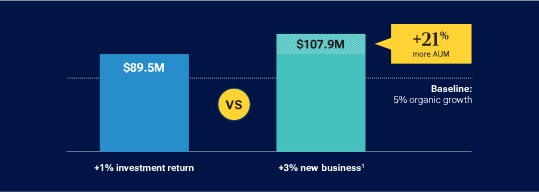
1AssetMark, The Impact of Outsourcing: Preference for TAMPs Is on the Rise; Why Investment Management Outsourcing Is Still the Way Forward, 2024. The study reports the advisors outsourcing investment management brought in ~3% more new assets in 2023, as a percentage of 2022 year-end assets excluding market performance, than non-outsourcers: 14% vs. 11%.
Hypothetical illustration for informational purposes only. Results are not representative of actual performance and are not a guarantee of future results. Assumes $50M starting AUM, 5% annual organic growth, 10 years, and either +1% annual return or +3% annual new business growth. Excludes fees, taxes, withdrawals, attrition, and market volatility.
Where could models fit in your practice? It starts with the need.
| Practice need | Model role | Team impact |
|---|---|---|
| Cleaner onboarding | Start households with a consistent investment framework. | Reduces one-off decisions and allows the team to deliver a streamlined first experience. |
| Book simplification | Consolidate fragmented holdings into a more repeatable structure. | Make reviews easier to prepare, explain, and hand off across the team. |
| Transition readiness | Create a portfolio framework that can be understood and carried forward by a successor or an acquiring firm. | Supports continuity and may make the practice easier for another team to evaluate, transition, and integrate. |
| Practice integration | Create shared investment language across teams or books. | Helps combined or growing teams align around common standards. |
| Scalable service | Deliver a consistent process without overextending advisor capacity. | Helps the team serve more households with quality and discipline. |
| High-net-worth focus | Use models for the scalable core while reserving customization for complex needs. | Frees senior advisors to focus on tax, estate, family, business, liquidity, and next-generation planning. |
| Scalable customization | Use models as the core while allowing targeted customization where needed. | Balances consistency with advisor discretion, so the team can scale without feeling one-size-fits-all. |
Model portfolios are not an all-or-nothing decision. For many practices, the opportunity starts with a specific need—cleaner onboarding, simpler reviews, transition readiness, scalable service, or more time for complex client conversations. By applying models intentionally, modern teams can create a more repeatable investment process while preserving the advisor’s expertise where it matters most.
Explore Practice Management

Contact us
- 202607-5645245