
Change is here: How to integrate AI into your retirement advisory practice
Artificial Intelligence
- Key Insights
-
- Most advisors are using artificial intelligence (AI) to gain incremental efficiency by automating routine tasks, but the larger opportunity lies in redesigning workflows to enable proactive plan monitoring, true personalization at scale, and scalable expertise.
- AI won’t replace retirement advisors, but those advisors who integrate AI thoughtfully and systematically may be better positioned than those who adopt it more slowly.
- Differentiation is more likely to come from disciplined integration rather than speed, combining AI with human oversight, compliance guardrails, and validation protocols.
- The path forward is practical: Advisors who begin building repeatable workflows and refining inputs today could strengthen their capacity, consistency, and long‑term positioning.
As with almost every aspect of modern life, artificial intelligence (AI) is bringing big changes to the retirement plan industry. However, many retirement plan advisors remain hesitant when it comes to AI adoption, with 43% of advisors still in the early evaluation stages according to T. Rowe Price’s 2025 Defined Contribution Consultant Study.
While this hesitation may be understandable with so much change on the horizon, the window for low-stakes learning and experimentation may not remain open indefinitely. Today’s advisors need a framework to understand and prepare for the changes that AI is bringing, grounded in historical precedent and offering practical guidance that can be applied right away.
Today’s advisors need a framework to understand and prepare for the changes that AI is bringing....
The age of electricity: Understanding transformative technology
History offers a useful lens through which to view AI’s potential impact. When commercial electricity emerged in the 1880s, adoption unfolded in three broad phases:
- Phase one brought incremental improvements. Factories replaced steam engines with electric motors but kept existing workflows intact. Electric motors were doing the same jobs, just slightly better.
- Phase two arrived about three decades later when Henry Ford redesigned his automobile assembly line specifically for electricity’s capabilities. The result: Production time for a fully assembled car dropped from 12.5 hours to just 93 minutes, an 88% productivity gain.1 The resistance to change wasn’t technological; it was imaginative. Manufacturers had to unlearn and discard old assumptions before they could see the new possibilities electricity could bring.
- Phase three took even longer: microprocessors; computers; mobile devices; and, ultimately, a global digital economy powered by electricity in ways early adopters never imagined.
With AI, most advisors are firmly in phase one. They use AI tools for discrete tasks: capturing meeting notes, editing communications, and summarizing research. These are valuable applications, but they’re incremental improvements to existing workflows.
AI adoption by advisors
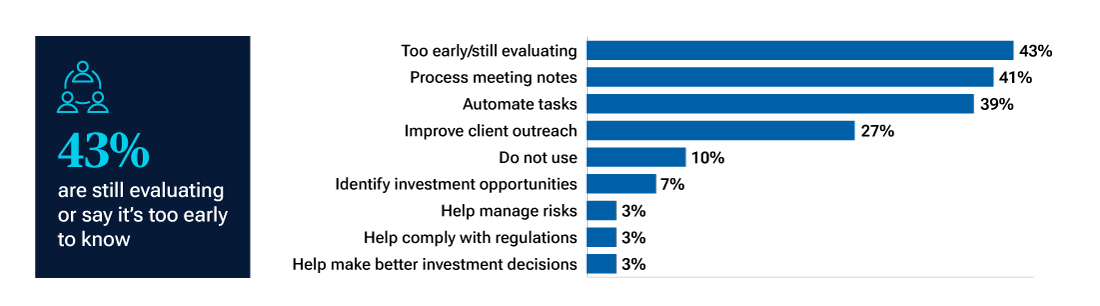
Source: T. Rowe Price 2025 Defined Contribution Consultant Study.
However, phase two is approaching faster than many expected. The AI tools available today are significantly more capable than those from just six months ago, and that pace shows no sign of slowing. Whether you view it as unsettling or exciting or some combination of the two, the truth is that today’s AI tools likely represent the least capable versions you’ll ever encounter.
Phase two is unlikely to take 30 years as it did for the age of electricity. Forward‑thinking advisory firms are already hiring AI operations directors to build workflow automation and deploy agentic AI systems that execute multistep tasks autonomously while maintaining human oversight for high‑stakes decisions.
We don’t know how phase three will ultimately play out over the coming years. However, we know enough about phase three to recognize that waiting for certainty could mean falling behind.
Of course, historical analogies are imperfect. Advisory practices operate within regulatory, operational, and cultural constraints that factories did not. It is reasonable for firms to move carefully, particularly where fiduciary responsibilities are involved. The question is not whether to be cautious—but how to experiment responsibly while continuing to serve clients well.
What’s at stake? The competitive reality
Increasingly, experts in the financial services industry are asking, “Will AI replace financial advisors?” We believe this question misses the point. It’s undeniable that AI excels at processing information rapidly and maintaining consistency. However, human beings provide what AI cannot: contextual judgment, emotional intelligence, and the ability to read between the lines of what and how clients communicate.
But advisory work isn’t one job. It’s a bundle of tasks, and AI can assume responsibility for the time‑intensive, repetitive activities that currently consume your capacity. This creates a stark divergence and a new competitive reality.
Let’s look at a hypothetical scenario:
- Advisor A uses AI occasionally. He continues business as usual, treating AI as an occasional convenience and operating largely as he did before. Advisor A remains personally responsible for most administrative tasks in his day.
- Advisor B uses AI systemically. She methodically identifies the tasks that AI can perform better or faster and delegates accordingly. The potential productivity gains may create flexibility to rethink pricing, capacity, or growth strategies.
In our scenario, Advisor A’s quarterly review prep takes two to three hours per plan, manually pulling data and building agendas. Using a firm-approved, privacy-protected system, Advisor B uploads the relevant plan documents and uses AI to surface red flags, key discussion points, and action items, reducing prep time to under 30 minutes. That reclaimed time is hers to reinvest in strengthening existing client relationships, prospecting for new clients, or expanding the capabilities of her practice.
Plan sponsors and clients increasingly may expect enhanced responsiveness and personalization enabled by AI. As a result, five years from now—assuming expertise, reputation, and rapport being equal—Advisor B is likely to have key structural advantages in finals presentations.
The bottom line: The biggest risk to Advisor A isn’t artificial intelligence. It’s Advisor B. Ultimately, however, the real beneficiary of this shift should be the plan sponsor and participant, who receive more timely insights, clearer communication, and more personalized support.
The biggest risk to Advisor A isn’t artificial intelligence. It’s Advisor B.
Four converging pressures create urgency
The retirement system’s complexity is being transformed by four converging trends:
- Rising participant expectations. Workers who’ve grown up in the digital age increasingly demand personalized, on‑demand guidance rather than generic cohort‑based advice. One‑size‑fits‑all communications are no longer as effective as they used to be.
- Administrative complexity. Fiduciary responsibilities continue to expand. Compliance requirements, benchmarking standards, participant education mandates, and documentation protocols demand both time and precision.
- Fee compression and talent competition. Advisors must deliver more value while competing to retain top talent. For many, improved efficiency could provide a sustainable path forward.
- Information overload. From SECURE 2.0 provisions to evolving market trends, the volume of information advisors must process, synthesize, and act upon continues to grow.
It’s a lot to deal with, but AI has the potential to address these pressures simultaneously. It processes regulatory updates rapidly, it can help craft personalized participant communications at scale, and it can automate routine documentation. All of this can help free valuable time for advisors to focus on relationship‑building and strategic guidance.
Beyond efficiency: Strategic shifts define the future
In our ongoing discussions with advisors, a consistent pattern emerges: Those who are embracing AI aren’t just more efficient, they’re also repositioning themselves as strategic partners. The winners won’t be those who automate the most tasks. Rather, the winners are likely to be those advisors who reimagine how they deliver advice, engage participants, and drive successful outcomes.
- From reactive to proactive. Traditional plan advisory practices balance proactive planning with reactive service. AI can enable continuous engagement. Like modern automobiles running constant diagnostics and alerting drivers before failures occur, AI‑powered practices can help to monitor participant behaviors and plan metrics and identify opportunities in real time. For example, low participation rates and contribution gaps get flagged in real time rather than being discovered in quarterly reviews.
- From cohort segmentation to true personalization. Current communications typically are segmented by broad demographics: age, income, and contribution rates. AI can enable genuine personalization at scale, customizing guidance to individual circumstances, goals, and behavioral patterns. This isn’t about inserting someone’s name into a form letter. It’s about fundamentally different advice for each participant.
- From capacity constraints to scalable expertise. The traditional model faces hard limits: There are only so many hours and only so many relationships one person or team can manage effectively. AI may help loosen some of these constraints, allowing advisor expertise to become systematized and scalable. For example, junior team members can deliver more senior‑level guidance because AI provides the knowledge infrastructure.
Elevate your AI prompting skills
Most advisors use AI at a basic level, with simple queries yielding generic responses. For example, a basic prompt might be “Summarize this quarterly investment commentary.” However, a more structured prompt adds role, context, and constraints:
- Role: Act as a veteran ERISA fiduciary specializing in accessible communication.
- Context: HVAC company retirement plan, committee and technician participants.
- Task: Create education explaining how QDIAs and target date funds work.
- Deliverables: 12 trade‑themed analogies; 10‑minute talk track; 8 FAQs.
- Constraints: 8th‑grade readable, avoid jargon.
After receiving an answer, ask a further question: “What additional context would help you deliver a better result?” Then refine and re‑prompt. This is the shift from basic prompting to iterative prompting where you’re thinking and collaborating with AI, transforming it into a sounding board to brainstorm and test the most effective solutions.
Guardrails: Responsible innovation as competitive advantage
The firms that will thrive in the age of AI won’t necessarily be those that move fastest. They’ll be the ones that move methodically and responsibly.
Critical safeguards include data encryption, controlled access, and cloud resiliency (ensuring systems remain available and data recoverable if outages occur). But the most important guardrail may be human oversight. It’s well documented that AI systems can “hallucinate” occasionally, presenting false information with the same confidence as accurate information, making errors hard to spot. Practically, this means that while AI could draft a quarterly plan review summary, a human advisor still needs to validate the data and recommendations before it reaches the plan sponsor.
Advisors should require sources and citations tied to plan documents so outputs stay grounded. They should also implement role‑based access controls, test outputs across demographic segments for consistent tone, and maintain clear audit trails for compliance purposes.
Fiduciary implications continue to evolve. While regulators have not issued definitive guidance on AI‑assisted advice, the prudent approach treats AI outputs as drafts requiring human validation before any participant‑facing communication. Firms that establish governance frameworks now, even imperfect ones refined over time, will be better positioned as regulatory expectations crystallize.
Clients and plan sponsors may increasingly ask about AI policies. “We don’t use AI” will sound outdated. But “We use AI with comprehensive oversight” will differentiate sophisticated practices from undisciplined ones without guardrails.
An AI road map for advisors
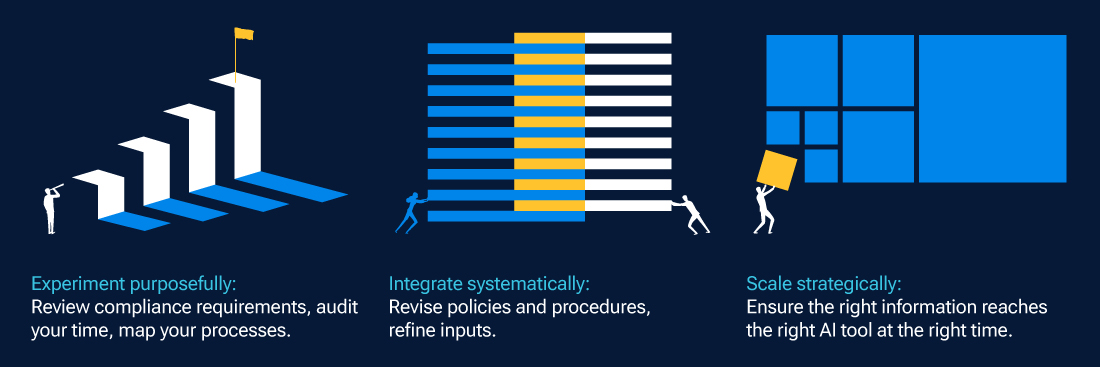
A practical road map for advisors
Phase one: Experiment purposefully
Before deploying tools, get clarity on compliance requirements and how to experiment prudently. The good news: Entry-level experimentation requires minimal investment.
The resource that matters most is time. Track how you spend a typical week, along with recurring monthly and quarterly projects. Identify repetitive, time‑intensive tasks where AI can compress preparation while maintaining quality: quarterly reviews, meeting documentation, participant communications, compliance checklists, RFP responses, social media posts, etc.
At the same time, consider your business processes as part of the experiment. AI performance is constrained by the workflow in which it’s embedded and the systems that feed it. Begin mapping where information lives (plan documents, CRM, recordkeeper portals, email, notes) and where the handoffs break down. Even simple standardization in templates and naming conventions can have a dramatic impact on overall quality and consistency. Adoption will require training, experimentation, and refinement. Early efforts may feel uneven, but iterative improvement is part of the process.
Phase two: Integrate systematically
Work with your compliance department to establish policies for responsible use of AI. Train your staff on validation protocols. Embed AI into existing workflow tools where work already happens. Document which tasks AI handles effectively, which require oversight, and where handoffs can occur and create repeatable processes.
Begin the practice of context management: the ability to intentionally control what the tool “knows” for a given workflow. Start packaging plan facts, IPS language, sponsor priorities, and participant realities into clean, reusable inputs. This is how AI produces work that reflects your firm’s standards rather than generic advice. Your firm’s AI system goes a long way toward defining how AI amplifies your unique value.
Phase three: Scale strategically
Form an AI best practices committee. Survey vendors, including asset managers, recordkeepers, and technology providers, about their AI strategies. Identify internal champions who share workflows across the organization. Graduate successful pilots to production with audit trails and approval gates.
Phase three is where your unique AI system becomes a formal asset. Internal knowledge sources, standardized data, reusable workflow components, and role‑based access ensure the right information reaches the right tool at the right time. AI becomes a multiplier of your strongest differentiators. It amplifies proactive insights, high-quality participant education, faster sponsor responsiveness, and more personalized guidance.
Plan sponsors will begin asking advisory teams about AI policies, security standards, and implementations. The quality of your answers will signal whether your practice is leading or following.
Change is here: Your window of opportunity
Advisors who begin experimenting today do so in a low-risk environment, one that will become far more competitive as adoption accelerates.
Phase two will arrive fully when firms stop asking “How can AI help with this task?” and start asking “How would we design this workflow if AI capabilities were a given from the start?” That redesign is already underway at forward‑thinking firms.
The advisors who experiment regularly now are likely to have accumulated learning, systematized workflows, and refined capabilities when phase two arrives. Those who wait may find themselves scrambling to reimagine their service model while competitors are busy moving forward with AI.
This isn’t about having the most sophisticated technology. It’s about combining AI’s computational power with uniquely human judgment, empathy, and relationship‑building to deliver better client outcomes than your competition.
Five years from now, you’ll likely compete against AI‑amplified advisors. The question is whether you’ll be one of them.
 Brandon Shea
U.S. Retirement Strategist
Brandon Shea
U.S. Retirement Strategist

- Aug 2025
- From the Field
SECURE 2.0 Act cheat sheet
Summary and effective dates of key provisions
1 Dennis Abrams, “The Invention of the Moving Assembly Line: A Revolution in Manufacturing” (Chelsea House, 2011).
Additional Disclosure
T. Rowe Price 2025 Defined Contribution Consultant Study: This study included 48 questions and was conducted from January 13, 2025, through March 10, 2025. Responses are from 36 consulting and advisor firms representing nearly $9.0 trillion assets under advisement.
Important Information
This material is provided for informational purposes only and is not intended to be investment advice or a recommendation to take any particular investment action.
The views contained herein are those of the authors as of February 2026 and are subject to change without notice; these views may differ from those of other T. Rowe Price associates.
This information is not intended to reflect a current or past recommendation concerning investments, investment strategies, or account types, advice of any kind, or a solicitation of an offer to buy or sell any securities or investment services. The opinions and commentary provided do not take into account the investment objectives or financial situation of any particular investor or class of investor. Please consider your own circumstances before making an investment decision.
Information contained herein is based upon sources we consider to be reliable; we do not, however, guarantee its accuracy. Actual future outcomes may differ materially from any estimates or forward-looking statements provided.
Past performance is not a guarantee or a reliable indicator of future results. All investments are subject to market risk, including the possible loss of principal. All charts and tables are shown for illustrative purposes only.
T. Rowe Price Investment Services, Inc., distributor. T. Rowe Price Associates, Inc., investment adviser. T. Rowe Price Investment Services, Inc., and T. Rowe Price Associates, Inc., are affiliated companies.
© 2026 T. Rowe Price. All Rights Reserved. T. ROWE PRICE, INVEST WITH CONFIDENCE, the Bighorn Sheep design, and related indicators (see troweprice.com/ip) are trademarks of T. Rowe Price Group, Inc. All other trademarks are the property of their respective owners. Use does not imply endorsement, sponsorship, or affiliation of T. Rowe Price with any of the trademark owners.
- 202602-5217199