
AI: Potentially the biggest productivity enhancer since electricity?
Equity
- Key Insights
-
- The internet delivered a powerful boost to productivity, but AI looks set to surpass it just three years after the launch of ChatGPT.
- Valuations still appear reasonable due to the strong earnings growth that large-cap technology companies—including the “Magnificent Seven”—are generating.
- We believe we are still relatively early in what is clearly a multiyear cycle. While competitive intensity is rising, profitability for now remains intact.
I believe artificial intelligence (AI) has the potential to drive the most significant productivity surge since the electrification era. Given that in just three years, the economic impact has surpassed that of the internet, this does not seem as grandiose or eyebrow‑raising a claim as at first glance.
Internet delivered a powerful productivity boost, but AI will likely surpass it

As of December 31, 2023.
Sources: Crafts (2021), NBER, BEA, Haver, IMF, J.P. Morgan Private Bank.
We are actually more bullish toward the AI theme now in 2025 than we were a year ago. The source of our optimism is twofold: (1) AI’s extremely rapid adoption, with ChatGPT reaching 100 million users in just two months, and (2) the early appearance of transformative applications. A key advance in 2025 has been the rise of reasoning, whereby the AI algorithm is given time to “think” before giving its answer to a problem. As the technology gets better, we are seeing a growing number of use cases that appear to hold great promise. Throwing more resources, or CPU‑intensive “compute,” into AI development as a strategy has clearly paid off, despite criticisms from some quarters.
AI arrived at an opportune time for the world economy
AI indeed may have arrived at a very opportune time for the global economy. Without it, the world would quite likely have experienced a significant slowing in economic growth. If we go back to Economics 101 and the Solow model of economic growth (Nobel Laureate economist Robert Solow), economic growth depends on three key factors—capital, labor, and productivity. On the capital front, the low savings rate (and hence investment) since the global financial crisis ushered in a period during which the capital stock expanded more slowly than before. At the same time, aging demographics became a constraint on the supply of labor in many countries. Thus, the world has effectively been locked in low‑growth mode since 2007.
It comes down to productivity to accelerate growth, and we think AI offers the best chance, raising trend productivity growth to levels that have not been seen in decades. AI is widely expected to substitute for labor in many occupations, more than compensating for a reduction in labor supply due to aging demographics. But there will also be other areas where AI is labor augmenting, creating new jobs that today can only be imagined.
Not a repeat of the dot‑com era
We acknowledge that there are speculative risks associated with AI, but we also see key differences compared with what transpired during the dot‑com era. First, unlike the “build it and they will come’’ ethos of the 1990s, many AI applications generate immediate revenues and a positive return on investment. Second, the valuations are largely more rational today. For illustration, when we look at the valuations of a cohort of leading AI‑related companies (as of September 30, 2025), they are mostly trading at between 20x and 30x 24‑month forward price/earnings, while mega‑cap tech firms during the tech bubble era traded at between 35x and 100x for the same time frame.
Nasdaq composite indexed return

Past performance is not a guarantee or a reliable indicator of future results.
Source: Financial data and analytics provider FactSet. Copyright 2025 FactSet. All Rights Reserved.
I would liken the current phase of the AI rally to the dot‑com phase of 1996–1997, that is, we are still relatively early in what is clearly a multiyear cycle, with competitive intensity rising, but where profitability for now remains intact (Figure 2). More critically, mega‑cap technology companies are largely self‑funding their infrastructure investments through cash flows rather than through debt.
How to navigate a potential AI bubble
In our Global Technology Fund, we are looking to invest in companies with the potential to make significant absolute returns over multiyear periods. But we are humble enough to acknowledge that these potentially higher returns tend to come with higher volatility and the risk of overexuberance creating potential bubbles. We need to acknowledge this and be watchful so that we can navigate any such bubble in a way that maximizes value for our investors. Since we face a dynamic opportunity set, we expect to manage a dynamic portfolio in which the top holdings vary over time in order to actively take advantage of the inherent asset class volatility.
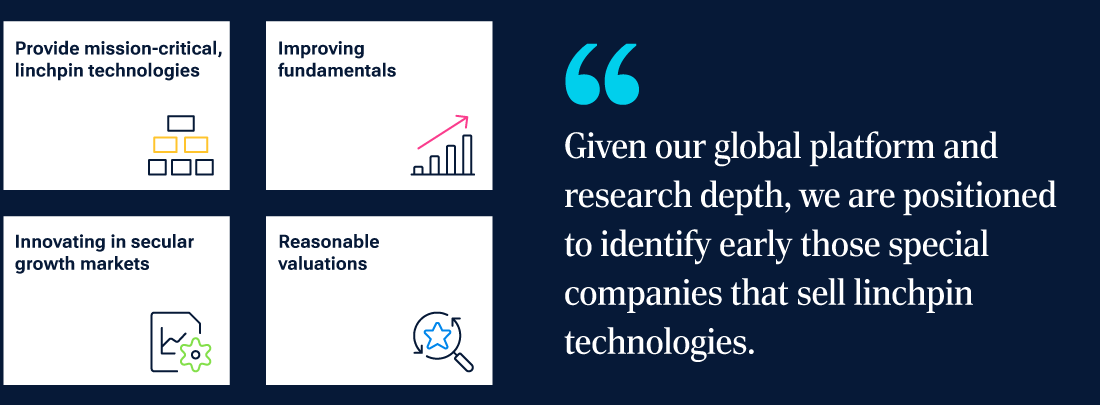
I view AI as a generational shift requiring disciplined navigation to capture the potential upside while managing speculative risks that may well increase over time. We look to manage AI risks responsibly, adhering to four safeguards or guardrails for support (Figure 3).
- I look to invest in companies with “linchpin” technologies that are critical to the tech ecosystem that meaningfully improve users’ experience and whose absence would fundamentally impact the AI world as we know it.
- I favor cash‑rich innovators that are taking market share in secular growth markets.
- These companies should have improving fundamentals, scalable margins, and rising free cash flow.
- I seek AI companies with reasonable valuations, accepting higher valuations only when accompanied by demonstrable fundamental improvements.
How do we navigate potential speculative bubbles responsibly?
Source: T. Rowe Price.
AI total addressable market

CAGR = Compound annual growth rate; E = Estimated.
Actual outcomes may differ materially from estimates. Estimates are subject to change.
Sources: AI chip market—AMD Data Center and AI Technology Premiere. AMD Financial Analyst Day 2025. Estimates provided are for the AI data center chip total addressable market (TAM). TAM is the total potential market for a product or service. There is no guarantee that any forecasts (AMD forecast, November 2025) made will come to pass and actual outcomes may differ materially.
Conclusion
It is only three years since the launch of ChatGPT in November 2022. Warnings about a repeat of 1999 may grab the headlines, but the AI rally is being led by some of the most profitable businesses in history. Valuations for the global tech sector today are not as high as in the late‑1990s dot‑com era, when the internet bubble led to extreme valuations. Current tech valuations appear more reasonable due to the huge earnings growth that large‑cap technology companies are generating, including the Magnificent Seven.
The outlook for equity markets and tech remains broadly positive, with additional U.S. fiscal stimulus expected in 2026 combined with further cuts in interest rates from the Fed. On the technology front, industry experts project the market for AI chips to grow exponentially over the next five years, from just USD 45 billion in 2023 to USD 500 billion in 2028 and USD 1 trillion in 20301.
This is a market so big that we think there will be room for many winners, not just the mega caps.
We think that technology led by AI will continue to gain share in many sectors of the economy as more and more businesses focus on digitizing their workflows. We believe many of the global technology companies that we are invested in have business strategies and initiatives in place that should serve them well over the longer term, even if the path ahead is occasionally bumpy.
We would also remind investors that global technology is not just about AI. There are many other positive, investible trends such as cybersecurity, enterprise software, e‑commerce, and increased tech spending in emerging markets. As cyberthreats continue to increase, we expect to see industry consolidation among leading cybersecurity vendors. Digital commerce and fintech continue to thrive, while digital advertising will benefit from advances in AI and machine learning.
 Dominic Rizzo, CFA
Portfolio Manager
Dominic Rizzo, CFA
Portfolio Manager

- Nov 2025
- On the Horizon
From hype to hard returns: AI enters a new phase
The focus is shifting from potential to profitability—and risk

- June 2026
- On the Horizon
2026 Midyear Market Outlook: Five shifts reshaping markets
Markets remain resilient, but the investment environment is becoming more fragmented and selective.

Contact us
1 Source: AMD Financial Analyst Day 2025. Estimates provided are for the AI data center chip total addressable market (TAM). TAM is the total potential market for a product or service. There is no guarantee that any forecasts (AMD forecast, November 2025) made will come to pass and actual outcomes may differ materially.
Additional Disclosures
For U.S. investors, visit troweprice.com/glossary for definitions of financial terms.
Important Information
Call 1-800-225-5132 to request a prospectus or summary prospectus; each includes investment objectives, risks, fees, expenses, and other information you should read and consider carefully before investing.
This material is provided for informational purposes only and is not intended to be investment advice or a recommendation to take any particular investment action.
The views contained herein are those of the authors as of December 2025 and are subject to change without notice; these views may differ from those of other T. Rowe Price associates.
This information is not intended to reflect a current or past recommendation concerning investments, investment strategies, or account types, advice of any kind, or a solicitation of an offer to buy or sell any securities or investment services. The opinions and commentary provided do not take into account the investment objectives or financial situation of any particular investor or class of investor. Please consider your own circumstances before making an investment decision.
Information contained herein is based upon sources we consider to be reliable; we do not, however, guarantee its accuracy.
Past performance is not a guarantee or a reliable indicator of future results. Investing in technology stocks entails specific risks, including the potential for wide variations in performance and usually wide price swings, up and down. Technology companies can be affected by, among other things, intense competition, government regulation, earnings disappointments, dependency on patent protection and rapid obsolescence of products and services due to technological innovations or changing consumer preferences. All investments are subject to market risk, including the possible loss of principal. All charts and tables are shown for illustrative purposes only.
T. Rowe Price Investment Services, Inc.
© 2025 T. Rowe Price. All Rights Reserved. T. ROWE PRICE, INVEST WITH CONFIDENCE, the Bighorn Sheep design, and related indicators (see troweprice.com/ip) are trademarks of T. Rowe Price Group, Inc. All other trademarks are the property of their respective owners.
- 202511-4969371