
How active ETFs can help reduce a portfolio’s tax liability
October 2026, Personal Finance
- Key Insights
-
- Exchange-traded funds generally have a more favorable structure for tax efficiency than some other investments, such as mutual funds.
- Transitioning from a traditional mutual fund to an ETF may turn an initial tax liability into long-term savings.
- Tax loss harvesting opportunities should be evaluated throughout the year, not just at year-end.
With year-end approaching, advisors may be reviewing portfolios for potential capital gain distributions and opportunities to apply tax-smart strategies in eligible accounts. Decisions made now—such as harvesting losses or realizing gains ahead of distributions—can meaningfully influence a client’s after-tax outcomes.
One way to enhance long-term tax efficiency is by reallocating assets into exchange-traded funds (ETFs), which are generally more tax-efficient than mutual funds. Actively managed ETFs, in particular, allow investors to pair those structural tax advantages with professional oversight, flexibility, and the potential for added return. With established managers like T. Rowe Price offering active ETFs, investors can combine the benefits of convenience, cost-effectiveness, and capital gains efficiency in a single vehicle—making them a timely tool for this year’s tax planning season.
Why consider using an active ETF as we approach year-end?
1. ETFs have been more tax-efficient
In terms of capital gains tax, ETFs have historically been a more tax-efficient vehicle than some other investment structures, such as mutual funds. The main reason ETFs have been more tax-efficient is due to the ETF’s unique create/redeem mechanism and the ability for ETFs to facilitate outflows in-kind. Even though ETFs may still generate a capital gain distribution, shareholder activity of buying and selling shares typically doesn’t create taxable events for ETFs, unlike in mutual funds.
Keep in mind, there are many factors that will impact the tax efficiency of an ETF and should always be taken into consideration (e.g., trading activity, issuer procedures, time in market). For investors who want the structural tax advantages of ETFs along with the benefits of active management—such as research-driven security selection, flexibility to adapt to markets, and risk management—active ETFs have the potential to add value to an investor’s portfolio.
Over the past five years, fewer ETFs than mutual funds paid capital gains
(Fig. 1) Percentage of U.S. Large-Cap Mutual Funds and ETFs That Distributed Capital Gains
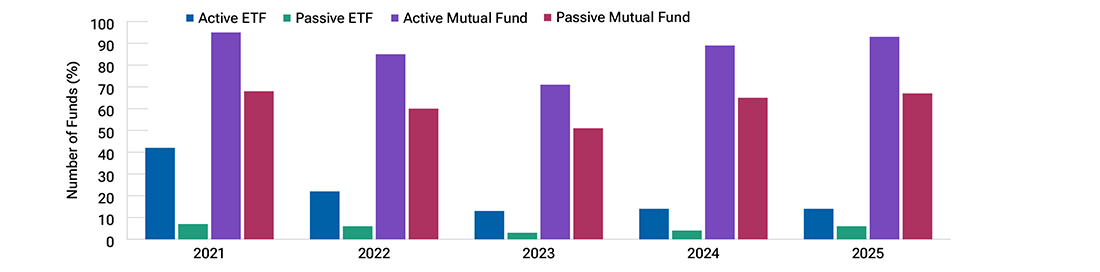
From December 31, 2021, to December 31, 2025.
Past performance cannot guarantee future results.
Source: Morningstar Direct, calendar year data as of December 31, 2025. Percentage of the total number of products that distributed long-term and/or short-term capital gains across all U.S.-listed mutual funds and ETFs. Percentages were calculated on a per-year basis at year-end, based on the Morningstar Direct database, and vary by year. Please see Additional Disclosures for more information.
Figure 1 illustrates the percentage of U.S. large-cap active and passive U.S.-listed mutual funds and ETFs that made capital gain distributions in each of the past five calendar years. It’s a myth to say that an ETF will never generate a capital gain, but structurally speaking, ETFs have done so at a much lower rate than mutual funds—even actively managed strategies. Some of T. Rowe Price’s active equity ETFs, for example, have distributed little (or in some cases, even zero) year-end capital gains over the past three years.
2. ETFs could turn a short-term tax hurdle into a long-term advantage
While transitioning a client from a mutual fund vehicle to an ETF may trigger an initial capital gains tax liability, the ongoing impact from staying invested in a mutual fund could pose a significant tax drag on total return over the long term.
As shown in Figure 2, the one-time tax cost of transitioning from a mutual fund to an ETF may be recovered over time through the ETF’s greater tax efficiency. Based on this hypothetical example, a mutual fund that has a cost basis equal to 50% of its current market value and carries a 20% average turnover rate could recoup the initial tax liability in approximately 2.6 years, after which the ETF structure may provide meaningful long-term tax savings. Beyond potential tax savings, clients may also benefit from many of the other well-known advantages of ETFs, including lower fees, enhanced transparency, and intraday trading flexibility.
ETFs could potentially generate significant tax savings over time
(Fig. 2) Break-Even Tax Analysis: ETFs vs. Mutual Funds
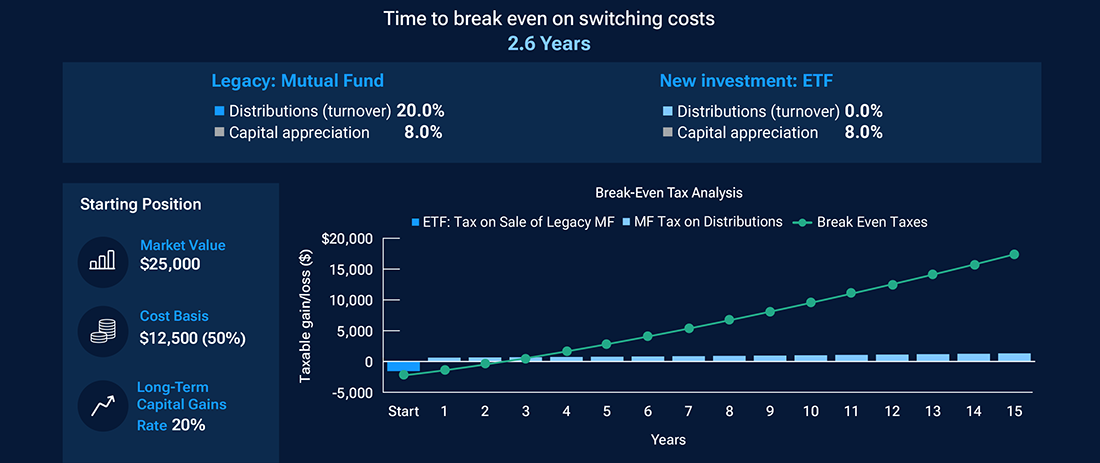
As of August 31, 2026
Past performance cannot guarantee future results.
Source: T. Rowe Price.
The concept is similar to a Roth conversion: Investors accept a tax cost today in exchange for potential tax benefits in the future. While transitioning from a mutual fund to an ETF may present upfront tax costs, the ETF’s greater tax efficiency may help offset that cost in the short term and has the potential to provide significant performance benefits over the long term.
3. Lower fees for an active approach
Just as active ETFs can add value through performance, they can also help reduce the overall cost of investing. When considering a move from mutual funds to ETFs, actively managed ETFs may also offer investors a way to reduce overall portfolio expenses in the process. Reduced expenses can help with the overall long-term outcome. ETF operational costs are often streamlined relative to active mutual funds with fewer shareholder services, client statement reporting, and other expenses. Well-established firms may have additional pricing advantages. By leveraging the global scope and scale of our firmwide resources, T. Rowe Price active ETFs are competitively priced relative to their peer groups. For example, illustrated in Figure 3 are some examples where T. Rowe Price active ETFs offer competitive fees relative to category averages.
Fees for actively managed ETFs can be significantly lower than comparable mutual funds
(Fig. 3) ETF Total Expense Ratios vs. Category Averages of Mutual Funds
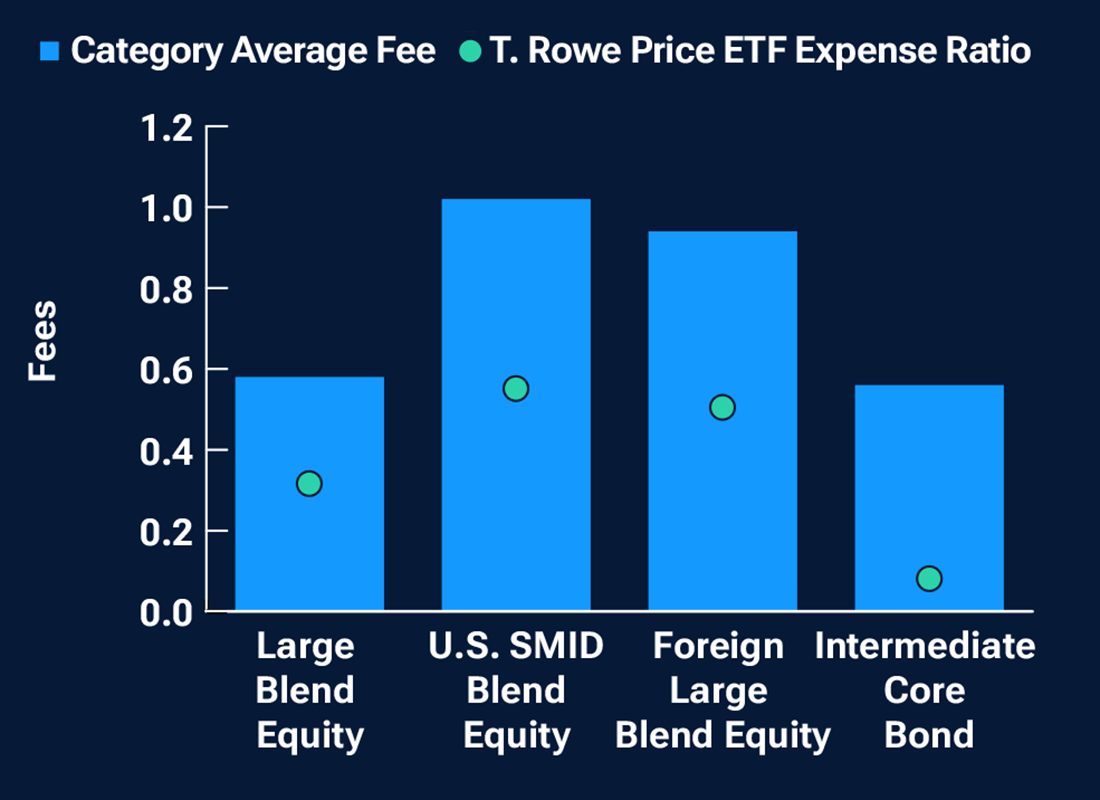
| Mutual Fund Category | Category Avg. Fee | T. Rowe Price Active ETF Solution | Expense Ratio | Difference |
|---|---|---|---|---|
| Large Blend Equity | 0.58% | TCAF | 0.31% | 0.27% |
| U.S. SMID Blend Equity | 1.02% | TMSL | 0.55% | 0.47% |
| Foreign Large Blend Equity | 0.94% | TOUS | 0.50% | 0.44% |
| Intermediate Core Bond | 0.56% | TAGG | 0.08% | 0.48% |
As of August 31, 2026.
Source: Morningstar Direct. Category Average Fee is based on all mutual funds in the category. All data are calculated and reported by Morningstar, Illustrated by T. Rowe Price. Please see Additional Disclosures for more information.
Tax-loss harvesting opportunities should be evaluated throughout the year
Beyond structural efficiency and lower expenses, advisors can apply active ETFs in tactical ways as well. One of the most important tools—especially in periods of heightened market volatility—is tax loss harvesting. This should be an ongoing, disciplined part of an advisor’s portfolio management process.
The technology sector provides a compelling example. Its relatively high volatility and broad return dispersion created meaningful tax-loss harvesting opportunities earlier this year as a first-quarter sell-off gave way to a strong rebound. Investor concerns around elevated valuations, artificial intelligence (AI) spending, inflation, interest rates, and geopolitical risks pressured prices, allowing advisors to harvest losses and potentially reposition clients into active strategies designed to better manage uncertainty and evolving market conditions.
An active technology ETF like the T. Rowe Price Technology ETF (TTEQ) not only offers the flexibility to adapt to changing market conditions but has also delivered strong results—outperforming many passive peers since the March lows (Figure 4).
Actively managed ETFs can help advisors adapt portfolios to changing market conditions
(Fig. 4) Performance of T. Rowe Price Technology ETF (TTEQ) and Invesco QQQ Trust (QQQ)
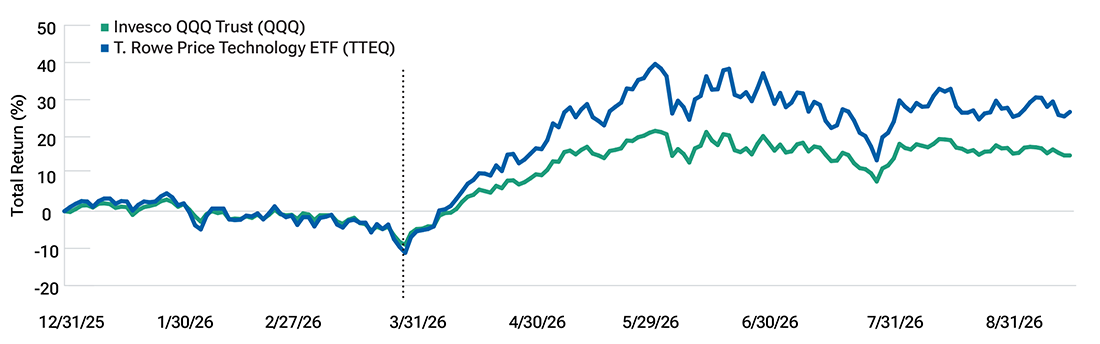
As of August 31, 2026
Past performance cannot guarantee future results.
Source: Bloomberg.
QQQ, the Invesco QQQ Trust, Series 1, is the largest passive technology ETF by assets under management, as tagged by VettaFi’s ETF Database. TTEQ, the T. Rowe Price Technology ETF, is an actively managed technology ETF.
Are there tax-loss harvesting opportunities this year?
Categories for consideration will depend on an investor’s holding period and individual portfolio allocations, and investors should always consult their financial professional and tax advisor.
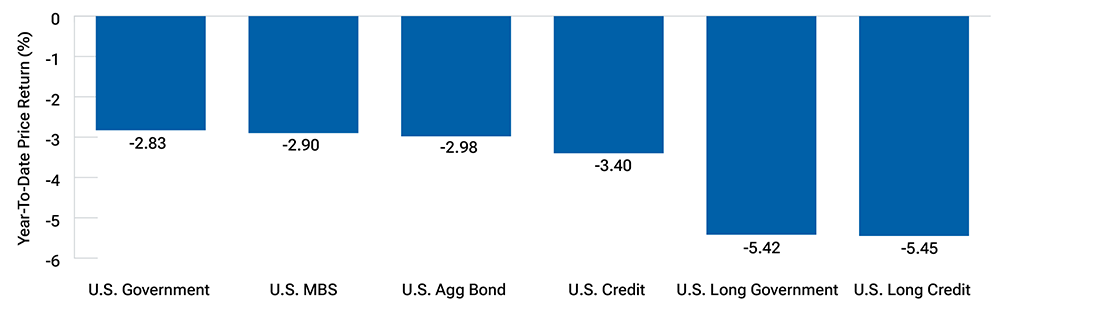
Year-to-date in 2026, there have been limited opportunities for tax loss harvesting. However, we have identified some potential areas to explore. For example, rising yields have put downward pressure on multiple bond sectors of late, particularly those with longer maturities.
Enhancing diversification, dialing down duration, and getting active
Advisors may use this underperformance as an opportunity to diversify their fixed income portfolios or shorten their duration with a broader opportunity set, particularly through the use of active management.
Active strategies have the ability to pursue market inefficiencies, adjust for credit risks, and seek enhanced yield and total return potential.
Rising rates have weighed on bond sectors, with long duration bearing the brunt
(Fig. 5) Price Return for Select Bond Categories
From December 31, 2021, to December 31, 2025.
Past performance cannot guarantee future results.
Source: Morningstar Direct, calendar year data as of December 31, 2025. Percentage of the total number of products that distributed long-term and/or short-term capital gains across all U.S.-listed mutual funds and ETFs. Percentages were calculated on a per-year basis at year-end, based on the Morningstar Direct database, and vary by year. Please see Additional Disclosures for more information.
The T. Rowe Price QM U.S. Bond ETF (TAGG) and T. Rowe Price Ultra Short-Term Bond ETF (TBUX) may offer compelling solutions. Advisors have the opportunity to use the funds individually or in combination, allowing for the targeting of a particular duration profile, adding diversification, and accessing the potential advantages of active management in fixed income.
TAGG
- Diversified broad fixed income exposure across U.S. Treasuries, corporate debt, mortgage-backed securities, and asset-backed securities.
- Quantitative and fundamental investment approach designed to identify opportunities and pursue consistent outcomes.
- Low-cost implementation with a competitive expense ratio of just 0.08%.
TBUX
- Diversified short duration exposure designed to enhance income potential while managing interest rate risk at a competitive expense ratio of just 0.17%.
- Active, multi-sector investment approach combining liquidity management, income generation, and a maturity ladder strategy.
- Global research platform integrating credit expertise, macroeconomic insights, and disciplined risk management.
Using TAGG and TBUX in combination could allow advisors to tailor portfolio duration
(Fig. 6) Duration and Expense Ratios for TAGG and TBUX
| ETFs | Duration (Years) | Weighted Average Expense Ratio (%) |
|---|---|---|
| T. Rowe Price QM U.S. Bond ETF (TAGG) | 5.83 | 0.08 |
| T. Rowe Price Ultra Short-Term Bond ETF (TBUX) | 0.59 | 0.17 |
| ETFs used in Combination | Duration (Years) | Weighted Average Expense Ratio (%) |
| 75/25 TAGG/TBUX | 4.52 | 0.10 |
| 50/50 TAGG/TBUX | 3.21 | 0.13 |
| 25/75 TAGG/TBUX | 1.90 | 0.15 |
As of June 30, 2026.
Past performance cannot guarantee future results.
Source: T. Rowe Price.
The Bottom Line: Active ETFs can be a powerful tool
While it may be top of mind at year-end, tax considerations should be part of an ongoing portfolio review. Active ETFs offer many benefits, including tax efficiency, lower costs, and the potential to outperform the benchmark. While individual circumstances will vary, ETFs offer a range of opportunities for investors looking to reposition their portfolios for the potential of long term benefits.
 Christopher Murphy, CIMA®
Head of ETF Specialists
Christopher Murphy, CIMA®
Head of ETF Specialists
 Thomas Guarini
Director, ETF Distribution
Thomas Guarini
Director, ETF Distribution
 Brian Navin, CFA
Senior ETF Specialist
Brian Navin, CFA
Senior ETF Specialist

- Jun 2026
- From the Field
Why every basis point matters in a core fixed income ETF

Contact us
Additional Disclosures
For U.S. investors, visit troweprice.com/glossary for definitions of financial terms.
Bloomberg Index Services Limited. BLOOMBERG® is a trademark and service mark of Bloomberg Finance L.P. and its affiliates (collectively “Bloomberg”). BARCLAYS® is a trademark and service mark of Barclays Bank Plc (collectively with its affiliates, “Barclays”), used under license. Bloomberg or Bloomberg’s licensors, including Barclays, own all proprietary rights in the Bloomberg Barclays Indices. Neither Bloomberg nor Barclays approves or endorses this material or guarantees the accuracy or completeness of any information herein, or makes any warranty, express or implied, as to the results to be obtained therefrom and, to the maximum extent allowed by law, neither shall have any liability or responsibility for injury or damages arising in connection therewith.
© 2026 Morningstar, Inc. All rights reserved. The information contained herein: (1) is proprietary to Morningstar and/or its content providers; (2) may not be copied or distributed; and (3) is not warranted to be accurate, complete, or timely. Neither Morningstar nor its content providers are responsible for any damages or losses arising from any use of this information. Past performance is no guarantee of future results.
For important terms, please see the following: https://www.troweprice.com/personal-investing/funds/benchmark-definitions.html
MSCI EAFE Index is an equity index that captures large and mid cap representation across developed markets countries around the world, excluding the U.S. and Canada. The index covers approximately 85% of the free-float adjusted market capitalization in each country.
QQQ, the Invesco QQQ Trust, Series 1, is an exchange-traded fund based on the Nasdaq-100 Index®. The Fund will, under most circumstances, consist of all stocks in the Index. The Index includes 100 of the largest domestic and international nonfinancial companies listed on the Nasdaq Stock Market based on market capitalization. The Fund and the Index are rebalanced quarterly and reconstituted annually.
T. Rowe Price Technology ETF (TTEQ)
Average Annual Returns as of August 31, 2026
| 1 year | 3 years | 5 years | Since inception | |
| Market price | 53.42% | — | — | 40.97% |
| NAV | 53.76% | — | — | 40.89% |
| Benchmark | 23.67% | 19.70% | 10.98% | 19.95% |
| Value1 | 30.09% | — | — | 20.94% |
Benchmark: MSCI All Country World Index Net.
Inception Date: October 23, 2024.
1 Value is the performance difference between the net asset value (NAV) and benchmark total returns.
T. Rowe Price Technology ETF (TTEQ) gross expense ratio: 0.63%. The gross expense ratio reflects the fund expenses as stated in the fee table of the fund’s prospectus prior to the deduction of any waiver or reimbursement.
Performance data quoted represents past performance and does not guarantee future results; current performance may be higher or lower than performance quoted. Investment returns and principal value will fluctuate and shares, when sold, may be worth more or less than their original cost. Market returns are based on the midpoint of the bid/ask spread as of 4 p.m. ET and do not represent returns an investor would receive if shares were traded at other times.
T. Rowe Price QM U.S. Bond ETF (TAGG)
Average Annual Returns as of June 30, 2026
| 1 year | 3 years | 5 years | Since inception | |
| Market price | 4.06% | 4.31% | — | 0.12% |
| NAV | 3.99% | 4.30% | — | 0.09% |
| Benchmark | 3.79% | 4.16% | 0.08% | 0.10% |
| Value1 | 0.20% | 0.14% | — | -0.01% |
Benchmark: Bloomberg U.S. Aggregate Bond Index
Inception Date: October 23, 2024.
1 Value is the performance difference between the net asset value (NAV) and benchmark total returns.
T. Rowe Price QM U.S. Bond ETF (TAGG) gross expense ratio: 0.08%. The gross expense ratio reflects the fund expenses as stated in the fee table of the fund’s prospectus prior to the deduction of any waiver or reimbursement.
Performance data quoted represents past performance and does not guarantee future results; current performance may be higher or lower than performance quoted. Investment returns and principal value will fluctuate and shares, when sold, may be worth more or less than their original cost. Market returns are based on the midpoint of the bid/ask spread as of 4 p.m. ET and do not represent returns an investor would receive if shares were traded at other times.
T. Rowe Price Ultra Short-Term Bond ETF (TBUX)
Average Annual Returns as of June 30, 2026
| 1 year | 3 years | 5 years | Since inception | |
| Market price | 4.61% | 5.81% | — | 4.12% |
| NAV | 4.63% | 5.79% | — | 4.11% |
| Benchmark | 3.97% | 4.81% | 3.45% | 3.62% |
| Value1 | 0.66% | 0.98% | — | 0.49% |
Benchmark: Bloomberg Short-Term Government/Corporate Index
Inception Date: September 28, 2021.
1 Value is the performance difference between the net asset value (NAV) and benchmark total returns.
T. Rowe Price Ultra Short-Term Bond ETF (TBUX) gross expense ratio: 0.17%. The gross expense ratio reflects the fund expenses as stated in the fee table of the fund’s prospectus prior to the deduction of any waiver or reimbursement.
Performance data quoted represents past performance and does not guarantee future results; current performance may be higher or lower than performance quoted. Investment returns and principal value will fluctuate and shares, when sold, may be worth more or less than their original cost. Market returns are based on the midpoint of the bid/ask spread as of 4 p.m. ET and do not represent returns an investor would receive if shares were traded at other times.
Important Information
Call 1-800-225-5132 to request a prospectus or summary prospectus; each includes investment objectives, risks, fees, expenses, and other information you should read and consider carefully before investing.
Performance data quoted represents past performance and is not a reliable indicator of future performance. Investment return and principal value will fluctuate so that an investor’s shares, when sold or redeemed, may be worth more or less than their original cost. Current performance may be lower or higher than the performance data quoted. To obtain the most recent month-end performance, visit troweprice.com or the fund companies’ websites. Market returns are based on the midpoint of the bid/ask spread as of 4p.m. ET and do not represent returns an investor would receive if shares were traded at other times.
The fund’s total return figures reflect the reinvestment of dividends and capital gains, if any.
For more information on the funds, visit the fund companies’ websites. Refer to the funds’ prospectus for more information.
This material is provided for informational purposes only and is not intended to be investment advice or a recommendation to take any particular investment action.
The views contained herein are those of the authors as of October 2026 and are subject to change without notice; these views may differ from those of other T. Rowe Price associates.
This information is not intended to reflect a current or past recommendation concerning investments, investment strategies, or account types, advice of any kind, or a solicitation of an offer to buy or sell any securities or investment services. The opinions and commentary provided do not take into account the investment objectives or financial situation of any particular investor or class of investor. Please consider your own circumstances before making an investment decision.
Information contained herein is based upon sources we consider to be reliable; we do not, however, guarantee its accuracy. Actual future outcomes may differ materially from any estimates or forward-looking statements provided.
ETFs are bought and sold at market prices, not net asset value (NAV). Investors generally incur the cost of the spread between the prices at which shares are bought and sold. Buying and selling shares may result in brokerage commissions, which will reduce returns.
Risk Considerations: Past performance cannot guarantee future results. All investments are subject to market risk, including the possible loss of principal. Active investing may have higher costs than passive investing and may underperform the broad market or passive peers with similar objectives. As with all equity investments, the share price can fall because of weakness in the broad market, a particular industry, or specific holdings. Fixed income investing involves risks, including, but not limited to, interest rate risk and credit risk. International investments can be riskier than U.S. investments due to the adverse effects of currency exchange rates, differences in market structure and liquidity, as well as specific country, regional, and economic developments. Diversification does not guarantee protection against losses. All charts and tables are shown for illustrative purposes only.
T. Rowe Price Investment Services, Inc., distributor. T. Rowe Price Associates, Inc., investment adviser. T. Rowe Price Investment Services, Inc., and T. Rowe Price Associates, Inc., are affiliated companies. © 2026 T. Rowe Price. All Rights Reserved. T. ROWE PRICE, INVEST WITH CONFIDENCE, the Bighorn Sheep design, and related indicators (see troweprice.com/ip) are trademarks of T. Rowe Price Group, Inc. All other trademarks are the property of their respective owners.
- 202609-5958620