
Advising women on Social Security claiming strategies to help boost lifetime income
Practice Management
More women are claiming Social Security benefits based on their own income rather than the more traditional approach of relying primarily on spousal benefits based on their husband’s earnings or moving between a benefit based on their own and their spouse’s work.
In fact, in 2025, roughly six in 10 women will rely on their own earned income when claiming Social Security, an 18-percentage point increase in the past 10 years, according to the Social Security Administration (SSA). Also driving this trend is that marriage is on the decline, with just 47% of households in 2022 consisting of married couples, down from 71% in 1970, according to the U.S. Census Bureau’s “America’s Families and Living Arrangements: 2022” report.
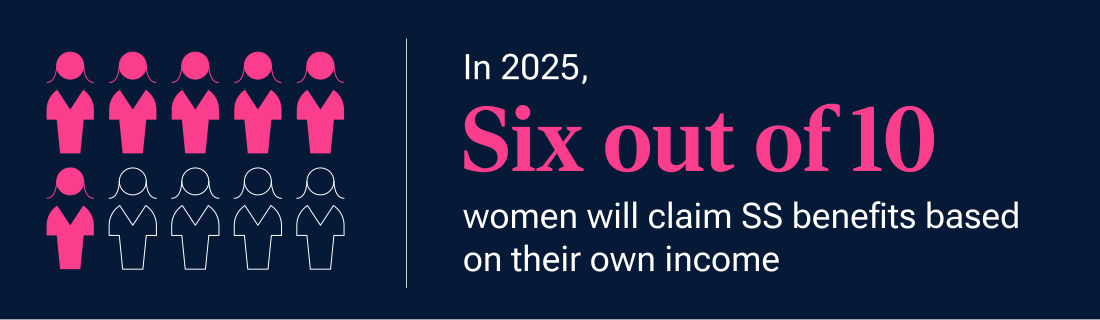
Source: U.S. Census Bureau’s “America’s Families and Living Arrangements: 2022” report
This shift in claiming means many women can potentially generate a larger income stream in retirement, reduce their reliance on spousal income, and benefit from greater financial independence.
What women claiming Social Security based on their own income means for advisors
No doubt, if you’re looking to grow your practice, building a lasting relationship of trust with your women clients and prospects means placing a sharper focus on the Social Security claiming decisions of both women and couples.
Women are increasingly in charge of their own finances. In fact, 70% of widows switch financial advisors after their spouse passes, according to McKinsey & Company. And 72% of women seek referrals from other women, recent data show. This shift means the financial planning toolkit and game plan for mapping out women’s retirement income streams are undergoing massive change. With women narrowing the pay gap with men, many women can now potentially generate more Social Security income with their own benefit than they can taking 50% of their spouse’s benefit. From a tactical standpoint, the trend of women claiming their own benefits impacts the number crunching and retirement income calculations that you perform for them.
But the human dimension in the advisor-client relationship matters too. So, lean in and dig deep with your women clients to help them enhance their Social Security benefits. Indeed, clients are increasingly looking for an advisor with Social Security and retirement incoming planning acumen as they transition to the next chapter of their lives.
Play the role of trusted advisor. Gain a better understanding of how women, whether they’ve never been married or they are married, divorced, or widowed, view Social Security in the context of their overall retirement plan. Listen to their individual concerns and anxieties. Show empathy. Answer their questions. And then empower them by charting a path forward with a Social Security claiming strategy that boosts their chances of financial independence in retirement.
Why the Social Security claiming decision matters to women
When it comes to income needs in retirement, there are multiple reasons why it’s vital that women make the smartest Social Security claiming decision to ensure that they receive a more sizable benefit check throughout retirement.
The biggest reason, of course, is that women have a longer life expectancy than men, and married women tend to be younger than their husbands and therefore will rely on Social Security benefits for a longer period. How much longer? On average, a wife will outlive her husband by roughly five years, according to our analysis of data from the Pew Research Center and the SSA.
The so-called pay gap is another key factor. Women, despite narrowing the pay gap in recent years, still earn less money than men. What’s more, lapses in employment for women during their careers, often from caring for children and aging parents, also limit lifetime earnings. Not surprisingly, women’s pay relative to men’s dips the most between the ages of 35 and 44, according to Pew Research Center. And it’s hard for women to replace lost income when they return to the workforce.
All this results in a 19% smaller Social Security benefit than men. Given the benefit shortfall many women face, it’s even more important for them to make the claiming decision that will potentially net them the largest potential benefit over their lifetime. And since the timing of claiming decisions is also key, it’s vital that married women coordinate their claiming decisions with their spouse. Adding to the urgency is the fact that women are more pessimistic about Social Security and its ability to provide an income stream in retirement, according to the SSA.
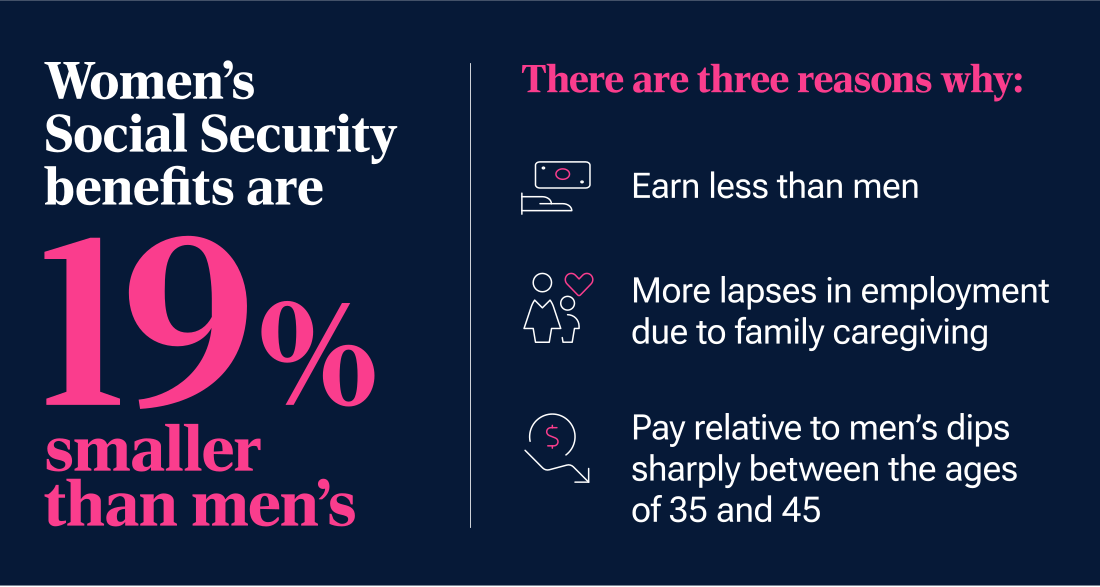
Source: Social Security Administration, 2023; U.S. Bureau of Labor Statistics, 2023; Pew Research Center
Helping women understand their Social Security benefits
You can build a longer-lasting connection with women by helping them better understand the nuances of Social Security. Play the role of teacher, advisor, trusted expert, and coach.
- Teach the basics of Social Security. Highlight the three types of Social Security benefits: their own worker benefit as well as spousal and survivor benefits. Explain how spousal and survivor benefits work and what claiming strategy makes most sense based on their personal situation. This type of learning provides comfort and clarity to your women clients.
- Quantify the benefits they’re entitled to. This is a good time to advise your women clients to view their Social Security statement at www.ssa.gov/myaccount. It’s also a good idea for married women to review their spouse’s statement as well as contact the SSA to find out if they qualify for spousal benefits from an ex-spouse.
It’s important to note that a Social Security recipient can only receive the highest benefit they’re eligible for and that benefits can’t be combined. Their own benefit, of course, is based on their personal career earnings. The spousal benefit payment is 50% of the spouse’s benefit payment at the spouse’s full retirement age (FRA). While FRA depends on a person’s year of birth, the FRA is 67 for those born in 1961 or later.
The survivor benefit (if it is higher than the surviving woman’s own monthly Social Security benefit) can be claimed when her spouse passes.
- Review the various Social Security claiming strategies. Discuss the different and smartest claiming strategies based on life expectancy. And when you’re working with married couples, illustrate the claiming strategies based on factors such as which spouse has the higher salary and who is expected to live longer—ultimately, you want to match the larger benefit to the longer life expectancy because you want the larger benefit to be the one that lasts the longest. Case studies, or claiming profiles, are also useful to help divorced, widowed, or never-married women understand their Social Security claiming options.
- Debunk women’s misplaced fears about Social Security’s solvency. Emphasize that Social Security, which is under financial stress, is not going away and payments are not going to stop. Social Security will be able to pay 100% of promised benefits until 2033, at which point the Trust Fund’s reserves will be depleted. After that, incoming funds through worker payroll deductions will be sufficient to pay about 80% of scheduled benefits—a reduction, but not to $0.
- Stress the positives. Let them know that the headwinds they face (such as earning less than men and likely having to rely on Social Security for a longer period of time than men due to a longer life expectancy) can be overcome with good planning. And be sure to emphasize that Social Security, which provides inflation-adjusted income for the remainder of their lives, is a critical piece of a secure retirement.
Helping women navigate Social Security and retirement planning is a way for advisors to better serve women clients and grow their practice and assets under management today and into the future. What better way to build strong relationships with women clients than guiding them through the confusing gauntlet of claiming options and helping them to optimize their Social Security income in retirement.
- Related Resources
Put the power of Social Security solutions to work for your clients
Help your clients conquer the complexities of Social Security and feel more confident.
Explore Practice Management
Women are uncertain about Social Security. Here’s how to help them take control
Financial advisors can put women clients at ease about their Social Security benefits with positive messaging and consistent benefits education.

Contact us
- 202512-4366537