
How a Monte Carlo analysis could help improve your retirement plan
June 2026, Retirement
- Key Insights
-
- Monte Carlo simulations help investors test retirement plans against a range of market environments.
- Advisors generally recommend that investors aim for a good, rather than a perfect, score.
- Regularly revisiting these analyses can help investors keep their retirement plans on track.
When it comes to market performance over a retirement that could last 30 years or more, it is impossible to know exactly what the future will hold. When financial advisors seek answers to these kinds of forward‑looking questions, they often turn to planning tools that use probability modeling, such as a Monte Carlo analysis. This type of analysis is particularly helpful for retirement planning when it comes to individuals as well.
What is Monte Carlo analysis?
A Monte Carlo analysis is a technique that simulates a range of possible outcomes for an uncertain event. In the context of financial planning, the analysis helps to test an individual retirement plan’s viability against a range of market environments and investment outcomes. The results of Monte Carlo simulations are then expressed as a percentage of scenarios (from 0 to 99) where there was money remaining at the end of the retirement horizon. For instance, a Monte Carlo score of 80 means that 80% of the test simulations resulted in $1 or more at the end of the period, while 20% of the simulations ran out of money.
By comparison, other types of retirement planning might assume a static annual rate of return (for example, 7%) for the entire duration of the planning period. While an average rate of return is an important assumption, that approach assumes that market returns go up every year and does not consider a period of poor market performance, for example.
“We don’t know how the market may behave in the future, but we do know that it goes up and down and that certain assets perform differently over various time periods.”
The T. Rowe Price Retirement Income Calculator
Our tool helps you gauge whether your retirement plan is currently on track.
A Monte Carlo analysis lies at the heart of the T. Rowe Price Retirement Income Calculator. A user can create a profile and enter retirement planning information such as their birth date, salary, retirement savings, retirement contribution amount, and portfolio allocation. They can also enter their spouse’s information to get a more complete picture. Utilizing proprietary capital market assumptions (asset class returns and volatility, for example), the tool runs 1,000 simulations that result in a Confidence Score illustrating the percent of successful trials.
Making Adjustments
The tool’s interface allows you to adjust your initial parameters to see how the choices you make could lead to a higher or lower score. Examples of these adjustable parameters include the amount being saved, retirement age, expenses in retirement, and portfolio allocation.
Tool Limitations
There are limits to this flexibility, however. The tool assumes that your expenses will remain constant through retirement, and it assumes that your income will remain relatively constant as well. Despite these assumptions, the Retirement Income Calculator offers users valuable insights on the overall resilience of their retirement plans.
Retirement Income Calculator illustration of 1,000 simulations and Confidence Score
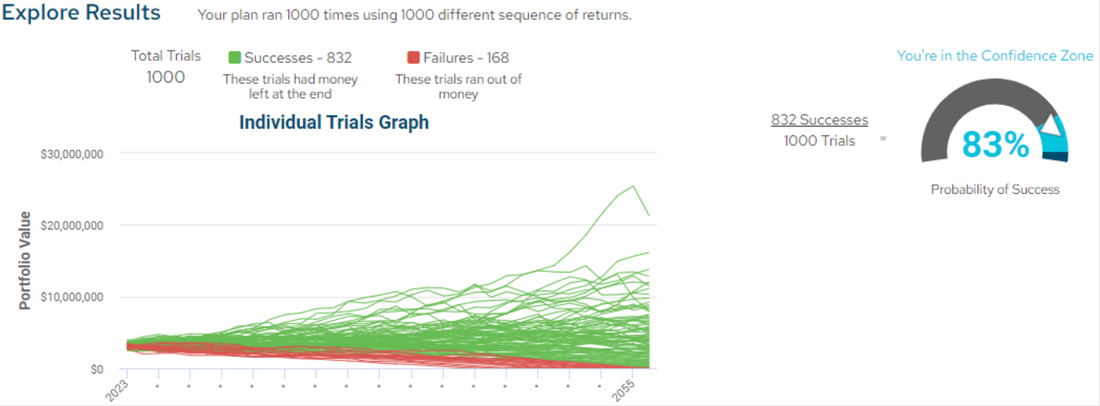
For illustrative purposes only. Not meant to demonstrate actual results of any investor. For full methodology, assumptions, and limitations of the Retirement Income Calculator, please visit troweprice.com/content/dam/iinvestor/Forms/retirement-income-calculator-methodology.pdf
Source: T. Rowe Price.
Understanding your score
While investors may assume that the highest success rate from a Monte Carlo analysis is best, that’s not always the case. These investors may be surprised when an advisor suggests that they can spend more in retirement, retire earlier, or both. After decades focused on saving, some investors feel reluctance to spend their own money. However, they may be in a position to enjoy retirement more than they think.
T. Rowe Price retirement advisors typically recommend aiming for a good score, rather than a perfect one. For example, many advisors, including the T. Rowe Price Retirement Advisory Service, counsel investors to aim for a Confidence Zone that ranges from 80% to 95%.
At the same time, a lower score, or seeing a dip in the score, may not mean it’s time to panic, either. The score is a helpful barometer to understand how much attention you may need to give to your retirement plan at a particular point in time.
Moderate adjustments can have a big impact on your score
The power of the Monte Carlo analysis is not just limited to the initial results. Most tools allow you to make adjustments and test how the changes could affect your long‑term financial success. For instance, minor adjustments in the following factors can lead to large changes in your score:
- Your retirement spending
- How much you save
- When you expect to retire
- Your asset allocation
What’s more, a Monte Carlo analysis as part of an advisor‑led planning service can help you craft your vision of retirement, personalizing your plan for your unique situation. An advisor can guide you through the process and help you prioritize what adjustments or actions will benefit your plan the most. (See “The benefit of our Retirement Advisory Service.”)
A Monte Carlo analysis is not a prediction of the future. It is merely a way to test various assumptions against an unpredictable future. The results of the analysis are heavily influenced by the quality and accuracy of those assumptions and inputs. Keep in mind, if you’re planning for retirement with a spouse or partner, you should also include their information for a more complete picture.
Moderate adjustments can make a big difference
(Fig. 2) Consider how the analyses run by two hypothetical investors using the T. Rowe Price Retirement Income Calculator led to adjustments in their retirement plans.
Hypothetical investor No. 1
| NADINE | |
|---|---|
| Nadine is 60 years old and has saved diligently for retirement. She hopes to retire at age 65 but would love to retire earlier if possible. She decides to engage with a retirement planning advisor to help her visualize her retirement. |
|
| She has $1,000,000 set aside for retirement in an aggressive portfolio (90% stock), earns $80,000 per year, and is contributing 15% of her salary toward retirement. | Confidence Score: 99% |
| Nadine is relieved that she’s on track. Her advisor asks what other goals she has as she could spend more. Nadine wants to travel, so they increase her annual retirement spending goal by 20%. | Confidence Score: 92% |
| The advisor also suggests that Nadine could consider a more moderate (60% stock) investment approach as she nears retirement. | Confidence Score: 96% |
| Nadine and her advisor chat about an earlier retirement if Nadine could be flexible about her spending goals. They target age 63 instead of 65. | Confidence Score: 89% |
| They stress‑test her portfolio and model a 20% drop in asset value. She could still retire at age 63 and remain in the Confidence Zone, but she may need to adjust her spending slightly. | Confidence Score: 88% |
| Outcome They decide to adjust her asset allocation to a moderate investment approach and target retiring at age 63. Nadine appreciates that she has flexibility with her retirement spending and looks forward to checking in with her advisor as retirement becomes a reality. |
|
As of August 2025.
For illustrative purposes only. Not meant to demonstrate actual results of any investor. Your results will vary.
Source: T. Rowe Price.
Ultimately, a Monte Carlo score is a data‑driven way to approach emotional decisions in a rational and informed way— and to strategically plan for a successful retirement. While the results of a Monte Carlo analysis may seem black and white or present as success or failure, they’re more of an indication that you may have to take some action to make your retirement plan sustainable. The good news is—most of those actions are in your control.
Moderate adjustments can make a big difference (continued)
(Fig. 2) Consider how the analyses run by two hypothetical investors using the T. Rowe Price Retirement Income Calculator led to adjustments in their retirement plans.
Hypothetical investor No. 2
| LEE | |
|---|---|
| Lee is 50 years old and thinks he’s in good shape to retire at age 65. | |
| He has $500,000 saved for retirement in a moderate portfolio (60% stock) and earns $100,000 per year, contributing 10% of his salary. | Confidence Score: 70% |
| Lee is a bit discouraged to see that his score is not in the Confidence Zone. He thinks increasing his contribution to 15% of his salary will improve his outlook. | Confidence Score: 77% |
| Lee wonders if he should also invest more aggressively to improve his circumstances. | Confidence Score: 76% |
| Lee is surprised to see that a more aggressive allocation does not change his score. He wonders if he might need to revisit his initial spending in retirement and reduces that amount by 6%. | Confidence Score: 83% |
| Outcome Lee is happy to see he’s in the Confidence Zone for an age 65 retirement. He decides to stick with his moderate investment approach. He sees that he may need to save a bit more over the next 15 years and start thinking about his spending expectations in retirement. He will continue to track his progress. |
|
As of August 2025.
For illustrative purposes only. Not meant to demonstrate actual results of any investor. Your results will vary.
Source: T. Rowe Price.
The benefit of our Retirement Advisory Service
Working with an advisor can give you access to more complex analyses and help you better understand what adjustments might be available or necessary.
The advisors with T. Rowe Price Retirement Advisory Service use Monte Carlo simulations as part of their process to guide investors on how to best plan for a dynamic retirement. Advisors walk clients through the different scenarios and review with them what changes might be necessary or available to improve their confidence in achieving their long‑term retirement goals as a household.
We find that our clients tend to focus on the extreme scenarios in an analysis, namely when the money runs out too early or when there is plenty left over at the end. We guide them to aim for a Confidence Zone of 80% to 95% to help keep the focus on the more likely scenarios and avoid making unnecessary sacrifices or aggressive adjustments to the plan.
After receiving a complimentary Monte Carlo analysis and resulting retirement plan, investors who opt to enroll in the ongoing Retirement Advisory Service gain the benefit of a dedicated advisor and a diversified portfolio monitored and actively managed by a team of experienced investment professionals at T. Rowe Price. The dedicated advisors touch base with their clients at least twice a year to review their situation and discuss any changes that might need to occur to keep their retirement plan on track.
 Lindsay Theodore, CFP®
Thought Leadership Senior Manager
Lindsay Theodore, CFP®
Thought Leadership Senior Manager

- From the Field
How unpacking health care expenses can empower retirement savers
We unpack health expense data to help retirement savers optimize their financial planning.
The projections in this article were calculated using the Retirement Income Calculator. The calculator uses Monte Carlo analysis to generate 1,000 hypothetical scenarios based on inputs such as, but not limited to, performance of various asset classes; saving and spending assumptions; a client’s time horizon, life expectancy, income, and expenses; and other variables. The Monte Carlo analysis provides ranges of potential future outcomes based on a probability model. The Monte Carlo simulation runs the user’s scenario 1,000 times. So, for example, if 600 of those runs are successful (i.e., all goals are funded and the user has at least $1 of assets remaining at the end), then the probability of success would be 60% and the probability of failure would be 40%. For purposes of the illustration: Hypothetical Investor No. 1 Assumptions (Fig. 2): is assumed female, single, and residing in Colorado with a date of birth of August 1, 1965. Ninety percent of the assets are in qualified retirement accounts. Expected annual living expenses in retirement are initially assumed to be $52,814. Those expenses are assumed to increase to $63,400 (about 20% from initial) and to $58,000 (about 10% from initial). To assess a decline of 20%, the starting asset value of $1,000,000 was reduced to $800,000. Hypothetical Investor No. 2 Assumptions (Fig. 2): is assumed male, single, and residing in Colorado with a date of birth of August 1, 1975. Ninety percent of the assets are in qualified retirement accounts. Expected annual living expenses in retirement are initially assumed to be $75,000. Those expenses are assumed to decline to $70,000 (about 6% from initial). Both illustrations assume the use of an aggressive allocation (90% stocks, 10% bonds) and a moderate allocation (60% stocks, 40% bonds). These allocations are assumed to be rebalanced annually to remain consistent. For details on this and other assumptions, please read our Methodology and Assumptions at troweprice.com/content/dam/iinvestor/Forms/retirement-income-calculator-methodology.pdf.
The information provided in this tool is for general and educational purposes only and is not intended to provide legal, tax, or investment advice. The assumptions and methodology are not tailored to the needs of any specific investor. Results are intended as an aid, are not guaranteed, and should not be your only source of information when making financial decisions. Other T. Rowe Price educational tools or advice services use different assumptions and methods and may yield different results.
IMPORTANT: The projections or other information generated by the Retirement Income Calculator regarding the likelihood of various investment outcomes are hypothetical in nature, do not reflect actual investment results, and are not guarantees of future results. The simulations are based on assumptions. There can be no assurance that the projected or simulated results will be achieved or sustained. Actual results will vary with each use and over time, and such results may be better or worse than the simulated scenarios. Clients should be aware that the potential for loss (or gain) may be greater than demonstrated in the simulations.
Additional Disclosure
Certified Financial Planner Board of Standards, Inc. (CFP Board) owns the CFP® certification mark, the CERTIFIED FINANCIAL PLANNER™ certification mark, and the CFP® certification mark (with plaque design) logo in the United States, which it authorizes use of by individuals who successfully complete CFP Board’s initial and ongoing certification requirements.
Important Information
The T. Rowe Price Retirement Advisory Service™ is a nondiscretionary financial planning and retirement income planning service and a discretionary managed account program provided by T. Rowe Price Advisory Services, Inc., a registered investment adviser under the Investment Advisers Act of 1940. Brokerage accounts for the Retirement Advisory Service are provided by T. Rowe Price Investment Services, Inc., member FINRA/SIPC, and are carried by Pershing LLC, a BNY Mellon company, member NYSE/FINRA/SIPC, which acts as a clearing broker for T. Rowe Price Investment Services, Inc. T. Rowe Price Advisory Services, Inc. and T. Rowe Price Investment Services, Inc. are affiliated companies.
This material is provided for general and educational purposes only and is not intended to provide legal, tax, or investment advice. This material does not provide recommendations concerning investments, investment strategies, or account types; it is not individualized to the needs of any specific investor and is not intended to suggest that any particular investment action is appropriate for you.
Any tax‑related discussion contained in this material, including any attachments/links, is not intended or written to be used, and cannot be used, for the purpose of (i) avoiding any tax penalties or (ii) promoting, marketing, or recommending to any other party any transaction or matter addressed herein. Please consult your independent legal counsel and/or tax professional regarding any legal or tax issues raised in this material.
The views contained herein are as of the date written and are subject to change without notice; these views may differ from those of other T. Rowe Price associates.
This information is not intended to reflect a current or past recommendation concerning investments, investment strategies, or account types; advice of any kind; or a solicitation of an offer to buy or sell any securities or investment services. The opinions and commentary provided do not take into account the investment objectives or financial situation of any particular investor or class of investor. Please consider your own circumstances before making an investment decision.
Information contained herein is based upon sources we consider to be reliable; we do not, however, guarantee its accuracy. Actual future outcomes may differ materially from any estimates or forward-looking statements provided.
T. Rowe Price Investment Services, Inc., distributor. T. Rowe Price Associates, Inc., investment adviser. T. Rowe Price Investment Services, Inc., and T. Rowe Price Associates, Inc., are affiliated companies.
Past performance is not a guarantee or a reliable indicator of future results. All investments are subject to market risk, including the possible loss of principal. All charts and tables are shown for illustrative purposes only. Diversification cannot assure a profit or protect against loss in a declining market.
© 2026 T. Rowe Price. All Rights Reserved. T. ROWE PRICE, INVEST WITH CONFIDENCE, the Bighorn Sheep design, and related indicators (see troweprice.com/ip) are trademarks of T. Rowe Price Group, Inc. All other trademarks are the property of their respective owners.
- 202507-4668453