

Global Economics: Divergent Paths Likely To Accelerate
Executive Summary
We see the global economy becoming increasingly divergent in 2016 as the slowdown in emerging markets is somewhat offset by the recovery in advanced economies.
- Weak aggregate demand will continue to affect the global economy in 2016. Emerging markets need to deleverage, and it is unclear whether advanced economies can make up the shortfall.
- The impact of the slowdown in emerging markets ultimately will be determined by whether it is an orderly or disorderly correction. We believe that it will be the former, which will lead to sustained weak growth but not a crash.
- China will avoid a hard landing—its fundamentals are strong, and it has the tools at its disposal to manage the slowdown effectively. Other emerging market countries, particularly those in Latin America, will be hit harder.
- After a dramatic 2015, the eurozone will return to moderate growth, which will also be supportive for emerging Europe. Improving fundamentals for US households’ real disposable income will combine with a favourable fiscal environment and an improving housing market.
Demand shortfalls will continue to weigh down the global economy in 2016. After more than six years of aggressive borrowing (Figure 1), emerging markets need to deleverage. To prevent global growth from falling precipitously, advanced economies must pick up the baton—but whether they are ready to is far from clear. In this environment, markets are likely to remain skittish, with participants anxiously scrutinising every new data point and central bank announcement for positive or negative signals. Policy errors have great scope to influence sentiment: Will the tightening of the US monetary policy curb demand excessively? Have the leading European economies repaired their balance sheets sufficiently for them to meaningfully support global demand?
Figure 1: Private Credit Growth in Developed and Emerging Markets (EM), 2000–2015
As of September 2015
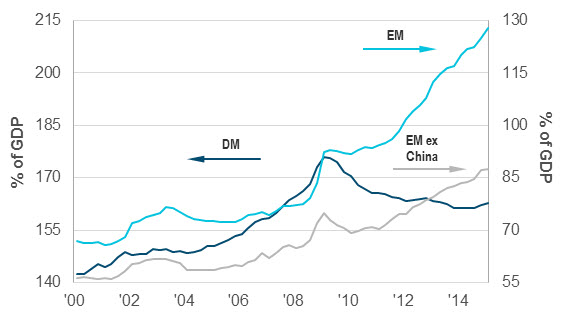
GDP refers to gross domestic product.
Source: J.P. Morgan Global Data Watch.
The Bank for International Settlements (BIS) provides detailed data on credit to the nonfinancial private sector, which includes both corporates and households. Since banks serve as financial intermediaries rather than final users of funds, we have excluded them from our analysis. The basic building blocks include bank claims and corporate debt securities. The database includes other sources of credit, which often are termed “shadow banking.” The components add up to total credit. Ideally, these components would be available for all countries. In reality, the BIS database only has total credit for the DM and a handful of EM countries, specifically, China, Russia, Korea, Mexico, Poland, the Czech Republic, and Hungary. For the remainder of the EM, the data are restricted to bank credit (domestic and external) and corporate bonds (domestic and external). With this information in mind, we constructed the “broad credit” database: Broad credit draws on the building blocks above to generate the most comprehensive measure of private sector debt. For the DM and the EM countries noted in the chart, this is total credit. For the remainder of the EM, broad credit is limited to bank credit and corporate bonds. While broad credit provides the most aggregate measure of debt, one drawback is that its coverage is inconsistent across countries.
EMERGING MARKETS: AN ORDERLY OR DISORDERLY SLOWDOWN?
The correction in emerging markets was overdue, in our view. In the wake of the global financial crisis, loose monetary conditions pushed trillions of dollars of capital into developing economies. The subsequent credit boom was welcomed by local policymakers as it mitigated the demand shortfall originating from retrenchment in the advanced economies. Growth among commodity-producing emerging markets was lifted further as rising commodity prices fueled an investment boom.
The tide of capital has now turned away from emerging markets: the commodity boom has faded as new supply and production techniques have been introduced and key commodity consumers such as China have entered a structural and cyclical slowdown; extended balance sheets have prompted emerging market lenders to become cautious; and global monetary conditions have tightened as advanced economies have sought to close output gaps.
Corrections are a fact of economic life; it is how orderly—or disorderly—they are that determines the severity of their impact. The experience of the past decade shows that any deleveraging process, particularly when combined with a trade shock, has the scope to become disorderly.
Although the risk of this happening again cannot be dismissed, we believe that a number of factors will help to ensure an orderly deleveraging process in emerging markets. The biggest of these is that the debt of emerging market borrowers is mostly in local currencies, and for the most part, external deficits are at manageable levels. Compared with previous corrections, the 2016 version appears likely to be a “slow burn” adjustment that will keep growth depressed but—crucially—avoid a collapse.
CHINA TO AVOID HARD LANDING
China has typified the Asian credit story in that it has mitigated weak external demand and falling exports by increasing credit penetration through local government and state-owned enterprises. In 2016, the authorities will continue to face the difficult task of managing the slowdown in a way that avoids a hard landing. They face some difficult challenges, such as deciding what to do about overcapacity in China’s heavy industries and residential housebuilding sectors.
Nonetheless, we believe the Chinese government has the tools at its disposal to manage the slowdown while supporting growth of 6.0%–6.5%. Its ability to support growth by expanding the fiscal deficit is limited, however, meaning that reforms are imperative. Here, there are concerns that the steps China is taking are too timid, particularly with regard to changing the governance structure of state-owned enterprises. However, this is a longer-term structural issue that should not have a major impact next year.
The fates of the other emerging Asian economies, which have for the most part struggled to manage their own credit bubbles, depend on how they are affected by China’s slowdown. Policy responses and growth outcomes will be coloured by the changing terms of trade—a tailwind for commodity importers like Thailand, the Philippines, India, and South Korea and a headwind to commodity exporters such as Indonesia and Malaysia.
END OF COMMODITY SUPERCYCLE TO HIT LATIN AMERICA
As a commodity-intensive region that is beset by slower nominal income growth and a lower level of investments, Latin America is likely to struggle more with the adjustment. The structural nature of the commodity price declines suggests that policymakers in the region need to devote substantial energy to shifting resources from the extractive industries toward manufacturing.
The re-establishment of competitiveness within the tradeable non-commodity industries is therefore crucial. In this respect, we are encouraged that exchange rates have been able to adjust without any major disruptions to the credit markets, as severe exchange rate shocks typically have a far more damaging effect in emerging markets. However, there remains a risk that some Latin American countries may resort to damaging procyclical monetary tightening in an attempt to prevent capital outflows as depreciating exchange rates create inflationary pressures. Any such moves could have serious long-term consequences.
EMERGING EUROPE TO BENEFIT FROM CALMER EUROZONE
The picture is more encouraging for manufacturing-focused countries in Eastern Europe. The terms-of-trade shock (the sudden net trade gain or loss caused by rapid currency changes and/or international trade volumes) has been supportive, and the credit cycle has, with a few exceptions, been much less protracted. As a manufacturing and assembly hub for developed economies, Eastern Europe is well positioned to benefit from a more benign backdrop in Western Europe (Figure 1) and looks in better shape than the rest of the emerging markets. The key risks to emerging Europe are from non-market-friendly political developments, such as the recently elected Polish government’s pledge to impose new taxes on banks.
After a highly eventful 2015, the eurozone has become boring again—and that is no bad thing. As the possibility of a “Grexit” (and potential domino effect of other peripheral countries leaving the eurozone) has diminished sharply, the bloc’s existential crisis looks very unlikely to reignite in 2016. This has reduced the uncertainty surrounding the eurozone considerably. Combined with accommodative monetary policy, fading fiscal headwinds, an undervalued currency, and loosening credit conditions, this should provide favourable conditions for growth of around 2% despite a highly challenging external environment. The main risks to the bloc are a disorderly deleveraging process in emerging markets or a sustained negative change in risk sentiment originating from tighter global monetary conditions.
TIGHTENING U.S. TO EXPERIENCE MODEST GROWTH
U.S. monetary conditions are set to tighten further in 2016. As in 2015, the bulk of the tightening will come from market variables, such as the rising dollar and wider credit spreads. Although the Federal Reserve resumed raising interest rates in December, we anticipate only two or three further hikes in 2016. Weaker external conditions, particularly those of emerging markets, will weigh on corporations already facing higher finance costs, a stronger dollar, and increasing labour costs. Additional external headwinds will come from net exports.
A number of factors will support US households’ real disposable income, including cheap commodities, low interest rates, and gradually rising wages. US fiscal policy also remains modestly supportive of growth and the housing market looks set to strengthen, resulting in an estimated GDP growth rate of 2.0%–2.5% in 2016.
INCREASING DIVERGENCE TO CREATE OPPORTUNITIES
Despite continued lower commodity prices, underlying inflation trends are set to diverge across emerging and advanced economies. In developed economies, inflationary pressures are expected to gradually build in response to closing output gaps, but this would be moderated by the strengthening of developed market currencies against emerging market currencies. In emerging markets, inflationary pressures should wane as the output gap opens in response to the deleveraging process. However, any further exchange rate depreciation could mean that low headline inflation figures will disguise the more benign underlying developments in emerging markets.
It is possible that some emerging market countries may try to maintain growth at unsustainable levels through fiscal expansion. It is important to monitor such potential developments closely—imprudent fiscal expansions against a tough external backdrop could cause serious problems for asset markets. Encouragingly, however, most emerging market central policymakers seem to acknowledge the structural nature of the slowdown and are adjusting policies accordingly. The threat of further capital outflows and continuing exchange rate pressures should help to keep them on track.
Investment opportunities are likely to arise in all parts of the world, including the strengthening advanced economies and the more strongly positioned emerging market nations. To capture and profit from these opportunities, a deep understanding of the micro foundations of individual markets and economies will be indispensable. Fundamental analysis and a sound analytical framework will be essential for any investor seeking to actively embrace the growing divergence of the global economy in 2016.
2015-GL-2982
重要情報
当資料は、ティー・ロウ・プライス・アソシエイツ・インクおよびその関係会社が情報提供等の目的で作成したものを、ティー・ロウ・プライス・ジャパン株式会社が翻訳したものであり、特定の運用商品を勧誘するものではありません。また、金融商品取引法に基づく開示書類ではありません。当資料における見解等は資料作成時点のものであり、将来事前の連絡なしに変更されることがあります。当資料はティー・ロウ・プライスの書面による同意のない限り他に転載することはできません。
資料内に記載されている個別銘柄につき、売買を推奨するものでも、将来の価格の上昇または下落を示唆するものでもありません。また、当社ファンド等における保有・非保有および将来の組入れまたは売却を示唆・保証するものでもありません。投資一任契約は、値動きのある有価証券等(外貨建て資産には為替変動リスクもあります)を投資対象としているため、お客様の資産が当初の投資元本を割り込み損失が生じることがあります。
当社の運用戦略では時価資産残高に対し、一定の金額までを区切りとして最高1.265%(消費税10%込み)の逓減的報酬料率を適用いたします。また、運用報酬の他に、組入有価証券の売買委託手数料等の費用も発生しますが、運用内容等によって変動しますので、事前に上限額または合計額を表示できません。詳しくは契約締結前交付書面をご覧ください。
「T. ROWE PRICE, INVEST WITH CONFIDENCE」および大角羊のデザインは、ティー・ロウ・プライス・グループ、インクの商標または登録商標です。
ティー・ロウ・プライス・ジャパン株式会社
金融商品取引業者関東財務局長(金商)第3043号
加入協会:一般社団法人日本投資顧問業協会/一般社団法人投資信託協会


