

European High Yield - November
Why QE extension would support European High Yield
Mark the 3rd of December in the diary. It’s the day of the European Central Bank’s (ECB) monetary policy meeting and given dovish rhetoric from its president Mario Draghi, expectations are high that new measures could be unveiled. While such an outcome is far from a done deal, if the ECB does decide to pull the trigger, I expect this to be supportive for European high yield and here’s why.
First and foremost, an announcement of new measures could help provide stability in European high yield markets. This would be most welcomed given that risk markets broadly could be prone to more bouts of volatility ahead as the Federal Reserve moves closer toward tightening monetary policy for the first time in almost a decade, and China’s economy continues to go through a multi-year adjustment program.
Another possible outcome from more easing is that it’s likely to keep yields on Eurozone government bonds low. As a result, there is potential that European high yield could benefit from increased inflows as investors seek alternatives to the low yields, and in some cases negative yields, on offer in Eurozone government bonds.
Additional easing is also likely to accentuate the divergence between European and US high yield. In stark contrast to the ECB, the Federal Reserve is mulling hiking interest rates as the US economy is further along the economic cycle. Europe is at a more credit-friendly phase with potential for growth to improve, which could feed through into better earnings going forward. Default rates are also expected to remain low in Europe, while in the US they are starting to pick up, particularly in energy names that have been pressured by the sharp decline in oil and commodity prices. As I have written about before, US high yield has much larger exposure to energy and metals and mining sectors than Europe.
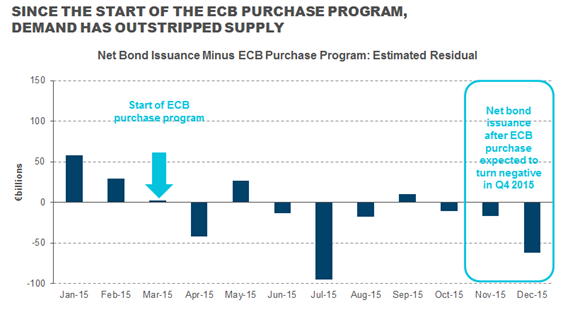
In all, supportive long-term fundamentals in the asset class remain intact. In fact, even without additional easing under the ECB’s current quantitative easing program, the central bank is buying a huge amount of Eurozone government bonds each month. So much so that net bond issuance after the ECB purchases is expected to turn negative in the final quarter of the year, as illustrated by Figure 1. With demand outstripping supply, Eurozone government bonds are likely to stay low, pushing investors further down the credit curve, potentially into high yield.
Taking all this into account, it’s evident that the asset class has a number of supportive features at present. From a portfolio perspective, we continue to focus on bottom-up credit research to uncover the best opportunities for our clients, while managing downside risk. This approach has led us to be overweight in the single-B rated segment of the market, where we have a preference for bonds with high coupons and shorter-dated maturities as price volatility is more contained.
Figure 1: Quantitative Easing Remains a Powerful Factor
As at 30 September 2015
Sources: JP Morgan, ECB and T. Rowe Price
2015-GL-2939
重要情報
当資料は、ティー・ロウ・プライス・アソシエイツ・インクおよびその関係会社が情報提供等の目的で作成したものを、ティー・ロウ・プライス・ジャパン株式会社が翻訳したものであり、特定の運用商品を勧誘するものではありません。また、金融商品取引法に基づく開示書類ではありません。当資料における見解等は資料作成時点のものであり、将来事前の連絡なしに変更されることがあります。当資料はティー・ロウ・プライスの書面による同意のない限り他に転載することはできません。
資料内に記載されている個別銘柄につき、売買を推奨するものでも、将来の価格の上昇または下落を示唆するものでもありません。また、当社ファンド等における保有・非保有および将来の組入れまたは売却を示唆・保証するものでもありません。投資一任契約は、値動きのある有価証券等(外貨建て資産には為替変動リスクもあります)を投資対象としているため、お客様の資産が当初の投資元本を割り込み損失が生じることがあります。
当社の運用戦略では時価資産残高に対し、一定の金額までを区切りとして最高1.265%(消費税10%込み)の逓減的報酬料率を適用いたします。また、運用報酬の他に、組入有価証券の売買委託手数料等の費用も発生しますが、運用内容等によって変動しますので、事前に上限額または合計額を表示できません。詳しくは契約締結前交付書面をご覧ください。
「T. ROWE PRICE, INVEST WITH CONFIDENCE」および大角羊のデザインは、ティー・ロウ・プライス・グループ、インクの商標または登録商標です。
ティー・ロウ・プライス・ジャパン株式会社
金融商品取引業者関東財務局長(金商)第3043号
加入協会:一般社団法人日本投資顧問業協会/一般社団法人投資信託協会


