

Economies and Markets: Have Central Bank Actions Distorted Markets?
Executive Summary
In the wake of the global financial crisis, major central banks took unprecedented actions to spur economic recovery. The Federal Reserve, Bank of England (BoE), European Central Bank, and Bank of Japan simultaneously slashed short-term interest rates in late 2008 to near 0%, where they remain today. They later progressively launched quantitative easing (QE) programs to drive down rates across their yield curves.
These unconventional actions reduced sovereign yields and corporate borrowing costs, weakened currencies, and lifted asset prices as low government bond yields drove investors into riskier securities. Yet global economic growth remains lackluster, and persistently low rates may be negatively affecting corporate and investor behavior.
T. Rowe Price recently gathered a panel of investment professionals with diverse experience in global equities and fixed income markets to examine how investor and corporate behavior has changed in an ultralow-rate environment. They discuss the impact of monetary stimulus on asset values, their outlooks for the economy and markets, and how they are investing seven years after the credit crisis sent shockwaves through global financial markets.
HOW HAS UNCONVENTIONAL MONETARY POLICY AFFECTED CORPORATE BEHAVIOR, AND ARE YOU SEEING ANY DISTORTIONS THAT WILL EVENTUALLY NEED TO BE UNWOUND?
Mr. Eiswert: Running a global equity strategy entails a lot of discussions with CEOs and CFOs about their views of the world. Their perceptions of the future affect their capital allocation decisions, which ultimately have a big impact on economic outcomes. Like investors, management teams—especially those in the developed world—are experiencing acute anxiety. There seems to be a general consensus that we’re in a period of “secular stagnation,” a term popularized by economist Larry Summers, whereby a persistent lack of demand has produced a self-reinforcing state of low growth, low inflation, and low rates.
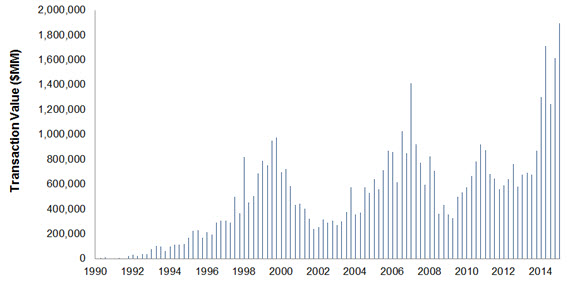
This deflationary worldview is influencing corporate behavior. Capital expenditures remain very low, as managers would rather squeeze operating margins than invest for an uncertain future. Despite rising home prices, U.S. homebuilders are reluctant to secure land for development because they’re still feeling “once bitten, twice shy” after last decade’s housing crash. Activist investors are playing a greater role in management decisions, and we’ve seen unprecedented mergers and acquisitions (see Figure 1). We have yet to see the peak in M&A, in my view; financing is inexpensive, and the market is rewarding both sides of deals.
Figure 1: Record Mergers and Acquisition Activity
As of June 30, 2015
Sources: FactSet and T. Rowe Price.
If there’s a bubble in today’s market environment, I’d argue that it’s the widespread belief in secular stagnation, which highly accommodative central bank policy helps to reinforce. The deep pessimism is ironic given all of the disruptions and innovations we’ve seen over the last seven or eight years. I see innovation and growth happening all over the world; it’s just coming in new forms and revealing itself over different time frames.
CENTRAL BANK STIMULUS PROGRAMS HAVE INVOLVED LARGE-SCALE BOND PURCHASES. HAS QE CREATED BUBBLES IN FIXED INCOME VALUATIONS?
Mr. McCormick: Surprisingly, fixed income valuations appear to be close to equilibrium despite a long period of extremely easy monetary policy. To understand why there haven’t been any major dislocations, it’s important to think about what hasn’t happened as a result of monetary stimulus, as opposed to what has happened. It’s notable that inflation hasn’t happened. Developed market central banks engaged in zero interest rate policies and QE with the express intent of hitting 2% inflation targets. None have been able to achieve that. Although inflation expectations appear a little low, inflation doesn’t look like it will be a problem for bond investors anytime soon. A 10-year Treasury yield at around 2% may seem low, but Treasuries are arguably cheap when compared with a 10-year German bund yielding about 0.60%.1 And a 2% Treasury yield is justified by the benign inflation, slow-growth environment that I believe will remain in place for a while longer.
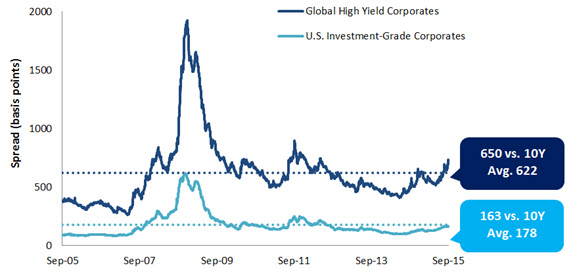
Credit spreads are another place to look for dislocations in bond markets. Investment-grade and high yield corporate bonds seem fairly valued, with spreads recently at or slightly above their 10-year averages (see Figure 2). While there are many idiosyncratic risks in credit markets, there are still a lot of great investment stories. The high yield market, for example, can be split into energy and non-energy sectors. Energy bonds are justifiably cheap as the sector struggles with low oil prices and potential defaults. Spreads on non-energy bonds have started to widen as well, and that should create opportunities.
With valuations where they are today, there are plenty of attractive opportunities, as well as some land mines to avoid. But I don’t see anything that would indicate bubble-like behavior.
Figure 2: Credit Spreads Near Long-Term Averages
As of September 30, 2015
Past performance is not a reliable indicator of future performance.
Sources: Barclays, J.P. Morgan, and T. Rowe Price.
LOOKING MORE BROADLY AT THE GLOBAL FIXED INCOME OPPORTUNITY SET, HOW HAS INVESTOR BEHAVIOR CHANGED IN AN ENVIRONMENT OF HIGHLY ACCOMMODATIVE CENTRAL BANK POLICY?
Mr. Husain: Monetary policy had been highly synchronized for several years. We now find ourselves in an environment of global divergence. The Fed will probably hike in December or early next year. The UK economy is heating up with wage inflation rising, so the BoE should also soon begin raising rates. But there are a lot of central banks around the world that won’t be raising rates. In fact, many are still cutting rates or will keep them very low for a long time. We’re hearing many bond investors ask, “Why should I run into the headwind of the Fed raising rates when I can enjoy the tailwind of accommodative monetary policy in other countries?” Clients are increasingly looking to globalize their fixed income portfolios.
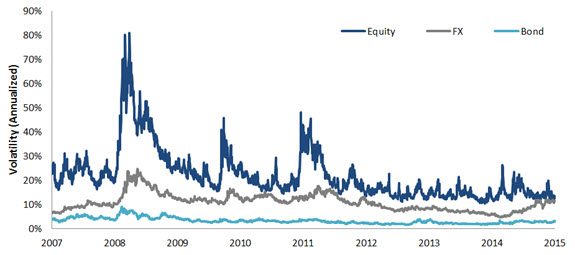
Another phenomenon involving investor behavior has to do with volatility. Along with low interest rates came greater clarity in monetary policy. The Fed introduced forward guidance and told the markets what it intended to do several months in advance. The increased level of central bank communication drove down volatility. Although it has risen recently, volatility has actually been quite subdued across equity, bond, and currency markets (see Figure 3). Low volatility gave investors a green light to reach for yield and take more risk. Along the same lines, there has been huge growth in new investment products, such as volatility-managed strategies and nontraditional bond funds. Asset managers introduced these products in a low-volatility environment, and I think investors need to question what performance will look like going forward as volatility rises.
Figure 3: Volatility Generally Subdued Since the Global Financial Crisis
As of August 31, 2015
Past performance is not a reliable indicator of future performance.
Sources: Bank of America Merrill Lynch, Reuters, Morningstar, and T. Rowe Price.
Equity volatility is represented by the VIX Index, bond market volatility by the MOVE (Merrill Lynch Option Volatility Estimate) Index, and Foreign Exchange (FX) volatility by the 3-month implied volatility of an in-the-money option on EUR/USD.
WE’VE DISCUSSED HOW AN ENVIRONMENT OF UNUSUALLY LOW GROWTH, INTEREST RATES, AND VOLATILITY HAS INFLUENCED INVESTOR AND CORPORATE BEHAVIOR. HOW DO YOU SEE THIS EVOLVING?
Mr. Eiswert: Corporate behavior is creating distortions that investors may not yet recognize. The low-yield, low-return environment is driving the realignment of entire industries and has tightened supply in unexpected places, as consolidation and underinvestment have corrected overcapacity. U.S. airlines are a good example. Airlines have benefited from lower energy costs, but it is the consolidation forced upon the industry by the global financial crisis that has really been the driver of incremental returns. There is a natural corrective mechanism at work in markets around the world. The longer rates stay low, the faster the adjustments will happen.
When I talk with corporate executives around the world, I sense deflationary mind-sets. Companies remain defensive and don’t want to invest or expand because they don’t foresee growth or interest rates ever rising. I’m less worried about what happens with China and more concerned about being prepared for the time when deflationary mind-sets shift to inflationary mind-sets. Think about U.S. consumers, who are in their best position in years: The dollar is strong, energy prices are low, and jobs are easier to find. At the same time, managements have been reducing capacity and underinvesting because they’re not expecting consumer demand. When mind-sets shift from deflation to inflation, it’ll happen rapidly. I expect volatility and want my portfolio to be ready for the eventual changes in corporate behavior and investor psychology.
Mr. McCormick: I think we’re heading down the right path toward stronger economic growth. However, I think we’re going to have to deal with a low-growth, low-return world for a little while longer. We’re still working our way through the deleveraging process that needs to take place globally. The U.S. is almost done, Europe is catching up, but many emerging markets still have a long way to go. The bond market isn’t signaling concern about inflationary pressures. Wage inflation tends to build slowly over time. When inflation has spiked in the past, commodity prices have almost always been the driver. With energy production costs falling and supply elevated, we’re not expecting a rapid rise in commodity prices.
I wish we would more quickly get to stronger growth, even if it might mean short-term losses in some bond portfolios. It would be exciting to be able to invest in high-quality sectors at higher yields. I’m optimistic about the global economy and expect growth to eventually accelerate. I just don’t foresee it happening in 2016. For now, I think it’s prudent to be a somewhat conservative fixed income investor.
Mr. Husain: Regarding volatility, I think there’s a structural shift taking place. In hindsight, we had been living in a world of almost perfect foresight. With central banks providing forward guidance, we knew that rates were going to stay low for a long time. Now things are changing. We’ve gone from a period of certainty to one of uncertainty. To me, that means higher risk premiums and higher volatility.
I think the unwinding of monetary stimulus has another important implication for investors. The massive wave of central bank liquidity lifted almost every asset class. As liquidity starts to be taken away, I think every asset class that rose is at risk of declining. That would have huge consequences for correlations—the typical relationships between asset classes that investors use to construct diversified portfolios. August 2015 was a difficult month for global investors. It also provided some interesting observations. During the month, German stocks declined nearly 9%.2 At the same time, yields on German bunds—typically a safe haven when equities decline—rose sharply. That’s a disaster for investors. Asset allocation structures assume that when stock prices go down, bond prices will go up. That relationship may still apply over the longer term, but I think we have to be more tactical in the way we think about correlations during this transition from easy money to tighter financial conditions.
SO WHAT DOES THIS ALL MEAN FOR HOW YOU’VE BEEN POSITIONING YOUR PORTFOLIOS?
Mr. Husain: I’m in the camp of investors who, instead of running into the headwinds of the Fed, is taking advantage of the global opportunity set. I’m moving away from the U.S. and looking for countries with deflation and central banks that will be cutting rates, or where yields are already high. I think those are better, safer places for bond investors than a country where the central bank is likely raising rates.
Mr. Eiswert: First, I think this is a time to be very selective. I want the structure of my portfolio to be as concentrated as possible, with specific reasons for every holding. We’re trying to avoid beta—or broad market exposures—in a period of volatility. Instead, I want to invest only in companies in which I’m confident that my investment thesis will come through and deliver alpha. I think our global research platform provides me with an opportunity to do that.
Second, I’m trying to identify businesses that should benefit from industry restructuring and distortions created by private equity and activist investors. I want to get in front of these opportunities for increasing returns on capital.
Finally, I like financials. Most growth investors have abandoned the sector, but I think there are some really interesting ideas. Regulatory pressures on banks have weighed on earnings growth. But there have been a lot of positive structural changes, with large U.S. financials taking market share from their international counterparts. With a slight increase in rates, I think certain banks will generate high marginal returns.
Mr. McCormick: Our recent activity was all about hedging risk in our U.S. taxable bond portfolios. We’ve reduced risk in many strategies, partially because of concerns that our high yield team expressed about energy-related bonds, and have focused on high-grade credit sectors. For instance, 10-year AAA rated commercial mortgage-backed securities, which offer about 125 basis points of extra yield over 10-year Treasuries, look appealing.
In this environment, we are really reliant on our global research platform. As Fed policy becomes a little more clear toward the end of the year, I think it will be very important to have some “dry powder” in portfolios in the form of high-quality, liquid securities to be able to take advantage of market volatility.
1 Source: Barclays. As of September 30, 2015.
2 Source: MSCI RIMES. In euro terms.
2015-GL-2823
重要情報
当資料は、ティー・ロウ・プライス・アソシエイツ・インクおよびその関係会社が情報提供等の目的で作成したものを、ティー・ロウ・プライス・ジャパン株式会社が翻訳したものであり、特定の運用商品を勧誘するものではありません。また、金融商品取引法に基づく開示書類ではありません。当資料における見解等は資料作成時点のものであり、将来事前の連絡なしに変更されることがあります。当資料はティー・ロウ・プライスの書面による同意のない限り他に転載することはできません。
資料内に記載されている個別銘柄につき、売買を推奨するものでも、将来の価格の上昇または下落を示唆するものでもありません。また、当社ファンド等における保有・非保有および将来の組入れまたは売却を示唆・保証するものでもありません。投資一任契約は、値動きのある有価証券等(外貨建て資産には為替変動リスクもあります)を投資対象としているため、お客様の資産が当初の投資元本を割り込み損失が生じることがあります。
当社の運用戦略では時価資産残高に対し、一定の金額までを区切りとして最高1.265%(消費税10%込み)の逓減的報酬料率を適用いたします。また、運用報酬の他に、組入有価証券の売買委託手数料等の費用も発生しますが、運用内容等によって変動しますので、事前に上限額または合計額を表示できません。詳しくは契約締結前交付書面をご覧ください。
「T. ROWE PRICE, INVEST WITH CONFIDENCE」および大角羊のデザインは、ティー・ロウ・プライス・グループ、インクの商標または登録商標です。
ティー・ロウ・プライス・ジャパン株式会社
金融商品取引業者関東財務局長(金商)第3043号
加入協会:一般社団法人日本投資顧問業協会/一般社団法人投資信託協会


