

FOMC Policy Decision and Statement
Executive Summary
The policymaking Federal Open Market Committee (FOMC) held policy rates steady at this week’s meeting and also repeated the criteria for taking the first step toward policy normalization: “[T]he Committee anticipates that it will be appropriate to raise the target range for the federal funds rate when it has seen some further improvement in the labor market and is reasonably confident that inflation will move back to its 2% objective over the medium term.” Today’s statement implicitly acknowledged “some further improvement in the labor market,” including “solid job gains and declining unemployment,” which tend to bolster confidence in the medium-term inflation outlook. At the same time, confidence that inflation will move back toward 2% over the medium term is undermined by adverse global economic and financial developments.
The policymaking Federal Open Market Committee (FOMC) held policy rates steady at this week’s meeting and also repeated the criteria (from the July 29 policy statement) for taking the first step toward policy normalization: “[T]he Committee anticipates that it will be appropriate to raise the target range for the federal funds rate when it has seen some further improvement in the labor market and is reasonably confident that inflation will move back to its 2% objective over the medium term.”
HIGHLIGHTING ADVERSE INTERNATIONAL DEVELOPMENTS.
Relative to these criteria, today’s statement implicitly acknowledged “some further improvement in the labor market” since the July FOMC meeting, including “solid job gains and declining unemployment,” which tend to bolster confidence in the medium-term inflation outlook. At the same time, confidence that inflation will move back toward 2% over the medium term is undermined by adverse global economic and financial developments, which “may restrain economic activity somewhat [weakening the growth-employment-inflation nexus] and are likely to put further downward pressure on inflation in the near term.”
Changes to the Summary of Economic Projections were relatively minor (table below) in light of these expressions of concern; near-term confidence in the forecasts may be lower.
FOMC Summary of Economic Projections – September 17, 2015
(The “central tendency” range of 17 individual forecasts: excludes the three highest and three lowest projectionsfor each variable in each year.)
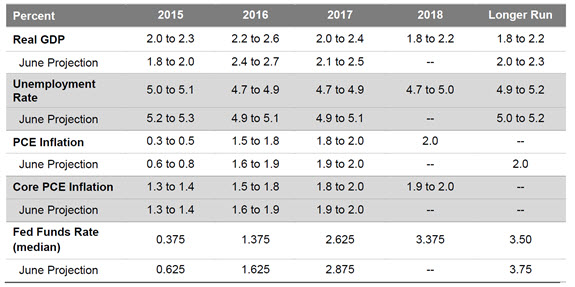
Note: Real GDP and PCE price indexes are projections for both measures of inflation are from the fourth quarter of the previous year to the fourth quarter of the year indicated. Unemployment rate projections are for the fourth quarter average of the year indicated. Fed funds rate projections are for year-end. Each participant’s projections are based on his or her assessment of appropriate monetary policy. Longer-run projections represent each participant’s assessment of the rate to which each variable would be expected to converge under appropriate monetary policy and in the absence of further shocks to the economy.Source: Federal Reserve.
Real GDP growth. The median 2015 forecast rose by 20 basis points (bp), incorporating stronger growth in the first half of the year than was apparent at the time of the June FOMC meeting, but implying just 2.0% growth in the second half of the year. Growth forecasts for 2016-17 were revised slightly lower, perhaps reflecting both the restraint from developments abroad and slightly lower estimates of longer-run (“potential”) growth.
Unemployment. The forecasts for the Q4 average unemployment rates were cut by 20-30 bp in 2015-17. The 2015 revision largely reflects a re-leveling to account for August’s surprising 20 bp decline to 5.1%. Farther out in the forecast horizon, a slightly lower collective view of the longer-run (“natural”) unemployment rate may also have played a role.
Inflation. Forecasts of 2015 headline PCE inflation were reduced by 30 bp, largely reflecting lower energy commodity prices; the central tendency of 2015 core PCE inflation forecasts was unchanged despite the dollar’s summer appreciation. Inflation forecasts for 2016-17 were little changed, suggesting that policymakers expect the stronger dollar’s pass-through to PCE inflation to run its course this year.
Fed funds rate forecasts shifted lower, with the median year-end forecast -25 bp in 2015-17 and in the longer run. Eleven of 17 participants came into this week’s meeting forecasting no more than one hike this year. I was in that camp, thinking it would come today. I still expect lift-off in 2015, and I view December 16 as being far more likely than October 28. If the Committee is concerned about the impact of international developments in general and of the July-August tightening of financial conditions in particular, September data probably will not be sufficient to sound the all-clear.
重要情報
当資料は、ティー・ロウ・プライス・アソシエイツ・インクおよびその関係会社が情報提供等の目的で作成したものを、ティー・ロウ・プライス・ジャパン株式会社が翻訳したものであり、特定の運用商品を勧誘するものではありません。また、金融商品取引法に基づく開示書類ではありません。当資料における見解等は資料作成時点のものであり、将来事前の連絡なしに変更されることがあります。当資料はティー・ロウ・プライスの書面による同意のない限り他に転載することはできません。
資料内に記載されている個別銘柄につき、売買を推奨するものでも、将来の価格の上昇または下落を示唆するものでもありません。また、当社ファンド等における保有・非保有および将来の組入れまたは売却を示唆・保証するものでもありません。投資一任契約は、値動きのある有価証券等(外貨建て資産には為替変動リスクもあります)を投資対象としているため、お客様の資産が当初の投資元本を割り込み損失が生じることがあります。
当社の運用戦略では時価資産残高に対し、一定の金額までを区切りとして最高1.265%(消費税10%込み)の逓減的報酬料率を適用いたします。また、運用報酬の他に、組入有価証券の売買委託手数料等の費用も発生しますが、運用内容等によって変動しますので、事前に上限額または合計額を表示できません。詳しくは契約締結前交付書面をご覧ください。
「T. ROWE PRICE, INVEST WITH CONFIDENCE」および大角羊のデザインは、ティー・ロウ・プライス・グループ、インクの商標または登録商標です。
ティー・ロウ・プライス・ジャパン株式会社
金融商品取引業者関東財務局長(金商)第3043号
加入協会:一般社団法人日本投資顧問業協会/一般社団法人投資信託協会

