

The Rise of M&A Activity in Europe: Implications for High Yield Investors.
Executive Summary
Since the beginning of 2014 merger and acquisition (M&A) activity among European corporates has risen sharply.
While any rise in corporate activity can potentially be seen as a destabilising influence, leading to a riskier environment for high yield investors, it is reasonable to suggest that, so far, much of the M&A activity we have seen in Europe has generally added value for investors in high yield credit.
Looking beyond simple headlines, it is important to adopt a holistic approach, drawing on broad resources and multiple areas of expertise, in order to capture the opportunities presented by M&A in Europe, while avoiding the risks often associated with such activity.
The steep rise in M&A activity among European corporates over the past 18 months is attracting a lot of attention — and dividing opinion. For some, it is a worrying trend, rekindling memories of the leverage-oriented environment that preceded the 2008 financial crisis. For others, however, it speaks of corporate optimism and growing confidence in Europe’s economic prospects, both of which bode well for a healthy market outlook. It seems appropriate, therefore, to step back and try to better understand what the current situation could mean for European high yield investors.
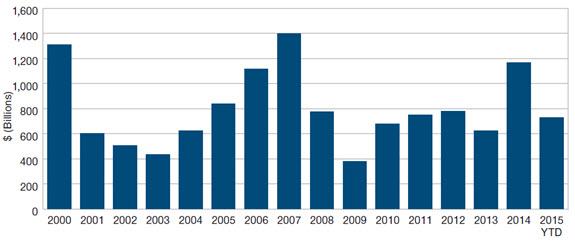
Certainly, any trend toward re-leveraging bears monitoring, while a larger volume of M&A activity (Figure 1) also increases the potential for event risk, as the companies involved experience fundamental change. However, European companies today are generally more financially secure than was the case in the lead-up to the financial crisis, while access to funding is a fraction of the cost of pre-crisis period. As such, companies are arguably well placed to seek out the kind of value-adding strategic deals that we have been seeing recently. We believe that increased M&A activity has a positive market influence because it creates opportunities for credit investors, particularly in high yield where such deals can result in a strengthened credit profile. However, information advantage is key, so a holistic approach is required, with careful analysis and selectivity key in capturing opportunities and limiting risk.
FIGURE 1: European M&A Activity—Deal Value
As of 30 June 2015
Source: FactSet Mergers
In 2014, European companies issued record amounts of new high yield debt. For many, the heavy supply of new debt suggests weakening balance sheets and credit quality. For this reason, M&A activity tends to be viewed in a generally negative light as it is associated with the risky, unstable backdrop that ultimately led to the financial crisis. However, closer analysis of today’s high yield market and the debt being issued by companies reveals a very different debt environment than that of the pre-crisis period.
COMPANY BALANCE SHEETS FUNDAMENTALLY IMPROVED
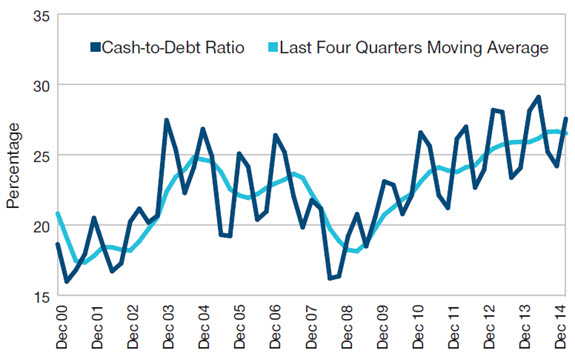
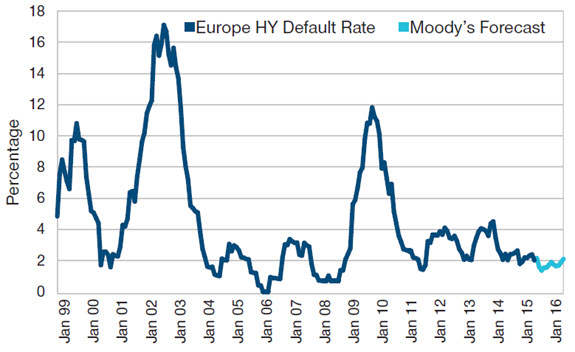
Principal among these differences is the fact that the fundamentals underpinning European high yield companies today are far healthier than in the lead-up to the 2008 financial crisis. Much has been written already about the balance sheet improvement generally characterising European and, indeed, global companies today. The severe economic and market turbulence experienced during the crisis period not only forced companies with the weakest finances out of business, but also shocked the rest into action. In the years since the crisis, management teams have focused on streamlining operations, paying down debt, cutting costs and accumulating cash. The overall effect of this prudence is that corporate balance sheets today are notably healthier than in 2008, characterised by greater cash reserves and, importantly, significantly improved cash-to-debt ratios (Figure 2). Further evidence of today’s more robust corporate environment can be found in the lower level of defaults among European high yield issuers. In 2014, the default rate was 2.6% by volume, well below the long-term average default rate of c. 4.8% (Figure 3).
FIGURE 2: European Corporate—Balance Sheet Cash-to-Debt
As of 31 December 2014
Source: Morgan Stanley
FIGURE 3: European Trailing 12-Month Default Rate
As of 30 June 2015
Source: Moody’s
LOW COST OF FINANCING A KEY DRIVER OF INCREASED ACTIVITY
The knock-on implications of the easy monetary policy adopted by central banks around the world in the years since the financial crisis have been significant for global bond markets. For companies issuing debt, the resulting low interest rate environment has meant far more favourable financing conditions, enabling companies to access funding of new debt at all-time low rates. This fact alone has been central in encouraging M&A activity. With the cost of debt today considerably lower than in the lead-up to the financial crisis in 2008, companies are taking full advantage of the low rates for a range of purposes, including funding more interesting corporate deals. For investors in high yield, this makes for an exciting and opportunistic environment.
German company HeidelbergCement, a bond issuer in 2014 and an active player on the M&A front, offers a good illustration of just how much more attractive the cost of borrowing has become for European companies over recent years. Back in 2010, BB+ rated HeidelbergCement issued a bond paying a coupon of 6.75%.1 Fast-forward to 2014 and the still BB+ rated HeidelbergCement launched its latest bond with a coupon of 2.25%.1 Considered in this context, the rise in M&A activity begins to look more reasonable, with companies able to seek out strategic deals without necessarily undermining their overall credit quality.
USE OF PROCEEDS TELLS AN INTERESTING TALE
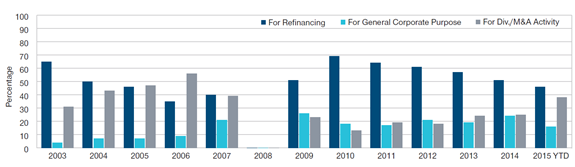
As mentioned, the record level of European debt being issued has raised some fears of a potential repeat of the highly leveraged environment seen prior to the global financial crisis. Back then, M&A activity and leveraged buyouts were a prominent market feature, with the majority of the debt issued being used for the purpose of funding corporate deals. Today, however, the proceeds of bond issuance are being used in a very different way. Given the very low cost of borrowing, companies have rushed to refinance and extend their existing, higher-coupon debt and issue new bonds at lower cost. As detailed below (Figure 4), refinancing remains the principal use of proceeds from new bond issuance, suggesting that European high yield companies remain more concerned with ensuring access to future liquidity reserves than with acquiring other companies.
This said, the high level of new issuance has also coincided with a rise in M&A activity among European high yield companies. At face value, this is understandably a concern for many investors, who compare it with the debt driven credit expansion that came so spectacularly unstuck in 2008. However, the underlying drivers of the current wave of M&A are arguably very different from those that fuelled the pre-crisis activity. One important distinction is that the majority of recent corporate deals we have seen have been traditional, company-to-company deals that have had a clearly strategic focus. Moreover, the involvement of third parties, such as private equity firms, so much a feature of the pre-crisis environment, is less prevalent, as are the leveraged buyout (LBO) deals engineered by them. Where we have seen instances of LBOs in the current cycle, these have been structured less aggressively than in the lead-up to the financial crisis, with lower leverage and larger cash flow cushions.
Figure 4: European High Yield New Issue - Use of Proceeds
As of 30 June 2015
M&A DEALS LARGELY STRATEGIC IN NATURE
The rise in corporate deals has also been spurred on by lacklustre economic growth, which has limited companies’ potential to generate growth organically and, at the same time, made some vulnerable to takeover. As such, management teams have sought to effectively ‘buy in’ growth through strategic acquisitions. The twin levers of cheap financing and healthy cash on balance sheets has enabled such transactions, often without a substantial deterioration in credit quality. Meanwhile, the rally in equities implies that investors are anticipating solid economic growth and increases in corporate earnings. Companies are therefore under pressure to justify current earnings multiples. M&A activity offers companies a way to grow profits quickly and deliver synergies and cost-cutting over the medium term. Recent activity has also generally created value for European high yield bondholders, with healthy premiums being paid, providing an incentive for further deals. While not always associated with credit improvement, we are at a point in the European credit cycle where deals are primarily being driven by strategic factors, e.g., to take out capacity or to consolidate a market. Hence we have seen a number of transactions involving European high yield companies merging with, or being bought by, larger, higher-quality peers.
One example is Kabel Deutschland, the largest cable TV operator in Germany,2 which was bought by investment grade telecom giant Vodafone in 2014. Kabel’s bonds rallied strongly after the acquisition and Moody’s subsequently upgraded Kabel’s debt from high yield to investment grade (Baa2). Six months later, Vodafone also bought the Spanish cable company ONO for €7.2bn,3 prompting a similarly positive rally in ONO’s bonds. For Vodafone, these strategic moves are clearly aimed at broadening its European coverage, particularly in the cable TV and Internet services areas. Today, Vodafone can effectively borrow the almost €15bn3 spent on these deals at a rate of around 2.0%–2.5%,4 compared with borrowing costs of more than 6% in early 2008.4 With borrowing costs at close to three times lower, this is encouraging many higher-rated companies to look for these sorts of strategic, value-accretive deals.
Even when high yield firms have targeted higher-quality, investment-grade names, bondholders have been treated relatively well. For example, Time Warner Cable (TWC) bonds sold off sharply in April amid expectations that Charter Communications,5 a sub-investment grade competitor, would launch a highly levered bid for TWC. But when it eventually announced the details of the $79 billion (€69 billion) deal,6 Charter surprised the market with a pledge to fully secure TWC’s bonds in order to maintain its investment-grade rating.
Figure 5: Top 10 European Corporate Deals in 2015
As of 30 June 2015
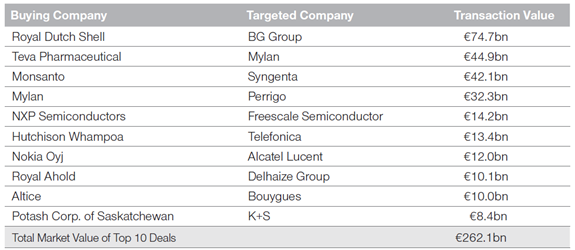
Source: FactSet
EUROPE SEEN AS A FERTILE AREA FOR INVESTMENT
Beyond the classic motives underlying strategic growth transactions, such as the desire to expand into new markets, increase revenues, grow market share and/or achieve economies of scale, M&A activity in Europe in 2014 was also characterised by a search for talent and new technologies. This has been particularly evident in the technology, media and telecommunications industry, which has undergone significant consolidation and was the top-ranked European sector in terms of deal value in 2014. Examples include Altice’s €17.0bn acquisition of SFR and subsequent €7.4bn acquisition of Portugal Telecom assets,3 both of which aim to combine a more traditional mobile company with a cable or fibre assets operator, allowing the combined entity to compete with operators that are establishing a competitive edge by offering quadruple-play (i.e., fixed phone, wireless phone, TV and Internet) solutions to their clients. Meanwhile, M&A activity involving European companies shows no sign of abating in 2015, with a number of substantial deals completed during the first half of the year, again highlighting the appeal of the region as an area of investment.
M&A ACTIVITY CAN OFFER OPPORTUNITIES FOR ASTUTE EUROPEAN HIGH YIELD INVESTORS
Heightened M&A activity offers bond investors the potential for strong return but also increases the likelihood of credit issuers experiencing fundamental change and producing unanticipated outcomes for investors. The globalised nature of financial markets adds another layer of complexity to the mix, with M&A deals involving European companies potentially arising from anywhere in the world. Such an environment calls for a holistic investment approach, with detailed research focusing on every aspect of a company, from financial robustness and growth prospects to business operations and the sector it operates in. Having both global scope and expertise in local markets is crucial in this regard, particularly given the increasingly international focus of businesses today. Amid rapidly changing markets, information edge is key.
A good example is the recently agreed deal between large European grocery chains Royal Ahold and Delhaize Group, which created the largest food retailer in Europe and the sixth largest in the US.7 Once the merger is completed in 2016, Ahold Delhaize will own 6,500 stores, will employ 375,000 people and is expected to generate c. €54bn in annual sales.8 The deal is strategically aimed at combining forces in order to battle sales pressure from discounters, both in Europe and the US. Key to assessing the potential synergies behind this deal—and in turn the potential of the combined business—was a thorough understanding of the business profiles of each company in their respective regions.
Extensive interaction and knowledge sharing among specialists across the globe is also a useful means of gaining a richer understanding of a company and greater visibility as to its ability to finance deals. For example, a recent innovation in bond markets has been the introduction of ‘portability’ clauses within bond covenants, essentially removing the investor’s right to sell bonds on change of ownership—hence the bonds in issue become portable—travelling with the issuer to any new owner.
Similarly, we are seeing growing instances of companies issuing payment-in-kind (PIK) bonds (or PIK-toggle notes), which provide the issuer with the option to pay lenders with more debt, rather than cash. PIK-toggle note issuance in Europe only really came to life in earnest in 2013, while such instruments were first introduced as early as 1986 in the US. The ability to share expertise between US and European analysts on these types of deals has been important in our own early involvement and experience with these structures in Europe.
Finally, it is important to understand any M&A activity from an all-round viewpoint, encompassing not only the impact of the credit metrics of the companies involved, but also the potential business activities derived from the deal and the achievability of expectations. In this sense, it is crucial to incorporate the expertise and insights of our large global equity analyst team (including a broad platform of European equity analysts) within our fixed income analysis and overall investment approach.
While credit analysis tends to focus on the potential downside risk of a company, equity analysts are more focused on the company’s growth profile, and so this contrasting perspective is an important input to our decision-making process. Sectors like telecoms, health care or packaging, which have seen substantial levels of M&A transactions, have been typical areas where the level of collaboration between our fixed income and equity teams has been elevated over the past 12 months.
A HOLISTIC, MULTI-FACETED APPROACH AND HIGHLY SELECTIVE INVESTING
There is a tendency among investors today to associate M&A activity with negative outcomes, with many quick to cite the highly leveraged environment that preceded the global financial crisis as proof of this. However, this line of thinking fails to recognise many of the underlying reasons driving M&A activity in Europe today—reasons that are potentially value-adding for bond investors, including the prospect of stronger competitive positioning, driving top line growth, enhancing or diversifying products/ services and reducing operating costs. This is particularly true of high yield companies, where prospective M&A activity with higher-rated companies can also bring about an improvement in credit quality.
Given the constantly changing industry competitive and operating dynamics, M&A activity remains a necessary and healthy strategic function, in our view, with the potential to add value for investors. However, the pace of activity in recent years does heighten the risk of negative outcomes, as companies potentially overleverage balance sheets and/or miscalculate expected synergies. This is where a holistic and collaborative investment approach is key, drawing on global resources and sector specialist expertise to provide analysis that is as comprehensive and that incorporates as many different views as possible. This focus on information advantage is the key to capturing the many opportunities we are seeing within European high yield, while avoiding many of the potential pitfalls.
1 Source: Reuters.
2 Source: Reuters. As of 20 April 2015.
3 Source: ft.com.
4 Source: European Central Bank
5 Source: Reuters. As of 26 August 2015.
6 Source: Bloomberg. As of 27 May 2015.
7 Source: Independent Newspaper. As of 24 June 2015.
8 Source: Independent Newspaper.
2015-GL-2441
重要情報
当資料は、ティー・ロウ・プライス・アソシエイツ・インクおよびその関係会社が情報提供等の目的で作成したものを、ティー・ロウ・プライス・ジャパン株式会社が翻訳したものであり、特定の運用商品を勧誘するものではありません。また、金融商品取引法に基づく開示書類ではありません。当資料における見解等は資料作成時点のものであり、将来事前の連絡なしに変更されることがあります。当資料はティー・ロウ・プライスの書面による同意のない限り他に転載することはできません。
資料内に記載されている個別銘柄につき、売買を推奨するものでも、将来の価格の上昇または下落を示唆するものでもありません。また、当社ファンド等における保有・非保有および将来の組入れまたは売却を示唆・保証するものでもありません。投資一任契約は、値動きのある有価証券等(外貨建て資産には為替変動リスクもあります)を投資対象としているため、お客様の資産が当初の投資元本を割り込み損失が生じることがあります。
当社の運用戦略では時価資産残高に対し、一定の金額までを区切りとして最高1.265%(消費税10%込み)の逓減的報酬料率を適用いたします。また、運用報酬の他に、組入有価証券の売買委託手数料等の費用も発生しますが、運用内容等によって変動しますので、事前に上限額または合計額を表示できません。詳しくは契約締結前交付書面をご覧ください。
「T. ROWE PRICE, INVEST WITH CONFIDENCE」および大角羊のデザインは、ティー・ロウ・プライス・グループ、インクの商標または登録商標です。
ティー・ロウ・プライス・ジャパン株式会社
金融商品取引業者関東財務局長(金商)第3043号
加入協会:一般社団法人日本投資顧問業協会/一般社団法人投資信託協会
