

Chinese Equities: Impact of Market Declines Appears Manageable
AN ENGINEERED EQUITY BOOM GOES TOO FAR
Over the past nine months, Chinese authorities have repeatedly shifted their approach to China’s domestic equity markets, first encouraging investors to buy stocks, then trying to rein in speculative excesses, then deploying an increasingly drastic set of measures to keep a disorderly retreat from turning into a full-fledged bear market.
As of July 20, markets appeared to have stabilized, with the Shanghai Composite Index down 23% from its June peak but still in positive territory for the year to date. However, the damage to market confidence—foreign investor confidence, in particular—while difficult to assess, may prove substantial.
For Beijing, encouraging an equity boom promised a number of benefits:
- The A share exchanges had been largely stagnant since the last major bull/bear cycle in 2007–2008, at a time when Beijing was hoping to encourage the development of domestic capital markets.
- A more dynamic A shares market would encourage reform of state-owned enterprises by making it easier for them to raise equity capital, and would help heavily indebted private companies reduce leverage.
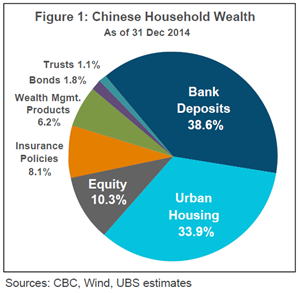
- Rising equity values would diversify household wealth portfolios, which are heavily concentrated in property and bank deposits (Figure 1).
THE REGULATORS STEP IN
The three-week free-fall that followed the June top exposed both the structural weaknesses in the A shares market and the counterproductive effects of China’s regulatory response.
Hundreds of companies took advantage of a provision that allowed them to suspend trading—a short-term measure designed to manage the release of company news, but used to freeze prices as liquidity vanished from the market. By the end of the first week of July, nearly half the listings on the Shanghai and Shenzhen exchanges—more than U.S. $ 2 trillion in market capitalization—had stopped trading.
The government’s reaction has been equally dramatic. In early July, China’s police ministry announced an investigation of “malicious” short selling, while China’s Securities Regulatory Commission imposed a six-month ban on insider sales by major shareholders, corporate executives, and directors. Margin requirements, tightened in the spring, have been loosened again, and real estate—even residential properties—can now be used as collateral.
With markets, as of this writing, apparently stabilizing, the number of suspensions has fallen by roughly half, and the Shanghai and Shenzhen exchanges should be trading normally by the end of July. The longer-term damage to the markets, however, is unclear. Foreign investor confidence in A shares has clearly been shaken, as the implications are obvious—impaired price discovery, unreliable liquidity, heightened political risk.
Whether, and how, Beijing can restore confidence is also unclear. MSCI’s decision not to include A shares in the MSCI Emerging Markets Index, taken at the very top of the bubble, was less significant for its direct impact on portfolio allocations than as a signal that China’s domestic equity markets still are not up to global standards—a judgment driven home by the events of the past month, in our view.
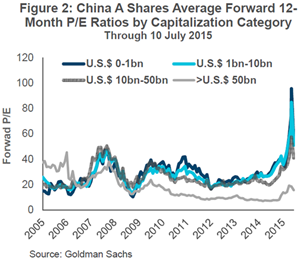
Meanwhile, there is a risk the stabilization measures taken to date have created a false equilibrium. While reported valuation multiples have come down (Figure 2), they remain at or near historical extremes—especially for smaller, speculative names. Stale pricing on suspended shares feeds a suspicion that multiples in the frothier sectors still have further to fall.
LIMITED WEALTH EFFECTS
We believe that the equity bubble and bust should have a relatively modest direct impact on China’s real economy:
- As noted above, equities account for a relatively small share of Chinese household wealth—and that share (as well as most of the leveraged speculation that drove the bubble) is concentrated among high-net-worth and ultra-high-net-worth investors.
- The wealth created by the bubble, while huge in nominal terms, existed only briefly. Standard economic theory would suggest that temporary changes in household wealth have relatively little impact on savings and consumption behavior.
- China’s property sector—far more important for both household and local government finances—is in the early stages of a recovery that began last year. This should help offset any negative wealth effects from the equity bust, especially if the PBOC remains in an easing mode.
OUR MARKET POSITION
While Chinese equity valuations are still elevated, especially for smaller and more speculative A share names, multiples for many of our favored companies have returned to levels that we believe offer attractive value on a 12-month (or longer) view. In this environment, we recognize there are often opportunities for long-term investors like T. Rowe Price to take advantage of mispricing caused by overselling.
Accordingly, our portfolio teams will continue to look for select opportunities both in the H and A share markets—although any moves into the latter will likely be slow and careful. We will also monitor macroeconomic developments to see whether China’s leadership can successfully manage the delicate balance between economic growth and financial deleveraging.
2015-GL-2240
Wichtige Informationen
Dieses Dokument wurde ausschließlich zu allgemeinen Informations- und Werbezwecken erstellt. Dieses Dokument ist in keiner Weise als Beratung oder als Verpflichtung zur Beratung zu verstehen (auch nicht in Bezug auf Treuhandanlagen). Es sollte zudem nicht als primäre Grundlage für eine Anlageentscheidung herangezogen werden. Interessierte Anleger sollten sich in rechtlichen, finanziellen und steuerlichen Belangen von unabhängiger Seite beraten lassen, bevor sie eine Anlageentscheidung treffen. Die T. Rowe Price-Unternehmensgruppe, zu der auch T. Rowe Price Associates, Inc. und/oder deren verbundene Gesellschaften gehören, erzielen Einnahmen mit Anlageprodukten und -dienstleistungen von T. Rowe Price. Wertentwicklungen in der Vergangenheit sind kein verlässlicher Indikator für zukünftige Erträge. Der Wert einer Anlage sowie die mit dieser erzielten Erträge können sowohl steigen als auch sinken. Es ist möglich, dass Anleger weniger zurückbekommen als den eingesetzten Betrag.
Das vorliegende Dokument stellt weder ein Angebot noch eine persönliche oder allgemeine Empfehlung oder Aufforderung zum Kauf von Wertpapieren in irgendeinem Land oder Hoheitsgebiet beziehungsweise zur Durchführung bestimmter Anlageaktivitäten dar. Das Dokument wurde von keiner Aufsichtsbehörde irgendeines Landes oder Hoheitsgebiets geprüft.
Die hierin geäußerten Informationen und Ansichten wurden aus oder anhand von Quellen gewonnen, die wir als zuverlässig und aktuell erachten; allerdings können wir die Richtigkeit oder Vollständigkeit nicht garantieren. Wir übernehmen keine Gewähr dafür, dass sich Vorhersagen, die möglicherweise getätigt werden, bewahrheiten werden. Die hierin enthaltenen Einschätzungen beziehen sich auf den jeweils angegebenen Zeitpunkt und können sich ohne vorherige Ankündigung ändern; diese Einschätzungen unterscheiden sich möglicherweise von denen anderer Gesellschaften und/oder Mitarbeiter der T. Rowe Price-Unternehmensgruppe. Unter keinen Umständen dürfen das vorliegende Dokument oder Teile davon ohne Zustimmung von T. Rowe Price vervielfältigt oder weiterverbreitet werden.
Das Dokument ist nicht zum Gebrauch durch Personen in Ländern oder Hoheitsgebieten bestimmt, in denen seine Verbreitung untersagt ist oder Beschränkungen unterliegt. In bestimmten Ländern wird es nur auf spezielle Anforderung zur Verfügung gestellt.
Das Dokument ist nicht für Privatanleger bestimmt, unabhängig davon, in welchem Land oder Hoheitsgebiet diese ihren Wohnsitz haben.
EXECUTIVE SUMMARY
The plunge in Chinese equities since mid-June, and the extraordinary measures taken by the government to arrest that decline, have raised doubts about the country’s financial stability and the strength of China’s real economy. In both cases, we expect the stock market correction to have a limited impact, reflecting the modest role that equities play in the portfolios of Chinese households. However, Beijing continues to wrestle with the policy dilemma of maintaining an acceptable economic growth rate while slowing credit growth and bringing leverage ratios down. Although equity valuations have moved back toward rational levels—at least for the larger, less speculative companies we find interesting—our approach remains cautious, especially in the renminbi-denominated A shares market.


