

Asian Equities. The Benefits of Diversifying into Asia for Australian Investors.
STRONG DOMESTIC EQUITIES
Over the past 10 to 15 years, many Australians have benefited greatly from investing in our domestic equity market.1 A commodity boom driven by the growth of China led to a period of exceptional returns from the resources sector and helped boost other areas of the economy and the stock market. Improving terms of trade led to a strengthening of the Australian dollar, which depressed AUD returns on overseas investments. Attractive dividends, plus franking benefits, have also been a strong attraction for many investors who are on the hunt for income. Low yields in fixed income markets, cash and term deposits have created more fuel and further support to domestic equities.
HEADWINDS AS COMMODITIES FADE
In more recent years, it has become apparent that the commodity supercycle has started to decline, and many of the positive benefits of the cycle have become headwinds. While the Australian government is acting to boost other areas of the economy and we remain optimistic on the outlook for Australian equities, the case for diversifying overseas has rarely been stronger. As well as the fall in commodity prices, global central banks’ monetary policy changes have led to a weakening of the Australian dollar, boosting returns from overseas investments. Asian equities offer diversification away from our commodity-heavy market and exposure to some of the most attractive growth opportunities to be found anywhere globally. We believe that Asia will increasingly become a home market—culturally and commercially—for Australia.
DOMESTIC BIAS OF INVESTORS
This has important implications for Australian investors who generally have a high proportion of their investments in domestic shares, concentrated particularly in resources stocks (20.6% of the ASX 200) and financial stocks (46.5% of the ASX 200).2 The cyclical nature of these sectors means they do well when the economy is strong, in the case of financials, or when the commodity cycle is booming, but they are vulnerable in a downturn, something that is occurring in both sectors at the moment.
DIVERSIFICATION BENEFITS
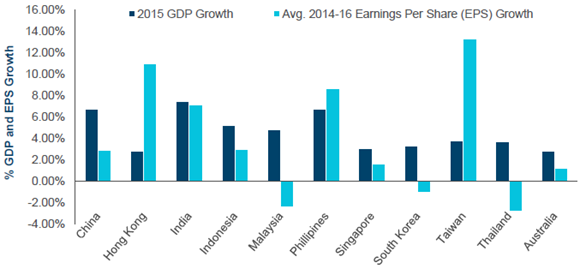
Diversifying Australia-heavy portfolios with offshore investments would help to offset this vulnerability. Investors would gain exposure to economies that are growing at different rates to Australia and which are often larger in size. Broadening the investment horizon would allow Australian investors to benefit from investing in emerging and developed Asian economies, such as China, India, Indonesia and the Philippines, whose potential rates of growth far exceed Australia’s.
Figure 1: 2015 GDP Growth Average 2014-2016 Earning Per Share Growth in ACAXJP Plus Australia
As of 31 May 2015
Sources: FactSet, Haver, and IMF.
LOW STOCK CORRELATIONS
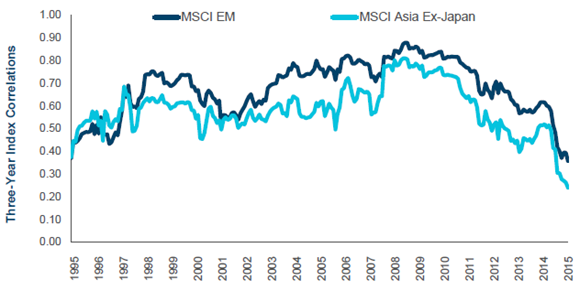
Recent correlations data also lend support to this view. Asia ex-Japan equities have low correlation with Australian shares, and the degree to which the ASX 200 has marched in tandem with the MSCI AC Asia ex-Japan Index has weakened as the impact of the global financial crisis rolls off, as the chart below shows. The global financial crisis caused a collective spike in volatility, prompting most assets to move together in the same direction, which increased correlations. As dispersion in performance returns have become more apparent with the easing of the crisis, we have seen the benefits of diversification come through.
Figure 2: Rolling Three-Year Stock Correlations With ASX 200 ($AUD)
As of 31 May 2015
Source: MSCI.
ATTRACTIVE COMPLEMENTARY STRENGTHS
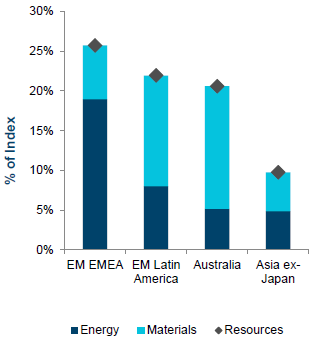
The complementary nature of Asia’s economies, with their low exposure to materials and resources in particular, is one of their key attractions. There are very few primary commodity stocks in the Asian region, something that differentiates Asia from the broader emerging markets (EM) opportunity set. In fact, as heavy consumers of oil, iron ore and other hard commodities, Asian economies, companies and households stand to benefit greatly from lower commodity prices in the years ahead. In this environment, inflation becomes easier to control, households have more money to spend and businesses have lower costs and therefore higher margins.
In addition, Asian markets provide a greater exposure to a wider array of sectors compared with Australia. The Australian market is dominated by financials and resources and has limited exposure to information technology, consumer discretionary and specialist manufacturing, which are Asia’s strengths. These sectors are being shaped by the rising household incomes and consumption of the burgeoning middle classes and provide high-quality exports for the global economy.
Figure 3: A Beneficiary of Lower Resource Prices— Resource Stocks as a Percentage of Market Capitalization
As of 31 December 2014
Sources: FactSet and IMF.
OPPORTUNITY FOR ALPHA
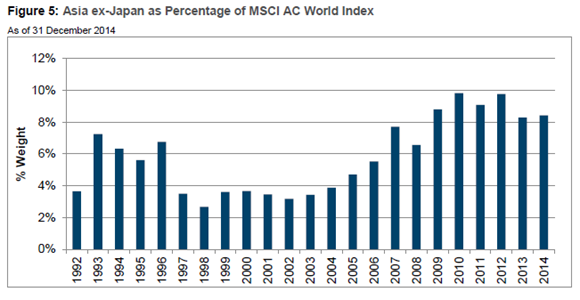
At the end of 2014, the Asia ex-Japan region represented 8.4% of the market cap of the MSCI AC World Index, more than double its weight in the mid-2000s.3 This share will grow as the regional economy and markets expand. We believe certain industries, such as domestic consumption, and countries remain under-represented in the index given their long-term potential to deliver superior returns. An active approach to investing in Asia can lead these changes in the pursuit of alpha.
HARNESSING PROFOUND CHANGES
Asian equities should also take a bigger share of a rebalanced portfolio, as Australia increasingly turns its attention towards its neighbours in Asia. Australia is seeking to harness profound trends that are altering its society and its role in the Asia-Pacific region in a bid to provide a stable environment for trade and investment.
Asia’s extraordinary ascent in becoming the largest and most populous trading area in the world—accounting for 37% of the world’s trade and home to more than half of the world’s inhabitants—is transforming the Australian economy, society and strategic environment. Asia will soon be the largest producer and consumer of goods and services. In the future, most of the world’s workers, and most of its middle class, will live there.4
INTEGRATING WITH ASIAN MARKETS
Australia’s Western cultural origins and alignments may at times influence its neighbours’ attitudes, but it has made strong efforts to integrate with the Asian region, forging close relationships and strong friendships. While the country is a U.S. ally, it also has close economic and social ties with China, its top trading partner and the biggest Asian investor in the country.
Australia is geographically well placed between the Indian and Pacific oceans to capitalize on what is increasingly being recognized as an Indo-Pacific era, in which the Asia that matters globally is not only East Asia but India as well.
ADDING TRADING PARTNERS
Indeed, trade with Asia has risen dramatically in recent decades, and the region is now Australia’s largest trading partner. Australia’s exports of goods and services rose to U.S. $319 billion in 2013, with members of the Asia-Pacific Economic Cooperation group accounting for 71.2 %. The main regional partners are China, Japan and South Korea. By contrast, the U.S., an important strategic ally, accounted for less than 5%.5It is also clear that Australians will retire in an economy and society that is much more Asian-centric. The country relies increasingly on Asian immigration, especially from China and India, to ensure its economy and society keep flourishing. More than 1 million migrants, out of a total population of 23.5 million, were born in Asia. Just over half of these were born in Southeast Asia, almost one-third in Northeast Asia, and one-fifth in Southern Asia. The biggest migrant groups were from Vietnam, China, the Philippines, India, Malaysia and Brunei.6
PURSUING PACTS AND ALLIANCES
Australia is promoting closer integration by pursuing a variety of approaches with its neighbours and international bodies. It is an active member of multilateral and regional forums like the WTO, the Group of Twenty (G20), the Asia-Pacific Economic Cooperation forum (APEC) and the Association of Southeast Asian Nations (ASEAN), where it seeks to reduce barriers to trade and investment and to increase global economic stability and cooperative relations.
It has forged new regional trade agreements with Malaysia, Republic of Korea, Japan and China and is negotiating with others. It has also increased bilateral engagement in a variety of areas, such as regulation. For example, it has agreed a statement of intent with Korea, New Zealand, and Singapore to provide a multilaterally agreed regulatory framework allowing participants to launch, market, and sell investment fund products in each other’s countries more easily.7 Australia is also participating in negotiations to create a Trans-Pacific Partnership Agreement—a free-trade agreement covering the region—and a Regional Comprehensive Economic Partnership,8 with the ulterior aim of generating momentum for competitive liberalization in regional agreements.
DEVELOPING AGRICULTURAL TRADE
Via these organizations, Australia not only seeks to liberalize trade but also to support the development of markets, among them those relating to agriculture in order to promote food security. Asia contains some of the world’s largest agricultural economies. The projected increase of the population and rise in consumption will require higher output that will mop up scarce land and water. The real value of global food demand is expected to rise by about 35% by 2025 from 2007 levels with most demand coming from Asia.8
Australia is already working with regional partners to develop the agriculture sector and build on its reputation as a leader in agricultural, food technology and science solutions.8 For example, it is conducting a study with China of the potential for investment to build capacity and to boost output and research. Australia has the opportunity to become an important supplier of high-value food, particularly “clean and green” agricultural commodities and food products, to meet strong demand from Asia’s rising populations and expanding middle classes. In recent years, it has gained new or improved market access for a number of products to regional markets, including chilled meat, citrus fruits and table grapes to China and plums and carrots to Taiwan.
Figure 5: Asia ex-Japan as Percentage of MSCI AC World Index
As of 31 December 2014
Source: MSCI
Investing domestically will still enable investors to access the Asian growth story even as the commodity boom fades. But why not also access directly the deep and exciting universe of stocks available right up the road in Asia itself?
DIFFERENTIATED APPROACH NECESSARY
Investing in this fast-growing region does carry risks, such as the strengthening of the U.S. dollar versus local currencies, geopolitical tensions or a loss of momentum in the reform process. Investors are adopting a differentiated and active approach to investment in the region due to the dispersion of returns. Broadly speaking, countries that are doing well are among those that have implemented social and economic reforms since the Asian financial crisis of 1997 and the “taper tantrum” of 2013; underperformers, on the other hand, are still saddled with large current account and budget deficits and too much debt denominated in U.S. dollars.
We have a large team of experienced equity analysts who constantly evaluate opportunities in public and private companies right across the region. They are supported by our regional hubs in Hong Kong, Singapore, Tokyo and Sydney. This ensures our investment teams have direct access to local markets. We believe the flat and integrated structure of our research platform—and the distinct company, sector and regional perspectives that it fosters—leads to insights, not just information, and provides us with the ability to make cross-border comparisons and to identify trends as they migrate worldwide.
We encourage clients to think of investments in the Asia ex-Japan region as long-term holdings. There will be periods of volatility, but the benefits are likely to play out over many years. Australia’s links to Asia make this a particularly exciting region.
ASIAN STOCKS: A CORE ASSET CLASS
Emerging and developed markets in Asia can offer many investment opportunities for Australians venturing offshore. In addition, valuations are now at attractive levels. The weakening of the Australian dollar in recent months may mean that the currency strength presents less of a headwind to overseas investment. We believe Australian investors will benefit in years to come from integration efforts and the easier flow of goods, services, capital, people and ideas. Australia’s strengthening economic, political, social, cultural links and cooperative projections with other powers should also serve to increase regional security and provide the stability for confident investment. Investors can also rest assured that this is a long-term effort by Australia to advance its interests in the region, cognizant that it faces growing competition for influence as Asia’s strong economic growth and increasing strategic weight gain international attention.
WHY INVEST? IN SUMMARY:
- Access to the growth in the Asian region
- Diversification away from Australian stocks and commodities
- A long-term investment opportunity
- T. Rowe Price expertise in the region
1 Annualised returns for the ASX 200 exceeded those of the MSCI World Index over 10 years and 15 years. Source: FactSet; as of 29 May 2015
2 FactSet; as of 31 May 2015
3 Source: MSCI; as of 31 December 2014
4 U.N. Economic and Social Commission for Asia and the Pacific website
5 Australian Government Department of Foreign Affairs, Trade at a Glance 2014
6 Australian Bureau of Statistics website; as of 26 August 2014
7 APEC: Asia Region Funds Passport, Statement of Intent 2013
8 Australian Government: Australia in the Asian Century, White Paper October 2012
2015-GL-2135
重要情報
当資料は、ティー・ロウ・プライス・アソシエイツ・インクおよびその関係会社が情報提供等の目的で作成したものを、ティー・ロウ・プライス・ジャパン株式会社が翻訳したものであり、特定の運用商品を勧誘するものではありません。また、金融商品取引法に基づく開示書類ではありません。当資料における見解等は資料作成時点のものであり、将来事前の連絡なしに変更されることがあります。当資料はティー・ロウ・プライスの書面による同意のない限り他に転載することはできません。
資料内に記載されている個別銘柄につき、売買を推奨するものでも、将来の価格の上昇または下落を示唆するものでもありません。また、当社ファンド等における保有・非保有および将来の組入れまたは売却を示唆・保証するものでもありません。投資一任契約は、値動きのある有価証券等(外貨建て資産には為替変動リスクもあります)を投資対象としているため、お客様の資産が当初の投資元本を割り込み損失が生じることがあります。
当社の運用戦略では時価資産残高に対し、一定の金額までを区切りとして最高1.265%(消費税10%込み)の逓減的報酬料率を適用いたします。また、運用報酬の他に、組入有価証券の売買委託手数料等の費用も発生しますが、運用内容等によって変動しますので、事前に上限額または合計額を表示できません。詳しくは契約締結前交付書面をご覧ください。
「T. ROWE PRICE, INVEST WITH CONFIDENCE」および大角羊のデザインは、ティー・ロウ・プライス・グループ、インクの商標または登録商標です。
ティー・ロウ・プライス・ジャパン株式会社
金融商品取引業者関東財務局長(金商)第3043号
加入協会:一般社団法人日本投資顧問業協会/一般社団法人投資信託協会
EXECUTIVE SUMMARY
Asian equities should play an increasing part in a rebalanced portfolio as Australia’s links strengthen with the fastest-growing and most dynamic part of the globe. Many investors are currently aware of the investment opportunities that exist in the Asia ex-Japan region but do not necessarily understand how best to gain access.
Nick Beecroft, portfolio strategist for Asia ex-Japan Equities, says now may be the time to consider an allocation to Asia ex-Japan given recent positive developments in regional politics. Earnings growth is also coming through while stocks still trade at attractive valuations relative to other equity markets, including our own, so we believe Asia’s stock markets look particularly attractive again following a number of years of underperformance relative to major developed markets.
