

Global High Income: Amid a Scarcity of Yield, Casting a Wider Net in Credit
Among bonds’ appealing features is the steady current income they provide to investors. But today, yield has become an increasingly scarce commodity amid widespread monetary easing by global central banks. This is perhaps most evident in Europe, where the European Central Bank (ECB) has resorted to negative deposit rates and will be buying more than double the expected net issuance of eurozone government bonds over the course of its recently launched asset purchase program. These efforts have resulted in negative yields even in fiscally troubled countries such as Portugal—which not long ago required a financial bailout—and very low yields on high-quality euro corporate debt.
The low global interest rate environment is unlikely to end anytime soon. The ECB has stated that its quantitative easing program will continue through at least September 2016. Even if it ends then, futures markets are not pricing in a meaningful increase in the ECB’s key policy rate, currently 0.05%, for several years. Meanwhile, the Bank of Japan may further loosen policy this year, as Japanese inflation is well short of its 2% target and growth remains weak despite a massive stimulus program. The U.S. Federal Reserve is formulating when to begin raising rates for the first time since 2006. But the pace of tightening is likely to be gradual and the eventual terminal rate lower than in previous cycles.In a world of exceedingly low absolute interest rates, we anticipate sustained demand for yield-oriented fixed income strategies for the foreseeable future. With core investment-grade sectors offering inadequate yields and rising interest rate risk, global high yield credit is an attractive alternative for investors who are willing to accept greater default risk and potential volatility in exchange for larger coupons and shorter durations.
AN EXPANDING OPPORTUNITY SET OUTSIDE OF THE U.S.
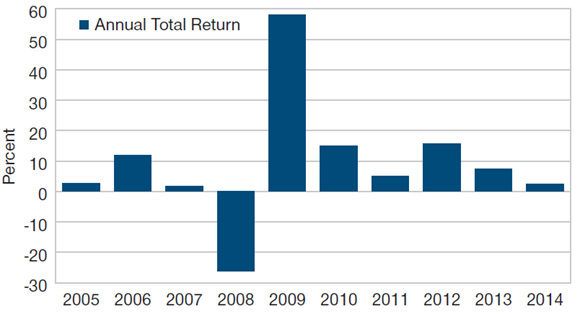
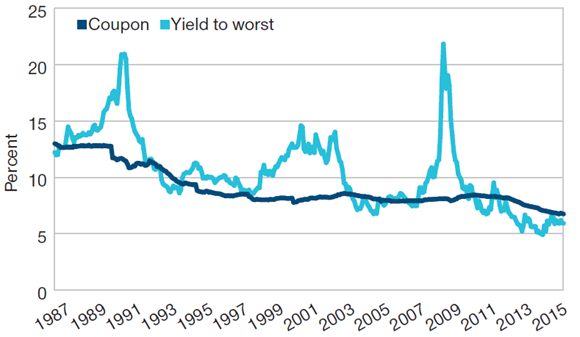
The U.S. high yield bond market—the most established segment of the asset class—has been a popular destination for investor cash since the 2008 financial crisis thanks to relatively attractive yields, sturdier corporate balance sheets, and muted default expectations. The default rate, which had peaked at nearly 11% in December 2009, ended May 2015 at just 1.6%.1 Against this improving fundamental backdrop, U.S. high yield bonds have produced positive total returns in every year since 2008 despite a sharp sell-off in the commodities space in the second half of 2014 (see Figure 1).There are numerous fundamentally sound, well-managed U.S. high yield companies. Many issuers have repaired their balance sheets, reduced capital costs, and extended maturities through refinancing activity over the past several years. We also remain constructive on the U.S. economy, which underpins high yield fundamentals. We see compelling credit stories in industries such as cable and wireless communications, where companies are pursuing strategic acquisitions. However, an influx of new investors seeking yield has led to less attractive valuations at the broad market level and, in some cases, inappropriate pricing of risk. Coupons have been on a sustained downtrend as issuers have refinanced debt at lower rates; overall yields have declined since cresting at nearly 23% in December 2008 during the depths of the credit crisis (see Figure 2); and with much of the U.S. market currently trading at a premium, capital appreciation potential is more limited.
FIGURE 1: Solid performance for U.S. high yield since the globalfinancial crisis
One-year periods ended December 2005–December 2014
Source: Barclays.
Past performance cannot guarantee of future results.
FIGURE 2: Less compensation for risk in today’s U.S. high yield market
As of January 1987 to May 2015
Source: Barclays.
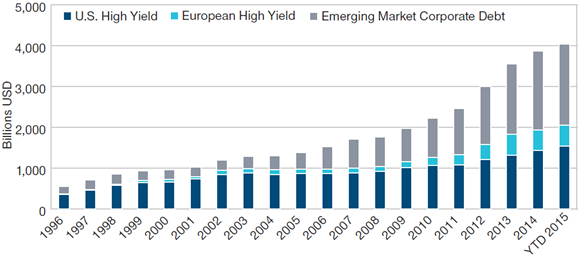
Encouragingly, the high yield opportunity set has expanded globally in recent years, providing additional avenues for investors seeking high total return. A decade ago, the high yield market consisted primarily of bonds issued by American companies; today the asset class is much broader, with an increasingly international flavor (see Figure 3). While the U.S. market remains an integral component of the global high yield universe given its relative stability and longer history, there has been a burgeoning supply of European and EM corporate securities, allowing for greater diversification.
FIGURE 3: Tremendous growth of the global high yield opportunity set
As of December 1996 to March 2015
Sources: BIS and Credit Suisse.
EUROPEAN HIGH YIELD HAS COME INTO ITS OWN
Europe’s high yield market has more than quadrupled in size since 2008. The rapid growth can be ascribed to financial disintermediation spurred by the malaise of the European banking system. In the U.S., regulators compelled domestic banks to recapitalize their balance sheets and shed nonperforming assets rather promptly following the credit crisis, enabling them to resume lending. In Europe, however, the absence of a banking union (until recently) and uncertainty about the quality of assets on bank balance sheets slowed the recapitalization process. With banks reluctant to lend—especially to less established, higher-risk companies— European firms have increasingly turned to public markets to finance their growth.
Formerly a small, esoteric market, European high yield has rapidly blossomed with a flurry of new issuance over the past six years. It is now roughly a third of the size of the U.S. high yield market and should continue to grow given Europe’s low interest rate environment and risk-averse financial institutions. A larger, more diverse pool of bonds with growing investor sponsorship has improved market liquidity and depth. It has also created more opportunities to benefit from security selection.
A challenge for creditors is that over 40% of new European below investment-grade offerings are from first-time issuers.2 Many of these names are not publicly listed, as Continental firms have traditionally been more reliant on banks than on capital markets to raise funds. With existing research on new issuers often in short supply, asset managers need to possess independent research capabilities and a local presence to thoroughly assess a company’s credit strength before participating in deals. An upside to this situation is that European high yield is more inefficient than the more mature U.S. market, providing ample opportunities to take advantage of mispriced bonds. Additionally, many first-time debt offerings come with a yield premium to compensate for a lack of credit history.
Altice is an example of a compelling European high yield credit story. Relatively obscure a few years ago, the multinational cable and telecom service provider has quickly become one of the highest-profile names in the entire asset class, taking advantage of investors’ thirst for yield to pursue strategic acquisitions. Its $16.7 billion cross-currency deal with subsidiary Numericable in 2014 to acquire mobile operator SFR from Vivendi was the largest high yield issue in absolute size on record across all regions. Altice continues to diversify its service offerings and expand its geographic footprint, recently purchasing the Portuguese assets of Portugal Telecom and announcing an acquisition of U.S. regional cable operator Suddenlink.
EXPLOITABLE INEFFICIENCIES IN EMERGING MARKETS CREDIT
Like European high yield, the EM corporate bond sector has experienced tremendous growth, more than doubling in size over the past five years. The opportunity set has grown not just in size but also in scope: from less than 30 issuers 10 years ago, there are now 549 issuers from 49 countries.3 About half of these issuers are rated below investment grade. The opportunity set is also fairly diversified from a regional and an industry perspective, providing opportunities to exploit different economic cycles and sector themes.
Despite its rapid growth, we believe that the EM corporate market is still in its early stages of development. Rather than increasing balance sheet leverage, companies in developing markets have been using the public debt market to refinance existing loans at longer maturities and more favorable rates than offered by local banks. By our estimates, the external bond market accounts for less than 10% of onshore private credit across the emerging world. Hence, there is considerable room for further growth.
As the least followed area of global credit, EM corporates are the most inefficient, meaning plentiful potential for alpha generation. As with European high yield, much of the new supply is coming from first-time issuers. But in contrast to Europe, many of these names are publicly traded. Having access to insights from equity cohorts who are familiar with company management and corporate governance practices affords our portfolio management team a significant advantage given the typically short underwriting windows for new debt offerings.
To succeed in these sometimes illiquid and geopolitically driven markets, it is also highly valuable to supplement fundamental credit research with input from sovereign analysts, as macroeconomic and geopolitical events can drive credit performance. As a recent example, Russian and Ukrainian corporate bonds have been volatile amid the neighboring countries’ territorial conflict, which has led to economic sanctions against Russia and raised the specter of a sovereign default by Ukraine. Brazil has likewise been a turbulent location for investors amid its unfolding government corruption scandal.
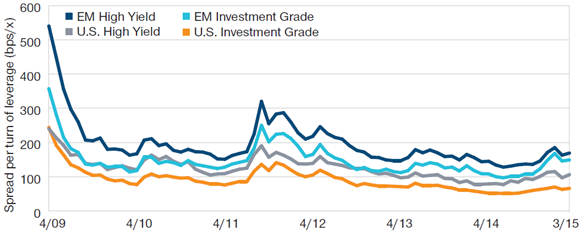
FIGURE 4: More spread, less leverage in emerging markets
As of April 2009 to March 2015
Source: Bank of America Merrill Lynch.
Despite these frequent idiosyncratic challenges, fundamentals in the EM corporate sector are solid as a whole. Many issuers are first-rate companies in their regions who stand to directly benefit from growing middle classes and rising domestic consumption trends. Corporate balance sheets in the developing world are generally sturdier than their developed market peers, with lower leverage and higher cash-to-debt ratios. Perhaps most compelling is the additional spread pickup they provide over U.S. corporate bonds relative to degree of leverage (see Figure 4). Split-rated and investment-grade EM corporates can sometimes offer more spread than lower-rated developed market credit. Therefore, our EM corporate allocation tends to be more conservative and may include some investment-grade names.
EXPECT GREATER PERFORMANCE DISPERSION AS MARKETS EVOLVE
Historically, there has been a high correlation between the performance of U.S. and global high yield. But this tight relationship has begun to break down as markets expand and mature (see Figure 5). We believe correlations should continue to decline given the unique economic and political forces at work around the world. Over longer time periods, we believe global high yield strategies hold an advantage from a yield and spread perspective by having flexibility to invest in the best ideas across global high yield markets and utilize tactical regional allocations.
FIGURE 5: Greater dispersion in performance as global markets evolve
As of December 1997 through May 2015
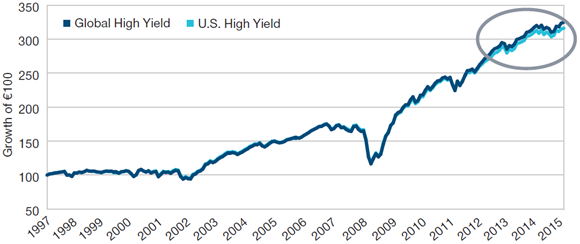
Source: Bank of America Merrill Lynch.
Past performance cannot guarantee future results.
For traditional high yield mandates, bottom-up security selection is the primary performance driver, with modest alpha generated from sector rotation. However, managers at the helm of global strategies need to take a more multifaceted approach. While selecting improving credits and avoiding downgrades and defaults remains critical for long-term success, additional top-down elements need to be woven into the investment process.
A key decision is how to allocate between the three major global high yield sleeves: the U.S., Europe, and emerging markets. Deft and dynamic geographic allocation decisions can generate superior performance. For example, investors would have benefited from overweighting European high yield over the past three years. Europe outperformed the U.S. between 2012 and 2014,4 as investors embraced the burgeoning market despite the eurozone’s well-known economic challenges, and falling European rates generated capital gains. In 2014, the European market also benefited from its low energy exposure as global oil prices tumbled late in the year. In contrast, energy accounted for almost a fifth of many U.S. high yield indexes, weighing on overall performance. With the sell-off in commodity producers, valuations in the U.S. have improved, and we believe that certain EM energy names hold potential.
Another important high-level consideration is how to allocate assets from a credit quality perspective. In Europe, the best opportunities have been concentrated in B rated bonds. European BBs currently offer average yields of less than 3%, and many of the exciting debut issuers are B rated. In developing markets, we are biased toward higher-quality issues, as crossovers and BBB rated credits can offer attractive spreads. Although yields look even more enticing in lower-quality tiers, we are highly selective in these waters due to uncertain recovery rates in countries with weak judicial systems and opaque bankruptcy processes. We are most comfortable obtaining lower-rated exposures from the U.S. given that market’s longer track record and clearer legal codes. Here, we look for balance sheet repair stories trading at a discount to gain some capital appreciation potential to complement high current income.
NOT FOR THE FAINT OF HEART
Although we believe global high yield strategies hold an advantage over regionally focused counterparts for long-term return potential, global high yield may be more volatile due to exposures to countries with less developed political and economic systems. Market liquidity can be particularly challenging in EM countries, and investors should expect and be willing to endure bouts of turbulence when sentiment wanes. However, we believe that the power of compound interest will reward risk-tolerant investors over the long term.
Indeed, volatility and economic instability create some of the best investing opportunities. For example, the steep decline in oil prices over the past year frightened many investors, sending credit spreads wider amid concerns about defaults in the energy sector. We saw this dislocation as a fertile opportunity. Working with equity colleagues, our credit analysts identified companies that should thrive in a low oil price environment, as well as likely default candidates. While avoiding the latter, certain weaker companies that are prospective acquisition targets or are capable of raising capital are piquing our interest.
Attractive investments can often be found in unlikely places. Argentina, for instance, is an intimidating place to lend money, having defaulted on its sovereign debt on two occasions since 2001. And with the plunge in oil prices, a collapsing currency, and Western sanctions restricting its firms’ access to capital markets, Russia was the epicenter of volatility in 2014. Yet there are world-class companies even in these sorts of troubled locales.
A GENUINE GLOBAL APPROACH
When considering global high income offerings, we recommend investors look under the hood to understand what portfolios actually consist of. We have found that many so-called “global” strategies contain primarily U.S. securities, with only modest exposure to one of the other sleeves. In our view, investors benefit from a truly global portfolio that utilizes the full high yield opportunity set to identify the best ideas. Because the opportunity set is so vast and dynamic, the investment process demands a higher level of collaboration between regional specialists, informed by insights from sovereign and equity analysts.
As the world’s credit markets continue to evolve, we believe that a global high income strategy should be considered as a core allocation for investors who desire higher total returns in below investment-grade credit and can tolerate higher risk. In addition to providing a broader array of securities to select from, global high income portfolios can take full advantage of divergent credit cycles, relative value disparities, and diminishing correlations between regions. There is also meaningful potential to profit from dislocations and volatility driven by the ever-present economic and geopolitical uncertainties across the global landscape.
1 Source: J.P. Morgan. Based on the par-weighted default rate over the 12 months ended May 2015.
2 Source: Barclays.
3 Based on the J.P. Morgan CEMBI Broad Index. As of April 30, 2015.
4 On a currency-hedged basis.
2015-GL-2020
重要情報
当資料は、ティー・ロウ・プライス・アソシエイツ・インクおよびその関係会社が情報提供等の目的で作成したものを、ティー・ロウ・プライス・ジャパン株式会社が翻訳したものであり、特定の運用商品を勧誘するものではありません。また、金融商品取引法に基づく開示書類ではありません。当資料における見解等は資料作成時点のものであり、将来事前の連絡なしに変更されることがあります。当資料はティー・ロウ・プライスの書面による同意のない限り他に転載することはできません。
資料内に記載されている個別銘柄につき、売買を推奨するものでも、将来の価格の上昇または下落を示唆するものでもありません。また、当社ファンド等における保有・非保有および将来の組入れまたは売却を示唆・保証するものでもありません。投資一任契約は、値動きのある有価証券等(外貨建て資産には為替変動リスクもあります)を投資対象としているため、お客様の資産が当初の投資元本を割り込み損失が生じることがあります。
当社の運用戦略では時価資産残高に対し、一定の金額までを区切りとして最高1.265%(消費税10%込み)の逓減的報酬料率を適用いたします。また、運用報酬の他に、組入有価証券の売買委託手数料等の費用も発生しますが、運用内容等によって変動しますので、事前に上限額または合計額を表示できません。詳しくは契約締結前交付書面をご覧ください。
「T. ROWE PRICE, INVEST WITH CONFIDENCE」および大角羊のデザインは、ティー・ロウ・プライス・グループ、インクの商標または登録商標です。
ティー・ロウ・プライス・ジャパン株式会社
金融商品取引業者関東財務局長(金商)第3043号
加入協会:一般社団法人日本投資顧問業協会/一般社団法人投資信託協会
Executive Summary
- In a low interest rate world, there will likely be long-term sustainable demand for high income-oriented credit strategies.
- U.S. issuers had historically dominated the high yield market. While the U.S. remains a key component, the opportunity set has expanded globally, with significant growth in European high yield and emerging markets (EM) corporate bonds. Because these markets are newer and less followed than the U.S. high yield market, they offer more opportunities to exploit security mispricing and market inefficiencies.
- In addition to having a broader array of securities to select from, global high income portfolios can take full advantage of divergent credit cycles, relative value disparities, and diminishing correlations between regions. There is also meaningful potential to profit from dislocations and volatility driven by the ever-present economic and geopolitical uncertainties across the global landscape.

