

Africa and Middle East Equity: Saudi Arabia’s Stock Market Opening Offers Opportunities for Global Investors
WEALTH OF OPPORTUNITY
Saudi Arabia opened up its US$554 billion stock market1 on 15 June 2015 as part of King Salman’s economic drive to diversify the region’s biggest economy away from its heavy dependence on hydrocarbons.
This is an exciting development for global investors, who are likely to be attracted by the size of the country’s equity market—larger than those in Indonesia, Malaysia, Mexico and Russia—and by its depth.2 They can now buy shares in some of the world’s biggest companies, such as the world’s largest petrochemical producer, Saudi Basic Industries Corp., and dairy company Almarai. The reform also puts the market on the path to an eventual inclusion in the MSCI Emerging Markets (EM) Index.
The reform creates more certainty in the investment environment. Being able to hold shares directly rather than indirectly via derivatives removes a theoretical credit risk with counterparties. Another plus is that the Saudi Arabian riyal is pegged to the US dollar, reducing the risk of currency fluctuations. In addition, the Kingdom enjoys strong sovereign credit ratings.
Figure 1 Tadawul Stock Exchange Market Capitalization— Saudi Arabia (US$)
As of 31 May 2015
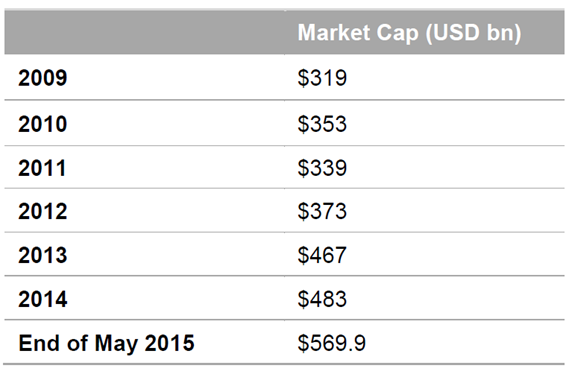
Sources: Tadawul stock exchange and Thomson Reuters Datastream
ATTRACTIVE SECTORS, COMPANIES
In our view, a number of companies are well positioned to earn above-average returns in the medium to long term, particularly in travel services, health, catering, food products and education supplies.
The health care sector offers strong structural growth potential due to the mismatch between supply and demand. There are only four hospital groups serving the capital Riyadh, with a population of 7 million, where there is an acute shortage of beds.3 Companies are expanding as fast as they can to meet the growing demand.
The consumer sector is also attractive and plays into a key emerging market theme: the expanding middle class and rising incomes. Valuations of companies in consumer staples and consumer discretionary compare favorably with those in a number of other large emerging markets such as India, Indonesia, and Mexico.
DEEP, LIQUID MARKET
The Saudi Arabian market is by far the most diversified and liquid in the Middle East/North Africa region, trading up to US$4 billion a day. The market covers the full range of economic sectors, excluding oil, which remains state controlled. There are 169 listed companies in 15 industries ranging from petrochemicals, banks and telecommunications to health care, education and travel.4
The Kingdom is pursuing a US$130 billion diversification plan to boost industries not related to oil and to develop the private sector. The plan is also aimed at creating employment for its very young population. More than 17% of its 27.3 million subjects are 15 to 24 years old.5 Some estimates suggest three million new jobs need to be created by 2019 to keep unemployment at current levels.6
Our regular investment trips confirm the speed at which the country’s landscape is transforming, with new universities, financial districts, ports, airports and, of course, the world’s largest tower all being built.
INCREASING TRANSPARENCY
The rationale for opening up is to slowly institutionalize the market. By attracting long-term foreign investors, the Kingdom hopes to reduce volatility, increase market efficiency and enhance local expertise and investment research. It also wants to raise the performance of listed companies by improving standards of transparency, disclosure and governance. Indeed, since 2006 when we first started meeting with Saudi companies, we have noticed a material difference in the quality of our meetings and the information provided by managers.
Until now, the market was restricted to retail investors who are residents, Saudi nonresidents and members of the region’s six-nation Gulf Cooperation Council. Foreign investors have only been able to invest indirectly, using swaps and derivatives known as participatory notes (P-notes) sold by local intermediaries.
Currently, nonresident foreigners only own 1.6% of the market capitalization and less than 4% of the free float.7 This compares with 64% ownership in Turkey and 30% in Brazil and South Korea.8
OWNERSHIP LIMITS
Global investors must now jump through a number of hoops to gain direct access to the market. They must first apply for qualified foreign investor (QFI) status. To be considered, an institution must manage at least US$5 billion in assets, have a five-year investment record and be domiciled in a jurisdiction with equal or better regulatory oversight than Saudi Arabia. The assets limit may be loosened at a later date.
The authorities have set ownership limits as well. A QFI can only own 5% of the stock of any particular company, while all QFIs together may not hold more than 20%. All QFIs, QFI clients and swap holders may not own more than 10% of the entire market capitalization.
T. ROWE PRICE TRACK RECORD
T. Rowe Price has been investing in Saudi Arabian equities via P-notes since it was allowed in 2008. Saudi investments account for 24% of the Africa & Middle East Equity Strategy and 7% of the Frontier Markets Equity Strategy.
Our five-strong, dedicated Africa, Middle East and frontier team covers and rates over 80% of the market cap of Saudi Arabian companies, including the banks, petrochemical, telecom, health care and retail companies, and is looking to expand the list. We are consequently well positioned to help our large global funds, which have been unable to invest via P-notes/swaps, enter the most exciting investments.
AIMING TO JOIN EM INDEX
While global fund flows into Saudi equities could be significant due to the low level of foreign ownership, we do not expect a stampede, partly because of the constraints maintained by the authorities.
The move to open the Saudi market comes after two of its smaller neighbors, Qatar and the United Arab Emirates (UAE), were promoted by MSCI Inc. last May 2014 from frontier to emerging market status, attracting a heavy flow of international funds as a consequence
CAPITAL MARKETS AUTHORITY (CMA) DECLARES ITS HAND
The Saudi Arabia stock market could also become a mainstream destination for international funds if it were included in index benchmarks, which is a declared aim of the CMA.
MSCI can take a relatively long time to reach a decision on including a market in one of the regional MSCI indices, but the debate about whether Saudi Arabia will enter—and potentially swamp—the MSCI Frontier Markets Index or go directly to the MSCI Emerging Markets Index is already underway. Saudi Arabia is currently a constituent of the MSCI Arabian Markets & Africa Index, and its weight is just over 30%.9
There are a number of obstacles, none that are insurmountable, before Saudi Arabia can win inclusion. One of them is the settlement process and another is liberalizing other eligibility criteria for foreign investors. Settlement in the Tadawul market is T+0, or immediate, which means that all trades must be prefunded. In most other markets settlement is delayed. Qatar and the UAE also had to make changes to be raised to emerging market status.
Figure 2 EM Index With Saudi Arabia
As of 31 May 2015
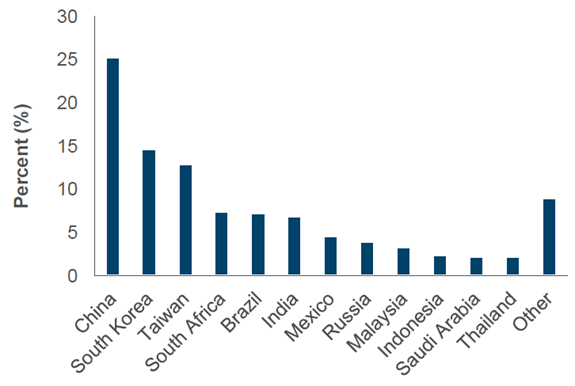
Source: T. Rowe Price
MSCI CONSULTING INVESTORS
Meanwhile, MSCI has created a standalone Saudi Arabia index, which is a preliminary step for its inclusion in one of the main regional gauges. MSCI has, to some extent, hurried the debate along by saying in its annual classification review on 9 June 2015 that it would consult international investors on the accessibility of the market before it considers adding it to the list of potential entrants to the EM index. We currently believe the earliest Saudi Arabia could enter either the frontier or emerging markets grouping would be mid-2018.
The Saudi Arabian market easily meets the size and liquidity requirements for inclusion in the EM index. If it were to join today, Saudi Arabia’s weight would be about 2%, assuming a foreign ownership limit of 20% in the Saudi market. This would make it the 11th largest emerging market, between Indonesia and Thailand.
BENEFICIAL IMPACT FROM INDEX INCLUSION
What might happen in the runup to inclusion in the index? The examples of Qatar and the United Arab Emirates are instructive. The markets there—Qatar’s QE Index, Abu Dhabi’s ADX Index and Dubai’s DFM General Index—outperformed sharply before they were upgraded to the main EM index in 2014.10
They were raised after MSCI demanded changes such as a buyer cash-compensation procedure, so that investors are paid in cash if a security is unavailable for delivery on settlement day. Qatar also increased foreign-ownership limits of companies in its US$141 billion stock exchange.11
However, there are significant differences between the smaller regional bourses and Saudi Arabia, which is a deeper, more liquid market with a stronger domestic following. This means that foreign flows might have a less perceptible effect, although a reclassification, if it occurs, is likely to be positive.
INVESTMENT CHALLENGES
As with any new market there are risks, and Saudi Arabia is no different. Bottom-up fundamental research is imperative in understanding both the opportunities and risks associated with investing in this nascent market. Alongside our rigorous fundamental stock analysis, which closely analyses companies’ financial health, models their growth prospects and looks closely at corporate governance, some of the particular risks we monitor in Saudi Arabia are the potential for social unrest, the vagaries of the oil market and geopolitical uncertainty.
As investors, we approach investment on a long-term basis. There often can be less information available on companies, and research coverage by analysts and brokerage firms is limited in these markets. For well-resourced teams, such as ours, these challenges can create opportunities to uncover neglected companies with healthy or improving operations and to identify stocks that have been ignored by the mainstream investment community.
POSITIVE FUNDAMENTALS UNDERPIN NEW OPPORTUNITY
We hold that the fundamental reasons for investing in Saudi Arabia are compelling still, even in the current environment of rising oil prices. The country will be offering up a broad range of investments and genuine opportunities to deliver potential returns. It enjoys abundant natural resources, a young population, a new king with reformist intentions, a big and growing regional economy that will prove an enduring and durable theme and a link to the US dollar that should insulate it from the impact of rising interest rates. Indeed, the peg should add luster to the market as higher US rates help to boost the margins of Saudi financial companies, the biggest weighting in the Tadawul as of 19 May 2015. Equity investors, while continuing to be aware of the potential for volatility in the short term, should recognize the long-term opportunities this market could offer.
2015-GL-2101
重要情報
当資料は、ティー・ロウ・プライス・アソシエイツ・インクおよびその関係会社が情報提供等の目的で作成したものを、ティー・ロウ・プライス・ジャパン株式会社が翻訳したものであり、特定の運用商品を勧誘するものではありません。また、金融商品取引法に基づく開示書類ではありません。当資料における見解等は資料作成時点のものであり、将来事前の連絡なしに変更されることがあります。当資料はティー・ロウ・プライスの書面による同意のない限り他に転載することはできません。
資料内に記載されている個別銘柄につき、売買を推奨するものでも、将来の価格の上昇または下落を示唆するものでもありません。また、当社ファンド等における保有・非保有および将来の組入れまたは売却を示唆・保証するものでもありません。投資一任契約は、値動きのある有価証券等(外貨建て資産には為替変動リスクもあります)を投資対象としているため、お客様の資産が当初の投資元本を割り込み損失が生じることがあります。
当社の運用戦略では時価資産残高に対し、一定の金額までを区切りとして最高1.265%(消費税10%込み)の逓減的報酬料率を適用いたします。また、運用報酬の他に、組入有価証券の売買委託手数料等の費用も発生しますが、運用内容等によって変動しますので、事前に上限額または合計額を表示できません。詳しくは契約締結前交付書面をご覧ください。
「T. ROWE PRICE, INVEST WITH CONFIDENCE」および大角羊のデザインは、ティー・ロウ・プライス・グループ、インクの商標または登録商標です。
ティー・ロウ・プライス・ジャパン株式会社
金融商品取引業者関東財務局長(金商)第3043号
加入協会:一般社団法人日本投資顧問業協会/一般社団法人投資信託協会
EXECUTIVE SUMMARY
Foreign institutions may now trade directly in Saudi Arabian shares. The Kingdom’s Tadawul stock exchange is by far the largest in the Arab world and offers institutional investors a broad range of investments and genuine opportunities to generate potential returns.
Oliver Bell, portfolio manager for T. Rowe Price’s Middle East & Africa Equity and Frontier Markets Equity Strategies, has many years’ experience of investing in Saudi shares and explains why the reform should put the Saudi market on the radar of international funds.
THE “RULES FOR QUALIFIED FINANCIAL INSTITUTIONS INVESTMENT IN LISTED SHARES”, WHICH WENT INTO EFFECT ON 1 JUNE, 2015, SET SOME LIMITS ON WHO CAN INVEST AND THE AMOUNT THEY CAN BUY OF COMPANIES LISTED ON THE TADAWUL ALL SHARE INDEX.
Investment institutions must apply to become qualified foreign investors (QFIs). They must manage at least US$5 billion in assets and have a five-year investment record. Saudi Arabia’s Capital Markets Authority may lower this threshold to US$3 billion at its discretion. There are a number of ownership constraints as well, which include:
- A QFI may own no more than 5% of a single stock;
- All QFIs together may not own more than 20% of a single stock (known as the foreign ownership limit);
- QFI and swap holders may not own more than 10% of the entire market cap;
- All foreign investors, including non-Saudi Gulf Cooperation Council investors, may not own more than 49% of a single stock.
