

EM Corporate Debt: A Bubble or Growing Opportunity?
EXECUTIVE SUMMARY
Emerging markets corporate debt has grown rapidly in recent years, but the market is not experiencing a bubble. Rather, it is still in the early stages of development and issuance as companies exploit the opportunity to access credit at longer maturities than typically extended by onshore banks.
In this Price Points, Samy Muaddi, a portfolio manager/analyst for T. Rowe Price’s Emerging Markets Corporate Bond Strategy, explains why he believes emerging markets corporate debt maintains many attractive features—including solid credit quality, diversification potential, and appealing yields—particularly when compared with those of developed credit markets.
The emerging market (EM) external corporate bond market has doubled in size in the past five years to almost $2 trillion and now exceeds the U.S. high yield debt market and the more traditional hard currency sovereign bond market.1 Many investors fret about such rapid growth and ask us, Are we are in a bubble? We firmly think we are not.
We believe that we are at the very early stages of growth of an asset class that is going to be a durable theme in the years ahead. To put things in perspective, the EM corporate debt market in U.S. dollars, the most prevalent type of issuance, still only accounts for less than 10% of the over $30 trillion in onshore private credit extended.2 We see significant room for further expansion of the opportunity set, given the wide scope of companies spread across the EM landscape. Some 70% of corporate issues are investment grade, signalling relatively strong balance sheets.
FIGURE 1: EM Corporate Fundamentals – High Yield
As of December 2014
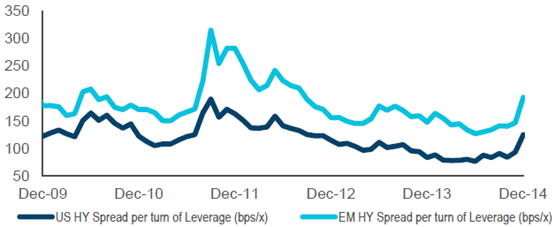
FIGURE 2: EM Corporate Fundamentals – Investment GradeAs of December 2014
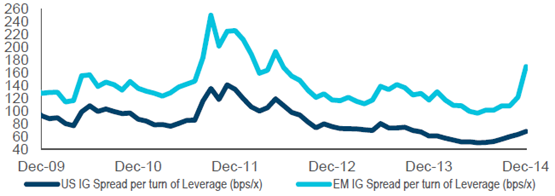
Source: Bank of America/Merrill Lynch (as of December 2014)
COMPELLING VALUATIONS
In our view, the EM corporate market offers significant return potential for investors willing to assume the risks inherent in a less-established market. The asset class offers an average yield of 6%, with an average duration of about five years.3 Not only are absolute valuations attractive in a low yield environment, but relative value is also compelling versus both investment grade and high yield corporate debt. The average dollar denominated emerging market BBB rated credit offers more than double the spread of a similar US-domiciled counterpart.4 Investors can effectively double the spread with less leverage than in developed markets—an opportunity not seen since the global financial crisis. Not only this, EM corporates offer better spread compensation relative to balance sheet gearing. The gradual reduction of idiosyncratic headwinds as we move into 2015 is likely to offer an attractive entry point for investors over the coming months.
There are signs that global investors, who are underweight emerging market debt, are beginning to return as headwinds have begun to wane, according to recent fund flows data.5 Political risk has diminished over the past year, with most of the elections in 2014 resulting in new governments that seem willing to adopt more market‐oriented reforms. Local currencies have also reached more competitive levels, which should help stimulate economic growth. And valuations are attractive relative to developed market debt. These trends, along with the powerful force of expanding middle classes with increasing purchasing power, are likely to support the continued growth of EM corporate debt in the years ahead.
REFINANCING DRIVES GROWTH
With economic activity likely to pick up, companies will need to raise capital to finance expansions. Indeed, the growth of the EM corporate debt market has been driven mainly by companies seeking long-term financing rather than an increase in leverage. Emerging market banks tend to offer short-duration loans due to a history of high inflation, while the external bond market offers an average tenor of seven years. Companies are therefore increasingly issuing corporate bonds to improve their capital structures and finance long-term capital expenditures. New issuers have contributed a large amount of the supply to the market, underscoring the fact that companies are refinancing existing debt into longer-term debt.
FIGURE 3: EM Corporate Offshore Bond Market as % of Onshore Private Credit
As of December 2014
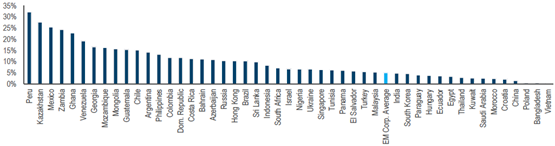
Source: T. Rowe Price, Fitch, J.P. Morgan as of December 2014Private credit includes onshore private sector credit and excludes local bond markets and cross border bank financing
MAJORITY BBB RATED
The largest component of the emerging market opportunity set is made up of BBB-rated companies, about 41% of the total market6, while the more speculative CCC-rated bracket is less than 3%. That compares with about 20% CCC exposure in the more mature US corporate debt market. The balance sheets of emerging market corporates also compare favorably with those of their developed market peers. It is quite reasonable, in our view, that the asset class has now eclipsed high yield debt in size. Bear in mind that emerging market corporates are the blue chip companies for the rest of the world outside of developed countries, whereas high yield companies in developed markets occupy the lower end of the quality spectrum.
Although emerging markets credit ratings have been on a long-term uptrend, we are likely to see a much more uneven world in the future, with less correlation and more divergent results. Recently, downgrade pressure has arisen, although largely related to sovereign stress, and a wide variety of ratings activity has persisted, and is expected to continue. Investors will increasingly need to differentiate between companies, sectors, and countries as credit trends diverge.
FOCUS ON CORPORATE GOVERNANCE
The potentially high rewards from investing in EM corporate debt entail particular risks associated with emerging markets. These include challenging recovery rates in countries with fragile judicial systems and bankruptcy processes, generally low levels of liquidity, or poor corporate governance.
The bar for corporate governance has to be high in these circumstances. We devote much time, attention, and care to this factor, and place great emphasis on gaining insights into companies well ahead of their bond issues. Our investment team evaluates opportunities in public and private companies across the capital structure. This process also involves extensive consultation with our equity colleagues, as many new debt issuers have longer track records in equity markets, and input from a large team of experienced analysts based across the globe. We devote considerable resources to emerging markets, covering 68 countries that are evaluated by 48 investment professionals who represent 17 nationalities and 22 languages.7 As an aside, in our experience, corporate management teams are forced to be more honest in their capital allocation plans when speaking to both shareholders and creditors in the same room.
CAPITAL APPRECIATION OPPORTUNITIES
The dramatic drop in commodity prices has affected emerging market companies in a variety of ways, creating a divergence between winners and losers, which reinforces the need for active management. The silver lining is that we are beginning to see opportunities now not just for current yield but also for capital appreciation, particularly in sectors such as energy and mining, where the debt of some companies has sold off more than the fundamentals would warrant. Many issuers should in fact benefit from lower input costs amid commodity-price weakness, helping them to protect margins.
ENCOURAGING FUNDAMENTALS
We believe emerging markets debt possesses many attractive features, including solid credit quality, diversification potential, and attractive yields when compared with those of developed markets. We are encouraged by the sector’s long-term positive fundamentals, which should support inflows of funds as global investors address underinvestment to emerging markets. Most emerging markets have stronger financial positions, larger currency reserves, and more flexible foreign exchange policies than they did a decade ago. All this, and the expected pickup in economic growth after a long period of underperformance, supported by reforms and growing middle classes with increasing purchasing power, stand to benefit private sector activity in these countries.
2015-GL-1549
重要情報
当資料は、ティー・ロウ・プライス・アソシエイツ・インクおよびその関係会社が情報提供等の目的で作成したものを、ティー・ロウ・プライス・ジャパン株式会社が翻訳したものであり、特定の運用商品を勧誘するものではありません。また、金融商品取引法に基づく開示書類ではありません。当資料における見解等は資料作成時点のものであり、将来事前の連絡なしに変更されることがあります。当資料はティー・ロウ・プライスの書面による同意のない限り他に転載することはできません。
資料内に記載されている個別銘柄につき、売買を推奨するものでも、将来の価格の上昇または下落を示唆するものでもありません。また、当社ファンド等における保有・非保有および将来の組入れまたは売却を示唆・保証するものでもありません。投資一任契約は、値動きのある有価証券等(外貨建て資産には為替変動リスクもあります)を投資対象としているため、お客様の資産が当初の投資元本を割り込み損失が生じることがあります。
当社の運用戦略では時価資産残高に対し、一定の金額までを区切りとして最高1.265%(消費税10%込み)の逓減的報酬料率を適用いたします。また、運用報酬の他に、組入有価証券の売買委託手数料等の費用も発生しますが、運用内容等によって変動しますので、事前に上限額または合計額を表示できません。詳しくは契約締結前交付書面をご覧ください。
「T. ROWE PRICE, INVEST WITH CONFIDENCE」および大角羊のデザインは、ティー・ロウ・プライス・グループ、インクの商標または登録商標です。
ティー・ロウ・プライス・ジャパン株式会社
金融商品取引業者関東財務局長(金商)第3043号
加入協会:一般社団法人日本投資顧問業協会/一般社団法人投資信託協会
