

U.S. Equities: Steady as She Goes!
EXECUTIVE SUMMARY
U.S. stock markets have continued to rise, with the S&P 500 and Dow Jones recently setting new all-time highs.
U.S. equities have continued to climb higher, as an improved economic environment and robust corporate earnings, have been reflected in higher share prices. While the current bull market is entering its 7th year, the reality however is that the markets have been climbing a “wall of worry” while navigating various global macro and geopolitical events, which has muted investor confidence. We have continually witnessed bouts of risk aversion with investors’ seeking to hide out in bonds and high-yielding investments rather than equities.
STRONG COMPANY FUNDAMENTALS HAVE BEEN REWARDED
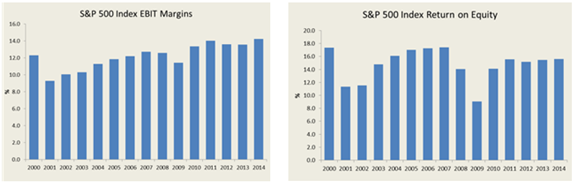
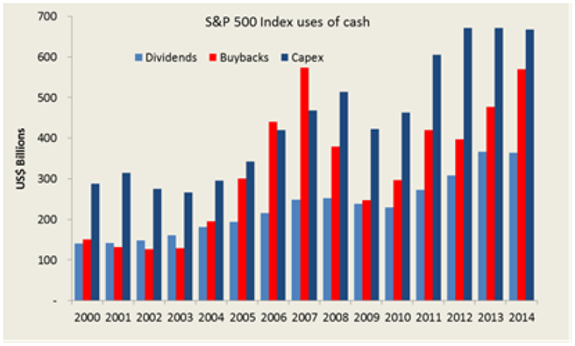
Much of the market move reflects the sharp recovery in corporate profits from the recessionary lows. Corporates have managed to squeeze business models to deliver record profitability, in spite of what has been somewhat of an anemic recovery in economic growth.
EQUITY VALUATIONS: CHEAP OR EXPENSIVE?
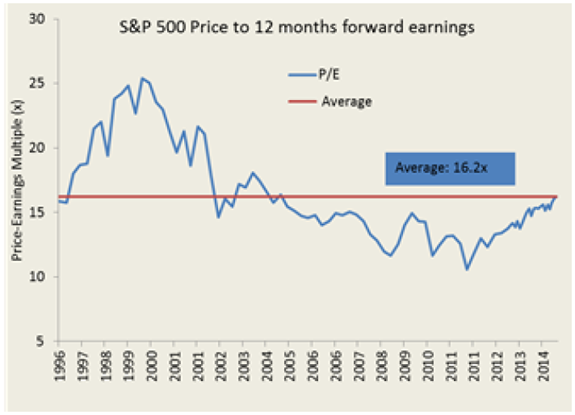
We believe valuations are best described as ‘reasonable’ for where we are in the economic cycle, although we would stress that this view is premised on the continued delivery of earnings growth. Figure 3 reflects valuations on a forward-looking P/E basis versus history. With U.S. equities trading around 17-times forward earnings, the days of extreme low valuations are firmly behind us. However, compared to an average of 16.2-times and highs of over 25-times, the market is not in extreme over-valuation territory. Equities also remain attractively valued when compared to U.S. treasuries. In addition, there have also been few signs of extreme capital flows that usually signify a bubble.
The risk of a crisis disrupting equity markets is ever present however, with Greece’s unsustainable debt burden and Russia’s economic and political stresses creating genuine causes for concern. These are risks, together with the evolution of corporate profits, which should be continued to be monitored closely.
FIGURE 3: Equity Valuations: Cheap Or Expensive?
Sources: Factset, T. Rowe Price
U.S. ECONOMIC RECOVERY REMAINS ON TRACK
An important factor underlying our outlook is that the U.S. economy continues to improve. Average job growth in 2014 was the strongest since 1999, and this strong employment growth has led to the first signs of a pick-up in wage inflation. Meanwhile, lower consumer debt is supportive of higher consumption. Stronger growth has also been reflected in the improved budget deficit, and government spending is now increasing. This has deepened our conviction in the self-sustaining nature of the recovery. However, as capacity utilization and unemployment approach 2007 levels, the focus of the debate has now shifted to when we will see a hike in interest rates.
Historically, given the unemployment picture coupled with the bottoming of wage inflation, the U.S. Federal Reserve would have already started increasing interest rates. However, given the severity of the global financial crisis and concerns over the delicate nature of the economic recovery, it was necessary for policymakers to take a different approach. As the U.S. recovery continues, however, we are moving ever closer to the first rate hike. Minutes though from the recent Federal Reserve meeting reflect a division over exactly when to begin raising interest rates. Many officials have said they fear a “premature” rise in rates could dampen the apparently solid economic growth and labor market recovery. However, the trend of U.S. economic improvement should not be overlooked.
Either way, when the Federal Reserve does raise rates, it is most likely to be at a more measured pace in order to assess the potential reverberations through financial markets and impact on growth.
RISING RATE ENVIRONMENT GOOD FOR STOCKS
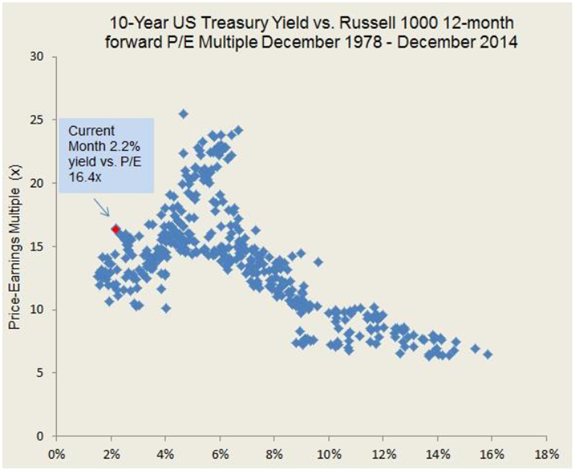
It is important to remember, however, that when interest rates do eventually normalize this will not necessarily be bad for stock prices. Higher rates often coincide with improved economic conditions, which typically bode well for equities. History shows that market valuations usually rise along with nominal interest rates. Over recent decades, 6% to 7% nominal 10-year Treasury yields have appeared to be the ceiling for P/E multiples, and while that ceiling may prove to be lower in the current environment, upside potential remains (Figure 4).
FIGURE 4: Stocks Have Typically Performed Well In Previous Rising Rate Environments
Sources: Factset, T. Rowe Price
WHAT ABOUT THE STRENGTH OF THE GREENBACK?
The U.S. dollar has risen strongly on a trade-weighted basis for much of the last 18 months. Lower commodity prices, emerging market stress, and divergent monetary policies help to explain the dollar's ascent. What is important for us as equity investors is that dollar strength does have the potential to become problematic for some S&P 500 companies, where a large part of their profits are derived from overseas. The impact will likely be seen throughout the year, and may cause some volatility in the share prices of impacted companies.
IMPORTANT TO DO YOUR HOMEWORK IN THESE MARKETS
As we witnessed in 2014, sentiment is likely to ebb and flow over the coming months. Therefore, for patient long-term investors, 2015 is again likely to present opportunities to invest in fundamentally attractive companies on bouts of stock-specific volatility. Fundamental, in-depth bottom-up research will be key to identifying those attractive long-term investment opportunities.
WHERE DO WE GO FROM HERE?
The market continues to face some challenges. Questions remain over global growth, and whether the U.S. can sustain its growth rate if conditions worsen overseas. The Federal Reserve is on course to begin monetary tightening at some point this year, and while we view this as indicative of strengthening economic growth, this change in monetary policy may impact investor confidence.
On the positive side, the corporate sector remains in robust shape and the U.S. is home to many industry leading innovative companies. Equity prices are though more likely to move in line with earnings growth rather than through any meaningful expansion in valuations. Importantly, conditions are still supportive for further gains, although the upside is likely more limited due to fair valuations and already high profit margins.
2015-GL-1595
重要情報
当資料は、ティー・ロウ・プライス・アソシエイツ・インクおよびその関係会社が情報提供等の目的で作成したものを、ティー・ロウ・プライス・ジャパン株式会社が翻訳したものであり、特定の運用商品を勧誘するものではありません。また、金融商品取引法に基づく開示書類ではありません。当資料における見解等は資料作成時点のものであり、将来事前の連絡なしに変更されることがあります。当資料はティー・ロウ・プライスの書面による同意のない限り他に転載することはできません。
資料内に記載されている個別銘柄につき、売買を推奨するものでも、将来の価格の上昇または下落を示唆するものでもありません。また、当社ファンド等における保有・非保有および将来の組入れまたは売却を示唆・保証するものでもありません。投資一任契約は、値動きのある有価証券等(外貨建て資産には為替変動リスクもあります)を投資対象としているため、お客様の資産が当初の投資元本を割り込み損失が生じることがあります。
当社の運用戦略では時価資産残高に対し、一定の金額までを区切りとして最高1.265%(消費税10%込み)の逓減的報酬料率を適用いたします。また、運用報酬の他に、組入有価証券の売買委託手数料等の費用も発生しますが、運用内容等によって変動しますので、事前に上限額または合計額を表示できません。詳しくは契約締結前交付書面をご覧ください。
「T. ROWE PRICE, INVEST WITH CONFIDENCE」および大角羊のデザインは、ティー・ロウ・プライス・グループ、インクの商標または登録商標です。
ティー・ロウ・プライス・ジャパン株式会社
金融商品取引業者関東財務局長(金商)第3043号
加入協会:一般社団法人日本投資顧問業協会/一般社団法人投資信託協会
