

Separating the Wheat From the Chaff in Emerging Markets
EXECUTIVE SUMMARY
Unlike developed markets, emerging markets are frequently viewed as a homogeneous asset class despite their significant economic and political differences. As a result, emerging markets have often led or lagged developed markets by substantial gaps, particularly in recent years as market sentiment has turned decidedly against the emerging world. To realize the significant opportunities these markets offer going forward, investors will need to be more discriminating and seek out those regions, countries, and, most importantly, the companies that offer the most potential for growth.
Investors participating in global equity markets would not likely lump such diverse economies as the United States, Australia, Japan, Germany, Italy, or other European countries into one basket, taking an all-or-nothing approach. Yet many investors have often viewed emerging markets as a homogeneous asset class despite their substantial economic, political, and geographic differences.
That view has led to periods of ebullience and despair for emerging markets with periods of outperformance and underperformance relative to developed markets.
For example, in the six years preceding the global financial crisis (2002 through 2007), the MSCI Emerging Markets Index had a 29% annualized return (in U.S. dollars) compared with almost 20% for global developed markets. Remarkably, only two emerging markets had annualized returns below 20%, and 17 of the 25 markets in the index had annualized gains exceeding 30%.
In contrast, in the subsequent six-year period (2008 through 2013), emerging markets had an annualized return of -0.9% compared with 3% for developed markets. Only half of the emerging markets managed even modest positive returns.
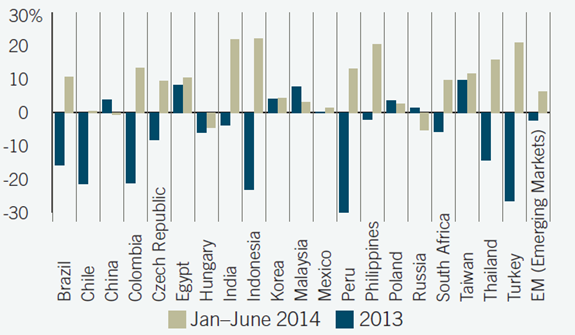
This shunning of emerging markets hit its peak last year when they trailed developed markets by a stunning 30-percentage-point gap, on average. Most emerging markets had negative returns, and none (with the exception of Greece) outperformed the average gain in the developed world.
That tide may be turning this year, however, as investors are showing more selectivity after last year’s broad, indiscriminate sell-off. India and Indonesia—spurred by hopes that new political leadership will bring renewed economic growth—and the Philippines gained more than 20% in the first half. Meanwhile, several other markets, including Russia, China, Chile, and Mexico, continued to struggle.
Figure 1: Emerging Market Performance: More Dispersion This Year After Broad Sell-Off
Total return in 2013 and Jan–June 2014
Sources: Morgan Stanley and Rimes Technology
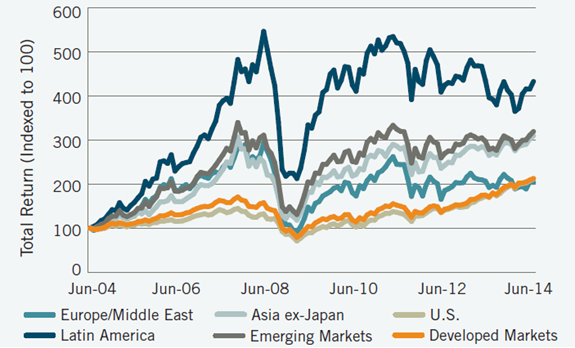
Investors’ disenchantment with emerging markets in recent years has been extreme. These markets have provided superior returns over the long term. However, from 2010 through June of this year, they had an average annual gain of less than 1% compared with about 11% for the developed world and 16% for the S&P 500 Index. Investors who turn away from emerging markets based on their recent performance are overlooking opportunities that should provide superior returns in the years ahead.
The fundamentals of the emerging world are dispersing near and long term, and investors need to examine these markets individually rather than as a correlated asset class. Opportunities to generate superior returns exist across all regions, but selectivity at the country, industry, and company level is becoming more important than ever.
EMERGING MARKET MISCONCEPTIONS
The reasons investors have tended to unceremoniously paint all emerging markets with a broad brush are varied. Perhaps they have underestimated their importance to the global economy. Emerging economies, although slowing recently, account for about half of global growth and about 40% of current global domestic product (GDP). Some individual emerging markets have economies larger than those in the developed world. Collectively, they are a bigger part of the global economy than the United States.
Figure 2: Emerging Markets Outperform Over Past Decade
Total return in U.S. dollars indexed to 100 as of June 30, 2004
Sources: Morgan Stanley and Rimes Technology
Performance is based on various MSCI indexes.
Perhaps investors view emerging markets as a niche asset class because they represent a small part (about 10%) of global market capitalization. But that is because the global index is a free float-weighted index. Without the free float adjustment, they represent about a quarter of the global market cap.
Another factor may be that in the prior decade, emerging markets were mainly driven by China’s double-digit growth pace and massive investment, leading a commodity supercycle. While that benefited some markets, such as Brazil, South Africa, and Russia, those powerful tailwinds have petered out. Other markets had different fundamental drivers that were overlooked. Now those drivers are becoming more important.
Finally, investors’ perception of emerging markets generally was shaped by the vaunted BRICs (Brazil, Russia, India, and China). For many, those markets became the bellwethers for emerging market performance, and there have been many times when one or all were struggling.
With the important exception of India, these countries are not the vanguard of the emerging market class. Russia suffers from an aging population, an aging infrastructure, and an economy hugely levered to energy prices. Brazil is also somewhat dependent on materials and is hampered by social and political issues. Its economy may grow less than that of the United States this year.
China, the world’s second-largest economy, is in a class by itself. Although its economy has slowed substantially, it is still growing much faster than the developed world. But it faces significant challenges in its financial system and in transitioning from an investment-driven to a consumer-driven economy.
There are certainly interesting investment opportunities in any of these markets, and we are taking advantage of them, but on the whole, the “BRICs” are not what emerging market investing is really about today.
NOT ALL CREATED EQUAL
Emerging nations are generally much stronger financially than they were during the financial crises in the 1980s and 1990s, yet wide economic disparities exist among them.
Over the past decade, markets in Asia and Latin America have significantly reduced their foreign debt (as a percentage of gross national income) while substantially increasing foreign exchange reserves, providing more policy options than available in the 1990s. But some have made more progress than others.
And recent rises in current account deficits, most notably for India and Indonesia, at a time when capital availability is tightening, pose a challenge for certain segments of the emerging world that became a focal point in 2013. The good news is that many countries took action last year and implemented policies to improve current account deficits, curb inflation, and support their currencies. The markets have rewarded such policies with stronger equity prices in 2014.
Figure 3: Snapshot of Emerging Market Economies
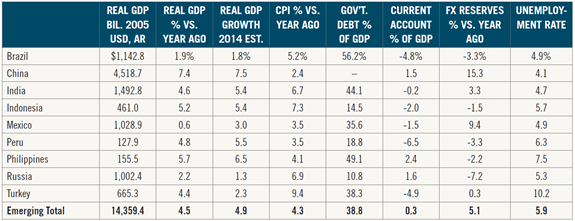
Source: International Monetary Fund, based on the most recent data available as of June 30, 2014
While Latin America dominated performance over the past decade, bolstered by rising energy and other commodity prices, it has significantly trailed emerging Asia in recent years. With the commodity tailwind abating and the rise of urbanization and consumerism becoming more significant, the emerging consumer is likely to drive returns over the next decade. The growth of the middle class can also be a political force for market-oriented reforms.
Demographics are important because in the developed world, several countries—such as Japan, Germany, and Italy—are coping with aging populations that pose a headwind to growth. Demographics are not uniformly attractive in the emerging world, but several countries in Southeast Asia, the Middle East, and Africa have relatively young, growing populations that are generating and spending wealth.
This is providing new opportunities for consumer-driven companies and financials, in particular, which benefit from superior economic growth rates and low penetration levels in emerging markets relative to developed markets.
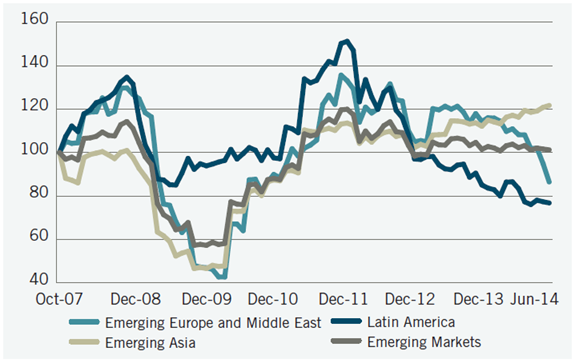
What is most important for investors is that the market’s tendency to lump emerging markets together creates a great opportunity. While corporate earnings growth in aggregate in the emerging world has slowed since the peak in 2011, what seems to be overlooked is that it was largely driven by Latin America, the most materials-intensive part of the emerging world. At the same time, earnings in emerging Asia reached an all-time high last year.
Figure 4: Asia Leads Emerging Market Earnings Recovery
Indexed to 100 as of October 2007
Sources: FactSet and MSCI
In fact, emerging market earnings overall have fully recovered from levels preceding the global financial crisis, along with those in the U.S., while earnings in Europe and Japan remain well below pre-crisis levels.
Valuations have generally moved up from the trough reached last year, but there are still parts of the emerging world where negative sentiment has driven valuations to levels that are out of sync with superior fundamentals and return potential. Some parts of the emerging world are more expensive than others, reflecting the breadth of opportunity. But with valuations generally no longer at distressed levels, other drivers of return become more important.
Quality of management is always an important consideration, and it varies widely in the emerging world. India, for example, is loaded with western educated, business-savvy, owner-entrepreneurs who tend to have big stakes in their businesses, but corruption at the government level remains an issue. In Russia, Brazil, and China, it is more mixed, with a combination of state influence and policies that are not always shareholder-friendly.
In China, many managers actually consider owning stock a conflict of interest. The banks and energy companies in China are quasi-vehicles of the state, and managers are more interested in just moving up the political ladder. Management in Russia is the Wild West where few businesses are run for the interest of shareholders.
WHERE ARE THE OPPORTUNITIES? SELECTIVITY IS KEY
Given the diverging fundamentals across the emerging world, we have focused on quality companies with the strongest and most durable earnings power operating in economies that offer higher potential growth with improving GDP per capita, favorable demographic trends, relatively controlled inflation, and prospects for political reform.
We are particularly encouraged by opportunities in such markets as India, Indonesia, the Philippines, Turkey, Peru, Mexico, and in such emerging frontier markets as Nigeria, Vietnam, and Myanmar.
For all the gnashing of teeth about India last year, it has grown at a 5% rate the past two years and has a young population, low GDP per capita, tremendous growth in the labor force ahead of it, rising urbanization and middle class, dynamic new growth sectors, and a significantly underbuilt infrastructure that poses both a challenge and opportunity.
The recent election of Narendra Modi offers the potential for a more growth- and business-oriented government. India has its economic and political challenges, but it has the potential to replicate what China achieved over the last 20 years.
The stars are also aligned in the Philippines, which has a well-run economy with a balance of payments surplus and moderate inflation. Indonesia has some materials and energy exposure, but not nearly on the magnitude of Brazil and South Africa. With demographics, infrastructure development, and low GDP per capita in its favor, that economy should grow at a 5% to 6% rate and potentially much greater. The country is moving in the right direction, and new political leadership could be a catalyst.
Turkey was labeled as one of the Fragile Five in 2013, but the policy steps the country implemented last year have been handsomely rewarded this year. The country has a robust long-term economic outlook with very favorable demographics, and while there is near-term political uncertainty, once that’s resolved valuations should rerate higher. Turkey’s flexible economy, strong government balance sheet, growing population, and labor participation suggest that growth should remain high.
Among frontier markets, Nigeria has its challenges, but it’s the largest and fastest-growing economy in Africa with more than 170 million people. Nigeria has cleaned up its banking system, and the non-oil parts of its economy (agriculture, services, and industrials) have had robust growth. Yes, there is political risk in Nigeria, but it’s a small part of a global portfolio, and if the political leadership improves, there is so much to like there.
We are also opportunistic in taking advantage of compelling individual valuation situations in otherwise less attractive economies, such as Brazil and China. In China, for example, we have longstanding investments in well-managed consumer Internet companies and recently added a homebuilder, an insurance company, and a bank depressed by concerns of a property bubble and leverage in the financial system.
In Brazil, economic growth is sluggish compared with other emerging markets, but, like in the U.S., the people have a predilection to shop, so shopping malls are a fertile area. One of our holdings has nearly twice the growth of shopping mall companies in the developed world with considerably lower valuation. And if inflation spikes in Brazil as some fear, shopping mall operators will actually benefit from that.
PICKING YOUR SPOTS: MORE DISPERSION AHEAD
As we have seen this year in Ukraine and elsewhere, lightning can strike anywhere. As a result, we have pursued a diversified but very selective strategy in emerging markets as we believe performance results will vary across countries and sectors based on diverging fundamentals.
Over time, we are confident that we can generate value in this part of the world due to the breadth and quality of opportunities that are available and our belief that this will ultimately matter more than the ebbs and flows of market sentiment.
As history shows, these markets have very different outcomes over longer periods of time, yet the perception persists that they are highly correlated. To reap the benefits emerging markets offer, investors will need to separate the wheat from the chaff.
2014-GL-518
重要情報
当資料は、ティー・ロウ・プライス・アソシエイツ・インクおよびその関係会社が情報提供等の目的で作成したものを、ティー・ロウ・プライス・ジャパン株式会社が翻訳したものであり、特定の運用商品を勧誘するものではありません。また、金融商品取引法に基づく開示書類ではありません。当資料における見解等は資料作成時点のものであり、将来事前の連絡なしに変更されることがあります。当資料はティー・ロウ・プライスの書面による同意のない限り他に転載することはできません。
資料内に記載されている個別銘柄につき、売買を推奨するものでも、将来の価格の上昇または下落を示唆するものでもありません。また、当社ファンド等における保有・非保有および将来の組入れまたは売却を示唆・保証するものでもありません。投資一任契約は、値動きのある有価証券等(外貨建て資産には為替変動リスクもあります)を投資対象としているため、お客様の資産が当初の投資元本を割り込み損失が生じることがあります。
当社の運用戦略では時価資産残高に対し、一定の金額までを区切りとして最高1.265%(消費税10%込み)の逓減的報酬料率を適用いたします。また、運用報酬の他に、組入有価証券の売買委託手数料等の費用も発生しますが、運用内容等によって変動しますので、事前に上限額または合計額を表示できません。詳しくは契約締結前交付書面をご覧ください。
「T. ROWE PRICE, INVEST WITH CONFIDENCE」および大角羊のデザインは、ティー・ロウ・プライス・グループ、インクの商標または登録商標です。
ティー・ロウ・プライス・ジャパン株式会社
金融商品取引業者関東財務局長(金商)第3043号
加入協会:一般社団法人日本投資顧問業協会/一般社団法人投資信託協会
