
Market cracks? Calling on derivative income for support
May 2026, Multi-Asset
- Key Insights
-
- Amid elevated valuations and heightened market concentration, derivative income strategies may help clients stay invested with higher cash flows and lower rate sensitivity than fixed income.
- Value-oriented derivative income strategies write covered calls to generate option premiums, seeking attractive yields and reduced downside capture.
- A modest allocation may help mitigate portfolio volatility and diversify income sources, complementing equities or U.S. high yield fixed income.
There are any number of bricks in the “wall of worry” for investors amid headlines about U.S. equity valuations, U.S. market concentration, and increased geopolitical and policy uncertainty. Against this challenging backdrop, our recent Portfolio Construction Pulse shows increased advisor use of less volatile equity alternatives to generate higher income, lower overall equity risk, and complement fixed income allocations.
Derivative income strategies can help investors stay invested through market uncertainty, offering higher income potential than the S&P 500 Index with less interest rate and credit risks than fixed income. Typically, these strategies buy equities and write covered calls on the positions to generate option premiums that can be distributed as income. This approach offers the potential for increased cash flow and reduced downside capture, albeit with some limits to upside participation.
While derivative income strategies come in a variety of forms, we encourage advisors to take a closer look at value‑oriented derivative income, where the underlying equities tend to include more defensive sectors of the market.
Navigating the menu of derivative equity strategies
Let’s take a step back and look at option strategies from a higher level. Morningstar typically divides option‑oriented strategies into three categories: derivative income, hedged equity, and defined outcome. Figure 1 outlines these three categories and highlights some of the key differences.
Strategies that generate income can vary widely and can include single‑stock covered call writing, put‑write, sector‑oriented, and style‑biased strategies. Derivative income strategies seek to generate income by writing covered calls and typically deliver yields in the 7% to 9% range, which are higher than most dividend‑oriented strategies. If you believe the S&P 500’s volatility will be elevated, derivative income strategies could be an appropriate option.
Option strategies come in many forms, each with unique characteristics
(Fig. 1) A menu of options strategies
| Category | Investment Strategy | More Favorable Environment | Less Favorable Environment | Investor Profile |
|---|---|---|---|---|
| Derivative Income | Covered call option writing to enhance income. |
Tends to outperform bonds when equity volatility is falling from peaks or when credit spreads are widening. Competitive with equities during flat or slightly down markets.
|
Less upside participation in strong equity markets or early recovery from downturns. Downside risk could exceed core fixed income if underlying equities decline.
|
Investors seeking higher income and who are concerned about equity valuations, volatility, interest rate risk, or credit risk.
|
| Hedged Equity | Less volatile equities, put options, and equity index futures. | Risk mitigation if expecting sharper drawdown while still maintaining some growth potential. | Less upside participation in strong equity markets. Offers only partial downside protection and can be more complex than covered calls. | Investors seeking lower risk during equity market downturns, or those sensitive to drawdown risk who want to reintroduce equity exposure. |
| Defined Outcome | Options provide predetermined downside buffer (e.g., 10%–15%) and upside participation within a predefined “outcome period”. |
Risk mitigation if expecting sharper equity drawdown over defined time horizon.
|
Less upside participation in rising equity markets. Upside potential is typically capped and can be more complex due to expirations and rollovers.
|
Investors seeking lower equity risk, nearing retirement, and who are willing to accept a limit on upside potential.
|
Source: T. Rowe Price.
As shown in Figure 2, option-oriented strategies have the potential to keep going in years when the broader equity market experiences a downturn. Derivative income strategies delivered less downside than the S&P 500 Index in each of the last five years ended December 31, 2025.
Focusing on derivative income strategies
Derivative income strategies are appearing more often in portfolios across the risk spectrum as a potential means to lower U.S. equity volatility or to complement fixed income plus‑sector exposure.
Derivative income strategies offered less downside risk than large-cap equities over the past five years
(Fig. 2) Option strategies versus major stock and bond indexes over past 5 years
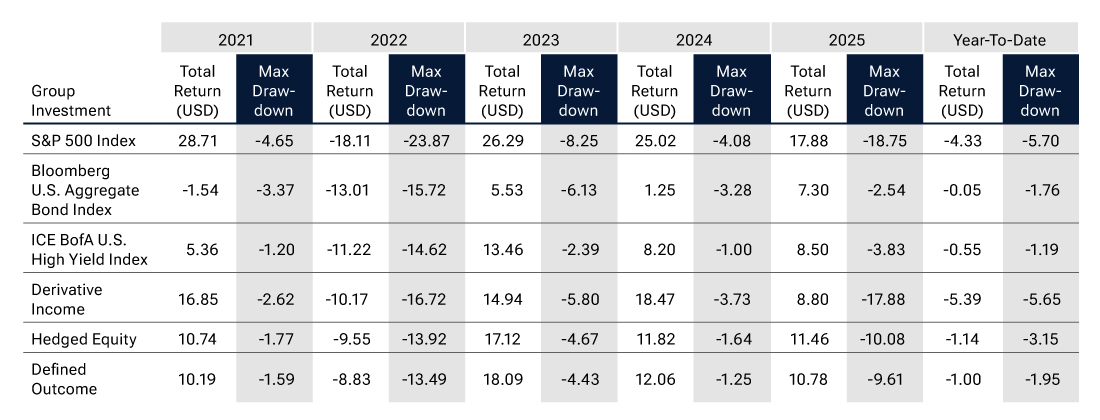
Source: Morningstar as of March 31, 2026.
Past performance is not a guarantee or a reliable indicator of future results. Index and Morningstar category performance are for illustrative purposes only and are not indicative of any specific investment. Investors cannot invest directly in an index or category.
Derivative income strategies seek to provide a higher level of income and may cushion against an unsettling market pullback, even though they may still experience a loss. They often complement an existing equity allocation and can even complement fixed income exposure, given their typically lower exposure to interest rate risk. Against the backdrop of U.S. interest rate cuts from the Federal Reserve, deregulation, and fiscal stimulus, the environment for U.S. equities is supportive, but valuations offer little room for missteps.
Funding derivative income from equities is one of several areas we have seen the category resonate as investors seek to mitigate equity market risk. However, we also see advisors maintain higher credit quality in fixed income, using derivative income equities as a complement to fixed income “plus” exposure.
Derivative income strategies can pursue multiple goals across various risk models
Even at a modest 5% allocation, derivative income strategies can have a meaningful impact on lowering portfolio volatility across various risk models, including conservative, moderate, and moderately aggressive portfolios.
5% derivative income allocation
| Portfolio Construction | Objective | Role |
|---|---|---|
| Conservative Portfolio (<50% equities) |
Seeks capital preservation |
Lower volatility, higher income complements dividend yield and high yield |
| Moderate Portfolio (50% to 70% equities) |
Seeks growth and income | Lower equity volatility complements high yield, defined outcome, and hedged equity |
| Moderately Aggressive Portfolio (>70% equities) | Seeks to mitigate equity risk |
Lower equity volatility complements higher growth allocations |
Funding and incorporating derivative income strategies
Let’s look at some examples showing how to integrate a derivative income strategy into model portfolios. We’re using an average allocation of 5% to derivative income, based on proprietary data from advisors in our latest Portfolio Construction Pulse.
Derivative income allocation can be funded from both equity and fixed income positions
(Fig.3) Derivative income implementation, 5% position size over the past 5 years as of March 31, 2026
| Up Capture Ratio | Down Capture Ratio | Return (Annualized) |
Standard Deviation (Annualized) | Semi-Standard Deviation (Annualized) | Sharpe Ratio |
|
|---|---|---|---|---|---|---|
| 60/40 Portfolio1 | 100 |
100 | 7.4% | 11.0% | 12.9% | 0.39 |
| 5% Derivative Income, equity fund2 | 93 | 91 | 7.3 | 10.2 | 11.7 | 0.40 |
| 5% Derivative Income, fixed income funded3 | 98 |
94 | 7.9 | 10.7 | 12.2 | 0.43 |
Past performance is not a guarantee or a reliable indicator of future results.
Source: Morningstar.
1 60% S&P 500 Index, 40% Bloomberg U.S. Aggregate Bond Index.
2 55% S&P 500 Index, 40% Bloomberg U.S. Aggregate Bond Index, 5% Derivative Income (iPath CBOE S&P 500 BuyWrite exchange-traded note).
3 60% S&P 500 Index, 35% Bloomberg U.S. Aggregate Bond Index, 5% Derivative Income (iPath CBOE S&P 500 BuyWrite exchange-traded note).
To help illustrate the point, let’s look at some real-world case studies1 pulled from our team’s daily interactions with financial advisors.
Advisor Case Study: Conservative Portfolios
- Concern: Advisor is sensitive to upward pressure on interest rates and widening spreads in U.S. high yield amid growing U.S. credit concerns.
- Goal: Higher income without increased credit risk.
- Solution: Fund a derivative income allocation from U.S. high yield as an income substitute.
Advisor Case Study: Moderate Portfolios
- Concern: Advisor’s single biggest contributor of equity volatility arose from an S&P 500 Index position characterized by high market concentration, strong momentum, and perceived lofty valuations.
- Goal: Reduce market concentration from growth‑oriented names.
- Solution: A value‑oriented derivative income strategy to moderate S&P 500 exposure.
Advisor Case Study: Moderately Aggressive Portfolios
- Concern: Advisor has exposure to a strategy that tracks the tech-heavy Nasdaq 100 Index and wants to maintain growth‑oriented tech exposure but is uneasy with negative tech sector headlines.
- Goal: Moderate tech volatility with value‑oriented income.
- Solution: A lower‑beta derivative income strategy to reduce concentration among indexes and help moderate growth exposure.
Portfolio Construction Solutions from T. Rowe Price: We’re here to help.
Derivative income strategies that write call options on underlying equities can offer higher income than index options, given greater single-stock volatility than a diversified index. Writing individual calls against lower-beta securities can help with capital preservation in the event of a significant market drawdown. Our Portfolio Construction Solutions team can evaluate your portfolio today to see if a value-oriented derivative income strategy deserves a closer look.
 Michael Kubik, CFA
Director of Investment Solutions
Michael Kubik, CFA
Director of Investment Solutions
 Andrew Wick
Lead Analyst
Andrew Wick
Lead Analyst

- Portfolio Construction Pulse
Pivot Point: Advisors broaden their investment playbooks
- YOUR PROCESS. OUR EXPERTISE
Portfolio Construction Solutions

Contact us
1 Advisor case studies are fictional illustrations based on the personas we are seeing in market.
Additional Disclosure
Bloomberg Index Services Limited. BLOOMBERG® is a trademark and service mark of Bloomberg Finance L.P. and its affiliates (collectively “Bloomberg”). BARCLAYS® is a trademark and service mark of Barclays Bank Plc (collectively with its affiliates, “Barclays”), used under license. Bloomberg or Bloomberg’s licensors, including Barclays, own all proprietary rights in the Bloomberg Barclays Indices. Neither Bloomberg nor Barclays approves or endorses this material or guarantees the accuracy or completeness of any information herein, or makes any warranty, express or implied, as to the results to be obtained therefrom and, to the maximum extent allowed by law, neither shall have any liability or responsibility for injury or damages arising in connection therewith.
© 2026 Morningstar, Inc. All rights reserved. The information contained herein: (1) is proprietary to Morningstar and/or its content providers; (2) may not be copied or distributed; and (3) is not warranted to be accurate, complete, or timely. Neither Morningstar nor its content providers are responsible for any damages or losses arising from any use of this information. Past performance is no guarantee of future results.
The S&P 500 Index is a product of S&P Dow Jones Indices LLC, a division of S&P Global, or its affiliates (“SPDJI”) and has been licensed for use by T. Rowe Price. Standard & Poor’s® and S&P® are registered trademarks of Standard & Poor’s Financial Services LLC, a division of S&P Global (“S&P”); Dow Jones® is a registered trademark of Dow Jones Trademark Holdings LLC (“Dow Jones”). T. Rowe Price’s products are not sponsored, endorsed, sold or promoted by SPDJI, Dow Jones, S&P, their respective affiliates and none of such parties make any representation regarding the advisability of investing in such product(s) nor do they have any liability for any errors, omissions, or interruptions of the S&P 500 Index.
CFA® and Chartered Financial Analyst® are registered trademarks owned by CFA Institute.
CFP Board owns the certification marks CFP®, CERTIFIED FINANCIAL PLANNER®, and CFP® (with plaque design) in the U.S.
For U.S. investors, visit troweprice.com/glossary for definitions of financial terms.
Important Information
This material is provided for informational purposes only and is not intended to be investment advice or a recommendation to take any particular investment action.
The views contained herein are those of the authors as of March 2026 and are subject to change without notice; these views may differ from those of other T. Rowe Price associates.
This information is not intended to reflect a current or past recommendation concerning investments, investment strategies, or account types, advice of any kind, or a solicitation of an offer to buy or sell any securities or investment services. The opinions and commentary provided do not take into account the investment objectives or financial situation of any particular investor or class of investor. Please consider your own circumstances before making an investment decision.
Information contained herein is based upon sources we consider to be reliable; we do not, however, guarantee its accuracy. Actual future outcomes may differ materially from any estimates or forward-looking statements provided.
Risk Considerations: All investments are subject to market risk, including the possible loss of principal. Derivatives: The use of derivatives exposes an investment to additional volatility and potential losses. A derivative involves risks different from, and possibly greater than, the risks associated with investing directly in the reference or assets on which the derivative is based, including liquidity risk, valuation risk, correlation risk, market risk, interest rate risk, leverage risk, counterparty and credit risk, operational risk, management risk, legal risk, and regulatory risk. Call option strategy: Writing call options will limit an investor’s opportunity to profit from an increase in the market value and other returns of the underlying asset to the exercise price (plus the premium received).
Past performance is not a guarantee or a reliable indicator of future results.
T. Rowe Price Investment Services, Inc., distributor. T. Rowe Price Associates, Inc., investment adviser. T. Rowe Price Investment Services, Inc., and T. Rowe Price Associates, Inc., are affiliated companies.
© 2026 T. Rowe Price. All Rights Reserved. T. ROWE PRICE, INVEST WITH CONFIDENCE, the Bighorn Sheep design, and related indicators (see troweprice.com/ip) are trademarks of T. Rowe Price Group, Inc. All other trademarks are the property of their respective owners. Use does not imply endorsement, sponsorship, or affiliation of T. Rowe Price with any of the trademark owners.
- 202603-5300885